Transforming resource
Pick and Roll Small-Sided Games Collection
$49 USD
Explore 40 small-sided games for ball handlers, screeners and defenders.
Langue
Change la langue du site. Les formations, téléchargements, le paiement et la livraison restent en anglais, sauf indication contraire sur la page.
Coaching Guide
A ball screen asks two defenders to solve one problem together.
Quick answer
A pick and roll is an on-ball screening action used to create an advantage. The ball-handler and screener coordinate their timing, angle and movement in response to the defense, while off-ball teammates make the resulting drive, shot or pass possible.
Whether the offense gains anything depends on how the handler, the screener and the three players away from the ball respond to what those defenders do.
No two coverages look the same, even when the defense calls the same one every time. The defender’s aggressiveness, the spacing, the score and fatigue all change what is open. Players develop by recognizing those openings live, not by memorizing one counter for each coverage.
A practical example
How do you teach the read rather than a predetermined pass?
Transforming's breakdown of Yago Santos against Baskonia follows the interaction between the ball-handler and the coverage. Look-aways, pass fakes and changes in distance alter what defenders can cover. The useful lesson is how a player creates an opening before choosing a pass.
Use the film to identify the defenders and teammates who matter to that decision. A smaller practice game can retain those relationships while reducing the number of options. A pass that worked in one possession should remain an option to explore, rather than become the required ending of every repetition.
Explore the source material
The foundations
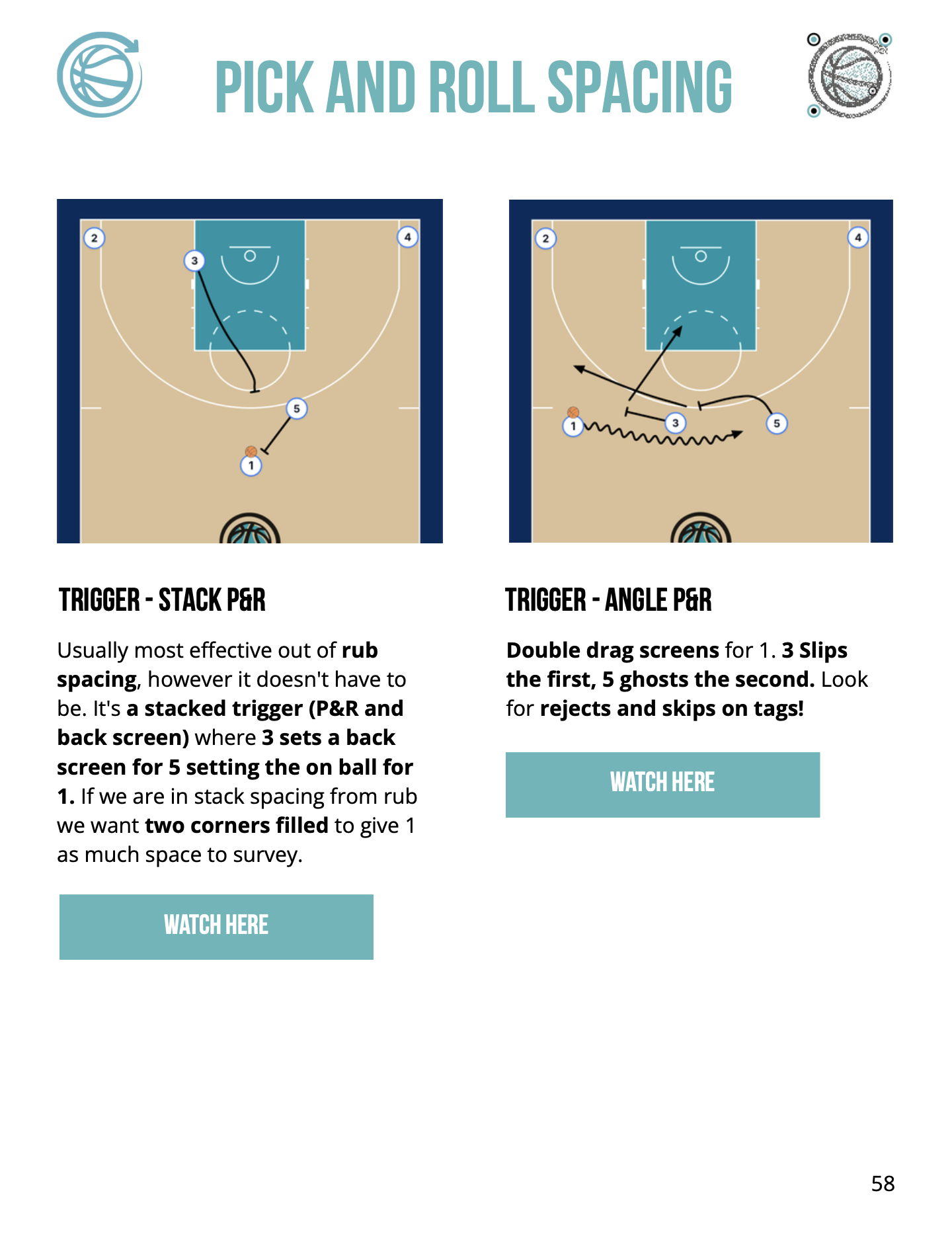
Coach Zico Coronel starts with one spacing so players can explore a coverage inside a recognizable team situation. One example fills both corners and a high wing, with the ball screen bringing the handler toward the middle. This is one way to organize learning; the spacing still needs to suit your players and offense.
Coronel describes beginning with one aggressive or conservative coverage before adding another. This gives players a clearer problem to explore. Later, change what the defense does and observe whether players recognize the difference rather than repeat the previous solution.
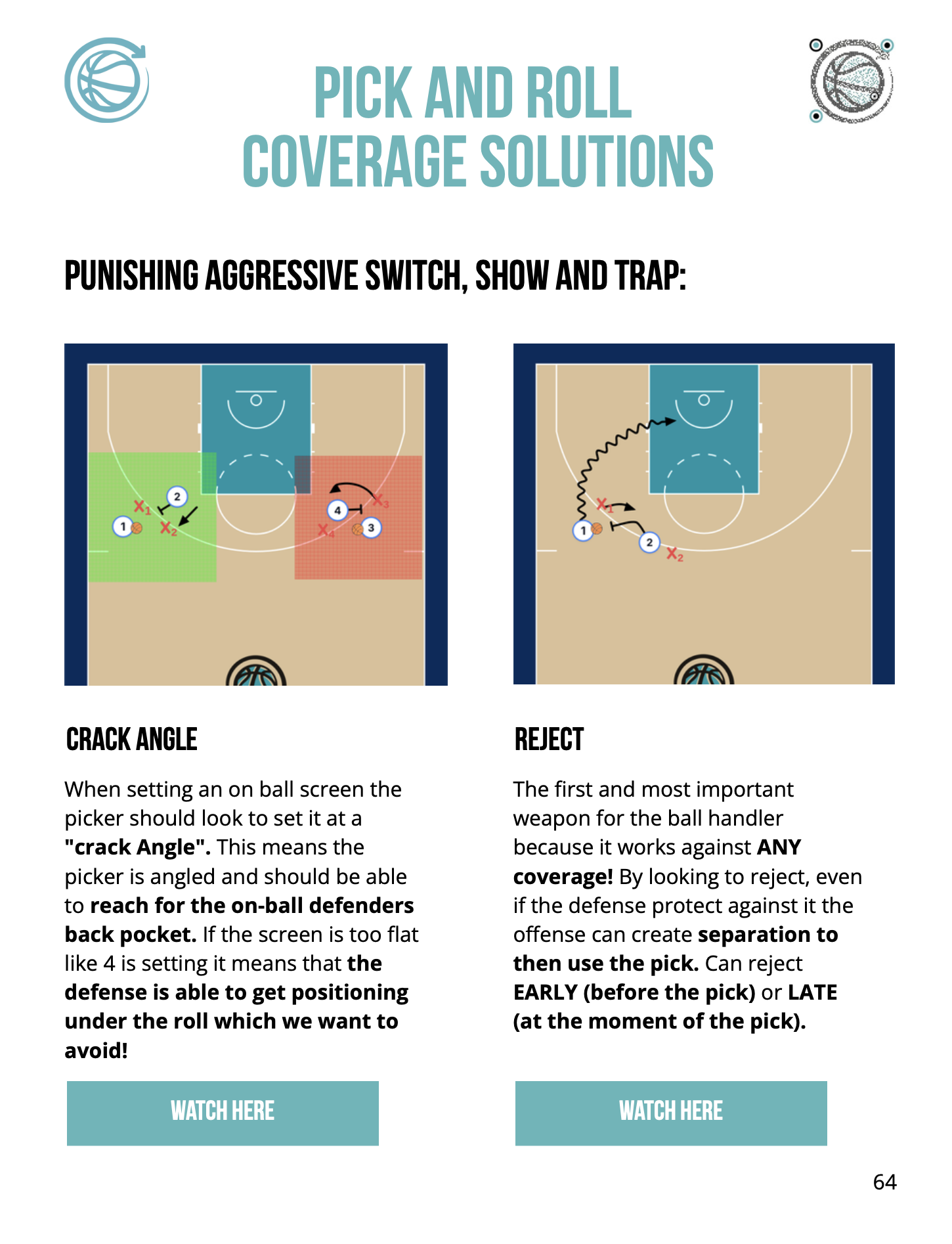
Going away from the screen can use an opening before the screen arrives. It is not automatically the best choice. If the offense already has an advantage, waiting to set up a reject may give the defense time to recover. Read the defender, the available space and the timing of the action.
The screener can change the angle, slip, roll, pop or use a ghost screen. Each changes what the defenders must cover. Help defenders matter too: a defender stepping toward the roller may open a pass elsewhere. Choose possibilities that fit the players and spacing rather than prescribing one answer to a named coverage.
Why it matters
Many teams teach the pick and roll as a set of rules: if the defender goes under, shoot; if they switch, post the mismatch. The trouble is that the coverage is never identical. Even a team that switches every screen will switch differently each time, depending on who is defending, how aggressive the switch defender is, the spacing, the time and score, and fatigue.
Coverage solutions are better treated as possibilities the team is looking for. Against a switch, those possibilities include rejecting, splitting the switch, ghost screens, slips, hard rolls, passes ahead or behind, pocket passes and skip passes. Players should be free to act on whichever one is most attractive in that moment.
That changes the order of teaching. Instead of explaining the solutions first, design small-sided games in which the defense plays the coverages you expect to face, add a changing shot clock so the offense has to be decisive, and let solutions emerge. Then attach names to the ones that work best for your players. Those names become your team’s coverage solutions.
On the page
Real pages from the Transforming Basketball materials — and the decision each one is teaching.
On the floor
Pick one spacing from your team’s vocabulary and keep the court area realistic for it, so a 2-on-2 does not drift into space that would be occupied in 5-on-5.
Constrain the defense to the coverage you expect early in the season. Coach their positioning and recovery so they compete for a stop and give the offense honest information.
Even a small number of live reps before you suggest anything is better than teaching the answer immediately and assuming players cannot find their own. Ask questions and watch which solutions appear.
If a useful solution is not appearing, reward it, for example a bonus point for a reject that leads to a score. If players still struggle after that, show the solution as one possibility, so repeated failure does not become discouraging.
Avoid these
Rehearsing a crossover away from a cone copies the look of a reject but removes what makes it work: a defender who is trying to take it away.
Instead: Use a 1-on-1+1, where the +1 sets the screen and a guided defender allows the reject but still tries to steal or contest the finish. The handler has to reject differently every time.
Teaching “against a switch, always do this” gives players one narrow answer to a situation that is never the same twice.
Instead: Keep the coverage name as shared language, then reward several solutions against it. A principle such as the short roll with a cut and slide can guide intent without becoming the only allowed outcome.
A screener who meets the defender too far from the basket rarely gets behind the defense, so the coverage contains the action easily.
Instead: Use outcome cues such as “screen the back pocket” and “race to the rim”, and pair them with quick separation out of the screen.
A demonstration implies there is a single ideal solution for players to copy, when many openings can appear from the same action.
Instead: Avoid demonstrating where you can. If players need to see an example, say clearly that it is one option and that they should not repeat it every time.
Take it to practice
Starting points to shape for your group. Pick one, then adjust the numbers and scoring.
Free coaching resource
A comprehensive breakdown of pick-and-roll offense, reads and counters.
Watch, listen & read
A few clips, conversations and reads to go deeper — then the whole library is one link away.
Transforming Basketball
Preview a clinic focused on pick-and-roll small-sided games.
Transforming Basketball
Questions
Begin with a spacing and a defensive problem your players need to understand. Live 2-on-2 gives the handler and screener opportunities to explore together. Add off-ball players when the problem includes tagging the roller, help or a pass out. Instruction can offer possibilities without prescribing the same response on every possession.
Read the depth of the screen defender, the recovery of the on-ball defender and the help behind them. Depending on the players and spacing, a shot, drive, pass or another screen may become available. Sometimes keeping the dribble alive preserves an advantage better than taking the first available midrange shot.
Several solutions can work: rejecting, splitting the switch, ghost screens, slips, hard rolls, pocket passes and skip passes. Because no switch is identical, players should expect to use different solutions against the same coverage.
Read the space, coverage and screener’s capabilities. A roll threatens the rim; a pop can open a shot or stretch help; a short roll can receive behind aggressive coverage. Give the screener live experience of those possibilities.

The Transforming perspective
A coverage solution is an opportunity players can use. The label “switch” or “drop” helps the team communicate, but the movement of the defenders tells the players what is available.
Behind the methodology
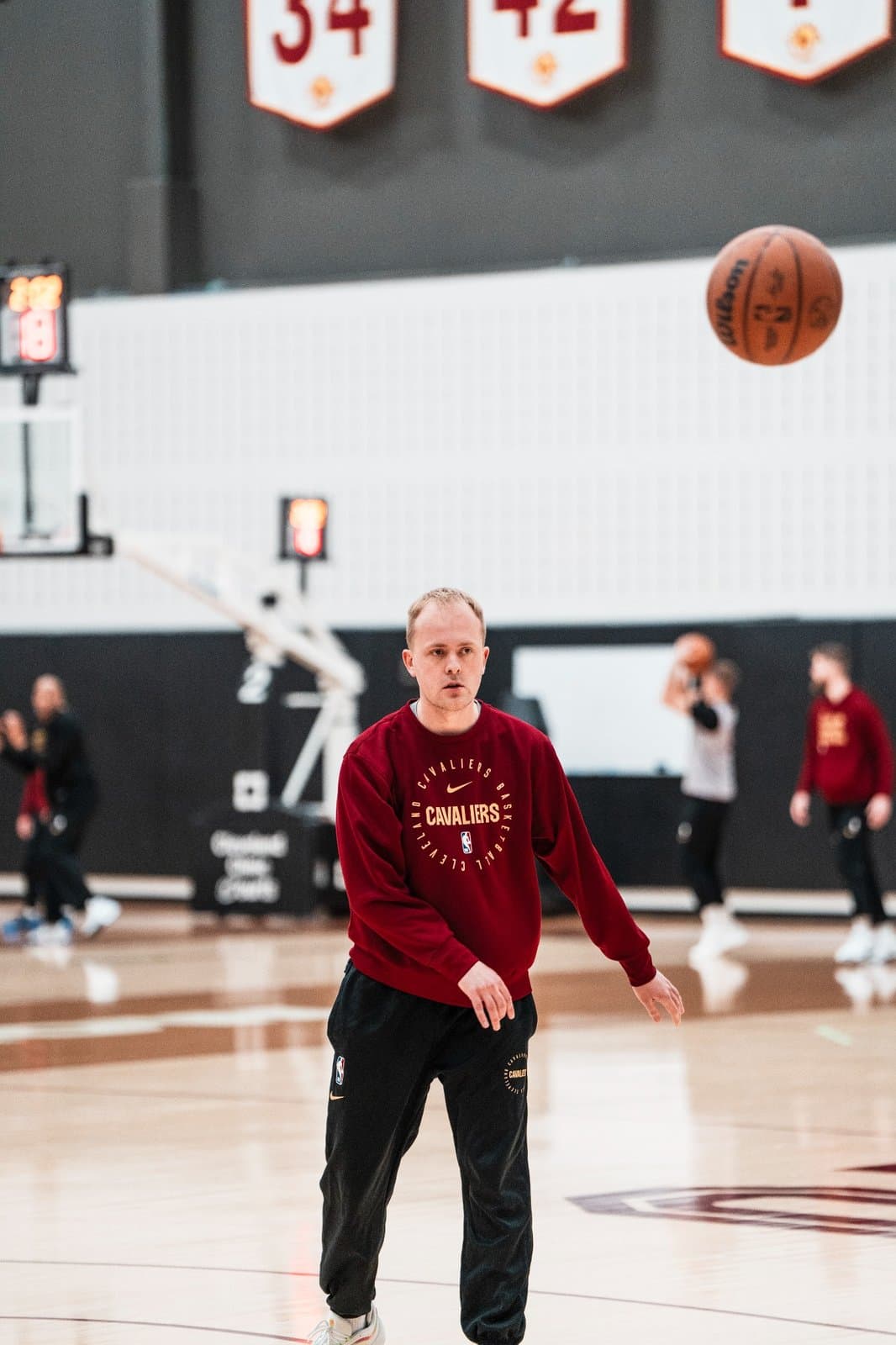
Alex Sarama is the founder of Transforming Basketball and Head Coach of the WNBA's Portland Fire. Previously, he served as Assistant Coach and Director of Player Development with the Cleveland Cavaliers.
His wider experience includes NBA Europe in Madrid, Paris Basketball in the EuroCup and the Rip City Remix, the Portland Trail Blazers' G League affiliate. Alex has delivered coaching education internationally and is the author of the Amazon bestselling book Transforming Basketball.

The book
The Amazon bestselling book on applying a constraints-led approach to basketball performance — the methodology behind this guide, in full.
View the book on AmazonContinue learning
Transforming resource
$49 USD
Explore 40 small-sided games for ball handlers, screeners and defenders.
Free
A comprehensive breakdown of pick-and-roll offense, reads and counters.