
EP18: Representative Learning Design with Alan Dunton
Punish the switch by using these 4 distinct coverage solutions instead of letting the defense force you into stagnant isolation.
In the modern era of pace and space, the pick-and-roll is the most heavily utilized trigger to create offensive advantages. To combat this, elite defenses increasingly rely on the switch. Switching is designed to flatten out the offense, neutralize any immediate advantage, and force the ball handler into a stagnant, predictable 1-on-1 isolation.
When confronted by a switch, many teams fall into a common trap: the offensive flow grinds to a complete halt. The ball handler holds the ball, the other four players stand still to clear out space, and the team slowly tries to exploit a perceived physical mismatch. However, stopping the flow to play isolation basketball allows the defense to catch its breath, load up the paint with help defenders (the MIG, or "Most Important Guy"), put defenders in the "shrink" position to decrease the available space in driving lanes, and ultimately force a low-value, contested shot.
Use small-sided games to explore the switch with both the handler and screener making decisions. Adjust the space, starting coverage and time according to the solution you want the players to investigate.
Dynamic Coverage Solutions to Beat the Switch
In the Transforming Basketball framework, players are taught a hierarchy of priorities to aggressively attack a switching defense:
1. The Reject
The absolute best way to beat a switch is to prevent it from happening in the first place. If the on-ball defender is anticipating the screen and jumps early to prepare for the switch, the ball handler should immediately reject the screen and attack downhill. Because the defense was preparing to exchange assignments, rejecting the screen instantly compromises their positioning and creates a direct driving lane to the rim.
2. The Crack and Slip
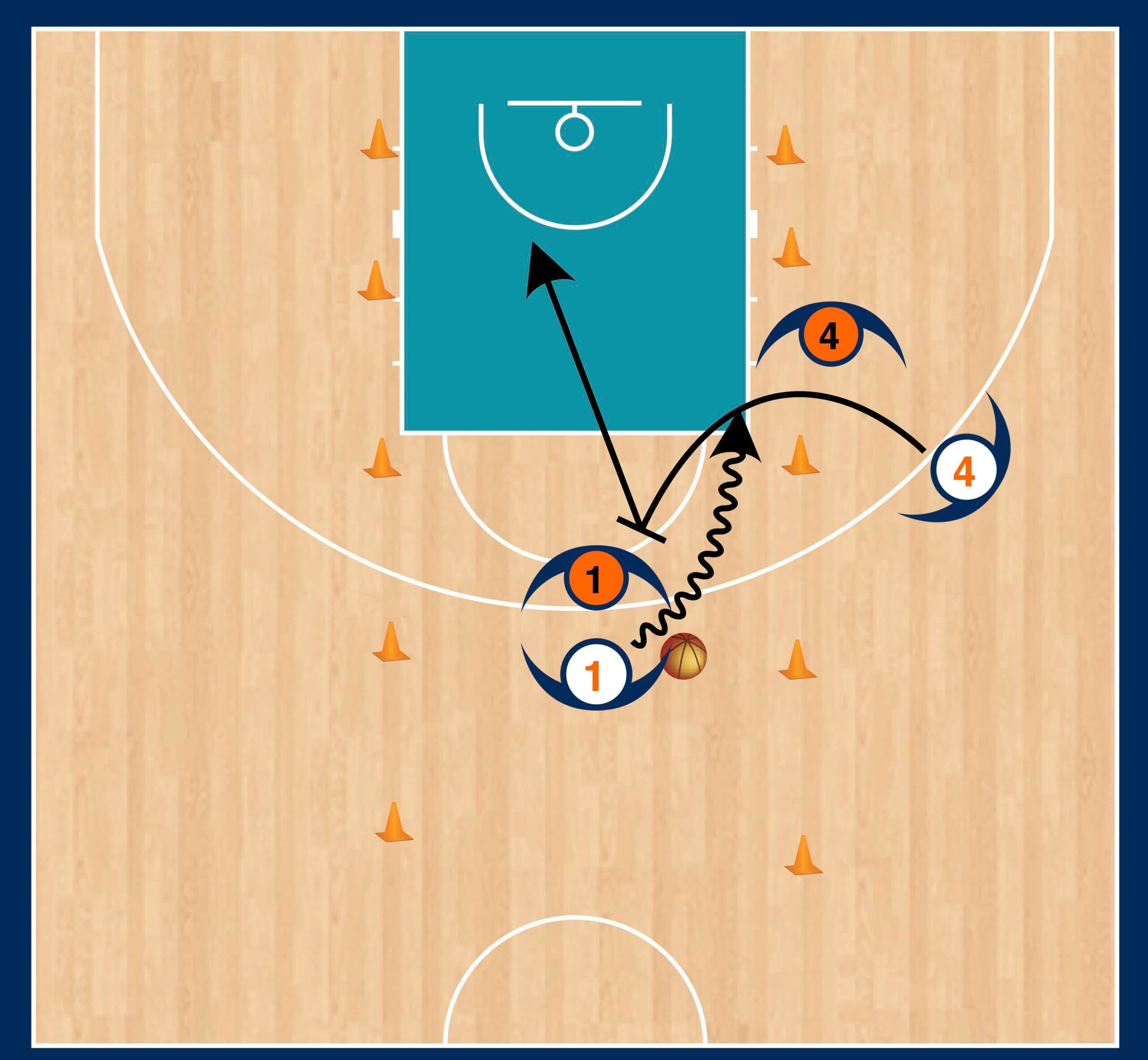
To punish a switch, the picker must set a great "crack angle" on the defender and then immediately slip to the basket before the new defender can attach their body to them. As the defense is anticipating to switch, the picker can slip out quickly by making minimal contact or no contact at all. By slipping at full speed without holding the screen, the offense can generate a rapid 2-on-1 advantage before the defense can successfully execute the exchange. Of course, the ball handler will have to find ways to execute a pocket pass over the switching defender.
Technical demonstration of the Crack and Slip vs. a switching defense
3. The Relay Pass
Switching defenses are often highly disruptive in the passing lanes. If the direct pocket pass is taken away, players must utilize the relay pass. This involves the ball handler making a quick pass ahead (in side spacing) or a quick pass behind (in rub spacing), who instantly relays the ball inside to the roller. (Learn more about the rub and side spacings here: The Pick and Roll Spacings Every Coach Needs to Know)
4. The Boomerang
If the defense executes the switch perfectly, containing the initial drive and taking away the roll, the ball handler should not hold the ball and dribble the air out of it. Instead, they should utilize the boomerang pass. The ball handler quickly passes the ball away to a perimeter teammate and immediately receives it right back. This lightning-fast give-and-go forces the larger, slower defender who just switched onto the guard to constantly adjust their stance and closeout, providing the guard with a dynamic driving angle to attack before the defender is set.
https://drive.google.com/file/d/1NBwxqoXKCNdTSggCZ_-8PF3wlmLBsHSS/view?usp=sharing
The Power of the Re-Trigger
Sometimes, despite executing perfectly, the defense successfully neutralizes the advantage, and the offense finds itself back in "neutral." In a traditional offense, this is where players look at the coach and wait for a new play call. In a conceptual offense, this is the exact moment players must flow seamlessly into a "re-trigger."
If the boomerang pass is covered, or if the switch completely flattens the action, the player with the ball must immediately initiate another trigger, such as a get, another pick-and-roll, or a blast cut, in less than three seconds. By rapidly chaining triggers together without pausing, the offense relentlessly tests the communication and stamina of the defense until the ice finally cracks and an advantage is found.
Coaching the Switch Using the Constraints-Led Approach (CLA)
You cannot teach players to dynamically punish a switch by running 5-on-0 scripted plays. To develop players who can process these chaotic coverage solutions at game speed, you must use Small-Sided Games (SSGs) and effectively manipulate constraints.
Here are two highly effective constraints to implement in your practices to train your players to punish the switch:
- 2-on-2 Wall Pick and Roll (Gold medals only): Set up a 2-on-2 pick-and-roll scenario and use cones to create an "invisible wall" that restricts the playing space. Instruct the defense to aggressively switch every action. To force the offense to be aggressive, apply a 4-second shot clock and dictate that the offense can only score a rim finish (gold medal) inside the "smile" (the restricted area).
- The Single Opportunity Constraint: Play 3-on-3 or 4-on-4 and give the offense one single opportunity to create dominoes out of their initial trigger. If the defense switches and the offense stays stuck in neutral without immediately finding a coverage solution or flowing into a re-trigger, blow the whistle and call an automatic turnover. This constraint raises the intensity and eliminates passive, stagnant offense.
Visualizing the Solutions: Transforming Basketball
If you want to see exactly how these concepts look in a live, messy practice environment, we highly recommend watching the Transforming Basketball YouTube video: "How Players can Become ELITE in the Pick & Roll with Alex Sarama."
In this video, Alex breaks down the essential pick-and-roll concepts with a live group of players, demonstrating exactly how to execute the reject, the relay pass, the pocket pass, and the boomerang against an aggressive switching defense. It is an incredible practical resource for observing how a coach can step back, manipulate constraints, and allow players to discover how to keep the dominoes falling without ever stopping the flow of the game.
For the practice-design reasoning, listen to Episode 18 with Alan Dunton on representative learning design. The discussion concerns the information players need in practice; it is separate from the coverage solutions shown above.
Continuez à progresser comme entraîneur.
Reliez ces idées au Success Pathway, à la vidéothèque d’activités, à la communauté d’entraîneurs et aux séances mensuelles en direct.
Découvrir l’abonnement