
Coaching guide · Defense
Basketball Defense
Every defensive possession is a run of quick decisions. When does the helper leave? How hard does the next defender close out? You can't practice those reads in a shell drill, against an offense that already knows where it's going.
16 min read
Vincent Collet coached France to two Olympic silver medals. Asked on EP175 how defense has changed, he didn't reach for a system. He gave a philosophy.
“When you play defense, you defend the danger, the offensive danger from your opponents.”
Twenty years ago, he explained, every team had its own defensive system, and the limit of that approach was that it didn't always fit the opponent's personnel. Scouting today is half about the opponent's system and half about its players. You still need team rules that hold against anyone, but the danger is different every night, and the first danger is usually the other team running.
So if defense means reading the danger, practice has to give defenders a live offense to read, one that's actually trying to score.
Defense Belongs in Player Development
Alex Sarama opens his article on defense in player development bluntly:
“Defense is arguably the biggest thing missing within the player development and skills training world.”
His question for anyone running workouts: how often will a player have to guard the ball or close out in a game, compared with how often they'll use the complicated dribble moves being taught? Small-group sessions of 1-on-1, 2-on-1 and 2-on-2 develop both ends at once, and the offense only gets as good as the defense it practices against. He's equally skeptical of drilling one defensive technique, such as the step slide, over and over. No defender stays in front of a dynamic ball handler with one movement pattern. The article lists what to build through live games instead.
- Defensive footwork that emerges from the game, not from a slide drill.
- Walling up and verticality without fouling.
- Chest stops and ball pressure.
- Help and gap positioning.
- Closeouts, post defense and defending cutters.
- Defending triggers, and talking while you do it.

Free
21 SSGs for Your Next Practice
21 small-sided games you can run and adapt at your next practice, each one keeping the defenders, decisions and scoring of the real game.
Write Your Defensive Principles on One Page
Chapter 7 of Transforming Basketball asks coaches to treat defense the way they treat a conceptual offense: a base structure that players adapt, not a scheme they repeat. Defense is mostly a response to what the offense does. You can only rotate once the offense starts dominoes (the moment an advantage is created). But some principles are yours to start, like trapping, zoning, top-locking a scorer or leaving a non-shooter open. The book lists the decisions a staff has to make so the team can prevent dominoes or recover from them.
- Your best matchups.
- How you defend the ball: level of pressure, direction, traps.
- How you help off the ball: aggressive (denial, top-locks) or conservative (gap support).
- How you rotate once dominoes start: peel switch, trap-the-box rotation, closeouts.
- Coverages for two-player actions: pick and roll, dribble hand-off, gets.
- Coverages for three- and four-player actions: screen away, flare, pistol, stack, stagger.
- Inbounds, zones and junk defenses (3-2, 2-3, match-ups, box and 1).
- How you foul and handle late-game situations.
How many of these you need depends on age, level and how often you practice. The book's reflective task is simple: write your core principles on one sheet of paper and keep updating it through the season. Inside those principles, players can be given choices. A defender who is quicker than their player, guarding a scorer whose ball handler isn't an isolation threat, might deny the pass. A slower defender, with a dangerous isolation player on the ball, might sit in a shrink position in the gap ready to help. That is KYP: Know Your Personnel.
One way to practice it comes from Tyler Arnold, a member featured in our small-sided games ideas article. The offense wears bibs that carry each player's scouting report, then plays live. Every closeout and coverage now depends on who caught the ball.
On the Ball: Get Back to Neutral
George Vaz's article on small-sided games for on-ball defense calls "staying in neutral" one of the golden principles of youth defense: pressure the ball as much as you can without conceding a blow-by, whether that's baseline or middle. Neutral means neither player has an advantage. When the offense does gain a step, the defender's job is to recover it.
Alex's alternative to defensive footwork drills, on EP37, is 1-on-1 with the defender starting somewhere different each time: behind, side-on, facing the basket, facing away. Each start asks for a different way back to neutral. Transforming Basketball turns that idea into a game, and its scoring makes defense the only way to win.
Chameleon 1-on-1
2 playersThe defender recovers from three different disadvantages, or holds neutral (chest to chest), while the offense tries to keep or extend its advantage.
How it works
- The offense gets three reps in a row, each from a new spot in the half court, with a three- to five-second clock.
- Blind start: the offense holds the ball on the defender's back, and the defender faces the rim and can't move until the ball is lifted.
- Hip start: the ball is on the defender's hip, side by side, a smaller advantage.
- Check-it start: the defender checks the ball to the offense from in front, a neutral start.
- After three reps, switch roles, then find a new partner.
- Scoring: the first player to five stops wins. A stop is a contested shot plus the defensive rebound, or a turnover. Three stops in a row wins instantly.
Adapt it
- Give a player more reps from the start they struggle with, such as defending from the hip.
- Start deeper, near half court, for transition-style recoveries.
- Add a second defender, or use the same starts for 2-on-2 up to 5-on-5 so the defense has to rotate back to neutral.
Sideline to Sideline 1-on-1
2 playersBall pressure and containment in a narrow space.
How it works
- The offense starts with the ball on one sideline and tries to get to the opposite sideline.
- The defense starts in front and tries to get a steal or force a turnover.
- The offense must stay within the marked area, or it's a turnover.
- Offense and defense switch every rep.
Adapt it
- A five-second clock.
- Points for the defense on every stop.
- A bonus point for forcing the offense to change direction three times.
Team Rules Without Drills: Keep the Ball Out of the Middle
The most common objection Alex hears to coaching defense with games is that players will each invent their own rules: one sends the ball middle, another sends it baseline. Chapter 9 of Transcending Basketball answers that the constraints-led approach isn't a free-for-all, and that team principles can be built into the scoring. Below is the book's example for a team that wants to keep drives out of the middle.
No-middle 1-on-1
2 playersChannel ball-handlers toward the sideline and short corner.
How it works
- Play 1-on-1. The offense receives three points for scoring on a middle drive and one point on a baseline drive.
Adapt it
- Reverse it so the defense scores: three points for a turnover, one point for a contested stop and rebound, and minus one point for allowing a score through the middle.
Watch for
- Is the defender taking away the middle without giving up an easy straight-line drive baseline?
“This is one of countless examples as to how defensive behaviors can be shaped through the CLA.”
Closeouts That Fit the Shooter
Neil Houghton, a Transforming member in Melbourne, points out in his article on 3-on-3 closeouts and rotations that whatever actions a team runs, they'll create closeouts, which makes them one of the most common situations in a game. He gives defenders three types:
- Hot, for a great shooter (think Steph Curry): run them off the line and make them drive.
- Cold, for a poor shooter (think Giannis Antetokounmpo): give them space and invite the shot instead of the drive.
- Normal, for a player who can do both (think Kevin Durant): close out about an arm's length away, ready to contest the shot and contain the drive.
Knowing your personnel tells the defender which one to use. Practicing it needs a receiver who can actually shoot or drive. On EP21 Alex described the traditional version, a coach passes, players close out to coaches with high hands and choppy steps, as a dead drill. He built the following game instead.
Blind closeout 1-on-1
3 playersClose out to a live receiver who can catch and shoot or attack the closeout.
How it works
- An offensive player starts in the corner. A defender stands in the mid-range area, unable to see them. A passer starts under the basket.
- The passer throws the ball off the backboard and catches it. That's the cue for the offensive player to move.
- The offensive player can only move between the deep corner and the wing, and must catch outside the three-point line.
- When the pass goes, it's live 1-on-1. The defender can move on the pass.
Adapt it
- Change the matchups often: a taller or shorter, quicker or slower defender produces different solutions.
- Change where the pass comes from and where the offense starts, or have the offense drift or lift before the catch.
- Add a three- or four-second clock and limit the space, or add a defender who stunts, so the advantage has to be used quickly.
- Give the defense extra points for taking away the advantage and getting back to neutral.
- For younger players, the defenders hold a basketball: fewer steals, but they can still block.
To get a lot of closeouts in a short time, run them as bursts, with the same players in the same roles for a set time.
Close-Out Bursts 1-on-1+2
3 players and a coach or extra playerClose out from the free-throw line to an offensive player who can shoot or drive, many times in one minute.
How it works
- The offense starts outside the arc in the guard spots, at or above the free-throw line extended.
- The defender starts with one foot on the free-throw line, at the spot closest to the offense (on the elbow if the offense is on the wing).
- The passer moves to a new spot every rep: kick-aheads, passes out of the post, extra passes and passes from trigger spots.
- The defender can close out once the ball leaves the passer's hands. Then it's live 1-on-1 on a random clock of two to seven seconds.
- After each rep the offense sprints to a new spot and the waiting defender comes in. Roles stay the same for 60 seconds, and the offense keeps its own score.
Adapt it
- Move the defender's start to make the closeout longer or shorter.
- Play between the wing and the corner so the offense has to drive in a tight space near the baseline.
- Add a second defender for 1-on-2, or a defender on the passer for 2-on-2.
Neil's 3-on-3 versions start from a closeout or a scramble, so the closeout leads straight into help and recovery instead of ending at the catch.
Help, Rotation and the Shell Drill
Help defense has its own shared language. At the EP13 clinic, Alex had the players name the help defender in his finishing game: the MIG, the most important guy or girl. Who the MIG is changes with every drive, so help defenders read both their own player and the developing advantage.
The traditional place to teach help and rotation is the shell drill, and Transcending Basketball is critical of it:
“The shell drill merely promotes false confidence and defensive rigidity.”
Transforming Basketball makes the same case. The shell builds knowledge about defense, but its offense is passive in a way no real offense is, and the defense soon learns the pattern.
“As soon as the defensive team learn the offensive pattern that is repeated within the shell, they effectively stop learning.”
The fix it suggests is variability: let the offense go away from the base pattern, so the defense never knows what's coming. Players will fail more, and the book warns against reaching for more control when they do. That struggle is where the learning happens.
Transcending Basketball adds that, outside high school basketball without a shot clock, the offense never tries not to score, and good team defense needs adaptiveness and individual decision-making that a pattern can't produce. It suggests giving the offense an advantage and watching how the defense rotates; principles such as peel switching can emerge from that live play. To demand early help, award the offense five points for a rim score on a primary drive without a kick-out. The low defender will start getting there.
Alex is more pragmatic in a professional setting. On EP63, talking with George Galanopoulos, then associate head coach of the Rip City Remix, he applied his idea of MAYA (most advanced yet acceptable): in the NBA everyone knows the shell drill, so it may not make sense to abandon it, but small changes make it far more unpredictable. George suggested letting coaches be the offense, prepared in advance, so the offense doesn't have to be explained to the defense before it goes, and starting the shell from transition, with defenders in random positions, instead of walking in from the baseline.
“You're never playing shell and coming in from the baseline.”
Guided Defense: A Different Coverage Every Rep
Guided defense is when a defender is limited in how they can guard, for a sequence or a possession. It's usually framed as a way to develop the offense, but Alex's article on guided defense in player development argues it develops defenders too. His example is a blast cut, a cut from a double gap into a single gap, with a passer, a cutter and a defender staying in the same roles for three reps.
- The defense tries to deny the blast cut.
- The defense gaps on the catch after the cut.
- The defense shades toward the baseline or the middle on the catch.
The defender has to use a different coverage on each rep, in an order the offense can't predict. That's repetition without repetition for the offense: the same action, a different read each time. The guide must be accurate, a point Alex credits to Mike MacKay. And guided defense doesn't mean playing badly so the offense looks good. Defenders learn how guarding an action one way invites a particular coverage solution from the offense, and they can still play live and try to steal or disrupt while giving the guide. If players struggle against one coverage, script it so the defense uses only that coverage until the offense finds a solution.
Transition Defense Starts on Offense
Collet called the opponent's transition the first danger, and George Vaz's article on transition defense starts on the other end of the floor: live-ball turnovers, bad shots and poor positioning on the shot all hand the opponent an advantage. When an emergency happens anyway, it gives three priorities:
- Protect the basket. The defender closest to your own basket calls "basket" and sprints to the front of the smile, and never leaves that role to take a kick-ahead.
- Stop the ball. The defender nearest the ball slows it down.
- Find the most dangerous. The off-ball players sprint back and close out to hot shooters first, running to a player rather than a matchup.
On missed shots, tagging up (all five offensive players getting level with the high side of whoever guarded them on the shot) is as much a transition defense system as an offensive rebounding one. Our rebounding guide covers it, along with 4-on-4-on-4 Defensive Shutdown, the three-team game where a stop only counts after a contested miss and a defensive rebound.
Scrimmages That Score Your Defense
Most scrimmages only reward the offense. Transforming Basketball shows how a 5-on-5 changes once one defensive principle can lose you the game.
Three Lives 5-on-5
10 playersMake one or two defensive principles decide the scrimmage.
How it works
- Play 5-on-5 for a set time, such as a five-minute quarter, or five trips before a reset. Use normal scoring.
- Each team has three lives. Lose all three and you lose the game, whatever the score.
- Choose how a life is lost. Start with one way, and add more once players know the game.
- The book's example: the last five minutes of a tied game, both teams on three team fouls, and a life lost for every open rim finish you give up. Up by 6 with 20 seconds left and you lose your third life? You lose.
Adapt it
- Other ways to lose a life: each offensive rebound conceded, a target player scoring, no communication on a coverage, a transition score within four seconds, the ball not stopped early in transition, or a ball handler left without pressure in the half court.
- Keep the other rules the same so the scoring does the work. The same lives idea fits any other game.
In 4-on-4-on-4 Defensive Shutdown, the book suggests codesigning the rules with your players. Ask them which defensive principles matter most and build their answer into the game. If they say communication on coverages, a defender who doesn't call the coverage in a leadership voice ends the rep.
Talk That Helps, and Why "Play Harder" Doesn't
George Galanopoulos described defensive talk in layers on EP63. First, simple shell talk on the way back that applies anywhere: back, I've got ball, I'm in the gap, shrink. Then coverage talk: which coverage are we in for this action, and does everyone know it? Transcending Basketball makes a similar point about time-outs. "We're not playing defense" and "play harder" rarely help. One or two specific intentions, checked in the next few possessions, usually do.
For on-ball and pick-and-roll ideas, see our pick-and-roll guide and small-sided games guide.
Small-sided games library
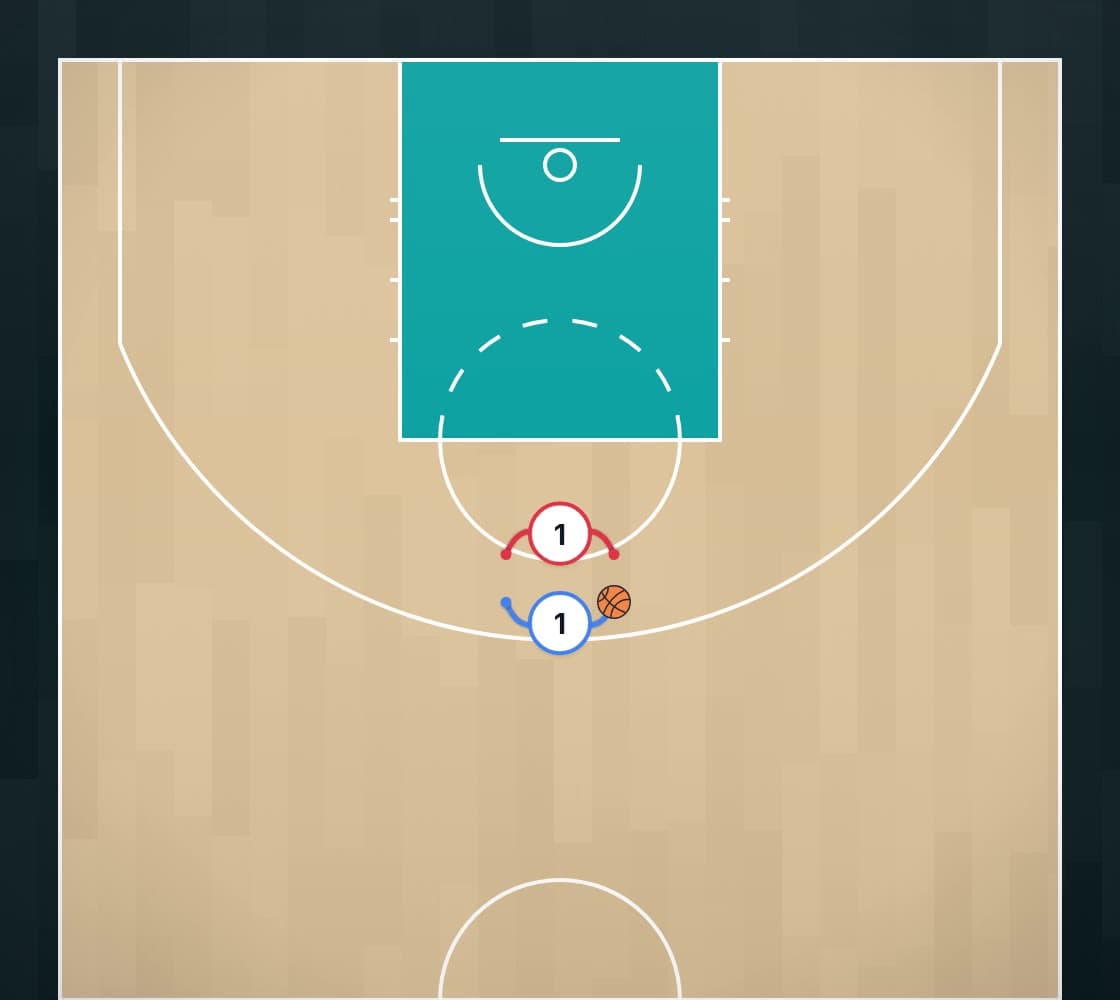
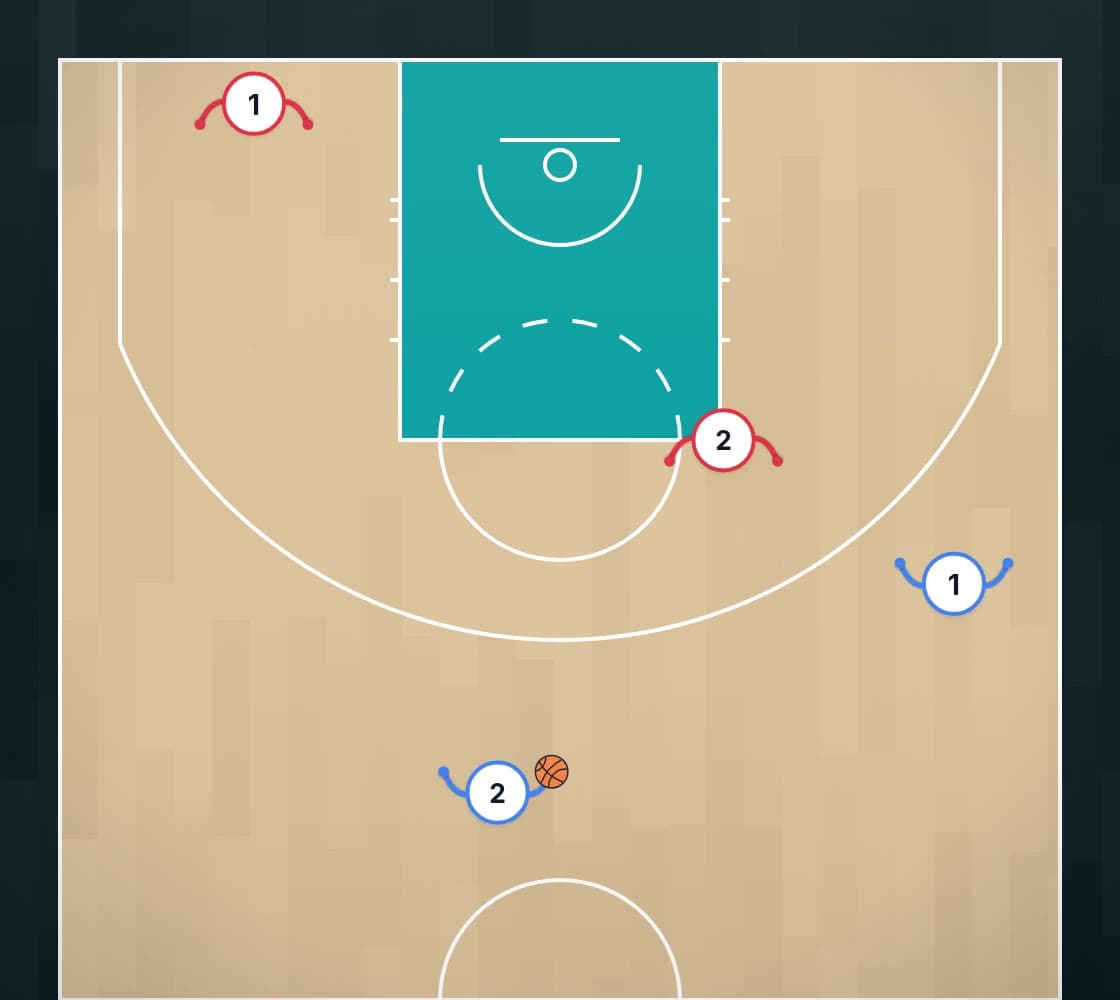
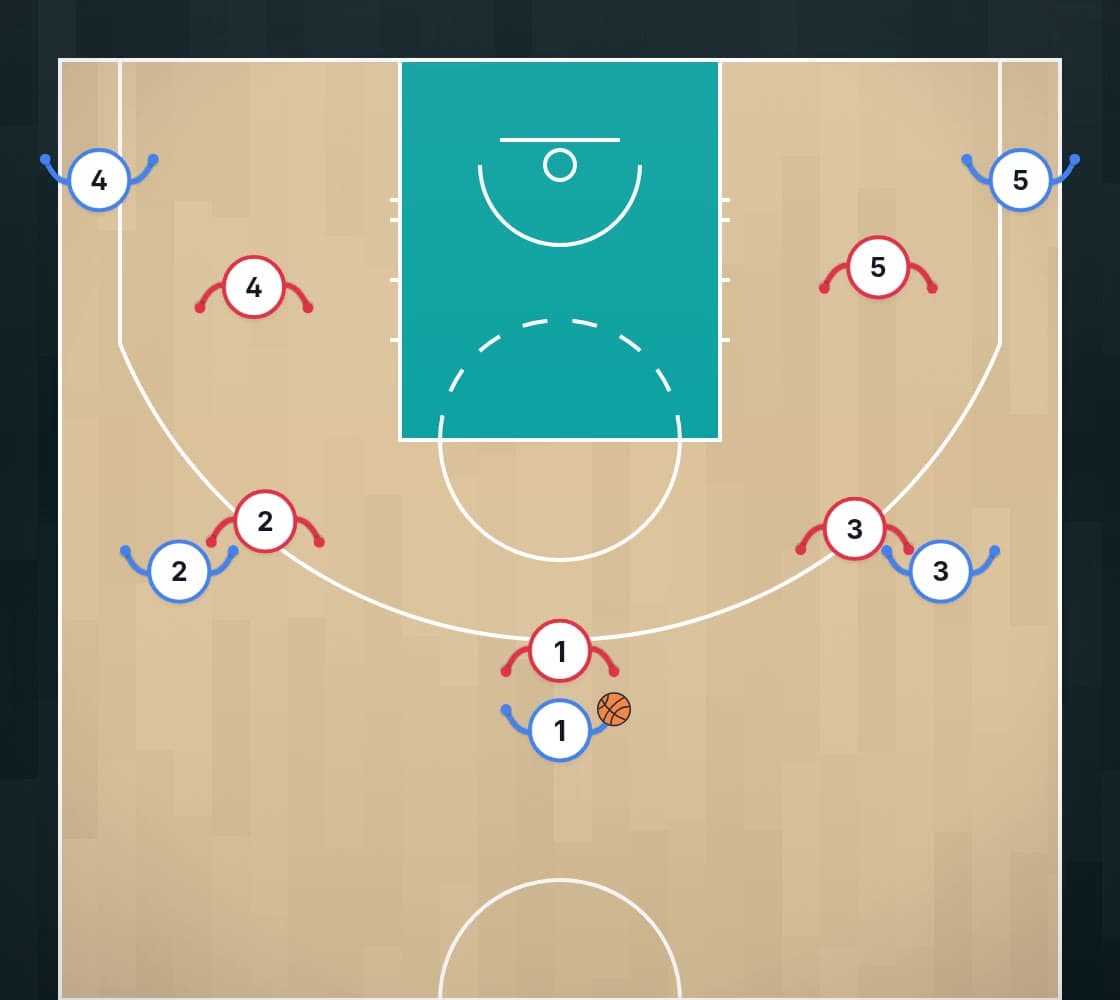
Games from This Guide in the Library
Questions Coaches Ask
How do you improve on-ball defense in basketball?
Play a lot of live 1-on-1 in limited space, starting the defender in a different position each time so they practice getting back to neutral. Games like Sideline to Sideline 1-on-1, with a short clock and points for stops, work better than step-slide drills against nobody.
What are hot, cold and normal closeouts?
Hot is for a great shooter: run them off the line and make them drive. Cold is for a poor shooter: give space and invite the shot. Normal is for a player who can do both: close out about an arm's length away, ready to contest and contain.
Is the shell drill worth running?
As a fixed pattern it rehearses positions without anyone reading anything, which is why Transcending Basketball calls it a source of false confidence. If you keep it, make it unpredictable: let coaches play offense without explaining it first, and start from transition with defenders in random spots.
How do you teach team defensive rules with small-sided games?
Build the rule into the scoring. To keep the ball out of the middle, play 1-on-1 where the offense gets three points for a middle-drive score and one for baseline, or flip it so the defense loses a point whenever the offense scores through the middle.
What is guided defense?
A defender limited to particular coverages, such as deny, gap or shade, used in an order the offense can't predict. It helps the offense learn to read coverages, and it teaches defenders how each coverage changes what the offense does next.
How do you improve transition defense?
Start on offense: fewer live-ball turnovers, better shots and better positioning on the shot. When an emergency happens, protect the basket, stop the ball and find the most dangerous shooter. Tagging up on the shot gets everyone matched up straight away.
Take It to Your Next Practice
Free
21 SSGs for Your Next Practice
21 small-sided games you can run and adapt at your next practice, each one keeping the defenders, decisions and scoring of the real game.
The Small-Sided Games Book
$49 USD
Build on your free games. Build your practice around 50+ small-sided games, with diagrams and constraints you can adapt to your players.
Sources
- Transcending Basketball, Alex Sarama (Wiley, forthcoming): chapters 3, 4, 5 and 9
- Transforming Basketball, Alex Sarama (2024): chapter 7, Principles of Play, and chapter 8, Transforming Activities
- EP175: Former France National Team Head Coach Vincent Collet on the Evolution of Principles of Play, with George Vaz
- EP21: What is Nonlinear Pedagogy & Why is it So Important for Basketball Coaches, with Philip O'Callaghan
- EP63: Intentionality in Professional Basketball with George Galanopoulos
- EP13: A Deep Dive Into the Constraints-Led Approach (Live Clinic)
- EP37: How to Improve ANY Basketball Drill
- Why defense belongs in basketball player development, Alex Sarama
- How To Use Guided Defense in Player Development, Alex Sarama
- On-ball defense drills: live basketball small-sided games, George Vaz
- 3-on-3 Closeouts and Rotations - Small-Sided Game Ideas, Neil Houghton
- Basketball Transition Defense: Priorities and Practice Ideas, George Vaz
- Small-sided games: basketball practice ideas, Alex Sarama
- Passos, Araújo, Davids and Shuttleworth (2008), "Manipulating Constraints to Train Decision Making in Rugby Union", International Journal of Sports Science & Coaching
- Silva, Garganta, Araújo, Davids and Aguiar (2013), "Shared Knowledge or Shared Affordances?", Sports Medicine
Behind the methodology
About Alex Sarama

Alex Sarama
Founder, Transforming Basketball · Head Coach, Portland Fire
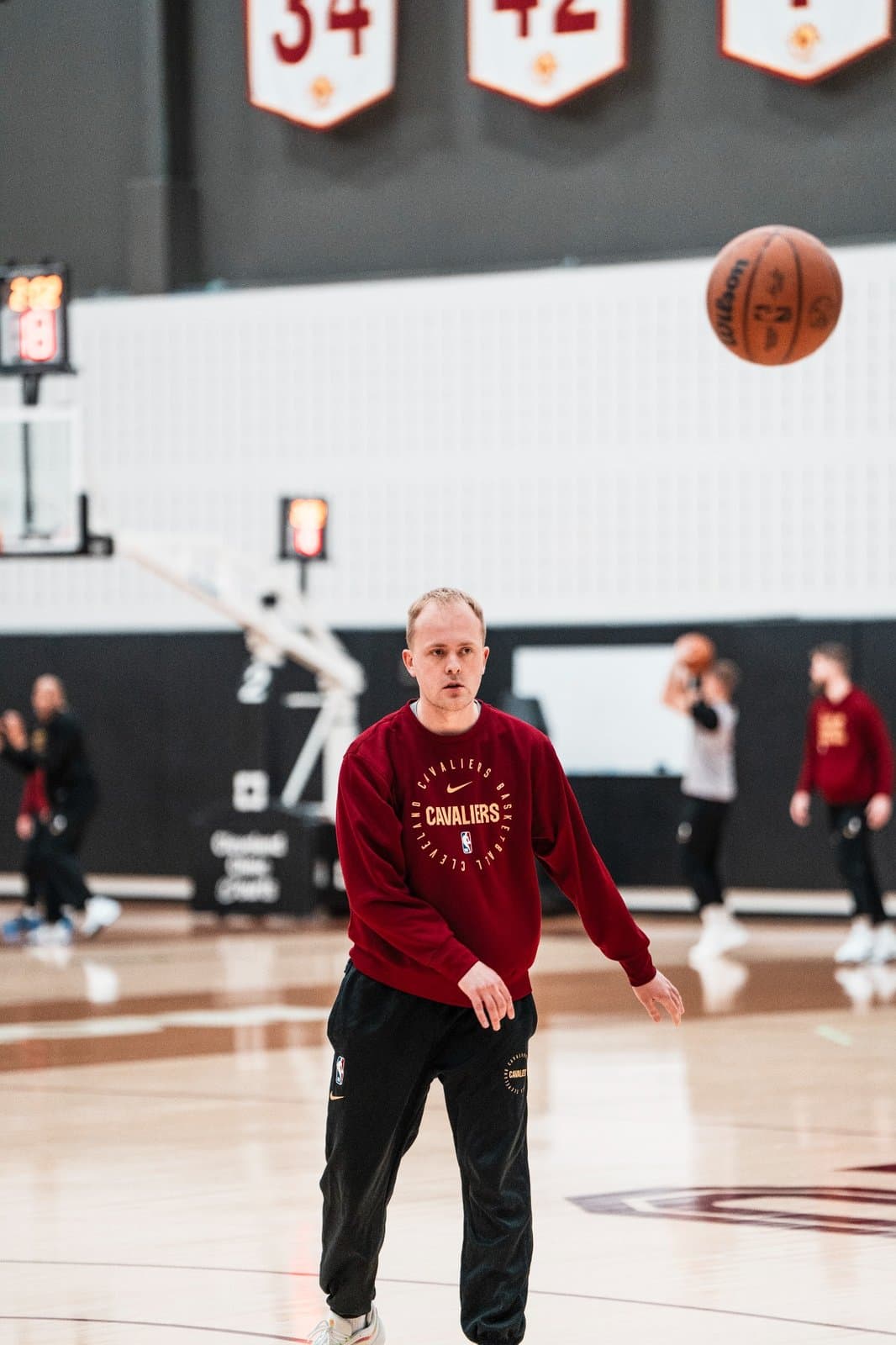
Alex Sarama is the founder of Transforming Basketball and Head Coach of the WNBA's Portland Fire. Previously, he served as Assistant Coach and Director of Player Development with the Cleveland Cavaliers.
His wider experience includes NBA Europe in Madrid, Paris Basketball in the EuroCup and the Rip City Remix, the Portland Trail Blazers' G League affiliate. Alex has delivered clinics in over 40 countries and has written three books on the constraints-led approach in basketball, including the Amazon bestselling Transforming Basketball (2024) and A Constraints-Led Approach to Coaching Basketball (2026).