
Small-sided games library
Close-Out Bursts 1-on-1+2
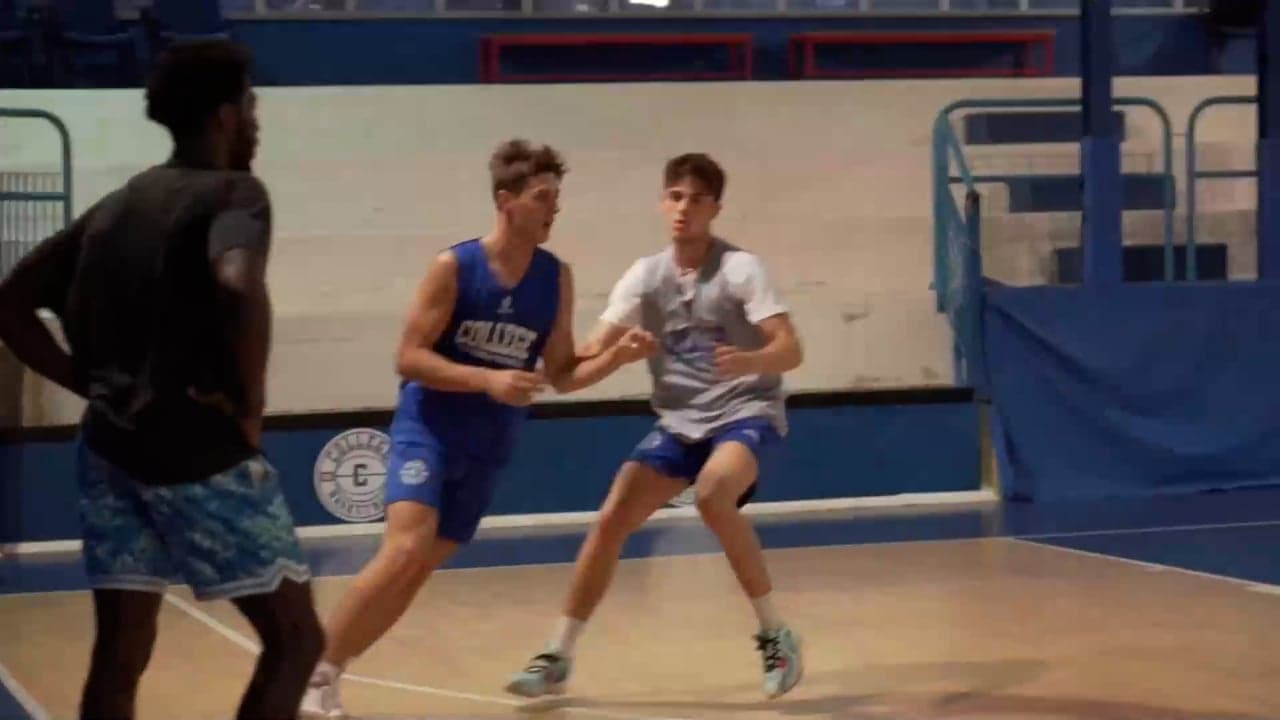
Close out from the free-throw line to an offensive player who can shoot or drive, many times in one minute.
- 3 players
- 1 basket
- Offense
- Defense
Quick rules
Run It in 30 Seconds
- The offense starts outside the arc in the guard spots, at or above the free-throw line extended.
- The defender starts with one foot on the free-throw line, at the spot closest to the offense (on the elbow if the offense is on the wing).
- The passer moves to a new spot every rep: kick-aheads, passes out of the post, extra passes and passes from trigger spots.
- The defender can close out once the ball leaves the passer's hands. Then it's live 1-on-1 on a random clock of two to seven seconds.
- After each rep the offense sprints to a new spot and the waiting defender comes in. Roles stay the same for 60 seconds, and the offense keeps its own score.
From our guide to Basketball Defense.
Setup, Constraints and Explanation
Setup
Three players and one coach or extra player are needed for this activity. The offense will start anywhere outside the 3PT line, but they must play in the guard spots between the FT line extended and above. The defender must begin with one foot on the FT line, starting anywhere on the FT line that is closest to the offense. For example, if the offense is standing on the wing, the defender should stand with one foot on the elbow. The passer will always be in a new position to promote maximum variability, which includes making transition kick-aheads, passing out of post, perimeter extras, and passes from perimeter trigger locations.
The defender can only close out as soon as the ball leaves the passer’s hands, at which point it becomes a live 1-on-1 with the relevant constraints (e.g. space, time, scoring system, and so on). As soon as the 1-on-1 is over and the possession changes, the offense sprints to a new location while the waiting defender sprints in. This respects the role of individual constraints by leading to various emergent solutions. The duration of the bursts and periods of rest in between each series should be based on the load and intensity of the practice, for example, continuously for 60 seconds or after a set amount of reps.
Given there are no real passing decisions within this activity, the coach can be used as a passer merely to facilitate more repetition without repetition for the players. If there is a waiting player, then this player can pass but with the coach playing defense. This helps the passer to explore functional passing solutions that enable the pass to be received on time and on target, while handling the pressure presented by the coach. The passing scenarios could be made more complex through manipulating constraints, for example, changing the location, increasing the distance of the pass, creating the pass opportunity out of a pick and roll, passing to the offense out of a double team (using an extra defender), and so on.
Constraints
- Reduce or increase the advantage through changing the defender’s start location.
- Change the location, for example, play in between the wing and corners. This creates affordances to drive in the tighter space provided by the deep corner and boundary line, which is a common turnover in basketball when players step out of bounds.
- Constrain the space that can be played in (e.g. middle third of the court, can’t venture into the corners).
- Manipulate the distance, for example, offense starting further back creates an affordance to stampede, or the offense can begin using an action like a ghost screen or floppy.
- Add an extra defender to make it a 1-on-2, or add a defender onto the passer to create a 2-on-2 where the passer can score only after a successful pass to their teammate.
- Use a random shot clock, where the offense and defense do not know how much time is left until the ball is passed in. This clock could be anywhere from two to seven seconds.
- Constrain the shots that can be taken, for example, only shoot 3PT shots if the focus is on shooting.
Explanation
This activity will be done as a burst, with everyone staying in their same roles either as the offense, defense, or passer for 60 seconds. The offense starts behind the 3PT line and can only play between the FT line extended. The defense must begin with one foot on the FT line in the closest location to the offense. As soon as the ball leaves the passer’s hands, the defender can closeout and the 1-on-1 is played within the random shot clock. After this, the offense immediately sprints to a new location while the waiting defender passes their ball to the passer ready for the next rep to be started immediately. The offense must keep track of their 2PT and 3PT scores during the entire duration of the burst.
From Transforming Basketball (2024) by Alex Sarama, chapter 8, pp. 267 to 269.
Make It Easier or Harder
Change one constraint at a time, watch what it does, then decide what comes next. The book's test is that the challenge point should be “just right” as opposed to being too easy or too hard. If players can't find a solution, take a constraint away rather than taking the defense away.
Adjustments from Our Guide
- Move the defender's start to make the closeout longer or shorter.
- Play between the wing and the corner so the offense has to drive in a tight space near the baseline.
- Add a second defender for 1-on-2, or a defender on the passer for 2-on-2.
From our guide to Basketball Defense.
Guides That Use This Game
Related Games
- HC Bursts 3-on-2The offense turns a numbers advantage into a good shot. The defense learns to stop it a player down.
- Jungle Shooting 3-on-2A representative shooting game. Shooters never shoot in a predetermined way in a game, so here they move, drive and pass to find their threes against live defenders.
- Battleship 3-on-3Start dominoes out of one trigger from different spots, against a defense that knows what you need.
- Around the Arc 1-on-1The offense deceives a trailing defender and keeps the advantage; the defender recovers to neutral.
Playing With Advantage
$39 USD
An on-court clinic on creating, keeping and extending advantages — spacing, zero-second decisions and the Floor Is Lava.
Transforming Membership
More Games, Rules and Video in the Membership
378 games filmed on court. Browse by area of the game, or tell Transform AI what your team is struggling with.
378 activity videos
Games filmed on court across nine sections, from warm-ups to defensive principles of play.
The Success Pathway
Ten pathways from the foundations of the constraints-led approach to game coaching, with assignments, peer review, graded quizzes and a shareable certificate.
Live every month
A masterclass and a coaches’ roundtable on the calendar, with every recording in the archive.