
Coaching guide · Practice design
Small-Sided Games in Basketball
There is a big difference between playing small-sided games and designing them. In a games-based approach, the coach rolls the ball out and the same small-sided games are used frequently. With a constraints-led approach (CLA), the coach changes the games continuously in response to what is emerging.
11 min read

In this guide, learn how to design small-sided games with constraints, with games you can use at your next practice. When players play the same 3-on-3 every day, they keep falling back on the same solutions. Changing one constraint at a time pushes them to find new ones.
Cutthroat 3-on-3 is a game we use often. Add one to three rules the players must follow, and breaking one is a turnover. Each new rule changes what players have to look for.
What Counts as a Small-Sided Game
A small-sided game is any live game with fewer than ten players: 1-on-1, 2-on-1, 3-on-3, 4-on-3 and so on. The numbers can be even, or tilted toward the offense or the defense. 5-on-5 is the most representative version of basketball, meaning it keeps the most of the information players use in a real game. Smaller games give each player far more touches while keeping the live defenders and teammates they have to read.
Fewer players means more repetitions of a specific situation, such as defending a pick and roll. If you want to work on drop coverages with pick and roll defense, 3-on-3 is a good choice. But you have to make sure players are in the same spacings they would be in the real 5-on-5 game. For example, working on a show defense may lead to negative transfer without having enough players to work on the correct rotations.

Free
21 SSGs for Your Next Practice
21 small-sided games you can run and adapt at your next practice, each one keeping the defenders, decisions and scoring of the real game.
Why 3-on-3 on Its Own Isn't Enough
Take two games of 3-on-3. In the first, the offense starts with a defender recovering from behind, so the game is about dominoes: keeping the advantage alive pass after pass until a quality shot appears. In the second, all three defenders are matched up and the offense has to start with a pick, so the game is about using a trigger to create an advantage in the first place. The number of players is the same, but the problem is different.
Playing the same small-sided game every time is a games-based approach. Players can keep resorting to the same movement solutions, and the coach is leaving development open to chance. In a constraints-led approach, the coach changes constraints (the rules and conditions of the game) based on what they see, because they know what they are looking for. We advocate for this at Transforming Basketball. As players get better at reading what is in front of them, the games should get more complex too.
Five Decisions That Change What a Game Teaches
Every small-sided game consists of task constraints. Change one constraint, and the affordances change within the game. Used well, every constraint has a purpose, so decide what you want to see first, then choose the constraint that may nudge players toward it.
| Constraint | What may emerge |
|---|---|
| Where the game starts: the defender recovers from behind, or starts matched up | Dominoes and quick decisions with a recovering defender. A trigger to create the advantage when everyone is matched up. |
| How much space: the whole half court, or a third of it | Easier for the offense but more challenging for the defense in more space (for example, 3-on-3 in the whole half court), and the opposite in a smaller space. |
| How it's scored: 3 points for a middle drive and 1 for a baseline drive | More drives through the middle, and a defense working to funnel the ball to the baseline. |
1. Where the Game Starts
The start decides whether the offense begins with an advantage, from neutral, or at a disadvantage. Many coaches use the same chaser start every time, such as two defenders waiting in tandem and a third sprinting back. That exact alignment rarely happens in a game. Change where the recovering defenders start on each rep, or have the third defender high five a moving coach before recovering, so the offense reads a different situation every time. Our article on advantage starts has a set of starts you can use from 1-on-1 up.
2. How Much Space Players Get
A 2-on-2 played across the whole half court has gaps that never exist in 5-on-5. Shrink it to roughly a third of the half court by moving the out of bounds line. Why you need to constrain space in small-sided games shows how.
3. How It's Scored
The scoring system shapes what players try to do without you stopping play. In 1-on-1, the offense can get three points for scoring on a middle drive and one for a baseline drive. Flip it for the defense: three points for a turnover, one for a contested stop and rebound, and a point lost when the offense scores through the middle.
Counting only gold and silver medal shots, which are finishes at the rim and catch and shoot threes, is one of the most influential task constraints we use. Players can't settle for a pull up or a floater, so they work to get to the rim for a more efficient shot.
Two more scoring tools work in almost any game. The golden snitch is an instant win for the behavior you most want to see. In Three Trips 4-on-3, for example, the team playing a player down wins straight away if it holds the other team scoreless across all three trips. Three Lives is normal scoring, but each team has three lives and loses the game when they're gone, whatever the score. You choose what costs a life, such as conceding an open rim finish or giving up an offensive rebound.
4. The Clock
Add a shot clock to your small-sided games. Without one, players hold the ball and the defense gets back to neutral. Vary the clock from possession to possession, and let the players waiting to go in call it out loud.
5. What the Defense Is Allowed to Do
When the offense is struggling, limit the defender instead of taking them away. A defender with one hand or one jump still moves, closes out and reacts, so players keep reading a real opponent. Here are different ways to constrain the defense, roughly from closest to the real game to furthest from it:
- The defender can only jump once.
- The defender can only take two steps.
- The defender can only use one hand.
- The defender plays live but holds a bib or a ball.
- The defender can't block or steal, only distract.
- The defender can only force a miss with their body position.
You can also script the defense by telling it which coverage to play. Requiring a switch on every pick, for example, gives the offense repeated chances to punish the switch. Our guide to guided defense has more.
Rebuild a Game You Already Use
Ball on the back 1-on-1 is a good example. The offense starts with the ball pressed against the defender's back, then goes. Played straight, the offense often keeps dribbling while the defender recovers, and the possession drifts back to neutral. The intention is to use the head start, so add constraints that keep it alive:
- The offense can only score in the smile (the restricted area).
- A time or dribble limit, sometimes just one dribble.
- Extra defenders who can stunt at the ball.
- The backboard can only be used from outside the square.
Nothing else about the game changes, but players now have to use the head start straight away.
Two More Games We Come Back To
Battleship 3-on-3 asks the offense to create an advantage from neutral with a trigger. 4-on-4-on-4 Defensive Shutdown asks the defense to finish possessions.
Battleship 3-on-3
6 playersCreate an advantage from neutral with a trigger, then punish whatever coverage the defense plays.
How it works
- Choose a trigger, such as a get or a ball screen, and four locations the offense can start it from.
- To win, a team must score from an advantage created by the trigger at each of the four locations.
- A qualifying basket earns a strike at that location. A basket that doesn't meet the requirement keeps possession but earns no strike.
- A defensive stop changes possession.
Adapt it
- Require the defense to switch the ball screen so the offense learns to punish the switch.
- Let the defense vary its coverage so the offense has to recognize what's happening.
Watch for
- Does the offense read the coverage, or run the same action whatever the defense does?
Defensive Shutdown keeps three teams busy at one basket, so it works when you have 12 players and one hoop.
4-on-4-on-4 Defensive Shutdown
12 players, one basketFinish possessions on defense and rebound, with three teams rotating at one basket.
How it works
- Three teams of four. Two play while the third waits outside the playing area. First team to five defensive stops wins.
- A stop counts when the defense forces a turnover or secures a rebound after a contested miss. An open miss doesn't count.
- After a stop, the defense stays on and the waiting team comes in on offense.
- After a basket, the scoring team becomes the defense, the previous defense leaves and the waiting team comes in.
Adapt it
- To emphasize rebounding, subtract a stop whenever the defense gives up an offensive rebound.
Watch for
- Are defenders contesting every shot, or do open misses keep costing them?
The free 21 small-sided games download has more games to plan from.
When a Game Is Too Hard or Too Easy
When a game goes badly, many coaches stop and drill the skill 1-on-0. That takes out the defenders and teammates players need to read. The alternative is task simplification: keep the game and make it easier by changing a constraint.
| If the game is… | Try this |
|---|---|
| Too hard for the offense | Give the offense more space, add an offensive player so 1-on-1 becomes 2-on-1, start the recovering defender farther behind, or limit the defender. |
| Too easy for the offense | Bring the defender closer, shrink the space or shorten the clock. |
You also don't need to climb from 1-on-1 to 2-on-2 to 3-on-3. Rigid progressions can hold skill development back. A practice might go from 5-on-5 to 2-on-2 plus 1 to 4-on-4, with each format chosen for what it amplifies.
Running Games with Big Groups, or One Basket
Small-sided games only help if players spend practice playing, not waiting in lines. Three habits keep time on task high.
- Explain it in 30 seconds. The "3, 10, 30" rule from Mike MacKay: no more than three points of emphasis, no more than ten minutes on an activity before changing it, and no more than thirty seconds to explain it. Name the game, say which principle it's about, how it starts and how it's scored, then play. Aim to start each activity in 20 seconds or less.
- Don't explain the rotation. Unless players are rotating badly, let them work out where to stand and who goes next. It saves time and gets them talking.
- Run more games, not longer lines. Three games of 1-on-1 running at once beat players waiting in a layup line. With twelve players at one basket, Defensive Shutdown keeps everyone involved.
The setup for bigger groups is in using small-sided games with large numbers, and our one basket practice guide covers tight spaces. This full practice is built almost entirely from small-sided games.
Small-Sided Games with Young Players
Young players get few touches in a 5-on-5, so small-sided games matter even more for them. Lower hoops, short lines and no waiting let a seven year old play a recognizable version of the game.
Scale the equipment first. Many younger players can't play a recognizable game with a full size ball on a 10 foot rim.
| Age group | Ball | Rim height |
|---|---|---|
| U8 | Size 5 | 8 feet |
| U10 | Size 5 | 8 feet 6 inches |
| U12 | Size 5 | 10 feet |
These recommendations come from A Constraints-Led Approach to Coaching Basketball (Routledge), written by Alex Sarama, Alex Lascu, George Vaz Rocha and Neil Houghton.
Ball weight changes how young players shoot. This study tested three weights in youth games: 440 g, the regulation 485 g and 540 g.
Our youth basketball coaching guide and U10 practice plan have more games for beginners.
Small-sided games library
Games from This Guide in the Library
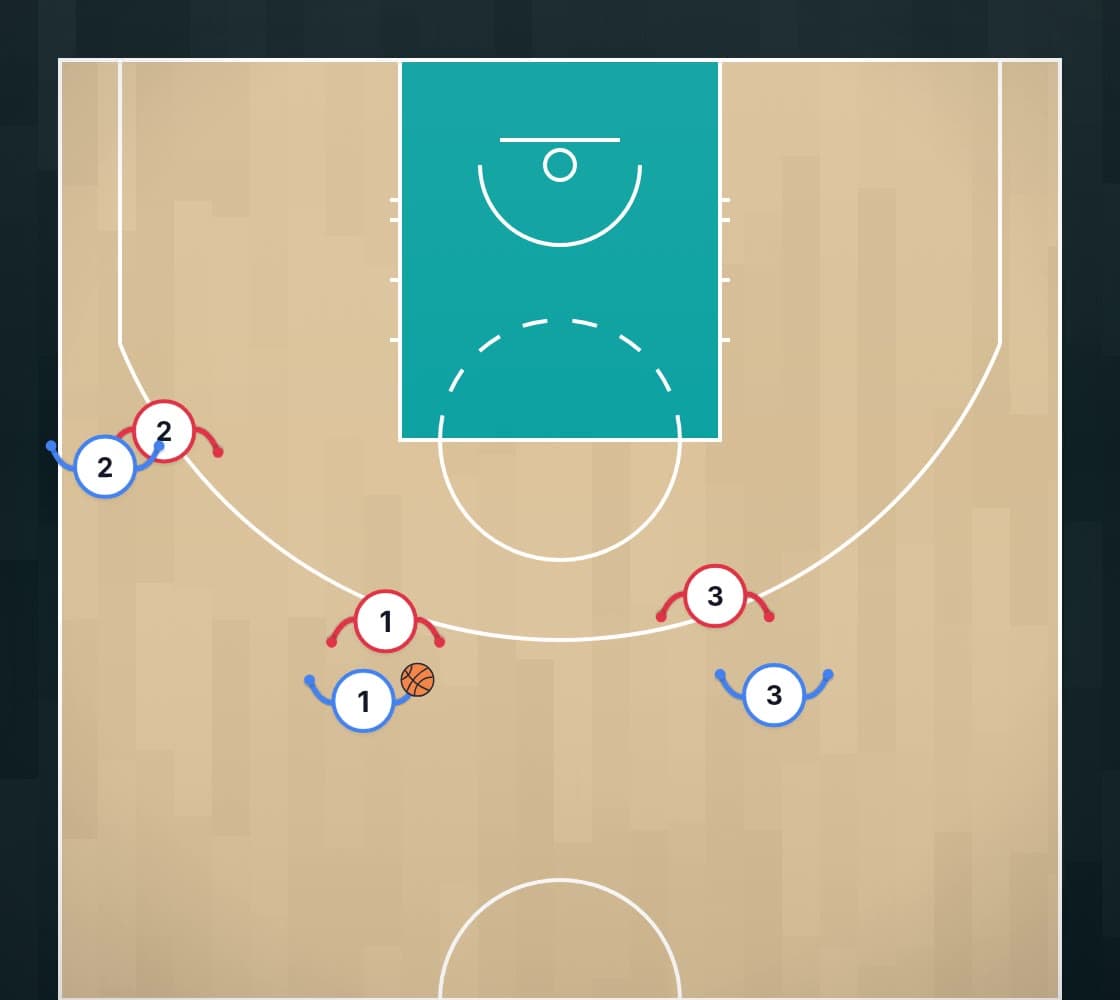
Questions Coaches Ask
What is a small-sided game in basketball?
Any live game with fewer than 5-on-5, such as 1-on-1, 2-on-1, 3-on-3 or 4-on-3. The numbers can be even or give one team an advantage.
What is the difference between a games-based approach and a constraints-led approach?
A games-based approach plays the same small-sided games and lets the game teach. A constraints-led approach changes the rules of each game, such as the start, space, score and defense, based on the behaviors the coach wants to see.
Should every small-sided game have a shot clock?
We advocate for it. Without a clock, players hold the ball and the defense gets back to neutral. Vary the clock so players can't settle into a rhythm.
Take It to Your Next Practice
Free
21 SSGs for Your Next Practice
21 small-sided games you can run and adapt at your next practice, each one keeping the defenders, decisions and scoring of the real game.
The Small-Sided Games Book
$49 USD
Build on your free games. Build your practice around 50+ small-sided games, with diagrams and constraints you can adapt to your players.
Introduction to the Constraints-Led Approach
$49 USD
Explore the framework behind representative practice with Alex Sarama's Introduction to the Constraints-Led Approach clinic.
Sources
- Transforming Basketball, Alex Sarama (Wiley, 2024)
- A Constraints-Led Approach to Coaching Basketball, Sarama, Lascu, Vaz Rocha and Houghton (Routledge)
- Transforming Basketball podcast, episodes 22, 37, 44 and 85
- Why You Need to Constrain Space in Small-Sided Games
- Using Small-Sided Games and the CLA in Large Numbers
- Arias (2012), Human Movement
Behind the methodology
About Alex Sarama
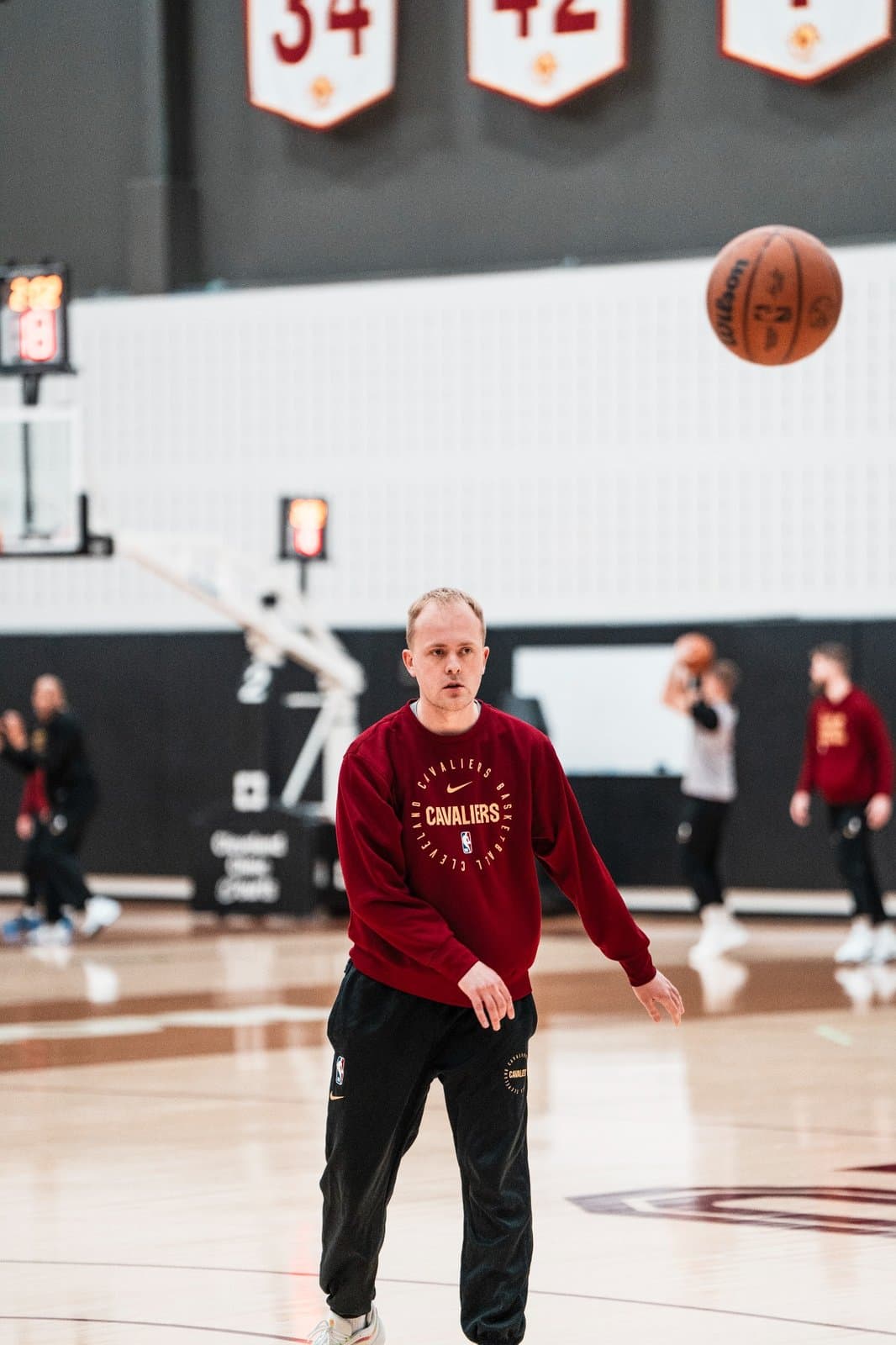

Alex Sarama
Founder, Transforming Basketball · Head Coach, Portland Fire
Alex Sarama is the founder of Transforming Basketball and Head Coach of the WNBA's Portland Fire. Previously, he served as Assistant Coach and Director of Player Development with the Cleveland Cavaliers.
His wider experience includes NBA Europe in Madrid, Paris Basketball in the EuroCup and the Rip City Remix, the Portland Trail Blazers' G League affiliate. Alex has delivered clinics in over 40 countries and has written three books on the constraints-led approach in basketball, including the Amazon bestselling Transforming Basketball (2024) and A Constraints-Led Approach to Coaching Basketball (2026).