
Coaching guide · Team offense
Zone Offense in Basketball
When the other team goes zone, keep your conceptual-offense principles. Players still have to create an advantage and keep the dominoes falling, one advantage leading to the next, so the zone can't get back to neutral. You adjust the spacing, the screening angles and the coverage solutions.
12 min read
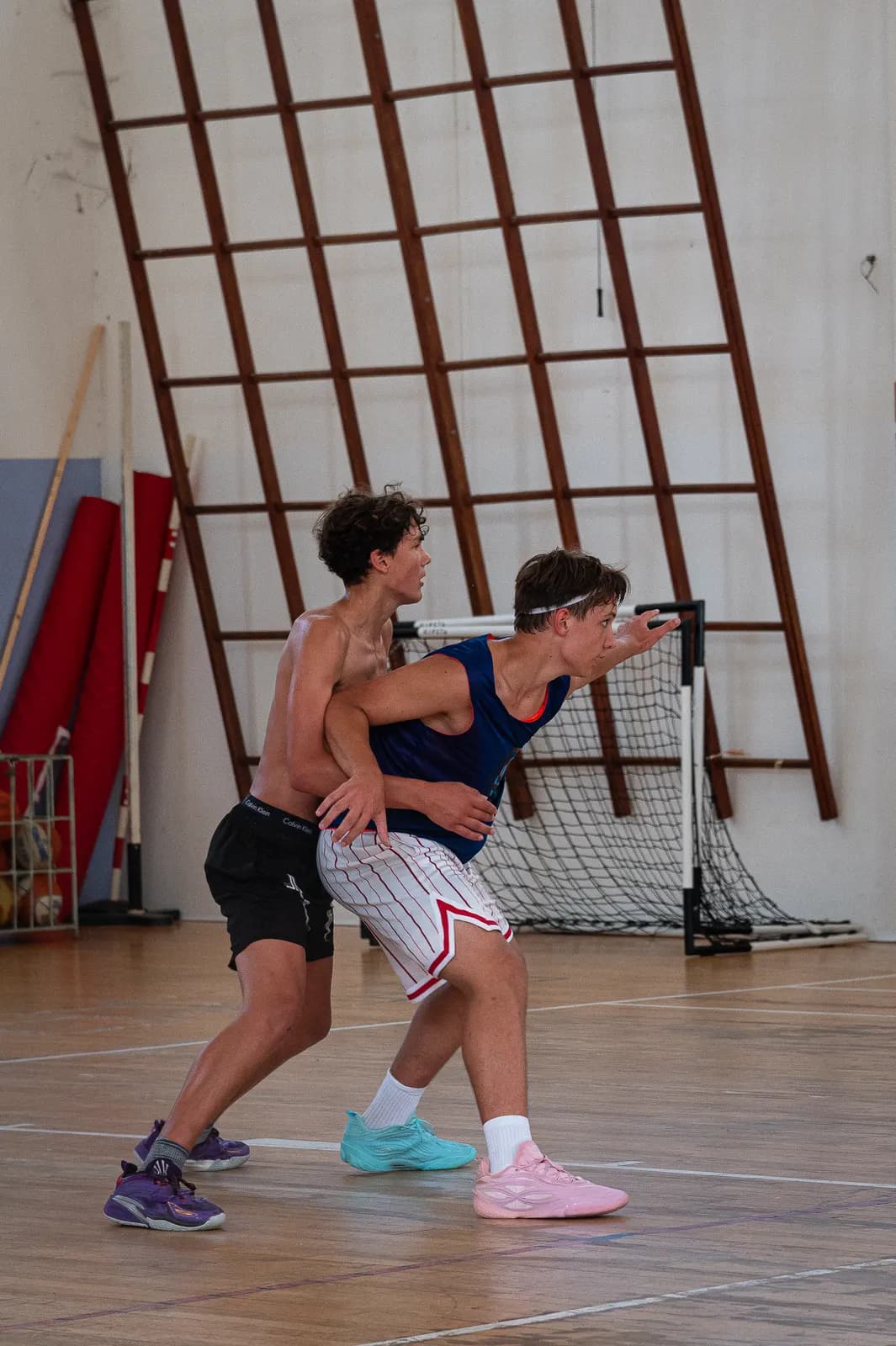
Oregon's Mike Mennenga explained his program's matchup zone on EP151 of the podcast. The point of it, he said, is to sell the zone look. His defenders are matched up, but an offense that thinks it's facing a zone changes how it plays.
“Essentially, we're matched up, but we want to get you in your zone offense instead of your motion game.”
That should make any offensive coach think. Switching to a different offense for the zone is the first problem on Alex's list below, and we don't think you need one. Keep the same principles and adjust them for how a zone shifts and helps.
What Usually Goes Wrong Against a Zone
Alex's zone offense presentation lists the problems coaches run into most often:
- A different offense
- Sets vs principles
- Threes vs the rim
- Limited cutting
- Less transition
With young players, the most common problem is more basic. George Vaz's article on beating a zone in youth basketball describes it:
“The indecision and holding the ball is the biggest error many youth players make when playing against zone.”
Unless they're waiting for a trigger, players need to play in zero seconds, before the defenders get back to their spots in the zone.
Same Principles, Adjusted
Alex makes this case in Transforming Basketball: one of the strengths of principles of play is that they hold up against any defense. A zone changes the task constraints, not the concepts.
“This means that a whole new offensive scheme is not required, as seen within the dominant approach with entirely separate offenses for zone and player.”
Dominoes is how a team keeps an advantage alive until the last domino falls on a high-value shot. The three dominoes principles from our conceptual offense guide all hold against a zone, and some matter more:
- Zero seconds. Drive, pass or shoot in zero seconds on each catch. Against a zone, every pause lets the defense get back to neutral.
- 1 can't guard 2. Space to a spot where one defender can't guard two offensive players. Against a zone, the aim is to make one defender choose between two scoring threats.
- The floor is lava. After a drive or cut, escape the paint and get back out to space quickly, so a teammate can use it.
In A Constraints-Led Approach to Coaching Basketball, the floor-is-lava rule covers everywhere inside the 3-point line except the dunker spot, and players can't catch there unless they're cutting to the rim. That exception matters against a zone, as the dunker sections below show. How a team fulfills these principles also depends on its players. Transforming Basketball gives the example of a team of great shooters using more exit screens to stay out of the lava, while a more athletic team that shoots less well looks for corner ghost cuts.
Transition still matters, because a zone that hasn't set up yet is the easiest to beat. The Routledge book puts it bluntly: at any level, the worst transition offense is better than the best half-court offense. A constraint such as four seconds to cross half court after gaining possession pushes the pace. Set plays can still have a place, but players also need ways to continue when the first action doesn't create an advantage.
Start by Watching 5-on-5
Alex's presentation suggests a starting point before any smaller game: set up the zone defense and play 5-on-5 against your principles of play. Constrain the offense to gold and silver medals (rim finishes and catch-and-shoot threes), play with a short clock of ten seconds or even less, and see what emerges.
Then choose a rate limiter, the thing most holding the offense back. Is the offense moving defenders, or just passing around the perimeter? Are flashes timed with the ball? Does the ball-handler recognize the space a screen creates? If players catch and hold while a passing window closes, use a temporary turnover rule for catching and holding the ball, and watch whether the next pass, drive or shot keeps the advantage. If players have no available option at all, changing the clock won't solve the spacing problem. Adjust the numbers or the defenders' freedom so they can work through the interaction, then return to the full zone.
Give Players Space to Move Into
A player standing at the high post isn't the only way to get the ball into the middle. A player can flash into that space when the movement of the ball, the screener and the defenders makes the pass available.
A good starting position is the weak-side dunker spot: near the baseline, outside the lane and opposite the ball. From there, a player can stay available near the basket, move into a passing window or make room for a teammate. The spot is available to different players, not reserved for the tallest one.
Timing matters. If the screener rolls toward the basket, the dunker can flash toward an open window and receive a pass to link up with the roller. If a teammate already occupies that window, moving into the same space lets one defender cover two offensive players.
Use the Pick and Roll to Create a Decision
Against a 2-3 zone, think about which front defender the screen engages and where the middle defender can help. Changing the angle or location of the screen changes the problem those defenders face.
Keep the ball-handler's options open. They may use the screen, reject it or split a gap if the defense makes that possible. The screener may roll or slip into space when the defense anticipates the screen. Completing a planned action matters less than recognizing the advantage that's already there.
Watch the player near the baseline too. A timely flash gives the ball-handler another passing option and a way to reach the roller, instead of every possession depending on the same short-roll pass.
Simplify the Middle of the Zone, Then Bring It Back
This is the sequence Alex used in his zone offense masterclass. It starts with one part of the zone and adds defenders as players solve it.
3-on-2 in the middle of a 2-3 zone
5 playersThe relationship between the ball-handler, the screener and the weak-side dunker.
How it works
- Use three offensive players: a ball-handler, a screener and a player in the weak-side dunker spot.
- Use two defenders representing a front guard and the middle defender of a 2-3 zone.
- Keep the ball-handler outside the three-point line, allow a maximum of two passes and count scores at the rim.
- Prevent the front defender from entering the paint, so that defender keeps representing the intended zone role.
Adapt it
- These are rules for the practice task, not rules for how every zone should defend.
Watch for
- Can the offense make one defender choose between two scoring threats?
- Does the dunker find a passing window without crowding the roller?
- Is the pass available while the advantage still exists?
Then bring the rest of the zone back:
- 3-on-3. Add the second front defender with the same offensive players. The ball-handler now has another defender to read, while the screener and dunker still have to coordinate.
- Statues. Add the two back wing defenders with limited movement. They can show their presence, step toward the ball and intercept nearby passes without collapsing on everything. The spaces look more like the full zone while the task stays manageable.
- 4-on-4, then 5-on-5. Add a perimeter player and defender on one side, then return to the full game. Each addition changes the passes, help and scoring options available. Drop earlier restrictions when they no longer serve the problem.
These are options for adjusting a game, not a progression every team has to complete in the same order.
When Three Players Arrive in the Paint
A drive, a roll and a player near the baseline can bring three offensive players into the paint at once. Alex calls this a convergence. Whether it creates an advantage or closes the space depends on what those players do.
- Make room near the baseline. The dunker can move lower along the baseline, creating separation from the drive and the roll while staying available for a pass.
- Seal the middle defender. The roller or dunker can use a legal screen or seal to keep the middle defender from helping freely. The ball-handler then has to recognize the opportunity it creates.
A temporary limit on the number of players in the paint can isolate a practice problem. It doesn't have to become a permanent rule; players still need to learn how to coordinate when several teammates arrive there.
More Zone Games from the Community
Neil Houghton, who coaches at Knox Basketball in Melbourne, wrote up a set of small-sided games for zone offense, each built around one principle of play. Four of them:
Shift the Zone
10 playersDistort the zone out of its preferred alignment.
How it works
- 5-on-5 half court.
- Scores after a reversal across the split line are worth double points.
- Bonus points for every offensive rebound.
Watch for
- Does the reversal actually open something, or is the ball just being moved?
Engage Two Defenders
6 playersUse the dribble to draw two defenders and play the 2-on-1 that follows.
How it works
- 3-on-3 with the space constrained to one side of the court.
- The player with the ball must attack with the intent to get a paint touch. If the dribble doesn't engage a defender, any score that follows doesn't count.
- Bonus points for every offensive rebound.
Pin-ins and Skip Passes
10 playersGive the receiver of a skip pass time and space to shoot.
How it works
- 5-on-5 live.
- A score off the skip pass doesn't count unless a defender is sealed or screened with a pin-in before the shot.
- Players debrief where a seal worked (for example, the dunker for a corner shot, or the elbow for a wing shot).
- Bonus points for every offensive rebound.
Adapt it
- The slip from the player pinning in can also be an option.
Flash Cut
8 playersFind what a flash cut behind the zone creates.
How it works
- 4-on-4 with the space constrained to one half of the court.
- Players start at point, wing, dunker and weak-side corner, and look for what a flash cut from the weak-side corner toward the middle opens up.
- Gold medals or catch-and-shoot threes only.
- Players debrief the options they found, such as a high-low or lob pass.
George Vaz's youth zone article collects four more ideas from a Transforming community challenge: constraining one part of the zone (such as the left corner and left wing of a 2-3), dynamic starts and bursts from Mohamed in Sri Lanka, a zero-seconds-or-turnover rule from Ryan in Illinois, and Ryan Josephson's games at Camas High School in Washington that isolate specific zone spaces.
Young Players and the Zone
Transcending Basketball has a strong view on zones at young ages. Extra defenders in the paint take away chances to finish at the rim and push young players to shoot from the perimeter, which is hard without scaled equipment.
“In Europe, zone defenses are almost universally banned until the under 16 age group category.”
A Constraints-Led Approach to Coaching Basketball suggests clubs consider a no-zone rule from U8 to U14, where local rules allow it, because players who aren't yet physically developed are held back by it. The concern carries on to older players too. Transcending Basketball argues that players kept in a zone for every minute of every game don't become attuned to the affordances they'll meet at the next level.
If your league allows zones, you still have to play against them, so keep the activity near the optimal challenge point, where it's neither too easy nor too hard. Consider passing distance, shooting range, equipment and how much defensive pressure there is. Adjust the space, numbers or pressure while keeping live defense in front of them, then return to the full game to see whether the solutions hold up with everyone present. Look for the intent behind a decision as well as whether the possession ends in a basket.
Alex's free Zone Offense Masterclass shows his concept-based approach to attacking zone defenses in full.
Questions Coaches Ask
How do you beat a 2-3 zone in basketball?
Use the same principles as against man-to-man: make zero-second decisions, put two threats in one defender's area, flash into the middle from the weak-side dunker spot, and use the pick and roll to make the front and middle defenders choose. Look for transition before the zone sets up.
Do you need a separate zone offense?
No. Keep your conceptual-offense principles and adjust the spacing, screening angles and coverage solutions for how the zone responds. Some defenses deliberately try to get teams into a separate zone offense instead of their normal game.
What is the biggest mistake youth teams make against a zone?
Holding the ball. Indecision lets the defenders get back to their spots. Unless they're waiting for a trigger, players should drive, pass or shoot in zero seconds.
How do you practice zone offense with small-sided games?
Isolate one part of the zone, for example a 3-on-2 with a ball-handler, screener and dunker against a front guard and the middle defender, then add defenders back: a second front defender, limited back defenders, 4-on-4 and finally 5-on-5.
Where should the high post be against a zone?
It doesn't have to be a fixed player. A teammate can flash into the middle when the ball, the screener and the defenders open the pass, often from the weak-side dunker spot, and the role isn't reserved for the tallest player.
Should youth teams play zone defense?
Ideally not at the youngest ages. Transcending Basketball notes that zones are almost universally banned in Europe until under 16, because extra paint defenders take away rim finishes and push young players into shots beyond their range. A Constraints-Led Approach to Coaching Basketball suggests a no-zone rule from U8 to U14 where local rules allow it.
Take It to Your Next Practice
The Conceptual Offense Playbook
$49 USD
Build on the Conceptual Offense Starter Kit with the full playbook. Explore the principles and decisions that help your players create and maintain advantages.
Implementing a Conceptual Offense
$49 USD
Take the Starter Kit onto the court. Alex explains how to teach shared principles, triggers and coverage solutions through game examples and small-sided games.
Sources
- Transcending Basketball, Alex Sarama (Wiley, forthcoming): chapters 3 and 4
- Transforming Basketball, Alex Sarama (2024): chapter 7
- A Constraints-Led Approach to Coaching Basketball, Sarama, Lascu, Vaz Rocha and Houghton (Routledge, forthcoming): chapter 3 (equipment and rule modifications) and chapter 4 (Table 4.2, phases of offense)
- Zone Offense, Alex Sarama, coaching presentation
- Zone Offense Masterclass, Alex Sarama
- EP151: How Oregon Recruits and Develops Players to the Pros with Mike Mennenga
- Zone Offense Basketball: Small-Sided Games to Teach It, Neil Houghton
- 4 Creative Ways to Beat a Zone Defense in Youth Basketball, George Vaz
- Using the CLA with Beginners, Alex Sarama, coaching presentation (optimal challenge point)
- Pinder, Davids, Renshaw and Araújo (2011), "Representative Learning Design and Functionality of Research and Practice in Sport", Journal of Sport and Exercise Psychology 33(1), 146–155. doi:10.1123/jsep.33.1.146
- Guadagnoli and Lee (2004), "Challenge Point: A Framework for Conceptualizing the Effects of Various Practice Conditions in Motor Learning", Journal of Motor Behavior 36(2), 212–224. doi:10.3200/JMBR.36.2.212-224
Behind the methodology
About Alex Sarama

Alex Sarama
Founder, Transforming Basketball · Head Coach, Portland Fire
Alex Sarama is the founder of Transforming Basketball and Head Coach of the WNBA's Portland Fire. Previously, he served as Assistant Coach and Director of Player Development with the Cleveland Cavaliers.
His wider experience includes NBA Europe in Madrid, Paris Basketball in the EuroCup and the Rip City Remix, the Portland Trail Blazers' G League affiliate. Alex has delivered clinics in over 40 countries and has written three books on the constraints-led approach in basketball, including the Amazon bestselling Transforming Basketball (2024) and A Constraints-Led Approach to Coaching Basketball (2026).