
Coaching guide · Offense
Basketball Transition Offense
Transition offense is won or lost in the first few seconds after you get the ball. Who pushes it? Where does everyone run? And what happens when the defense gets back to neutral? We coach principles of play for those seconds, like lag-free reactions, corners first and the two-side, and we teach them through live games.
17 min read
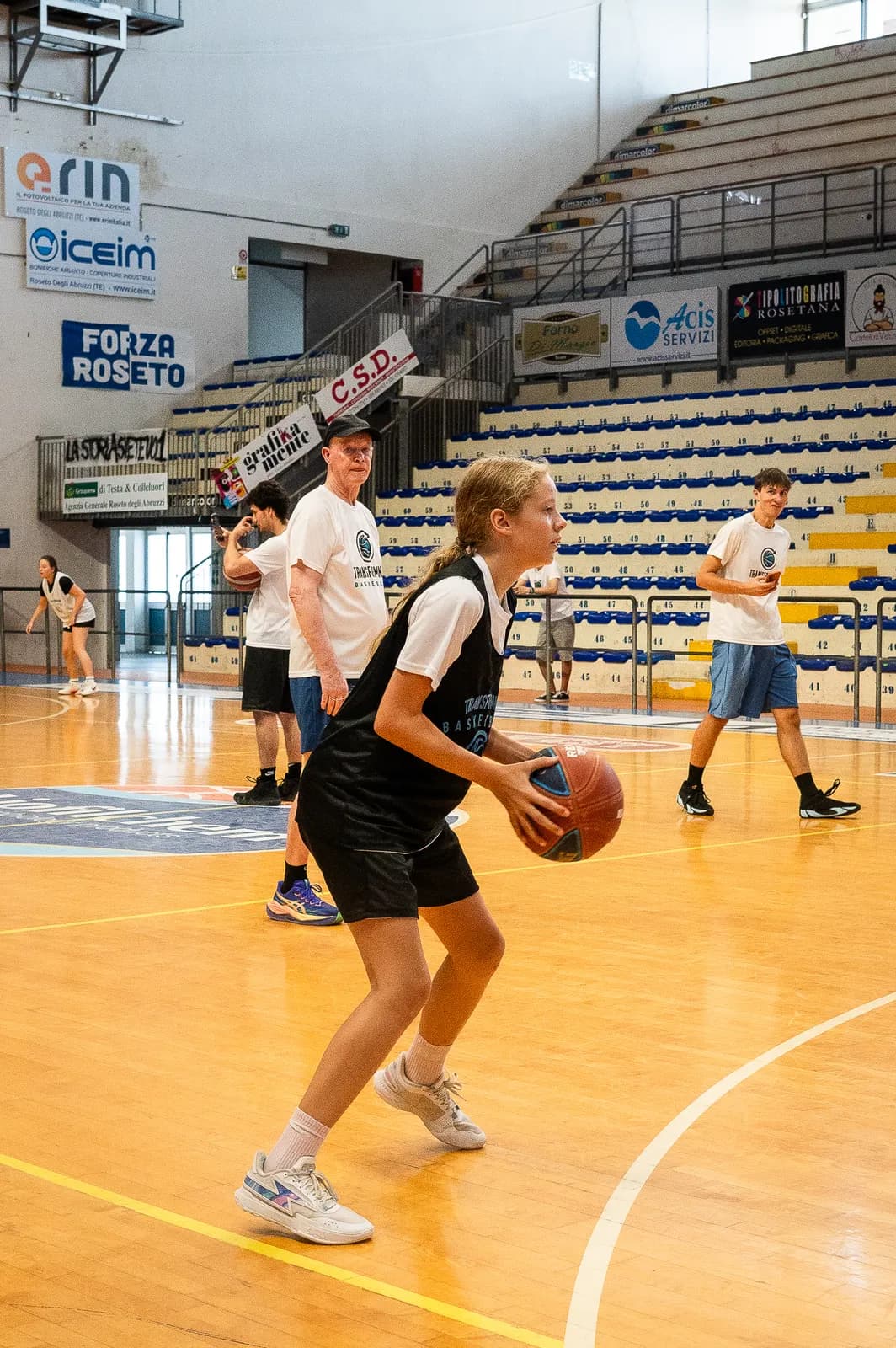
At a European Championship in Nice, someone came up to Francesco Rossi, the youth director at College Basket in Borgomanero, Italy, with a question. Why were his teams always the ones that ran the most fast break at the Italian national finals? Francesco, who told the story on episode 39 of the podcast, wasn't sure at first, but he settled on one answer.
“But the key is the cambio game.”
Cambio is Italian for "change". Play a normal 3-on-3, 4-on-4 or 5-on-5, and when the coach calls "cambio", the team with the ball has to score at the other basket. Wherever the ball is, wherever the defense is, everyone has to switch on immediately. Francesco adds a rule: two seconds to decide what to do.
Alex Sarama spent three years in Borgomanero working with Francesco, and on the same episode he explained why the game works. A lot of coaches run very predictable transition, he said, and even their small-sided games are predictable because the players always come from the same place. Cambio is never the same twice. Players have to read the affordances in transition, so he wants repetition without repetition in practice: the same goal, but a different picture every time.
The First Three Steps
George Vaz sets out the starting point in his fast-break article: if players don't react "lag free" or win their first three steps, the numerical advantages never appear.
Lag-free reaction. In a Q&A released as EP137, Alex described what he wants when the ball comes off the rim: all four players off the ball sprint immediately, instead of walking, then jogging, then running. The academy season plans in his principles-of-play presentation list it for the youngest group as "lag free reaction and bolts". In Transforming Basketball, Alex credits both terms to Ross McMains. A lag-free reaction is winning the first three steps up the floor the moment your team gains possession, and a bolt is sprinting the floor at maximum speed.
The book also gives transition its own metaphor. Dominoes describes how a team plays once it has an advantage; "fast and furious" describes how it wants to play in transition. Plenty of coaches say they want to play fast, Alex writes, but few back it up with clear intentions and specific actions. His suggestion is to put pace into the scoring of your small-sided games and scrimmages: a score within five seconds of gaining possession is worth double, or the ball has to cross half court within four seconds after a make. Rotate those constraints so practice doesn't get repetitive.
No outlet. The traditional rebounder lands facing the rim, then looks for the point guard. Alex credits Mike MacKay of Basketball Canada with the alternative on EP30: land like a quarterback. Secure the ball with vision of the floor and go straight into a break-out dribble. Alex's point is that catching, facing the rim and then finding the point guard for the outlet only reduces the chances for easy, efficient scores. The U12 plan lists it as "No outlet: break-out dribbles."
“Removing the outlet greatly speeds up transition, opening up transition scoring affordances.”
You don't have to coach the landing as a technique. The book's point is that landing like a quarterback often comes naturally once the constraints ask for it: no passes allowed in the backcourt, or extra points for quick scores in transition. Players then break out on the dribble or kick ahead, depending on what's in front of them. Made baskets and dead balls are where a designated point guard brings the ball up.
In practice that means whoever rebounds is the point guard, one of the transition principles George lists. Keep it flexible. Where the rebounder is comfortable with the ball, they start the break; if they aren't yet, a teammate may be the better way forward. George described the London Lions version on EP108: players whose half-court jobs were setting screens or finishing would still rebound, bust out on the dribble and create advantages, instead of always handing the ball to the designated playmaker.

Free
21 SSGs for Your Next Practice
21 small-sided games you can run and adapt at your next practice, each one keeping the defenders, decisions and scoring of the real game.
Where to Run
Our transition spacing principles tell players where to run. What they do when they get there depends on what the defense gives them. These are the rules Alex walked his staff through on EP137.
| Principle | What it means on the floor |
|---|---|
| Seek the nearest sideline | Sprint up the side of the floor closest to you. The exception: if you think you can get a 1-on-0 layup or a 2-on-1, you can go through the middle. |
| Corners first | The first player to arrive fills the corner. If the corner is taken, fill the 45. |
| Keep the highway clear | Don't dribble or run through the middle. That's the lane retreating defenders sprint back through. On EP30 Alex called the same idea "race car": leave the middle free for the ball-handler. |
| Never cross in front of the ball | This takes precedence over the nearest sideline. If reaching your sideline means running in front of the ball, go the other way. |
| Fix the overload | If the third player arrives on a side that's already full, they can cut through to the weak-side dunker spot, or fill the 45 and call "bump" so the player there goes through. |
Why corners first? Transforming Basketball takes the dominoes idea of 1 can't guard 2 and uses it for transition spacing. Traditional transition spacing sends players down designated lanes to stop at the wings or the high post, which crowds the floor and takes away the break-out dribble and the easy drive. Filling the corners stretches the defense both ways, and the next spot that keeps one defender from guarding two is the 45.
None of these are plays. As Alex said on EP30, the principles set up possibilities, and the players still have to perceive the affordances the defense leaves open.
“So within all these things, coaches, it's not absolute, it's possibilities.”
The Two-Side Read
A two-side is spacing where the corner and the 45 on the same side of the floor are both filled. George's two-side break article credits Brent Tipton with popularizing the two-side break, and the logic comes from how teams defend in transition. Retreating defenders protect the basket first, then the ball, then the most dangerous player. So if two defenders are back to cover the two players on the weak side, one of them is usually guarding the rim. Skip the ball to that side and you can have a 2-on-1.
It's a read. Some games give you eight or ten two-side skips, Alex said on EP137, and some give you one.
The pass Alex is wary of is the single-side kick-ahead to the corner. Throw it only if the receiver is wide open. Usually a defender is nearby, and one good short closeout puts the offense back to neutral. An early kick-ahead to a wing with space to drive is different: the defense isn't set and there's room to attack.
When the Defense Gets Back to Neutral
Neutral means neither team has a clear advantage: the defense has recovered. In Alex's view on EP137, the hardest part of transition is the switch from the break into half-court offense, and that switch has to be lag-free too.
“What we have to avoid is players coming over, dribbling for like 3 to 6 seconds, and then pulling the trigger.”
A trigger is a two- or three-player action, such as a pick, a get or a dribble handoff, that tries to create a new advantage. George's article sets the target as flowing into one within three seconds of recognizing neutral. Run it from the spacing players arrive in. Stopping everyone to relocate to a set pattern gives the defense more time to settle. And the trigger is only an attempt to create an advantage, so players can score before it's finished. If the player with the ball hasn't recognized neutral, someone else has to come to the ball and start the action.
Arrival spacing is positionless, so your center may end up in a corner. The book treats that as a bonus: the defense's big now has to guard in unfamiliar territory when the first trigger starts. A player who is effective from the dunker spot can go straight there if they are level with or ahead of the ball, and if they're trailing, they can get involved in the first trigger instead, with a drag screen or a screen away. Pushing the pace also produces cross matches, with bigs guarding guards. When that happens, the book suggests flowing into 4-out 1-in with the weak-side dunker filled, which opens double gaps to attack the mismatch.
After a made basket, the same rules apply, just less often. The closest player grabs the ball and inbounds fast, and Alex still looks for a two-side. For a team that can't inbound quickly, he described a constraint: if the ball isn't in within two seconds, it's a turnover. The U12 plan lists "quick inbounds" as its own principle.
Coaching Transition from the Bench
Transcending Basketball gives coaches a traffic light for in-game feedback. Green is when the game is flowing, especially in transition. Yellow is still flowing but slower, like a team bringing the ball up to start its first trigger. Red is any dead ball. In green, long instructions are counterproductive, and the book suggests one-word prompts tied to the principles: "corners", "push", "two-side" and "dominoes".
“If coaches are too prescriptive in green, then it hinders players by distracting them from perceiving attractive affordances.”
There's a limit to what any cue can do, though. The book's example is a coach telling a team to "look to play in transition as much as possible by using quick bust-out dribbles". If players haven't become attuned to those chances in practice, the feedback will have little impact.
Games That Teach Transition
Each game below starts from a different place, and most use a dynamic start, with players already moving before the break begins. How often does a real fast break begin from the exact same spots? Almost never.
The weave, made over
5 playersReplace the three-player weave with a live 3-on-2 where spacing is different every time.
How it works
- Three offensive players move randomly inside the three-point area instead of lining up on the baseline.
- Two defenders also move around inside the three-point area. For novice players, use one defender.
- When the coach throws the ball in, the offense has an eight-second shot clock to convert its extra-player advantage and score in transition.
- As soon as the defense wins the ball with a stop or a score, it attacks 2-on-3 the other way.
Adapt it
- On EP37 Alex riffed a version where one defender starts in the paint, one starts anywhere else, and a defender begins with the ball and shoots, so the break starts from a live rebound. His clock: eight seconds to end the possession with a rim finish, a foul or a catch-and-shoot three.
- Add a third defender who arrives from a random angle, add another trip, or change the scoring to fit your principles.
Watch for
- Does the ball move ahead while the defense is still outnumbered, or does the offense let the advantage expire?
The book's case for replacing the weave is that it isn't representative: there's no defense to read and nothing in it looks like the game, and even when coaches flow it into a 2-on-1, the offense and defense always arrive from the same spots.
“Players never pass in a diagonal line without perceiving the positioning of teammates and defenders, before sprinting and following behind their pass.”
5-on-4+1 Paint Start
10 playersConvert an advantage before a recovering defender gets back, and recognize when the defense is back to neutral.
How it works
- Begin with five offensive players and four defenders moving inside the paint. A fifth defender waits on the baseline.
- The coach passes to an offensive player at an unpredictable moment, starting the transition toward the other basket.
- The waiting defender can sprint back when the ball crosses half-court.
- The offense tries to find a valuable scoring opportunity before the defense recovers. For a focused round, end the possession if the defense gets back to neutral. Agree what neutral looks like so both teams understand the task.
Adapt it
- Release the recovering defender earlier if the offense converts too easily; give the offense longer if the extra defender erases the opportunity before players can use it.
- Then play continuously without the neutral-turnover rule, so the offense has to recognize both situations: use the advantage while it exists, or flow into a trigger when it doesn't.
- To sharpen shot selection, count only gold and silver medals: rim finishes and catch-and-shoot threes.
Watch for
- Is the ball moving ahead while the defense is still recovering? Does a held ball let the extra defender get back?
4-on-3 Full Court, Three Trips
7 playersPractice any transition principle (bust-out dribbles, lag-free reactions, kick-aheads, the two-side) across several changes of possession.
How it works
- Two teams. One always has an extra player.
- The team with three players starts with the ball in the half court. The defense passes it in to them for a shot, and it's live after the shot.
- Play three more trips after this, then reset.
- In George's two-side break version, play to 12 points, counting twos and threes, and switch which team starts after each reset.
Adapt it
- Call a turnover if the offense doesn't create a weak-side two-side, or if players don't react lag-free after gaining possession.
- Make it a turnover if the rebounder doesn't land like a quarterback.
- Add a shot clock, or play nickels and dimes: first to 10 points or 5 stops.
- Be careful about stacking too many rules at once, which can confuse players.
- Transforming Basketball's version plays first to 21 with a 12-second clock on each trip, and makes any score within five seconds of gaining possession worth double.
- Golden snitch, also from the book: the team that starts a player down wins the whole game, before anyone reaches 21, if it holds the other team scoreless across the three trips.
- Reverse the order so the first trip is 3-on-4, to practice playing against pressure from a disadvantage.
Two more games change the start without any setup. Cambio, from the opening story: any half-court game becomes a transition game the moment you call it. And from EP37, play trips: a half-court 3-on-3 runs a trigger, and when the defense wins the ball they go the other way. If you want an advantage, call the name of one new defender, who has to high-five you before they can get back. Sometimes that's a 3-on-2, sometimes the defense scrambles and it's 3-on-3 again.
Three Lives
10 playersMake every change of possession count, from Alex's book Transforming Basketball.
How it works
- Play a five-minute 5-on-5 game with normal scoring and three lives for each team.
- Choose one consequence that costs a life. To emphasize transition, a team could lose a life when it concedes a score within four seconds of losing possession.
- Losing all three lives ends the game, even if that team leads on the scoreboard.
Adapt it
- Begin with one consequence so players can remember what matters.
- Observe whether the rule creates purposeful transition opportunities or encourages rushed attempts, and adjust it to your group.
Transition with Young Players
The academy season plans in Alex's principles-of-play presentation build transition up by age. U12: no outlet and break-out dribbles, lag-free reactions and bolts, sprint up the sideline, kick-ahead passes, quick inbounds. U14 adds getting to the nail, keeping the highway clear, the two-side break and clap-backs. U16 adds deep outlets, a free-throw break and 2-for-1s.
A Constraints-Led Approach to Coaching Basketball makes transition a priority for beginners, because it is often the easiest way for them to create scoring chances. The book calls this phase "green" and introduces it through 2-on-1 and 3-on-2 games in the half court and full court. This one brings in seeking the sideline, bolting the floor, the burst-out dribble and the kick-ahead pass.
2-on-1 (+1) Full Court Transition with Scramble
Groups of 4Introduce full-court transition with an advantage. The defense learns to find the most dangerous player (FMD), and its version of a bolt is a dash back.
How it works
- Work in groups of four so the next group is ready to go straight away.
- X1 starts in the middle and passes to either O1 or O2 to begin.
- A chaser starts on the baseline, ready to dash back.
Adapt it
- O1 attacks "Go Until Stopped" (GUS).
- O2 bolts wide into a passing window.
- A 6-second shot clock and a maximum of 3 passes.
- Contest until the rebound.
- +3 points for a gold medal finish, and +2 points to the defense if it neutralizes the advantage.
- When players are ready, extend it to 3-on-2 (+1).
Watch for
- Does the ball handler keep going until a defender stops them, and does the other offensive player bolt wide into a window?
Sean Keating, a high school varsity coach in St. Peter, Minnesota, went further on EP92. His youth league, adapted from a format Jeff Boos started in Sun Prairie, Wisconsin, replaces 5-on-5 with a continuous fast-break game: one team goes down 4-on-3, the other comes back 3-on-2, over four ten-minute quarters. Defenders don't guard beyond the three-point line, so any player can bring the ball up, and they can't reach in to steal the ball, only intercept passes. There's always someone open, and Sean said the kids learn to play in space.
For how transition flows into your half-court offense, see the conceptual offense guide. For the other end of the floor, George's transition defense article covers the priorities.
Questions Coaches Ask
What are the key principles of transition offense in basketball?
The rebounder starts the break with a break-out dribble instead of looking for an outlet, and everyone else sprints immediately. Players run up the nearest sideline, fill the corner first and then the 45, keep the middle clear and never cross in front of the ball. If the defense recovers to neutral, the team flows straight into a trigger from the spacing it arrived in.
What is a two-side break in basketball?
A two-side break fills the corner and the 45 on the same side of the floor. Retreating defenses tend to protect the basket first, so a skip pass to the two-side can create a 2-on-1. Don't expect it every time. Some games give you many skips and some give you one.
Should the rebounder outlet the ball to the point guard?
In our approach, usually not. The rebounder lands like a quarterback, with vision of the floor, and pushes with a break-out dribble, because waiting for an outlet gives the defense time to get back. If a rebounder isn't comfortable handling the ball yet, a teammate can take it.
What can I use instead of the three-man weave?
A live 3-on-2. Three offensive players and two defenders move randomly inside the three-point area, the coach throws the ball in, and the offense has eight seconds to score. When the defense wins the ball it attacks 2-on-3 the other way. Use one defender for novice players.
What is a good transition offense drill for basketball practice?
5-on-4+1 from a paint start: five offensive players and four defenders move in the paint, the coach passes to the offense at an unpredictable moment, and a fifth defender can sprint back once the ball crosses half-court. The offense has to score before the defense recovers.
When should a team stop pushing in transition and run offense?
As soon as the defense is back to neutral, with every defender guarding their player. Flow into a pick, get or handoff from the spacing you arrived in, without dribbling around for several seconds first.
Take It to Your Next Practice
Free
21 SSGs for Your Next Practice
21 small-sided games you can run and adapt at your next practice, each one keeping the defenders, decisions and scoring of the real game.
The Conceptual Offense Playbook
$49 USD
Build on the Conceptual Offense Starter Kit with the full playbook. Explore the principles and decisions that help your players create and maintain advantages.
The Small-Sided Games Book
$49 USD
Build on your free games. Build your practice around 50+ small-sided games, with diagrams and constraints you can adapt to your players.
Sources
- Transcending Basketball, Alex Sarama (Wiley, forthcoming): chapter 3 (three-player weave make-over), chapter 4 (knowledge of and about), chapter 5 (traffic light feedback)
- Transforming Basketball, Alex Sarama (2024): Three Lives
- EP137: Q&A with Alex Sarama (Part 1)
- EP39: How Does a Small Italian Town Produce So Many Professional Players? With Francesco Rossi
- EP30: What are Principles of Play & Why Are They SO Important For All Coaches?
- EP37: How to Improve ANY Basketball Drill
- EP108: A New Chapter with George Vaz
- EP92: Sean Keating 4v3 3v2
- Coaching the Fast Break: Key Transition Offense Principles, George Vaz
- Two Side Break: Transition Principles, George Vaz
- The Best Basketball Transition Offense Drills (SSGs), George Vaz
- Principles of Play, Alex Sarama, staff presentation (academy season plans)
- Vilar, Araújo, Davids and Button, "The Role of Ecological Dynamics in Analysing Performance in Team Sports", Sports Medicine (2012)
- Silva, Garganta, Araújo, Davids and Aguiar, "Shared Knowledge or Shared Affordances? Insights from an Ecological Dynamics Approach to Team Coordination in Sports", Sports Medicine (2013)
- Transforming Basketball, chapters 7 and 8, Alex Sarama (2024): transition offense principles of play; Three Trips 4-on-3
- A Constraints-Led Approach to Coaching Basketball, Sarama, Lascu, Vaz Rocha and Houghton (Routledge, forthcoming): 3.1.5 transition principles; 3.6.4 transition SSGs for beginners
Behind the methodology
About Alex Sarama

Alex Sarama
Founder, Transforming Basketball · Head Coach, Portland Fire
Alex Sarama is the founder of Transforming Basketball and Head Coach of the WNBA's Portland Fire. Previously, he served as Assistant Coach and Director of Player Development with the Cleveland Cavaliers.
His wider experience includes NBA Europe in Madrid, Paris Basketball in the EuroCup and the Rip City Remix, the Portland Trail Blazers' G League affiliate. Alex has delivered clinics in over 40 countries and has written three books on the constraints-led approach in basketball, including the Amazon bestselling Transforming Basketball (2024) and A Constraints-Led Approach to Coaching Basketball (2026).