
Coaching guide · Player evaluation
Basketball Tryout Drills
A tryout built from drills tells you who's good at drills. Want to see who can play? Put them in live games where they have to read defenders and teammates, keep your explanations short, and write down what each player actually did.
12 min read
At the NBA pre-draft combine, Kevin Durant couldn't lift 185 pounds. He was the only one who couldn't, and he remembered the strength coaches laughing. Alex Sarama quotes Durant's reaction in Transcending Basketball:
“I was embarrassed at that point, but I'm like, give me a basketball, please. Give me a ball.”
Durant's reaction points to the problem with most tryouts. A bench press, a vertical jump, a timed lane slide and an uncontested shooting drill all measure something. None of them shows you what a player does when there's a defender in front of them and a teammate cutting behind. Alex's chapter on the combine, and his earlier article NBA combine testing: why it fails to evaluate talent, make the case at the professional level. The same holds in a high school gym in November.
What a Drill Can't Show You
The combine sets out to measure "athleticism". Transcending Basketball prefers the term action capabilities: vertical jump, power, quickness and so on. They shape which movements a player is capable of, but they aren't skills. Skill is acting on the right affordance (an opportunity for action, like a gap to drive or a teammate coming open) at the right moment, and those affordances come from teammates and opponents.
The book's example is a 6-foot-11 player with an impressive vertical jump score. That score could mean nothing if the player can't perceive the affordances around them, while a player with a far lower score might be much better at finding space around the rim. Touching a vertical pole is a different task from anticipating a layup and timing a jump to contest it. In the game, players jump under time pressure, in fractions of a second. In the test, they can prepare.
“Real agility requires authentic affordances and opponents. Any movements within a closed drill such as lane slides cannot be labelled as agility because this requires the presence of a real opponent.”
Alex's article quotes Karamvir Gill, the athletic performance coach who has worked with RJ Barrett, on the sprint test: "You could have the fastest player in the world, but if they are not attuned to the opportunities to get behind the defense and accelerate in transition, then it accounts for nothing."
Physical qualities still matter. A bigger vertical can give a player more chances to finish above the rim, but those qualities can only be judged in the situations where players use them. A player who jumps higher doesn't automatically secure more contested rebounds, and a faster player doesn't automatically see the best opening.
Transforming Basketball puts the general rule in one line, written about player development but true of any evaluation:
“A player cannot truly be evaluated in an activity that is not somewhat similar to the performance environment that is inhabited during the game.”

Free
21 SSGs for Your Next Practice
21 small-sided games you can run and adapt at your next practice, each one keeping the defenders, decisions and scoring of the real game.
What the NBA Draft Gets Wrong
Chapter 5 of Transforming Basketball has a case study on reframing player evaluation, and most of it transfers straight to a school or club tryout. Draft combine data can tell a front office about a player's action capabilities, Alex writes, but the data alone means very little, because what decides a player's effectiveness is how they use those capabilities against the opportunities a game gives them. Predraft workouts are his example of decomposed practice tasks:
“In many cases players are trained specifically to excel at predraft tasks such as spot shooting. The reality is that becoming proficient in such tasks provides little indication as to how the player would perform in a real NBA game.”
His alternative, when there's no live play to watch, is a more representative small-group workout linked to the team's own principles of play. He also suggests a different thing to look for. Instead of judging players against long-held opinions about what correct technique looks like, value dexterity and adaptability: a player who shows a variety of movement solutions to the same problem. In tryout terms, that's the player who finishes three different ways against three different defenders in jungle finishing, not the one with the tidiest two-step layup.
The chapter also warns about a bias. Research by Staw and Hoang on the NBA found that players drafted early tend to get more minutes and are less likely to be traded than later picks performing at the same level. A club can do the same thing on a smaller scale with last season's starters, so judge what you saw on the day.
How Much Can a Tryout Predict?
On EP8, Alex told Dr. Alex Lascu that one of his biggest frustrations in Italy was how his players were evaluated: "all they were doing was looking at things like quickness, speed, height", not things like dexterity and attunement. Lascu, who did her PhD on talent identification, described pathways that picked players on gut feel, and noted that the people who end up in them are usually the ones who happened to fit the sport already.
Transcending Basketball is blunt about how much anyone can predict.
“Ultimately talent development is akin to a lottery. It is difficult to predict the career trajectory of most players.”
So treat your tryout as a record of what players did under the conditions you set, on that day. The more representative those conditions are of real basketball, the more the record tells you.
A Real Tryout Plan: Ranney
Tahj Holden's tryout plan for Ranney Boys Basketball, dated November 25, 2024, is a real example of a tryout built this way. Its stated intentions include a positive experience for players, lots of time playing and no excessive instruction. It combines short live tasks with bigger games.
The plan labels each activity with the TLC framework: teaching, learning or competing. In the competing parts, coaches observe and take notes instead of repeatedly stopping play. That way you see which affordances players act on. Two of its activities follow.
2-on-1 shooting
3 playersSee which shot a player takes, and whether they find the better option, under a little pressure.
How it works
- The defender starts in front of the rim and passes to the offense.
- The offense has one pass and a four-second clock to find a jump shot.
Adapt it
- Optional changes allow cutting, or more complete attacking options.
Watch for
- Look at the opportunity a player uses, not only whether the shot goes in.
- Does the receiver have an open attempt? Does the defender make the teammate the better option?
4-on-3 dominoes bursts
4 offense, rotating defensesWatch how players play dominoes with an extra player, keeping the advantage alive pass after pass until a quality shot appears.
How it works
- Four offensive players start spaced around the perimeter.
- The defense passes the ball in to begin.
- On a stop or a score, a new defense comes in.
- The offense stays on for one minute before roles change.
Watch for
- Does the offense move so one defender can't guard two?
- Who keeps the advantage moving with the next pass, drive or shot, and who stops it?
The plan then moves into full-court 4-on-4 with a third team rotating, which brings the same interactions into wider play. A burst means players stay in their roles for a fixed time instead of one rep and then the back of a line, so every offensive player gets a minute of decisions you can watch.
Where to Watch: 3-on-3 and 4-on-4
Don Showalter, who has worked with USA Basketball for more than 20 years, told George Vaz on EP153 that small games are where weaknesses show up. If a right-handed player struggles with their left hand, you'll pick it up immediately in a 3-on-3.
“You can really evaluate that in the 3-on-3, 4-on-4 situations.”
He also told George what he looks for first: "When I go evaluate players, one of the main things I look for is versatility." Can they play more than one position, and can they guard more than one? A small-sided game where the defense has to switch shows you both.
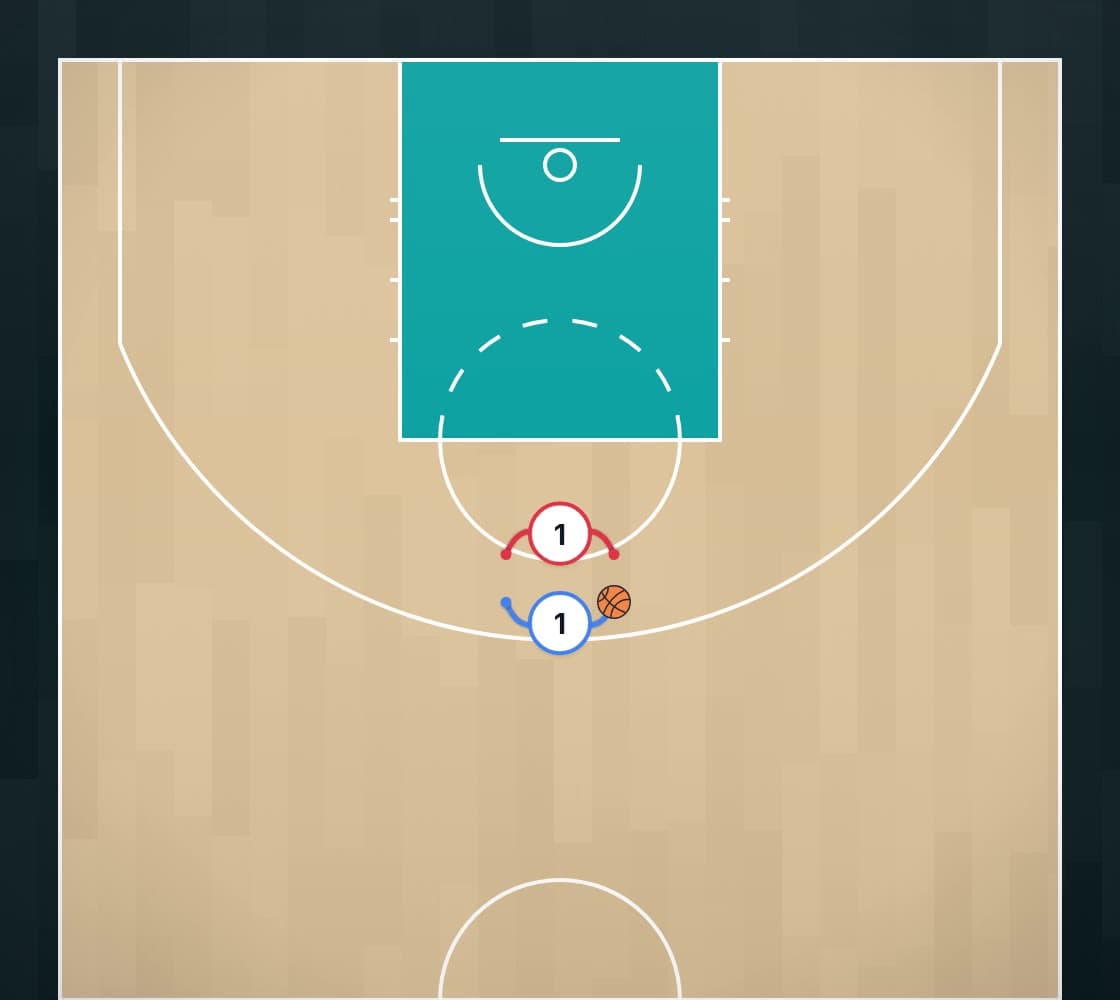
For 1-on-1 evaluation, Chameleon 1-on-1 from chapter 8 of Transforming Basketball gives every player three different starts and a new opponent each round, and it is scored only on defense, so you see both ends.
Chameleon 1-on-1
2 players per game, partners rotateThe offense keeps, extends or creates an advantage; the defense recovers or holds a neutral, chest-to-chest relationship.
How it works
- The offense gets three reps in a row, each from a different half-court location. Like a chameleon, the defender changes color: a different start each rep.
- Blind start: the offense has the ball on the defender's back, and the defender can't move until the ball is lifted.
- Hip start: the offense has the ball on the defender's hip, side by side, a smaller advantage.
- Check-it start: the defender checks the ball to the offense from right in front of them, a neutral start.
- Each rep has a five-second clock. After three reps, change roles, then find a new partner.
- The only way to win is on defense. First to five stops wins, and a stop is a contested shot followed by the defensive rebound, or a turnover. Three stops in a row wins straight away (golden snitch).
Adapt it
- Change the depth as well as the location: a start near or beyond half court looks more like transition.
- Add an extra defender (1-on-2), or use the same starts for 2-on-2 up to 5-on-5.
Watch for
- Who uses the advantage before the defender recovers, and who can get back to neutral from a blind start?
Running a Tryout with Big Numbers
Live games with 60 or 100 players sound impossible. At a live clinic recorded for EP13, Alex said he'd run a tryout for around 120 players, maybe 140 on one day, with four hoops, "and we made it work." The first game he showed coaches was jungle finishing, which he said works with 10 or 12 players on a hoop.
Jungle finishing
10–12 players per basketLots of live drives at the rim against defenders, with almost nobody waiting.
How it works
- Three defenders stay on for a burst of 45 seconds or a minute. Everyone else is on offense.
- Offensive players can go at any time but must drive from a different spot outside the three-point line each time.
- Only finishes inside the smile count. The first to four layups wins, and players call their score out each time or it doesn't count.
- One defender can only defend outside the paint, one only in the paint but not the smile, and only the third can defend in the smile.
Adapt it
- When players defend, give the defense a point for every stop.
Watch for
- Who reads the defender in their way, and who drives into them regardless?
With 12 players at a basket, Defensive Shutdown gives you three teams of four and a clear rotation. Our one-basket practice guide has more ways to fit a big group onto a few hoops, and Alex's large-numbers article was written for exactly this question: youth camps, tryouts and big turnouts.
Keep the explanations short. Mike MacKay's rule in Transcending Basketball is no more than 30 seconds to explain an activity: name it, say how it starts and how it's scored, and let them play. In chapter 8 of Transforming Basketball, Alex sets coaches an even tighter challenge: start each activity in 20 seconds or less. Demonstrate enough for players to begin, then let several possessions go by before you add anything.
Write Down What You Saw
"Good basketball IQ" isn't a note you can use. Record what a player did and in what situation: recognized the help and found the open teammate, recovered to contest a shot, moved so one defender couldn't guard two receivers. Note who they were playing with and against.
| Instead of | Write what you saw |
|---|---|
| Good shooter | In 2-on-1, took the open jump shot inside four seconds, and passed when the defender stepped to them |
| Athletic | Got past the paint defender to finish in the smile twice in jungle finishing |
| Smart player | In 4-on-3 bursts, moved away from the ball so one defender couldn't guard two |
| Good defender | Guarded the ball-handler and the screener after a switch in 3-on-3 |
Vary teammates and opponents wherever you can. One great possession against your weakest defender tells you less than three ordinary ones against different players. A short tryout only samples some of the situations a player can face.
Give players a chance to show their defense as well as their offense. Rotating roles, as the bursts do, means everyone gets observed on both ends. Our player development guide covers what to do with these notes once the team is picked, and functional solutions in 1-on-1 explains why we judge a move by whether it works against a defender rather than by how it looks.
Small-sided games library
Games from This Guide in the Library
Questions Coaches Ask
What are the best drills for basketball tryouts?
Live games rather than drills: 2-on-1 shooting with a one-pass limit and a short clock, 4-on-3 advantage bursts, 3-on-3 and 4-on-4, and full-court play with a rotating third team. They show how players read defenders and teammates, which uncontested drills can't.
How do you evaluate basketball players at tryouts?
Watch them in live situations and write down specific actions and the situation they happened in, such as finding the open teammate after the help came. Vary teammates and opponents, and treat the tryout as a sample of what players did on the day, not a prediction of their future.
Are physical tests like the vertical jump worth doing at tryouts?
They tell you about action capabilities such as jump height and power. They don't tell you much about skill. A high vertical may give a player more chances to finish above the rim, but jumping in a test without time pressure is a different task from timing a jump to contest a shot. Judge physical qualities in game situations.
How do you run tryouts with a lot of players?
Run several small games per basket and keep players in roles for timed bursts. Alex Sarama has run tryouts for around 120 players on four hoops using games such as jungle finishing, which work with 10 to 12 players at one basket.
Should coaches teach during tryouts?
Keep it to a minimum. Explain each activity in 30 seconds or less, then observe. Tahj Holden's Ranney tryout plan labels activities as teaching, learning or competing, and during competing activities coaches take notes instead of stopping play.
What should coaches look for at basketball tryouts?
Specific actions in live play: shot choice, whether players use an advantage before the defense gets back to neutral, spacing so one defender can't guard two, and defending more than one type of player. USA Basketball's Don Showalter says versatility is one of the first things he looks for.
Take It to Your Next Practice
Free
21 SSGs for Your Next Practice
21 small-sided games you can run and adapt at your next practice, each one keeping the defenders, decisions and scoring of the real game.
Tryout Practice Plan Bundle
$39 USD
Everything you need to run organized tryouts — session plans plus a player evaluation form and a parent presentation template.
Sources
- Transcending Basketball, Alex Sarama (Wiley, forthcoming): chapters 4 and 8 and the glossary
- NBA Combine Testing: Why It Fails to Evaluate Talent, Alex Sarama
- Ranney Boys Basketball tryout plan, Tahj Holden, November 25, 2024
- EP8: How Do Basketball Players Develop Skill with Dr. Alex Lascu
- EP13: A Deep Dive Into the Constraints-Led-Approach (Live Clinic)
- EP153: The Gold Standard with Don Showalter, with George Vaz
- Using Small-Sided Games and the CLA in Large Numbers, Alex Sarama
- Pinder, R. A., Davids, K., Renshaw, I. and Araújo, D. (2011), "Representative Learning Design and Functionality of Research and Practice in Sport", Journal of Sport and Exercise Psychology. doi:10.1123/jsep.33.1.146
- Morganti, G., Lascu, A., Apollaro, G., Pantanella, L., Esposito, M., Grossi, A. and Ruscello, B. (2023), "(Beyond) the field of play: contrasting deterministic and probabilistic approaches to talent identification and development systems", Sport, Education and Society. doi:10.1080/13573322.2023.2212689
- Transforming Basketball, Alex Sarama (2024): chapter 4 (evaluation in representative tasks), chapter 5 (case study: reframing player evaluation), chapter 8 (Chameleon 1-on-1)
- Staw and Hoang (1995), "Sunk costs in the NBA: Why draft order affects playing time and survival in professional basketball", Administrative Science Quarterly, cited in Transforming Basketball
Behind the methodology
About Alex Sarama

Alex Sarama
Founder, Transforming Basketball · Head Coach, Portland Fire
Alex Sarama is the founder of Transforming Basketball and Head Coach of the WNBA's Portland Fire. Previously, he served as Assistant Coach and Director of Player Development with the Cleveland Cavaliers.
His wider experience includes NBA Europe in Madrid, Paris Basketball in the EuroCup and the Rip City Remix, the Portland Trail Blazers' G League affiliate. Alex has delivered clinics in over 40 countries and has written three books on the constraints-led approach in basketball, including the Amazon bestselling Transforming Basketball (2024) and A Constraints-Led Approach to Coaching Basketball (2026).