
Spunto per l’allenatore
A useful practice plan records the session’s intention as well as its activities. Include logistics, the day’s load, weekly outcomes, game rules and possible constraints. After practice, record what players actually did so the next plan responds to evidence from your team.
Leggi la guida: Basketball Practice PlanningA 60-minute youth basketball practice plan
This is an editorial adaptation of the actual Transforming U12 Practice 1 sample, for twelve players with two baskets and enough space for four trios. The original sample has no minute-by-minute timings. The schedule below includes explanation, changes of activity, water and recovery within each block; it is a starting allocation to adjust, not sixty minutes of continuous high-intensity play.
| Time | Activity and organization | Intention and adjustment |
|---|---|---|
| 0–8 minutes | Check in, then differential-learning shooting in pairs. Share the two baskets and vary locations, stances and ball flight. | Begin at an appropriate pace. The sample rotates the shooter after six attempts. |
| 8–16 minutes | Shield Tag: four trios in separate marked spaces. One escaper, one tagger and one shield; change roles on a tag or violation. | Explore evading and tracking another player. Add a dribble for the escaper if the base game is manageable. |
| 16–28 minutes | Changing-advantage 1-on-1: six players per basket, one pair live at a time. Alternate ball-on-the-back and ball-on-the-hip starts; change the starting spot. | Attack the rim before the defender recovers. Rotate pairs after each possession and change opponents during the block. Adjust the starting advantage before adding rules. |
| 28–42 minutes | 3-on-2 dominoes bursts: six players per basket, five playing and one recovering. Use short bursts; rotate the resting player and defensive roles between bursts. | The source uses one-minute bursts and an eight-second clock. Begin there if appropriate, then adapt. Include a pause between bursts and keep scoring within the players’ range. |
| 42–55 minutes | 3-on-3 at each basket. This replaces the source’s wider 5-on-5 game so all twelve can take part. | Look for the same advantage and spacing intentions with equal numbers. Use fewer constraints and observe whether players recognize when to attack or pass. |
| 55–60 minutes | Recover and debrief together. | Ask what created an advantage, what helped keep it and what the team needs next. Record one observation for the next plan. |
In Shield Tag, the shield uses position to help the escaper evade the tagger; keep the interaction controlled. For the 1-on-1 and 3-on-2 blocks, waiting and recovery are part of the rotation. Adjust the burst length, rest and activity if the players need a different load.
What changes in the U14 sample?
The U14 Plan 1 sample begins with differential-learning finishing and shooting. Around the Arc 1-on-1 starts both players in the deep corner, with the defender chasing until the attacker steps inside the arc to attack the rim. The plan then includes 2-on-1 shooting, a 2-on-2 that becomes two separate 1-on-1s, and 3-on-3 games involving gets.
The shooting activity looks for a ROB shot: within range, open and balanced. Its initial version permits passing and shooting, then lists cutting and driving as additions. The 3-on-3 work introduces shared actions and defensive communication. Use these as choices for the group’s needs, rather than assume every U14 team is ready for the same complexity.
U12 sample: activity setups and coaching adjustments
U14 sample: ROB shooting, gets and 3-on-3
Use the full age-group practice plans
The U12 and U14 bundles each contain twenty practice plans. The examples here come from the real sample plans; the full product pages explain the corresponding bundles.
U12: twenty basketball practice plans
U14: twenty basketball practice plans
If the numbers or facilities change
With fewer players, retain the main interaction and use smaller team games. With one basket, assign short rotations and use basket-free passing or tag only where a separate safe area is available. A half gym may require planned rest instead of simultaneous activities.
One-basket practice: rotations for 6, 9, 10 or 12 players
A useful youth basketball practice plan records the session’s priorities, activities, player roles, equipment and possible adjustments. Save it with a few notes afterward so the next session responds to what the players actually did. The original planning advice below is followed by the same plan-do-review approach in the U12 and U14 examples.
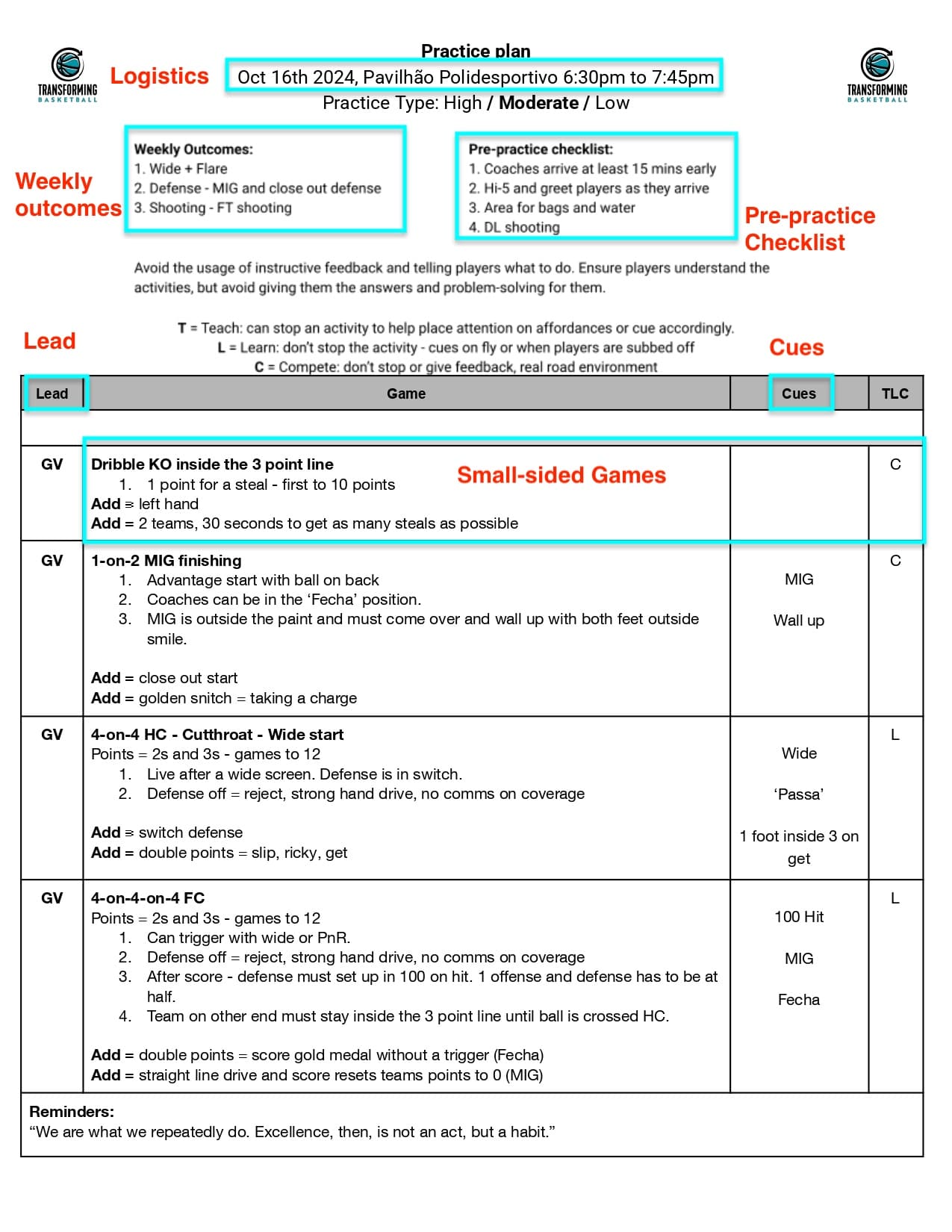
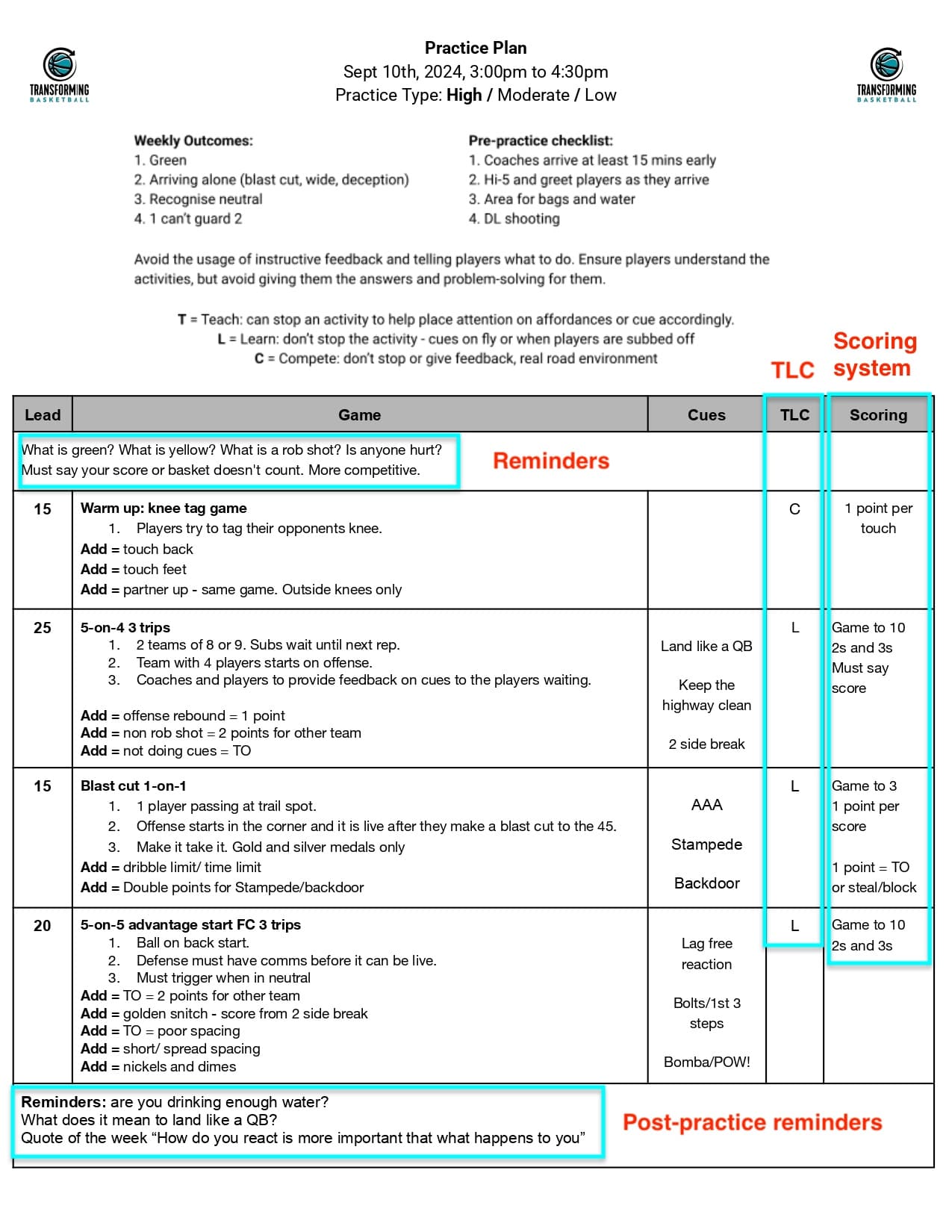
Below is a copy of one of my practice plans from last season at MVP Academy in Portugal. These follow the same style as the Transforming Basketball Youth Practice Plan Bundle.
Practice Plan Checklist
- Logistics: Where, when, and what time is practice.
- Practice type: Low/Moderate/high stress day. This can help with load management and ensuring players do not get burnt out.
- Weekly outcomes: This helps me remind myself what we want to prioritise for the week ahead.
- Pre-practice Checklist: This can help me and the assistant coaches know exactly what to do upon arriving in the gym — check in with players, encourage differential learning shooting exercises to warm up, as well as any other reminders of how we want to coach.
- Reminders/AOB for pre-practice: Sometimes I might quiz the players on our terminology to check for understanding.
- Small-sided Games: SSGs, their rules, and potential constraints. I like to anticipate how I think players will respond to the games with the constraints. Sometimes it works; sometimes I am way off.
- Scoring system: You can see from the examples above that I removed this section in the plan to suit my needs. The team was used to the scoring systems we used.
- Lead: Who is going to be coaching the activity.
- Cues: I like to look at this as the intention of the game. What are we trying to teach? This can help with providing feedback and influencing the players’ intentions and attentions. Note that these are all in our terminology.
- TLC: Teach, learn, compete. This is taken from Mike MacKay. I find it helps me with two things: Knowing when to step in and provide feedback or to let them play and figure it out. Load management. If it is a low-stress day, I might include more ‘teaching’ in the activity.
- Post-practice reminders: This may also include a time for the players to reflect on the practice and what we learned.
Practice Planning Best Practices
Basketball can be a mix of emotions — highs and lows — for youth players. A player can arrive at practice after a bad day at school, and the right practice can quickly transform their poor mood into one of growth and joy — and vice versa!
That being said, it is important to remember that learning is complex in an environment as unpredictable as the basketball court. Here are some best practices for you to remember to help deal with some of this unpredictability:
- Be adaptable: The same way we try to teach our players to be adaptable and creative, we as coaches should strive for the same thing. If you can see the players are learning and growing in a game, perhaps you should stick with it longer — sacrificing another game at practice if needed.
- Move on if it is not working: Know when to say “no.” On the flip side of the above, it is equally important to move on if something is not working. You tried to be creative and create a game that, in your head, would solve all your problems about how to punish a zone defense — and it isn’t going as expected. Move on and…
- Plan, do, review: Take the example above and review why your activity didn’t work, make the necessary changes, and come back to it.
- KISS — Keep it Simple, Stupid! Sometimes less is more when trying to teach something. Too many constraints and rules can confuse not only the players but even us as coaches!
Remember…
Coaching youth players is extremely different from coaching professional players. Youth players are still learning both the game of basketball and life. As a youth coach, our job should be to be as transformational as possible!
This is why I always consider it important to check in with each player throughout the week. Last season, my assistants and I intentionally divided the players up each week for who we would each speak to. We would catch up before practice and ask how school and life outside basketball were going. This helped us build a solid rapport with the players and create a safe learning environment where they knew we cared about their holistic development — not just basketball!
Continua a crescere come allenatore.
Collega queste idee al Success Pathway, alla videoteca di attività, alla comunità di allenatori e agli incontri mensili dal vivo.
Scopri l’abbonamento