
Coaching guide · Player development
Basketball Ball Handling
In a game, nobody dribbles for the sake of it. Players put the ball down to beat pressure, advance it, create space for a drive, pass or shot, or keep an advantage. So practice ball handling against a live defender, where every dribble has to react to someone.
14 min read
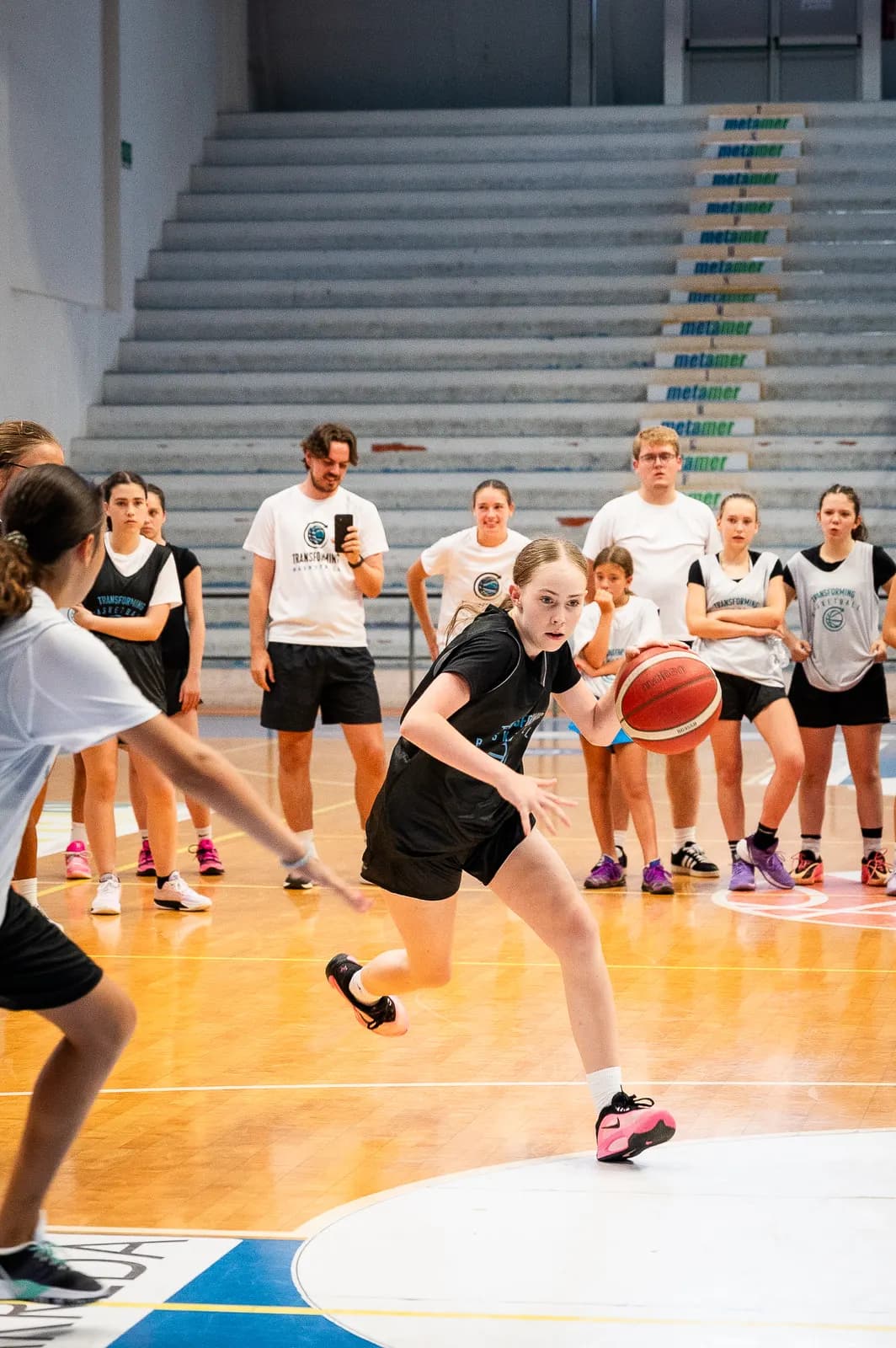
Most coaches have seen a freestyle performer, in basketball or soccer, do things with a ball that look impossible. On episode 37 of the podcast, Alex Sarama pointed out that when those players step into a real game, we're often disappointed.
“dribbling a ball in a fancy manner, one-on-zero in a static environment, is not the same as dribbling the ball in a game situation when we have defenders, teammates, and other constraints.”
That's why you won't find two-ball dribbling, cone weaves or tennis balls in the games below. Alex said on the same episode that he sees no value in static dribbling of any type, whether it's one ball, two balls or a tennis ball, because it's a completely different task from the game. Every activity on this page has someone trying to take the ball.
Chapter 1 of Transforming Basketball quotes Jamal Crawford, who says he never did ball-handling drills at all. His explanation:
“It was always off instinct, because that cone is not going to be a 6’5”, 6’6”, 6’7” wing who’s athletic, who can jump and can move.”
What a Cone Can't Teach
Transcending Basketball is precise about the ceiling of 1-on-0 work.
“The absolute most that coaches may teach a player through a 1-on-0 dribbling task is how to couple various movements together and maintain possession of the ball.”
In a game, the book goes on, players dribble to create space to pass, shoot or drive, and what matters is the relationship between the player and the ball, the defenders, teammates and the rim. A cone never moves. A defender does, and the dribble that works is coupled to what that defender is doing. That link between what a player sees and what they do is perception-action coupling, and a cone gives it nothing to work with.
Transforming Basketball makes the same point about fatigue. A player who struggles to decide well when dribbling under pressure, especially when tired, won't fix it with two-ball or static routines. The tiredness those routines produce comes from standing still and repeating near-identical movements, and it is nothing like the fatigue of a game. The book's answer is to design dribbling games where the picture keeps changing, such as Shield Tag and Gauntlet 1-on-3 below.
Transcending Basketball's chapter on pseudoscience takes on props directly. A tennis ball has none of the information a defender provides. It's arguably more variable than stationary or two-ball dribbling, the book concedes, but both options miss the bigger picture. The alternative is constrained 1-on-1s and the many formats of dribble tag.
Coaches who use props often argue that players need the technique first: "If a player cannot stationary dribble with their eyes up, they cannot dribble moving." The book's reply:
“The reality is that coaches should more creatively develop situations where players can show what they can do, even if this leads to struggle.”

Free
21 SSGs for Your Next Practice
21 small-sided games you can run and adapt at your next practice, each one keeping the defenders, decisions and scoring of the real game.
Four Jobs a Dribble Does
The book lists why players dribble: to advance the ball, to create time and space, to create an angle for a pass, or to keep an offensive advantage. Each is a different problem. Pick the game for the job your players struggle with, their rate limiter, as the book would put it: the thing currently stopping a skill from showing up.
| The job | What's hard about it | Games to try |
|---|---|---|
| Protect the ball | A defender is trying to steal it and there's little space. | Dribble tag, Shield Tag, the cage |
| Advance the ball | A second defender arrives after you beat the first. | Gauntlet 1-on-3, the zig-zag make-over |
| Create space | The defender is in front and you need a gap to drive, shoot or pass. | Live 1-on-1 in a third of the half court |
| Keep an advantage | You've beaten your player and now have to make the next decision. | 2-on-2 with shoot, drive or pass |
Protect It: Start with Tag
Dribble tag is the simplest live handling game there is, and it works with any age. On EP45, answering the coach who asks how a beginner can ever dribble in a game without static drills, Alex's answer was tag.
“Even beginners will have fun and start to develop their dribbling solutions in a dribble tag game.”
Knee-Tap Dribble Tag
PairsProtect your own dribble while tracking an opponent.
How it works
- Both players have a ball. Use a particular space, or no spatial constraint at all.
- A player scores a point every time they touch their opponent's knee.
- First to three points wins.
- Winners hold the ball above their head and find another winner; losers hold it below and find another loser, so everyone keeps playing different opponents.
Alex shared that version on EP26, his episode on the CLA with beginners. Once you start thinking about different ways to play dribble tag, he said on EP45, you can quickly have ten activity ideas. George Vaz's 10 ideas for improving ball handling collects games from coaches in the Transforming community, including George Cremos's dribble-tag warm-ups and Verdell Billingsley's knee-tap game with third- and fourth-grade girls.
With the very youngest players, you don't even need an opponent at first, as long as the space is crowded. In her case study in Transforming Basketball, Samara Funnell, an assistant coach with Skyliners Frankfurt, describes her miniball games: everyone dribbles inside the three-point line and tries to keep the ball alive without bumping into anyone. Then she adds rules. Change hands after three dribbles, high-five a teammate as you dribble past, or try to steal someone's ball. She doesn't teach crossovers or tell players to keep their eyes up. Those show up on their own because the game asks for them.
Shield Tag
Groups of 3Protect the ball using a teammate's position.
How it works
- Play inside a marked area. One player protects their ball, one defender tries to steal it, and a third player acts as the shield.
- The ball-handler and defender both dribble; the shield has no ball and positions themselves to help protect the ball-handler.
- Change roles after a steal, or after 30 seconds without one.
- The center circle, the paint or the area inside the three-point line offer different amounts of space.
Adapt it
- Make it easier: give the ball-handler more space to move.
- Make it harder: reduce the playing area or remove the defender's basketball so they can defend more freely.
Watch for
- Does the ball-handler notice how the defender moves around the shield?
- Does the shield reposition as that relationship changes?
For older players, raise the pressure. Francesco Rossi's cage, from EP39, puts a point guard with the ball in a small area marked with cones or lines, against a "pit bull" defender whose only aim is to touch or steal the ball. There's no basket to defend. Francesco sometimes adds that the handler has a basket to face, so they can't turn their back to the defender, only a shoulder. He uses it with senior and under-19 guards. Alex's Stay Alive 1-on-1 is the same idea with a reward: survive five seconds of pressure in a small area, then play. Both are covered in our press-break guide.
Advance It: Past the Next Defender
Getting past one defender is a different problem from getting past three in a row, because the solution that beat the first may not be there against the second. Transforming Basketball calls these nested affordances: beat the first defender with a hesitation and a gap may open, or a new defender may suddenly be in your path. Start with one defender and a target, then add more.
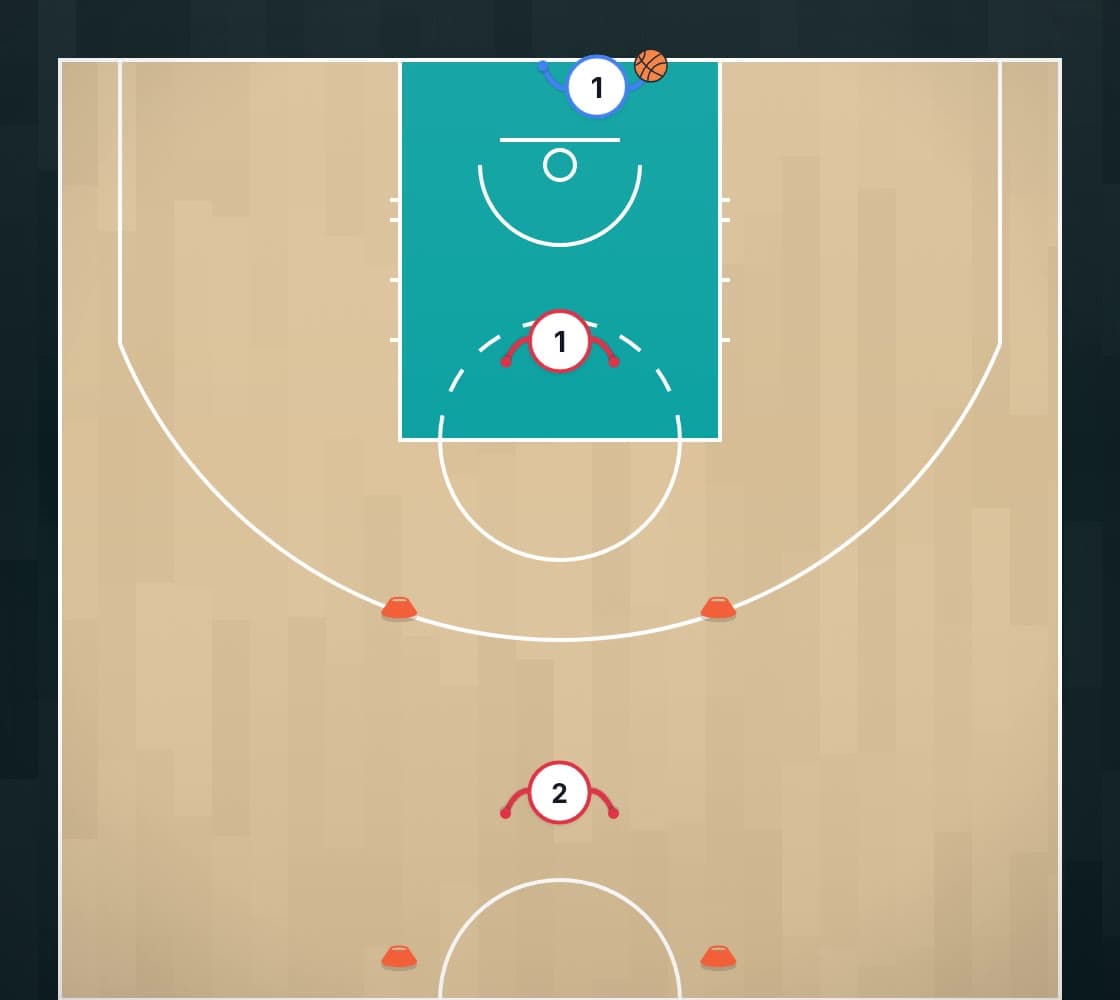
Touchdown Tag 1-on-1
PairsAdvance the ball against a defender who is trying to tag you. It also works as a warm-up.
How it works
- The offense starts anywhere on the baseline with a ball. The defender starts on the free-throw line, at least three steps from the baseline.
- The offense can go at any time and has seven seconds to reach the half-court line.
- The defender scores with a two-handed tag. A one-handed tag doesn't count.
Adapt it
- The defender dribbles too and tags with one hand.
- Shrink the space to make it harder for the offense, or widen it to make it harder for the defense.
- Run two or three games at once so players have to read the space around them.
- The defender pulls a bib from the offensive player's shorts, or tries to steal the ball instead of tagging.
- Play the full length of the court and finish with a live 1-on-1 at the basket.
Gauntlet 1-on-3
4 playersAdvance past successive defenders in a tight space.
How it works
- Mark a narrow corridor from baseline to baseline, approximately three meters wide. Divide it into thirds, with one defender in each third.
- Defenders stay in their own section.
- The offense has ten seconds to reach the other baseline without losing the ball, stepping out or committing a violation.
- Award one point for completing the gauntlet and one to a defender who forces a turnover.
Adapt it
- Have defenders dribble a ball or defend with one hand if the task is too difficult.
- Remove a defender to create a 1-on-2 version with more space.
- For a different challenge, finish with a live 1-on-1 at the basket.
- Change the corridor's width or shape when you want players to encounter different spaces.
Watch for
- What changes between defenders? A solution that gets past the first player may no longer be there against the next.
Transcending Basketball asks three questions of the zig-zag drill. When would a defender let the ball-handler dribble in front of them without trying to steal or pressure the ball? When would a defender wait for the offense to reach the sideline or lane line before changing direction? How often do you see a step-slide in a game?
The book's make-over adds a live defender. It constrains the offense to half of the full court, with a 10-second shot clock to advance the ball and get a rim finish. For beginners, the defender holds a bib or defends with their hands behind their back. If there's a violation or turnover, the defense goes straight into offense instead of stopping the rep.
On EP37 Alex added a way to manage the load, since full-court 1-on-1 is intense. Put extra defenders in segments of the court as "octopuses" who can only move within a narrow rectangle, playing in groups of three and rotating in. Or use pylons and floor mats to make irregular shapes, and award points for reaching the end of the area within a time limit without losing the ball.
Create Space: Let the Move Emerge
Coaches often ask how to teach a specific move without drilling it. Jonas De Bruyne, a coach in Germany, answered exactly that in his guest article on developing shifty dribble moves. Jonas had reposted a particularly shifty move on Instagram, and another coach asked how he'd teach it with the CLA. His answer was to design a game where the chance for a similar move might appear, knowing the exact move may never emerge and may not be functional for every player.
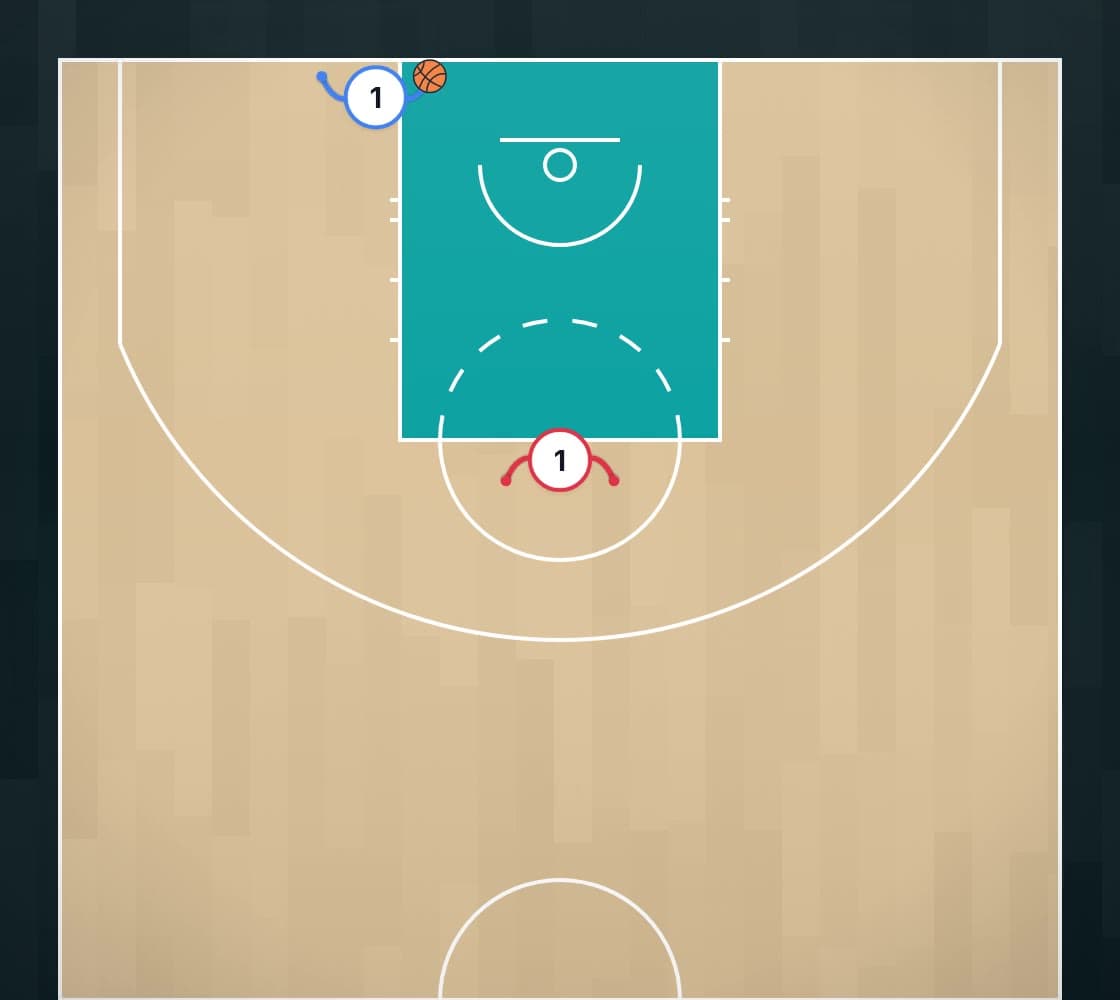
- Play live 1-on-1 off the dribble in a third of the half court, with the half court divided into three areas: sideline to slot, slot to slot and slot to sideline.
- The offense starts behind the half-court line and the defender inside the three-point area. It's live as soon as the offense enters the space.
- If the offense scores, they stay on, starting the next rep in a different third.
- If they struggle, give the defender a ball to hold with both hands. If it's too easy, make it 1-on-2 with the second defender starting two meters behind.
This takes longer than teaching a move on air and then adding a dummy defender, Jonas admits. In the short term the scripted version would show the move more often. His point, borrowing from Rob Gray, is that those short-term gains don't last, so players should keep experimenting with perception and action coupled.
Transforming Basketball has a 1-on-1 built around deception. When you demo it, the book says, don't show one ideal technique. Make it clear the offense can drive however they like, whenever they like.
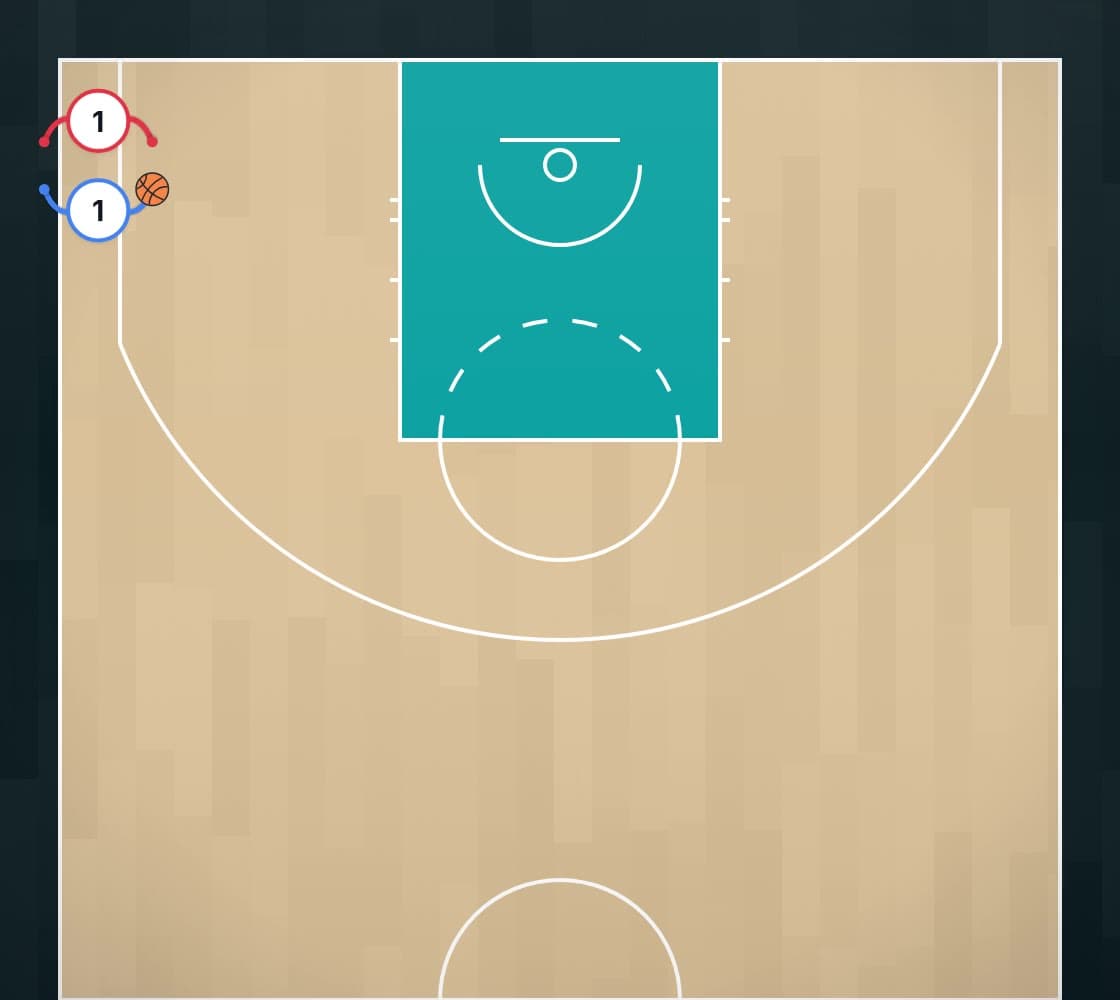
Around the Arc 1-on-1
PairsThe offense deceives a trailing defender and keeps the advantage; the defender recovers to neutral.
How it works
- The offense starts in the deep corner with both feet outside the arc, facing half court, with the defender behind them.
- The offense dribbles around the arc and can drive at any moment. The defender can only step inside the arc once the offense does.
- The offense gets a bonus point every time the defender enters the arc first.
- Finish within a five-second clock, then switch roles. Baskets are worth 2. First to 8 wins.
Adapt it
- Beginners: the defender starts with both feet outside the arc, or dribbles a ball. Advanced players: the defender starts with one or both feet inside.
- Score by dribbles: 3 points for a one-dribble rim finish, 2 for two dribbles.
- Specify where the offense must break the arc, such as corner to 45 or 45 to 45.
- Use the same start for 2-on-2 or 3-on-3 from different spacings.
When the Game Is Too Hard
If the ball is stolen almost every time, the game is past the optimal challenge point, too hard for players to learn much. Keep the defender and make the task easier, what the book calls task simplification. Alex's beginners presentation lists the options for constraining the defense:
- The defender can't jump.
- The defender plays with one hand.
- The defender dribbles or holds a basketball.
- The defender has limited steps or a limited space.
The slide before it lists ways to help the offense instead: a numerical advantage, a larger space, two baskets, a bigger head start, or scaled equipment. On EP26 Alex said he especially likes having the defender dribble at the same time, since both players are working on their handle. Remove the restriction once it's too easy and the offense is scoring without having to read the defender.
Keep an Advantage: Add the Pass and the Shot
Handling games isolate the dribble, so after a handling activity, play 2-on-2 with the options to shoot, drive or pass, and watch whether the ball-handler recognizes when a teammate is open and when there's space to advance.
A player may protect the ball well but miss the chance to pass out of pressure. When that happens, put the receiver and their defender into the next game so the player works on the decision as well as the ball. Transcending Basketball suggests a 1-on-1 + 1 at a basket, where the offense has a passing option if they pick up their dribble, as a far more game-like replacement for the line drill.
For full-court pressure, see the press-break guide. For scoring around defenders, see the finishing guide, and for designing the choices players face, the decision-making guide.
Small-sided games library
Games from This Guide in the Library
Questions Coaches Ask
What are the best ball-handling drills for basketball?
Any game with a live defender in it. Dribble tag, Shield Tag, a 1-on-3 gauntlet and a constrained 1-on-1 all put players under pressure they have to respond to. Cones and stationary dribbling can't do that.
Is stationary dribbling a waste of time?
We don't use it. Dribbling on the spot or two-ball dribbling has none of the information a defender provides, so at most it teaches players to coordinate movements and keep possession. Players dribble in games to protect the ball, advance it or create space, and that needs an opponent.
How do you teach ball handling to beginners?
Start with dribble tag. If it's too hard, make the game easier and keep the defender. Give more space, use a lighter ball, or limit the defender: one hand, a bib to hold, hands behind their back, or a ball of their own to dribble.
How do you improve ball handling under pressure?
Play small games where a defender is trying to steal the ball, like Shield Tag, a 1-on-3 gauntlet or a cage game where the handler survives in a small area. Adjust the space or the defender so the handler succeeds some of the time but not every rep. That's the challenge point you want.
How do you teach dribble moves without drilling them?
Design a 1-on-1 where the chance for that kind of move is likely to appear, such as live 1-on-1 in a third of the half court, and let players find their own solution. The exact move may never appear, and it may not suit every player.
What can I use instead of the zig-zag drill?
Add a live defender. Play in half of the full court with a 10-second clock to advance the ball and finish at the rim. For beginners, the defender holds a bib or defends with their hands behind their back.
Take It to Your Next Practice
Free
21 SSGs for Your Next Practice
21 small-sided games you can run and adapt at your next practice, each one keeping the defenders, decisions and scoring of the real game.
The Small-Sided Games Book
$49 USD
Build on your free games. Build your practice around 50+ small-sided games, with diagrams and constraints you can adapt to your players.
Introduction to the Constraints-Led Approach
$49 USD
Explore the framework behind representative practice with Alex Sarama's Introduction to the Constraints-Led Approach clinic.
Sources
- Transcending Basketball, Alex Sarama (Wiley, forthcoming): chapter 3 (zig-zag make-over, line drill), chapter 8 (training props), chapter 9 (1-on-0 dribbling)
- Transforming Basketball, Alex Sarama (2024): Shield Tag and Gauntlet 1-on-3
- Transforming Basketball, Alex Sarama (2024): chapter 1 (Jamal Crawford), chapter 3 (nested affordances, static dribbling fatigue), chapter 5 (Samara Funnell case study), chapter 8 (Touchdown Tag, Around the Arc)
- EP37: How to Improve ANY Basketball Drill
- EP45: Why Basketball Fundamentals are Outdated
- EP26: How to Use the CLA with Beginners
- EP39: How Does a Small Italian Town Produce So Many Professional Players? With Francesco Rossi
- Using the CLA with Beginners, Alex Sarama, presentation (task simplification and constraining the defense)
- 10 Ideas for Improving Ball Handling, George Vaz
- How to Develop 'Shifty' Dribble Moves through the CLA, Jonas De Bruyne
- Pinder, Davids, Renshaw and Araújo, "Representative Learning Design and Functionality of Research and Practice in Sport", Journal of Sport and Exercise Psychology (2011)
- Rietveld and Kiverstein, "A Rich Landscape of Affordances", Ecological Psychology (2014)
- Arias, Argudo and Alonso, "Effect of Ball Mass on Dribble, Pass, and Pass Reception in 9–11-Year-Old Boys' Basketball", Research Quarterly for Exercise and Sport (2012)
Behind the methodology
About Alex Sarama
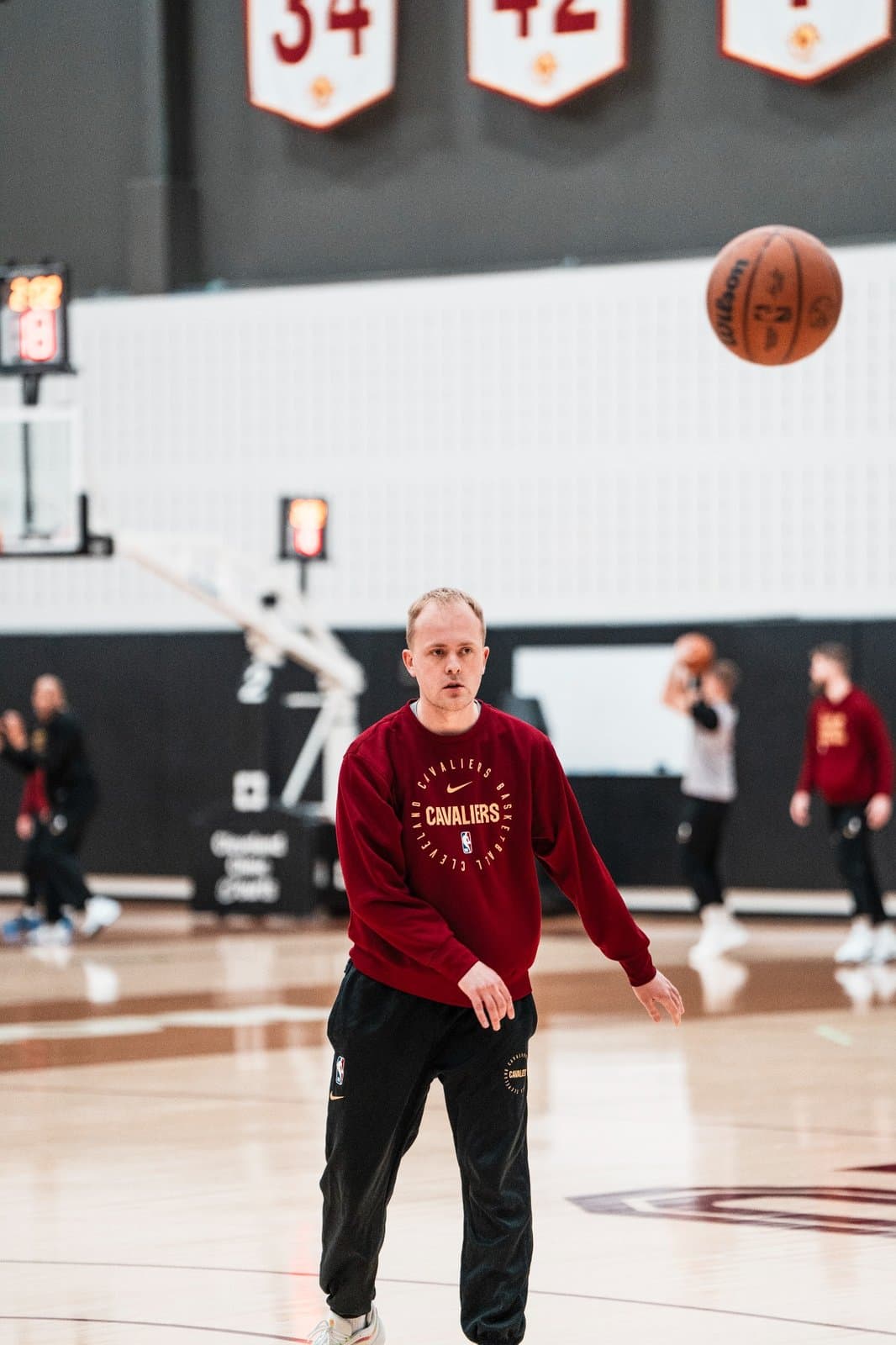

Alex Sarama
Founder, Transforming Basketball · Head Coach, Portland Fire
Alex Sarama is the founder of Transforming Basketball and Head Coach of the WNBA's Portland Fire. Previously, he served as Assistant Coach and Director of Player Development with the Cleveland Cavaliers.
His wider experience includes NBA Europe in Madrid, Paris Basketball in the EuroCup and the Rip City Remix, the Portland Trail Blazers' G League affiliate. Alex has delivered clinics in over 40 countries and has written three books on the constraints-led approach in basketball, including the Amazon bestselling Transforming Basketball (2024) and A Constraints-Led Approach to Coaching Basketball (2026).