
Coaching guide · Finishing
Basketball Finishing
Finishing at the rim is all about problem-solving. Where is the defender? What is their positioning? And how fast are they coming over to help? A player who only finishes through 1-on-0 practice, such as layup lines and the Mikan drill, never has to solve these problems.
12 min read
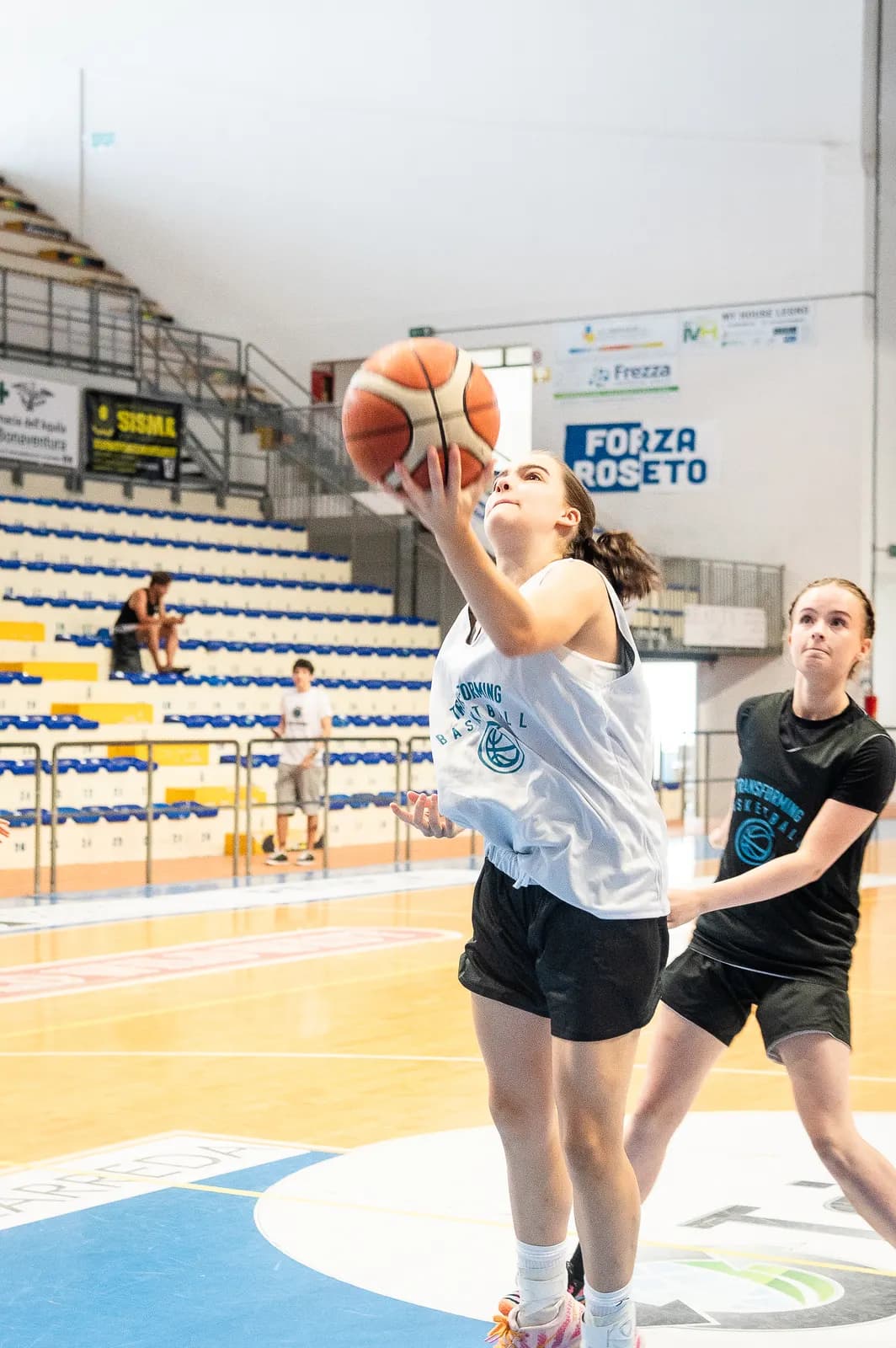
If your players are performing in 1-on-0 drills but then struggle in games, the drill design is the problem. In 1-on-0 drills, players encounter none of the information they find in the real game. Start with a small change: add one defender to all your finishing activities.
Here is one example of a small-sided game we use at Transforming Basketball to develop finishing solutions: repetitions at the rim against a defender, playing continuously off the rebound after a make or miss, with a different decision every time.
Smile 1-on-1
Pairs, one basket (run several at once at side baskets)Repetitions at the rim against a defender, with a rebound and a new decision every time.
How it works
- Two players play 1-on-1 inside the smile, the restricted area under the basket. No dribbles.
- The same offense stays on continuously for 30 seconds or six finishes in a row. One point per score.
- After a make or a miss, the offense rebounds and goes up again from wherever the ball dropped.
Adapt it
- For a player who avoids their left: left hand only for one round.
- Too hard for the offense: the defender can't block, holds a ball, or can't jump.
- One dribble allowed, so players can create space.
- Younger players: use a smaller ball and a lower rim (see the table further down).
Watch for
- Is the offense finding functional solutions to finish successfully?
Why Layup Lines and the Mikan Drill Don't Transfer
For many players, finishing opportunities come after situations such as drives, offensive rebounds, cuts or a roll to the rim. If a player has only practiced finishing in the Mikan drill, we've removed everything that made those finishes complex: the defense, the varied locations, the time and score, and where teammates are. This is called task decomposition: breaking the game into pieces and taking out the information players need to act.
When an offensive player is up in the air to finish, there is no time to think about technique or what they are going to do. They react to the defense. This is the process of self-organization; movement solutions emerge naturally rather than being chosen in advance. Something complex like an up and under emerges from the problem the defender poses. In games, players are never consciously thinking of what move they are about to use, because the game simply moves too quickly. Despite this, this is the approach taken by many coaches and trainers today in an attempt to supposedly teach "moves."
Furthermore, coaches would actually be frustrated if a player robotically executed a finishing sequence planned in advance that exposed the ball and was easily contested. However, this is exactly what the dominant approach encourages. The dominant approach is the traditional way of coaching, where technique comes first and games come later.
Smile 1-on-1 is essentially the Mikan drill with a defender, made better by using a constraints-led approach: change one constraint at a time and it can become 20 different activities. Our guide to the constraints-led approach has more on this. The table below shows what happens when you start to introduce constraints.
| Constraint | What may emerge |
|---|---|
| Bursts: the offense stays on for a set burst | Equal reps. Add a point for a stop and players keep playing until the rebound. |
| Scoring: 1 point for making the defense jump, 2 for a score, and a block resets the offense to zero | More pump fakes, more jumping on defense, more deception at both ends. |
| One dribble allowed | Players create space by initiating contact, and the defense has to be stronger. |
| Different balls: inflated, deflated, normal | A softer touch with the inflated ball, more force with the deflated one. |
| A two second shot clock | Faster play, more reps, quicker (and sometimes rushed) decisions. |
The idea of using constraints is that there is an intention behind each one; it isn't done just for variety's sake. An important question to ask yourself as a coach: what constraints may guide players towards different intentions?

Free
Shooting & Finishing Games
Bring shooting and finishing into live practice with free games you can adapt to your players.
Stop Teaching "Correct" Layup Footwork
Most of us as coaches were taught the "correct" way to perform a layup: outside foot first, followed by the inside foot, then an overhand finish off the backboard at the perfect 45 degree angle. However, how many finishes in a game actually happen with this technique? Finishing is always different, because the constraints are always changing.
Contrary to the idea that there is one perfect layup technique, the layup often known as the "goofy" layup, with the opposite arm and opposite leg, is actually a more natural tendency for a beginner because it continues the running stride. Furthermore, a traditional 1-2 step layup may actually take longer and give the defender more time to alter or block the finish.
The real cost comes later. Many coaches teach advanced finishing moves 1-on-0, but how many of these could have emerged from the start if players were trained within a constraints-led approach?
If you watch some of the most creative finishers of all time, such as Kyrie Irving, Steph Curry, Maya Moore and Sabrina Ionescu, they are so successful because they are adaptive. The traditional approach to coaching views these as stored moves or muscle memory, but at Transforming Basketball we reject this term. Furthermore, with what we know about ecological dynamics, there's no such thing as storing movements in the brain and bringing them out on demand.
None of this means anything goes. The positioning of the defender has an enormous impact on the finish that emerges. Give a player a reason to finish off one foot, off two, with the inside hand or extended away from a shot blocker, and those solutions show up without anyone naming them.
Coach Finishes with Cues That Leave Gaps
This doesn't mean we're against specific terms for finishing solutions. Phrases such as "euro step", "Nash dribble" or "stride stop" work because they are specific enough to educate intention without overconstraining athletes into the minute details of how they should supposedly move. For instance, a euro step simply means evading a help defender. It doesn't say where the offensive player should move their feet or what type of euro step to use. We can then constrain this in a 1-on-1 game with a help defender coming from different locations, and the offense encouraged to evade the help defender in different ways. This naturally leads to varied euro steps emerging every time, instead of the same euro step repeated over and over again.
Constrain the Defense, Don't Remove It
A defender with no constraints can be too challenging for a beginner. The answer is task simplification: make it easier for the offense while keeping representative information. Many coaches pull defenders out, practice 1-on-0, then go back to a small-sided game. We want to avoid this because it removes perception-action coupling, the link between what a player sees and what they do. When players inevitably struggle in a small-sided game, that's good: the coach can creatively apply a different constraint instead of reverting to on air practice.
Here are different ways you can constrain the defense if you're working on finishing in different small-sided games:
- One jump only
- Two steps only
- One hand only
- Live, but holding a bib or ball
- Can distract but not block or steal
- Can only force a miss with body position, which still changes the finish because where the defender stands matters
- A guided defender who holds their arms straight up, or a basketball or medicine ball above their head, instead of jumping or blocking (see George Vaz's article on guided defense for finishing)
- A help defender who starts from a different location each time
This 1-on-1 game puts the finisher under contact, which is where a constrained defender helps most.
Here's another example of how to use the CLA for finishing, from Transforming clinician Kerri Kuzbyt.
Around the Arc 1-on-1 is another solution, with a different start: the offense dribbles around the three point line before the drive.
Around the Arc 1-on-1
Pairs, one basketDribbling and finishing solutions for beating a defender, while the defender works on recovering from a bad start.
How it works
- Offense and defense start in the deep corner. The offense has both feet outside the three point line and faces half court, with the defender behind.
- The offense dribbles around the arc and can drive at any moment. The defender can only enter the arc when the offense steps inside it.
- Finish the 1-on-1 within a 5 second shot clock, then change roles.
- Each basket is 2 points, and the offense gets a bonus point each time the defender enters the arc first. Play to 8.
Adapt it
- Beginners: the defender keeps both feet outside the three point line, or even dribbles a ball and tries to score a layup before the offense.
- Points for dribbles: 3 for a rim finish off one dribble, 2 for a finish off two dribbles.
- Give the offense a 3 to 7 second shot clock after breaking the arc.
- Add players for a 2-on-2 or 3-on-3 from the same start.
Watch for
- Is the offense free to drive however they like, rather than copying one demonstrated technique?
Finishing Games for a Full Gym
The main challenge with 1-on-1 finishing games is that you may only have two baskets. How can you keep time on task high with two baskets and 20 or more players? The answer is games with very quick rotations, such as Jungle Finishing, where you can work on finishing with 10 players at a basket.
Jungle Finishing
3 defenders, the rest on offense, one basketLots of drives and finishes against help that's always somewhere different.
How it works
- Three defenders stay on defense for a burst of a minute or 45 seconds. Everyone else is on offense.
- Offensive players drive whenever they choose, always from a different spot outside the three point line, and can only score gold medals (finishes at the rim).
- Each defender is limited to a zone: one can only defend outside the paint, the others only in the paint, and only one of them can be in the smile.
- First offensive player to four layups wins, and players must call out their score each time or it doesn't count.
- Defenders score a point per stop and keep their own tally.
Adapt it
- No backboard, or the opposite: must use the backboard, or only the sides of the backboard.
- The ball has to hit the board above the square.
- Swap a defender in whenever they get a stop, steal or rebound, instead of using timed bursts (this rewards the defense).
Watch for
- Are players driving from corners and angles they never use in a layup line?
1-on-3 Statues
Group game, one basketContested finishing against defenders who can barely move.
How it works
- Three defenders are statues, each holding a ball.
- Offensive players drive to score.
- To start, the statues can't move. Later they can take one or two steps.
- Offensive players find space to finish inside the paint. A gold medal finish is worth 3 extra points.
Adapt it
- Two offensive players go at the same time.
Our large group guide covers more ways to keep a full group of players occupied if you only have two baskets.
If you do want to keep running layup lines, which can be useful for pregame warm ups, here's one easy way to make them more CLA like: make the rebounder play as a guided defender. Instead of waiting outside the three point line and following in for the rebound, the rebounder goes earlier and walls up outside the smile, so the driving player has to find a functional solution.
Adapt Constraints to the Offensive Player
The real value of a constraints-led approach comes when you design constraints around a particular player, in response to what they need. These needs are known as rate limiters: something very specific that's preventing a player from being more skillful as a finisher. One example could be a player who really struggles with contested finishes when a help defender enters their space. Here are some examples of how we may use constraints in response to common rate limiters players encounter when finishing:
| If the player… | Try this |
|---|---|
| Doesn't finish well through contact | Smile 1-on-1 with the defender limited at first: one hand, holding a ball, or one jump |
| Keeps the ball inside the frame of their shoulders | A guided defender with arms fixed up, or holding a medicine ball |
| Only ever drives from above the three point line | Every drive has to start from a different spot, including the corners |
| Finishes well against the primary defender but not against help | Add a defender on the help side |
| Struggles to finish with their left hand | More left hand finishes, or a left hand only round of Smile 1-on-1 |
| Gets blocked because they never use fakes | Two bonus points if the defender leaves their feet before the layup |
Start the player with a drive or a cut instead of finishing from a static spot under the rim. Have them approach the basket from different angles and get the ball from different teammates. And finishing doesn't have to be the only outcome. Add a shot or a pass to the game and transfer is more likely, especially when the chance to finish becomes less predictable.
The video below has more ideas of constraint manipulations you can add to your finishing games.
Equipment Scaling with Youth Players
Many younger players can't finish a layup with a full size adult ball on a 10 foot rim. This is where equipment scaling comes in.
| Age group | Ball | Rim height |
|---|---|---|
| U8 | Size 5 | 8 feet |
| U10 | Size 5 | 8 feet 6 inches |
| U12 | Size 5 | 10 feet |
Research on ball size shows why this matters for coaches. José Arias compared a 440 g ball, a regulation 485 g ball and a 540 g ball in youth games.
Younger players won't self-organize into functional finishing solutions with a ball that is too big for them, because they can't act on what the defender offers. A lighter ball and a lower rim give them a chance to find those solutions. George Vaz's article on teaching layups with live games and our youth basketball coaching guide have more for beginners.
Questions Coaches Ask
What can I use instead of the Mikan drill?
Smile 1-on-1: the same offense stays on for 30 seconds or six finishes in a row against a defender, and after every make or miss rebounds and goes up again from wherever the ball dropped. It keeps the repetitions near the rim but adds the defender that changes every finish.
How do you teach layups to beginners?
Scale the equipment first, with a lighter ball and lower rim, then keep a defender in the game but constrain them. A stationary defender, one step only, one hand only or a defender holding a ball keeps the problem real while giving the beginner room to succeed.
How do you improve finishing through contact?
Practice it against live or guided defenders rather than in lines, and keep the possession going after misses. Scale the defender's freedom up as the player adapts.
Should young players learn the outside foot, inside foot layup first?
We don't teach one correct layup first. Finishes with the opposite arm and leg are often more natural for beginners and a traditional 1-2 step layup can take longer. Give players a defender and a goal, and let footwork that suits them emerge.
Take It to Your Next Practice
Free
Shooting & Finishing Games
Bring shooting and finishing into live practice with free games you can adapt to your players.
Contemporary Player Development
$39 USD
Build on your Player Development Toolkit with Alex’s clinic for the German Basketball Federation. See how individual development and team play can happen in the same activity.
Sources
- Transforming Basketball, Alex Sarama (Wiley, 2024)
- A Constraints-Led Approach to Coaching Basketball, Sarama, Lascu, Vaz Rocha and Houghton (Routledge)
- Transforming Basketball podcast, episodes 13, 37 and 122
- Guided Defense: Developing Finishing at the Rim
- How to teach basketball layups with live games
- Arias (2012), Human Movement
Behind the methodology
About Alex Sarama

Alex Sarama
Founder, Transforming Basketball · Head Coach, Portland Fire
Alex Sarama is the founder of Transforming Basketball and Head Coach of the WNBA's Portland Fire. Previously, he served as Assistant Coach and Director of Player Development with the Cleveland Cavaliers.
His wider experience includes NBA Europe in Madrid, Paris Basketball in the EuroCup and the Rip City Remix, the Portland Trail Blazers' G League affiliate. Alex has delivered clinics in over 40 countries and has written three books on the constraints-led approach in basketball, including the Amazon bestselling Transforming Basketball (2024) and A Constraints-Led Approach to Coaching Basketball (2026).