
How to attack a 2–3 zone
Begin with the defenders’ responsibilities. Two players cover the top line and three cover the lower areas, but their exact movement changes with the team and the ball. A useful attacking position is one that makes a defender choose between the ball and another reachable threat.
Against that structure, a drive into a gap can draw help; a receiver between the lines or behind the lower defenders can create another passing route. A reversal can move the defense before it recovers. These are opportunities to recognize, not instructions to force an entry pass or complete a pattern on every possession.
| What the offense sees | What to explore | What the coach should watch |
|---|---|---|
| A gap between defenders | Attack with the intent to score, then pass if help commits. | Does the dribble change what a defender must cover? |
| The defense moving with a reversal | Use the next catch before the defenders recover. | Is a shot, drive or further pass available on arrival? |
| A receiver between the defensive lines | Find an inside pass, then respond to the collapse. | Can the passer reach the receiver, and can the receiver act on the catch? |
| A defender watching the ball | Explore a cut or baseline movement behind them. | Does the movement create a passing window without crowding another attacker? |
Start with the original 3-on-2 gap game
The original collection below begins with 3-on-2 in a constrained area above the first hash mark. The ball-handler tries to draw a help defender before passing to the open player. Keep a live scoring target and let the defenders choose how to protect it. Change starting positions and rotate the defender roles after a short round.
This smaller game concentrates on drawing help and using the next opportunity. It leaves out the rest of the zone. After several rounds, restore 5-on-5 against the actual 2–3 alignment and observe whether the players recognize the same relationship with more defenders present.
Choose a constraint for the zone problem
| Problem | Source activity to use |
|---|---|
| The ball moves around the perimeter without shifting the defense | The “Shift the Zone” game rewards a score after reversing across the split line. Watch whether that reversal opens an opportunity. |
| Players miss the next receiver after a drive | The one-side relocation game connects attacking a gap, passing and moving into a new window. |
| The team cannot create an inside-outside interaction | The high-post version gives a reason to explore a receiver in the middle of the zone. |
| The lower defenders stay comfortable facing the ball | The flash-cut and baseline-runner games explore movement behind them. |
The conditions below are practice constraints. A requirement such as inside-outside passing can focus an activity, but remove it if players reject an available score simply to satisfy the rule. Keep the shot selection appropriate to the players’ range.
Zone offense for teams with limited shooting range
Do not assume that standing farther from the basket will stretch the defense. The receiver must remain a threat the defense needs to address, and the passer must be able to reach them. Use reachable gaps, movement behind help and advantage starts, then adjust the space as the players develop.
Keep the team’s language simple: make one defender cover two threats, find a passing window and act while the advantage is available. Those intentions can remain consistent while the solution changes against different zone rotations.
Four coaches’ practical zone-offense contributions
Passing games for windows and decisions
Spacing explained with original film examples
What Are Small-Sided Games for Zone Offense Basketball?
For the format of this blog, I have split small-sided game ideas into four categories (dribbling, passing, spacing and moving), with sub principles of play within each activity. The small-sided games are designed around the specific zone offense principle of play.
Dribbling
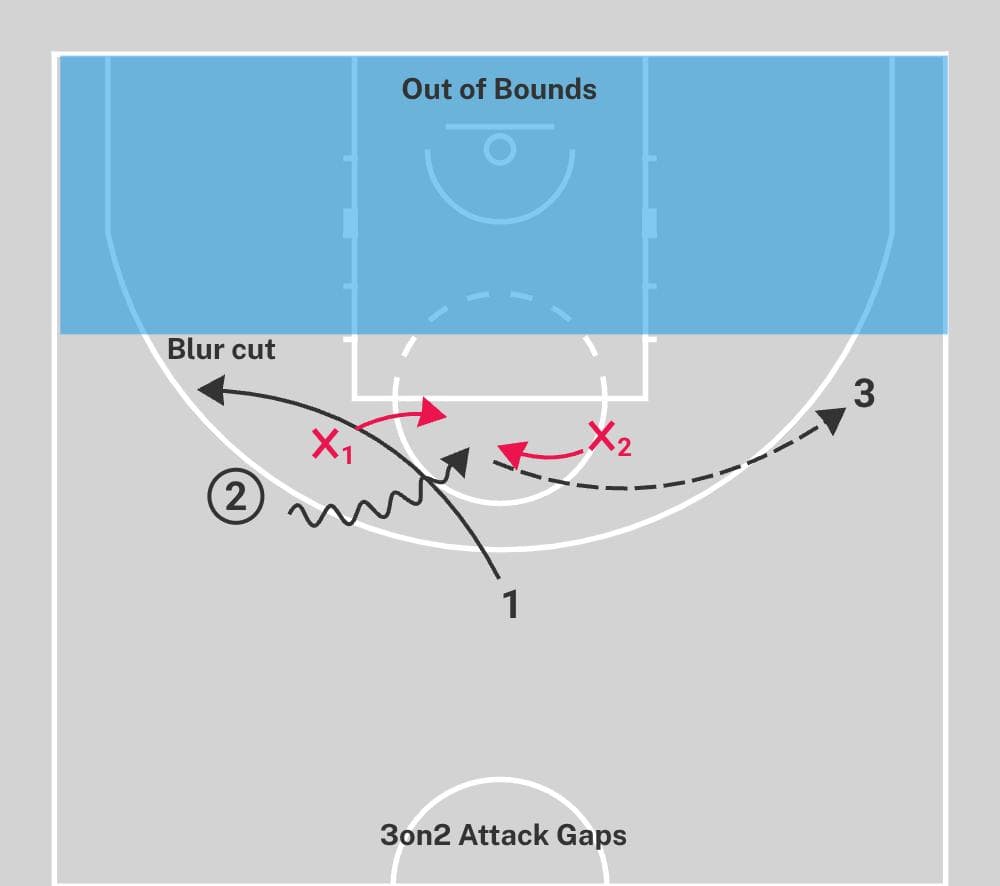
Principle of Play = Attacking and Exploiting Gaps
- SSG and Constraints = 3-on-2 with space constrained to playing only above the 1st hash mark. The player with the ball must force a help defender to commit to stopping the ball before kicking out to an open player with a numbers advantage. Bonus points for every offensive rebound and punishing one of the weaknesses of the zone.
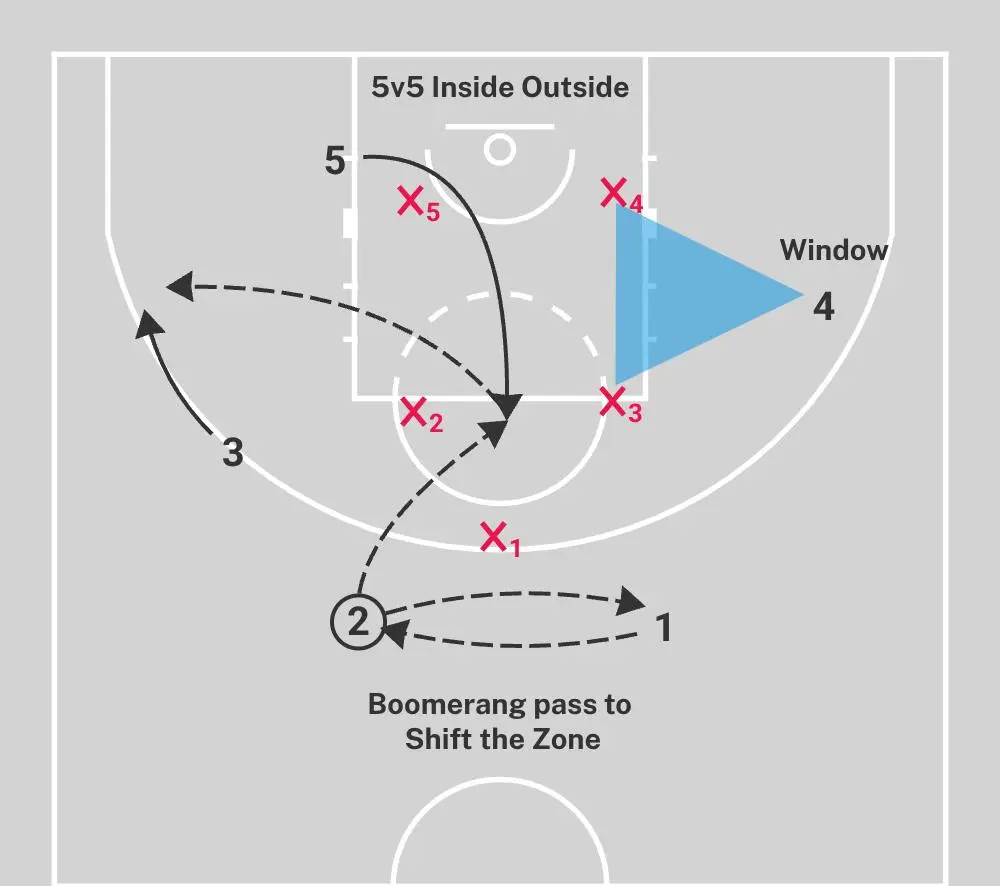
Principle of Play = Shift the Zone
- SSG and Constraints = 5-on-5 half court. Players can explore how to shift or distort the zone out of their preferred alignment. Scores after a reversal across the split line are worth double points. Bonus points for every offensive rebound.
Principle of Play = Engage Two defenders
- SSG and Constraints = 3-on-3 with space constrained to one side of the court. Players will use a dribble to draw two defenders and utilise the 2-on-1 advantage. Player must attack with the intent to get paint touch and if dribble does not engage a defender, then any subsequent score does not count. Bonus points for every offensive rebound.
PASSING
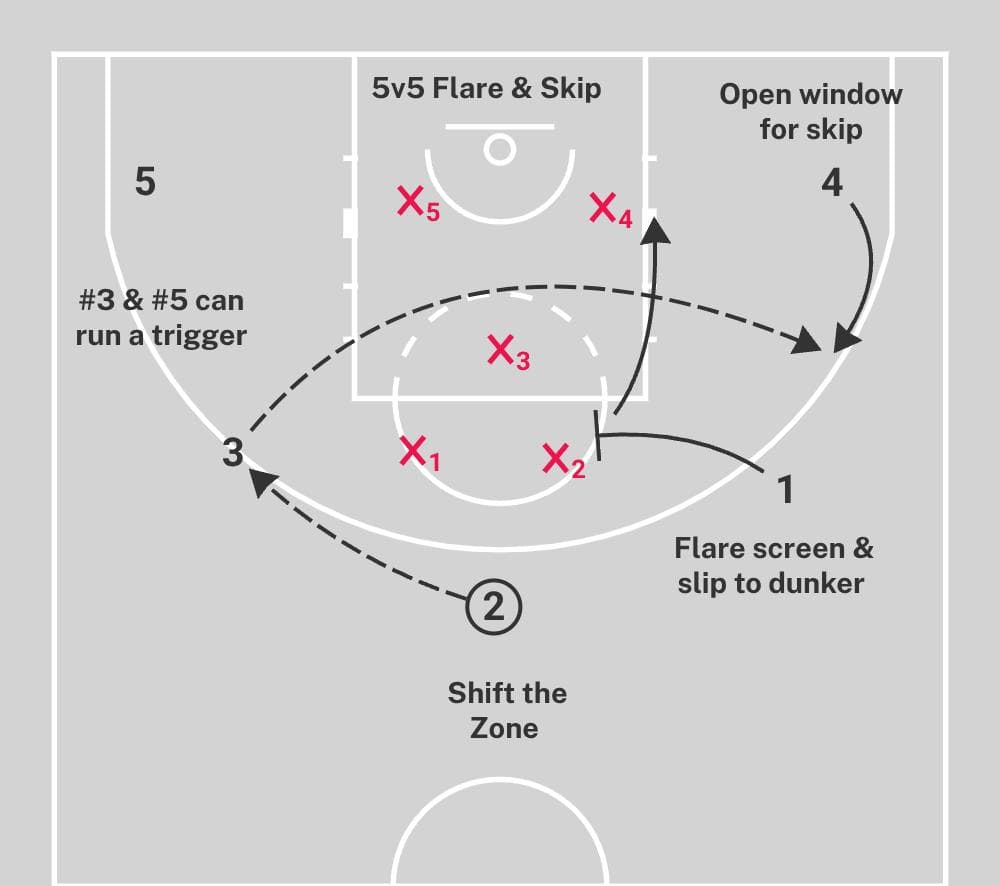
Principle of Play = Pin-Ins and Skip Passes
- SSG and Constraints = 5-on-5 live. Players explore how to give the receiver of a skip pass some time and space for the shot. A score on the skip pass does not count unless a defender is sealed / screened with a pin-in before the shot. Players to debrief where a seal was effective (e.g. dunker for corner shot, or elbow for wing shot). Bonus points for every offensive rebound. Note the slip from the player pinning in can also be an option.
Principle of Play = Misdirection
- SSG and Constraints = 4-on-4 half court. Players must explore how to use misdirection and force the defence to closeout. Players to debrief misdirection solutions (e.g. pass fakes, boomerang passes, ball reversals, quick reversals into a pick and roll, etc).
Principle of Play = Inside-Outside
- SSG and Constraints = 5-on-5 half court. The ball must go inside-outside at least once on each possession for score to count. This can be done with a high post player playing through the middle of the zone.
.
SPACING
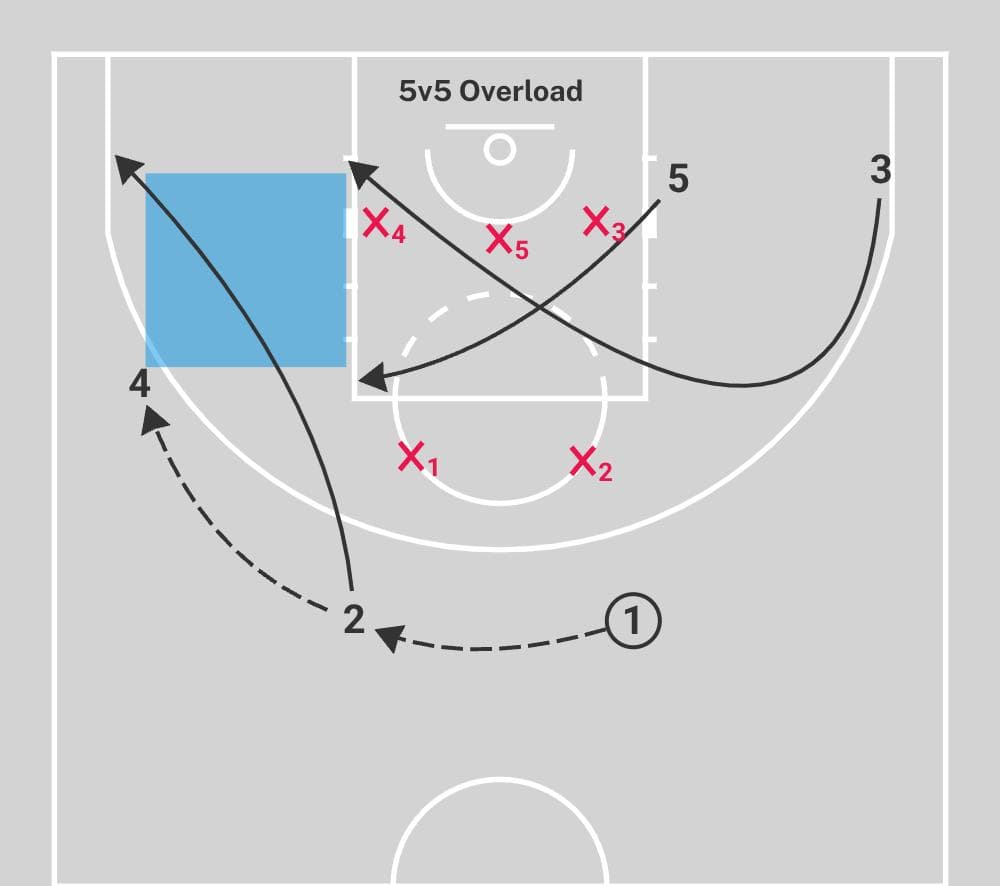
Principle of Play = Overload the Zone
- SSG and Constraints = 5-on-5 full court with 3 trips. Must be a different player in the dunker each trip and players have to explore how many different overloads they can create. Players debrief solutions (e.g. triangle, box, cut through, etc). Only ROB shot counts.
Principle of Play = Relocations
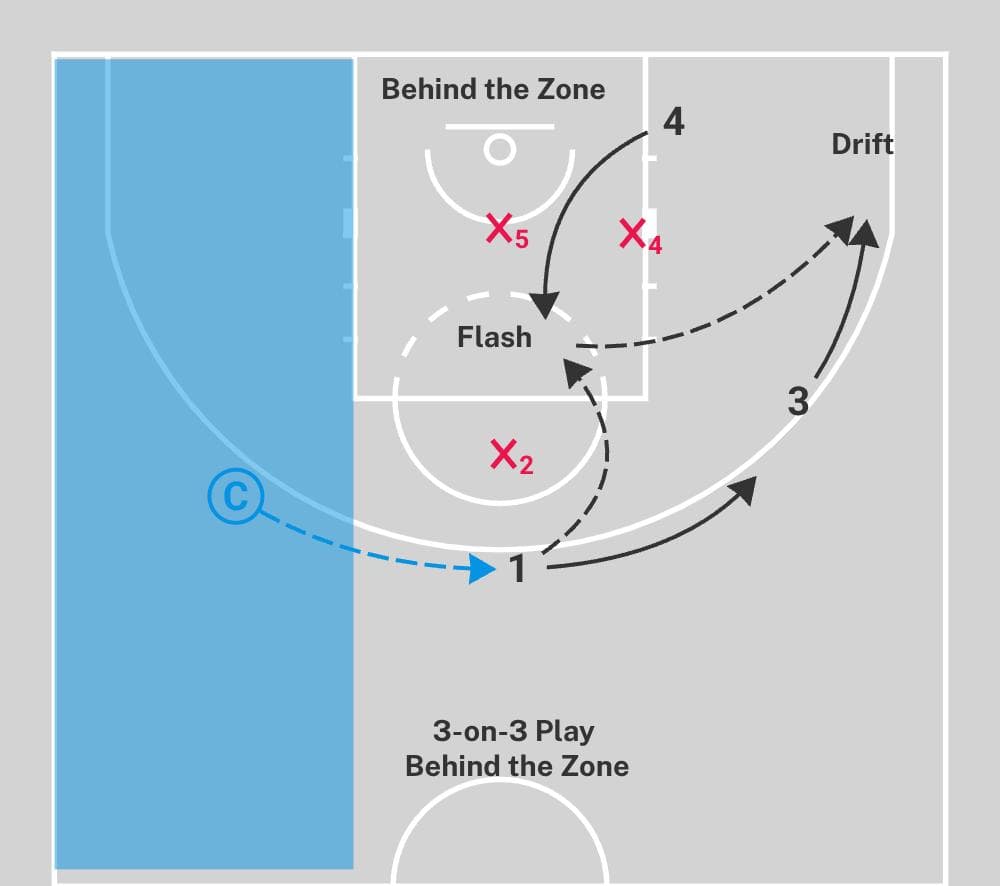
- SSG and Constraints = 3-on-3 with space constrained to one side of the court. Players to explore how to use dribble to attack gaps, kick out and relocate. Players to debrief relocate solutions (e.g. ghost screen, drift, lift, flare).
MOVING
Principle of Play = Flash Cut
- SSG and Constraints = 4-on-4 with space constrained to one half of the court and players have to explore affordances from a flash cut behind the zone from weak side corner towards the middle. Players start point, wing, dunker and weakside corner. Players to debrief the attractive affordances (e.g. high-low or lob pass). Gold medals only or catch and shoot threes.
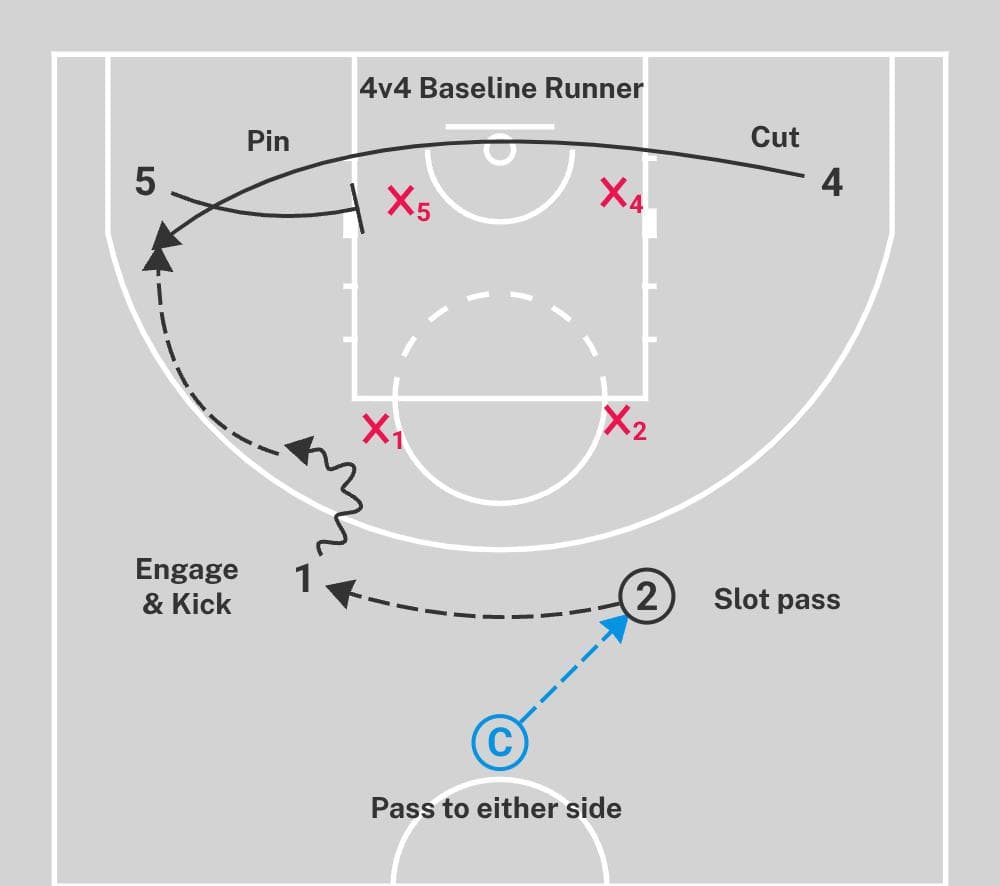
Principle of Play = Baseline Runner
- SSG and Constraints = 4-on-4 with space constrained below the block. Players have to explore how a baseline runner from behind the zone can create attractive affordances and/or numbers advantage. Player to debrief solutions found (e.g. exit screen on baseline for catch & shoot). Gold medals and 3s only.
Principle of Play = Screening the Zone
- SSG and Constraints = 3-on-2 with space constrained above the first hash mark on the key. Players have to explore ways to use a screen to get an open shot. Players to debrief solutions found (e.g. wing to point screen). Plus 2 points for screener scoring.
Continue evoluindo como treinador.
Conecte estas ideias ao Success Pathway, à videoteca de atividades, à comunidade de treinadores e aos encontros mensais ao vivo.
Conheça a assinatura