
A double gap gives a ball-handler more space between adjacent offensive teammates. It can make a drive harder to help on, but the effect depends on where the defenders are and whether the other attackers remain a scoring or passing threat.
Use the double gap as a spacing option within your principles of play. Watch how it affects the defender’s help distance and the next passing window.
Understanding Basketball Spacing: Single vs Double Gaps
To understand a double gap, we must first define our spacing templates. In a standard perimeter setup, a single gap represents the natural distance between two adjacent offensive players—for example, one player positioned in the corner and the next player positioned at the "45" or wing.
A double gap, on the other hand, occurs when that adjacent spot is intentionally left empty. If a player is standing at the slot and their nearest teammate is all the way down in the corner, leaving the 45 completely unoccupied, they have created a double gap. the double gap stretches the help defense, not allowing 1 defender to guard 2 offensive players.
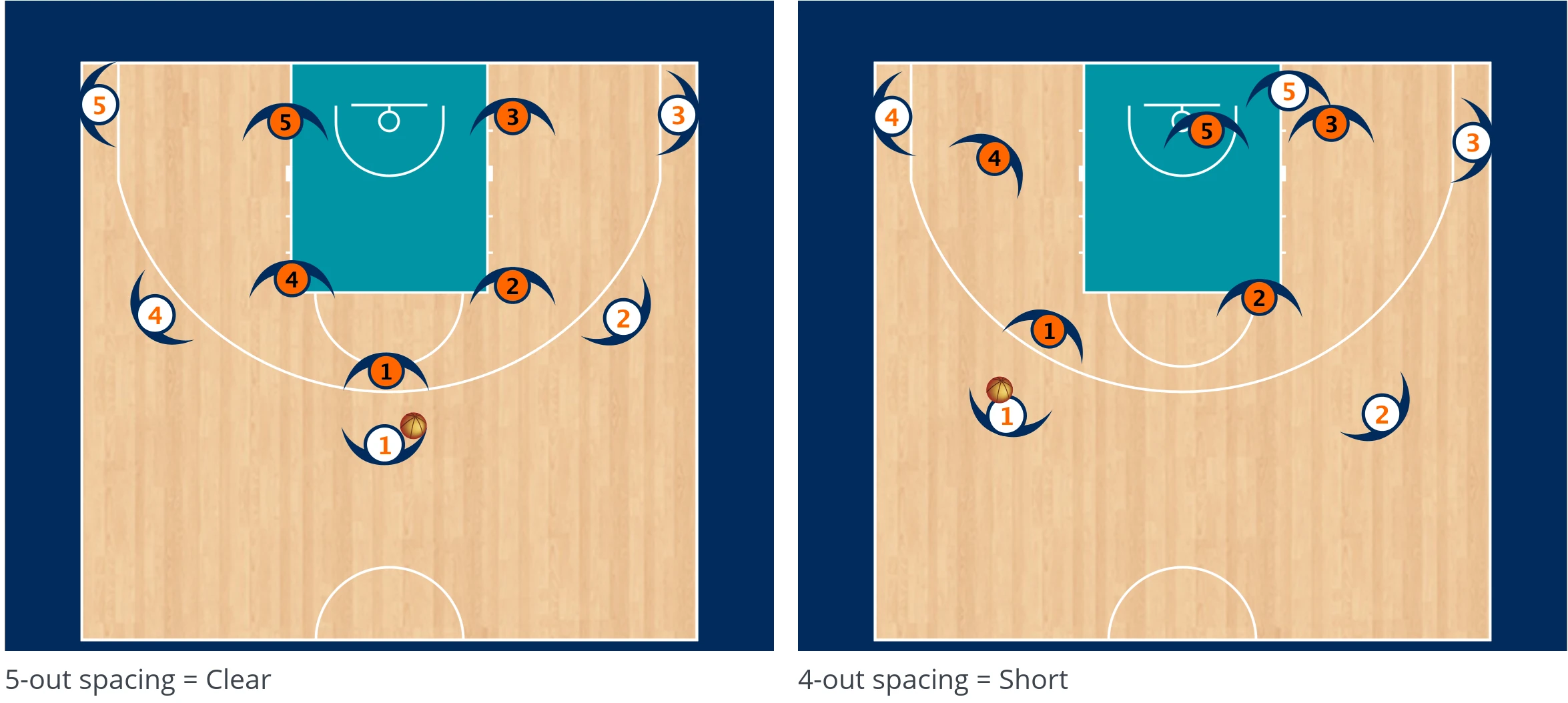
Within Transforming Basketball we use 2 spacing shapes:
"Clear" = 5 out. All 5 players are outside the 3-point line. The picker or screener can be inside the 3 if they are initiating the trigger.
"Short" = 4 out 1 in. 4 players out, and 1 player inside in the dunker spot. This spacing naturally creates double gaps.
Why Double Gaps are Lethal
It comes down to a core offensive principle: One Can't Guard Two.
- Increased Closeout Distance: Help defenders must travel a massive distance to stunt at a drive and recover if the pass is made.
- Increase Gold Medal opportunities: By having someone in the dunker, this allows the ball handler to finish or pass inside for a rim finish. Whereas when everybody is space in "clear", the pass will usually be a kick out.
The Trap of Traditional Pass-and-Cut Motion
Many traditional youth and high school offenses actually destroy double gaps by design. In a standard "pass, cut, and fill" motion offense, players are taught to automatically cut to the basket after making a pass and then replace empty spots on the perimeter.
While this looks organized, pass and cut actually removes space. When an offensive player is driving into a gap, an automatic fill cut immediately drags a gap defender directly into the driving lane. Furthermore, because the paint becomes constantly clogged by robotic cutters, it neutralizes the ball handler's advantage and kills any opportunity to exploit the open floor. Instead of reading the defense and holding their space, players run a memorized pattern that helps the defense stay in position.
2 Proven Methods to Intentionally Create Double Gaps
To build an adaptable, dynamic offense, we must replace rigid motion patterns with conceptual spacing principles. Here are two highly effective ways to organically create double gaps within your offense:
1. Utilizing the Weakside Dunker Spot
You do not need to play a strict "5-out" offense to have great spacing. In fact, placing a player in the weakside dunker spot (short corner/baseline area) is one of the most effective ways to naturally open up the perimeter. By hiding a player behind the defense, you stretch the floor vertically and horizontally, guaranteeing that a ball handler on the perimeter has a massive double gap to attack via a 1-on-1 drive.
2. The Blast Cut
A blast cut is an explosive, dynamic movement where an offensive player cuts from a double gap into a single gap to receive the basketball.
- Forward Momentum: Because the player is sprinting into the open space, they catch the ball on the move.
- Triggering Advantages: We utilize the blast cut as a trigger for youth teams to force the defense into difficult closeout situations in this dynamic 1v1 situation.
Example of a Blast Cut from a double gap into a catch-and-go situation. (see SSG below)
Coaching Double Gaps Using the Constraints-Led Approach (CLA)
Here are 3 highly effective SSGs designed to help your players exploit "short" spacing and double gaps.
1. 1-on-1+1 Blast Cut (or Blind Blast Cut)
This SSG is perfect for teaching players to engage in a "dynamic solo," where they receive the ball with momentum rather than from a static, stationary position.
- Setup: The offensive player starts in the corner (a double gap) and makes a blast cut to the 45-degree wing (a single gap) to receive a pass from the top of the key. The game is live as soon as the ball is caught.
- Blind Variation: To increase difficulty, have the defender face the baseline. The offense taps the defender's hands and blasts toward the wing; the defender can only turn and trail once their hands are tapped. (see video above)
- Constraints & Scoring: Play "make it take it". Limit the offense to a maximum of 3 dribbles or a 4-second shot clock. To encourage aggressive downhill attacks, award double points if they score using a "stampede" dribble (running through the catch).
2. 5-on-5 Full Court – Turtle / Mouse
This game scales the solo concept up to a 5-on-5 setting, teaching the entire team how to space the floor specifically to isolate a weak defender. Coaches can assign a "turtle" (or "mouse") by having that player play on-ball defense with their hands behind their backs. The offense has to look to get the "turtle" to guard the "target" player, either through cross matches in transition or by switching in PnR.
- Setup: The defense is instructed to switch on pick-and-rolls.
- How it Works: The offense must use actions (like a pick-and-roll) to intentionally create a mismatch. Once the mismatch is created, the team must space the floor properly ("short") and generate dominoes by using a "Turtle" or "Mouse" solo attack.
- Constraints & Scoring: Play games to 12 (using 2s and 3s).
3. 2-on-2 Solo - Train Start
Players will start in a train start inside the paint: Offense, defense, offense, defense. The offense ball handler is looking to attack the double, if it is there or make a quick whip it pass to their team mate if the defense is over helping.
- Setup: Offense spins the ball out. Off ball player can choose to go single or double gap away. Ball must touch the paint before it can be passes.
- Constraints: Constrain the number of dribbles.
Further Learning
If you want to see exactly how these spacing concepts look in a live practice setting, we highly recommend watching the Transforming Basketball YouTube video, "How to Teach Basketball Spacing Using the Constraints-Led Approach". You will see a live demonstration of how to manipulate constraints so players naturally seek out these open driving lanes.
Coach's Note: For more on how to implement CLA in your daily sessions, check out our Small-Sided Games (SSG) Book.
Continua a crescere come allenatore.
Collega queste idee al Success Pathway, alla videoteca di attività, alla comunità di allenatori e agli incontri mensili dal vivo.
Scopri l’abbonamento