





Transforming Basketball Blog

Aug 18, 2025
George Vaz
Looking to generate quality shots within the first 6–8 seconds of the shot clock? The 2-side break could be the key to enhancing your team’s transition offense.
Living in the age of information, paralysis by analysis is easier to experience than ever. Implementing a Constraints-Led Approach with a basketball team is no different. Sifting through the research, books (such as the book, Transforming Basketball), podcasts, etc., you are inundated with potential routes to using a CLA and it can be difficult to decide where to start. The starting point we would suggest is centered around principles of play.

Aug 11, 2025
admin
Are you searching for the best small sided games (SSGs) to improve your basketball practices? Want to replace boring, low-transfer drills with competitive games that actually develop player decision-making and in-game skills?
In this post, I’m sharing my top 5 favorite small-sided basketball games—designed to teach core concepts like closeouts, pick-and-roll, advantage creation, and transition offense and defense. These basketball SSGs are intense, purposeful, and built around real-game actions.
Whether you're coaching youth basketball, high school, or pros, these top small sided games will make your sessions more effective, more engaging, and more fun—for both players and coaches.
Let’s break down each game and how it can transform your practices.

Aug 4, 2025
George Vaz
A coverage solution is how the offense reads the defense and creates an advantage. In off-ball screening, this is related to the screener and receiver. It is worth noting that many of the off-ball screening actions shown below pair effectively with the use of the reject for the handler. This is a universal coverage solution that a handler should look to explore in virtually every scenario, out of every trigger. In the NBA, this is typically known as a "sneak drive", when a handler rejects out of a screen-away or stagger scenario.

Jul 28, 2025
George Vaz
What do video games and basketball have in common? More than you might think—especially when it comes to game design. In this blog post, we explore how the principles of game design—commonly used in the video game industry—can be applied to basketball coaching and practice planning. By integrating key concepts like core mechanics, decision-making, and reward systems, coaches can build dynamic, engaging training environments that boost player development and retention. Whether you're designing small-sided games or structuring a full practice session, these game-based learning strategies help create a competitive edge. Keep reading to discover five powerful principles that can transform your basketball training sessions into high-impact, player-centered experiences.

Jul 21, 2025
George Vaz
Coaching goes far beyond just calling plays and giving instructions. Much like players who have specific roles on a team, coaches too have distinct responsibilities during practice. While the traditional model often has the coach taking center stage with a loud whistle and top-down authority, the modern coaching philosophy emphasizes player autonomy and collaboration. In today’s game, particularly in high-level settings like the EuroLeague, coaches and players work together to craft strategies and adjust in real-time. Coach's role in practice can cover different aspects as well!
Take, for instance, Olympiakos' Georgios Bartzokas, who, in the heat of a close game, actively involves his players in decisions—asking them what play they prefer to run. This shift towards player involvement doesn’t just happen in games; it should be ingrained in practice as well.
In this post, we'll dive into the key roles of a coach during practice, from designing dynamic drills to collaborating with players, and explore how fostering a more interactive and adaptable environment can help elevate both individual and team performance.

Jul 14, 2025
George Vaz
Warm-ups are a crucial part of any practice session, and using them effectively can enhance both physical preparation and decision-making skills. As a coach, it’s important to view warm-ups not just as a way to reduce injuries and prepare physically but also as an opportunity to sharpen players’ mental skills. By integrating Perception-Action Coupling (PAC) into warm-ups, we can simulate real-game decision-making scenarios, helping players respond quickly to dynamic stimuli on the court.
In this post, we’ll explore how to leverage the Constraints-Led Approach (CLA) during warm-ups to foster decision-making development. Specifically, we'll dive into how modifying classic drills, like the popular "Dribble, Pivot, and Pass" drill, can make training more game-like and improve a player's ability to process game situations. With this approach, we maximize every minute of the 10-15 minutes spent in warm-ups to benefit players’ decision-making and their performance throughout the season.
As a coach, we can all agree that warm-ups are an essential and important part of practice. A good warm-up can reduce the likelihood of injuries, preparing players both physically and mentally for the practice. They can also be a great way to ‘break the ice’ - allowing players to have some fun while expanding their movement solutions. With my U18 team, this season alone we had 60 (+/-) team practices. That is 10-15 minutes per practice that we can use to not only prepare the players’ bodies but also improve their decision-making as well. You do the math. As coaches, we can sometimes get caught in the complaining cycle, saying, “There’s never enough time.” But if we can use warm-ups effectively, we can generate even more time during the season.

Jul 7, 2025
George Vaz
What are some coverage solutions (or coverage attacks) that can be used against a show coverage? In this blog, we’ve summarized all the Transforming coverage solutions we emphasize when playing against a show coverage. The concept of a “coverage solution” - or “coverage attack” as Mark Daigneault calls them— is for your team to create an advantage against the show coverage to trigger dominoes. The goal is to avoid staying neutral at all costs. This occurs when teams fail to have coherent coverage solutions within their principles of play.

Jun 30, 2025
George Vaz
Iisalo has enjoyed tremendous success over the last few seasons, coaching with the Crailshelm Merlins and Baskets Bonn in Germany, before making the move over to Paris Basketball and winning the EuroCup in the 2023/24 season. This preceded his move to the Memphis Grizzlies as lead assistant for the 2024/25 season, where he was announced as Head Coach this off-season. While his principles of play stand out as being incredibly effective, what is clear from the Serbian clinic is that he embraces contemporary skill acquisition. He even made reference to the need to move on from blocked drills and for coaches to embrace variability in practice.

Jun 23, 2025
George Vaz
Back in my youth basketball days, my coach used to yell, "Only one stat matters: who scored the most points!" That mindset—focused purely on raw output—ignored the deeper layers of what drives success on the court. Today, as basketball analytics evolve, it’s clear that volume (how many shots you take) and efficiency (how well you convert them) are the twin pillars of performance.
This article breaks down how these two core metrics offer coaches a powerful framework for understanding and improving team performance—at any level of the game.

Jun 16, 2025
Simon Caret




check what's trending

What is ecological dynamics and how is it connected to a constraints-led approach?
Dec 8, 2025
George Vaz
Are you searching for the best small sided games (SSGs) to improve your basketball practices? Want to replace boring, low-transfer drills with competitive games that actually develop player decision-making and in-game skills?
In this post, I’m sharing my top 5 favorite small-sided basketball games—designed to teach core concepts like closeouts, pick-and-roll, advantage creation, and transition offense and defense. These basketball SSGs are intense, purposeful, and built around real-game actions.
Whether you're coaching youth basketball, high school, or pros, these top small sided games will make your sessions more effective, more engaging, and more fun—for both players and coaches.
Let’s break down each game and how it can transform your practices.
Aug 4, 2025
George Vaz

Whether you’re coaching in the NBA, EuroLeague, or youth basketball, one thing remains universally true: the worst transition offense is still more efficient than the best half-court offense. Yet, many teams still struggle to fully capitalize on transition opportunities, often opting to slow down the game instead of pushing the pace. The question is, why? By running more intentionally, teams can create easier scoring opportunities. So why do some teams hesitate?
Apr 7, 2025
George Vaz
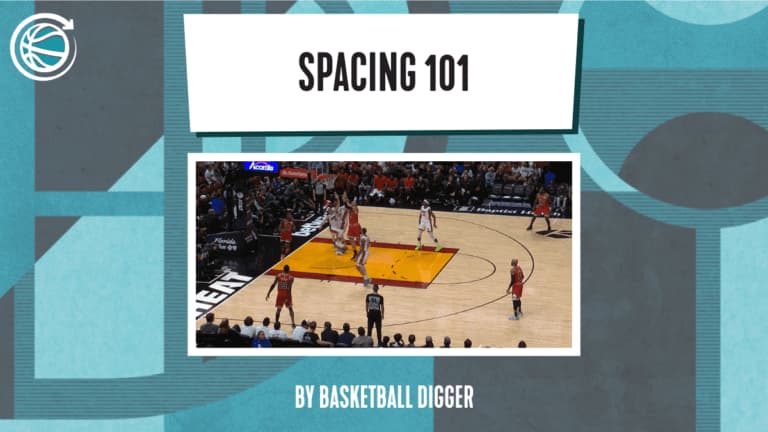
Spacing has changed the game. NBA offenses today look nothing like they did in the ’90s—more threes, better efficiency, and smarter shot selection. But why? The key lies in how teams use space to create and capitalize on advantages.
Mar 31, 2025
Simon Caret
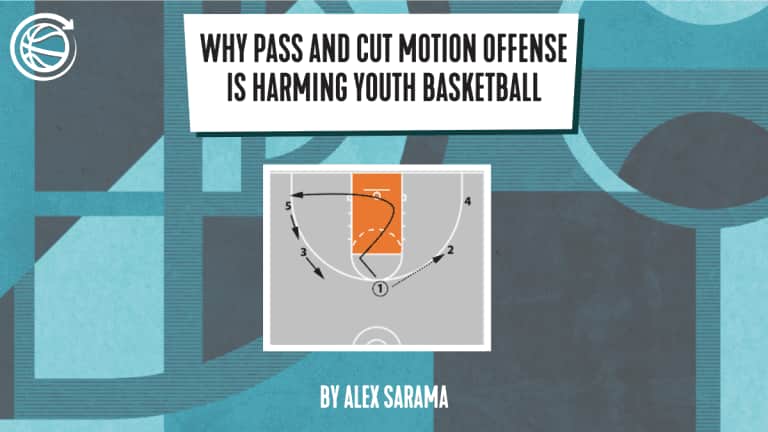
This article breaks down why pass and cut motion offense limits youth player development, and explores better ways to teach spacing, decision-making, and offensive creativity.
May 1, 2024
Alex Sarama
Approaches within the basketball industry are predominantly based upon experiential knowledge and traditions.


