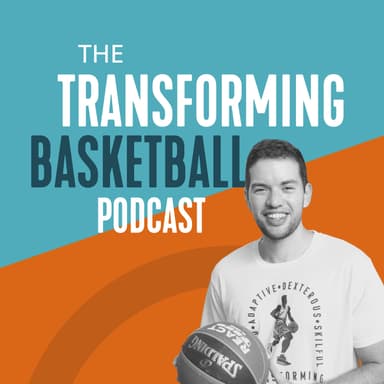
EP160: Representative Shooting Drills with Arkansas State Assistant Coach Anthony Goods
George is joined by Anthony Goods to explore representative shooting, scouting insights, and how coaches can better prepare players for real game conditions.
Alex Sarama interviews Alan Dunton, a lecturer at MTU Cork and expert in contemporary skill acquisition ideas.

Keep listening while you explore. Your episode keeps playing as you browse other pages on this site.
In this episode, Alex Sarama interviews Alan Dunton, a lecturer at MTU Cork and expert in contemporary skill acquisition ideas. Alan discusses the importance of variability in basketball training and how coaches can introduce it into shooting drills. He also emphasizes the need to focus on functional movements in warm-ups and explains the concept of meta-stability in skill development. Alan highlights the gap between research and practical application in basketball coaching and suggests ways to bridge that gap.
Our skill acquisition workshop is a comprehensive resource for you to learn about evidence-based coaching strategies. Get instant access here: https://transformingbball.com/online-skill-acquisition-workshop
Cette transcription correspond à l’audio original en anglais.
This is the Transforming Basketball Podcast, and I'm your host, Alex Sarama. This is the podcast where we help coaches and practitioners change the way we think about basketball performance. Our goal is to create the ultimate resource to help make sense of how contemporary skill acquisition ideas can be applied within the basketball world.
Throughout the podcast, we'll unpack how an ecological dynamics framework alters our perspective If you're ready to join us in our quest to transform the basketball world, then this is the podcast for you. Welcome back to the Transforming Basketball Podcast. Really delighted to be joined today by Alan Dunton.
Explore Transforming Basketball membership and continue your coach development.
George is joined by Anthony Goods to explore representative shooting, scouting insights, and how coaches can better prepare players for real game conditions.
George welcomes Coach Nick Hauselman, founder of BBall Breakdown, to discuss revolutionary changes in defensive principles of play and shooting.
George Vaz is joined by Norbert Opitz, a cornerstone of Alba Berlin's youth development program.
So Alan, thanks so much for taking the time today.
No problem at all, Alex. And thank you for that introduction. Very flattering of you. So hopefully we can keep that good explanation of difficult concepts going in this podcast. It'd be great.
Love it. So Alan, just for the benefit of the listeners, you've actually worked In basketball in Ireland, you've done some work there too. Could you just kind of maybe introduce your background and also the, you know, some of the stuff you've done in the basketball space?
Yeah, I can, of course. I have never played basketball in a competitive environment before, so working in it was interesting. But my background, very much grew up loving sports, have always played a multitude of sports my entire life, kind of honed in on martial arts from kind of 15, 16 upwards, and was quite fortunate to represent my country and traveling around the world a little bit with that.
So a lot of that fed in heavily to me wanting to pursue a career in sport. Didn't really know what it was or where it was going to be. I just knew that I didn't really like school and really enjoyed sports. So that kind of led me to my undergrad in CIT in Cork, which is now NTU, in sport and exercise management.
And then following on from that, towards the end of that, I met my supervisor for my PhD, uh, Ed Collin. Who kind of, I just couldn't get enough of questions constantly around concepts that we'll hopefully talk about today. I did my PhD on kind of guiding visual attention, initial study in basketball actually, which was quite interesting in terms of if we manipulate or remove the lower visual field, what kind of an impact does that have on your ability to use your visual attention forwards to pick up more information?
So. I spend less time looking at the ball when I'm dribbling, especially kind of novices or younger athletes. I spend more time directing my vision outwards towards the game environment. Do I do a better job of picking up on the movement of my teammates or my opponents?
And transitioned that into football or soccer, whichever term is more comfortable for you. From there, and yeah, finished my PhD over 3 years ago now. I was in Dublin for 2 years lecturing in TU Dublin, and now I'm back in MTU Cork and going into my second year lecturing here.
So. Yeah, all good stuff. All while consulting with athletes along the way, which is the kind of enjoyable part. That's a nice doublet.
So Alan, one of the, um, the way you started the clinic in Sweden was awesome because it was so practical and it was, I always remember the task you, you asked people to write their name 3 times.
Yeah.
And you know, that was your segue to introduce the power of variability. I'd be really interested in hearing about, how would you start to a coach or a practitioner in any other role in basketball introducing this topic, contemporary skill acquisition? How would you go about that?
Yeah, that is, that is a great question, to be honest, Alex. And probably one I've altered how I actually approach that as I've done this for more years. I think primarily I would try and get a good understanding of where the coach is initially.
Try and get an understanding of why it is they're talking to me in that instance, what it is they came to talk to me about or for, and then piece the issues out from there. So if they feel like what's happening in practice isn't transferring well to competition, then we look at what is actually happening in practice.
For all intents and purposes, the best way you could possibly describe it is a practice audit. So if I'm working with a coach in a consultancy capacity, I almost do a full audit. of their practice, what it is they're doing, their session design, to how the session runs, to the feedback they give, the instructions they give.
All of that encompasses it. And it, it's kind of all then built around the identity the coach or that club have. So what is that particular club or coach's way? Because this is all highly individual, as you'll know. So it, it's very much context dependent and kind of starts with an audit.
I love that. I think definitely the idea of meeting them where they're at. Do you think, Alan, that necessarily starting with the ideas of ecological dynamics and kind of getting into that, do you think that can be too complex sometimes? Because this is something I'm always wrestling with.
Do you think it's better to look at other simple things like maybe variability and talking about what that might mean for a coach?
Yeah, I think it depends on the person. Some people will have done a bit of reading before they come and speak to me, and they'll be used— I kind of mirror the terms they use initially and Tease out what those terms mean to them, because I think the terms are one thing, what the terms mean to the person is another.
Um, but to come to your point, the, the variability angle is probably one of the best, hence why I ask people to write their name in the same place a number of times. Or it can be simple as draw 10 lines from one dot to another in the exact same place.
And what you instantly discover is there is A high degree of variability in such a simple motor task that when we look at the more complex ones in sports, that inherent variability is always there. And when they get a little bit more comfortable with that, quite often helps the dialogue of a conversation and the explanation of why ecological dynamics and adaptability is key.
Maybe let's get straight to what this looks like in basketball. And I remember during the clinic, it was great. You brought members of the audience up onto the court to coach, and I think There's one example where you, you ask them to design a shooting activity.
What could coaches do to encourage variability within shooting as opposed to, you know, like a dominant approach of shooting many times without an opponent in the same place?
Yeah, I think that that is in a nutshell one of the primary things that I see when I have been in a basketball setting. The players may go out and warm up themselves, or the coach will start and it will be unopposed shooting.
From the same spot with a lot of potential value there. Now, there's caveats to all of this. A coach may have a fantastic reason for doing that, but quite often, more than not, when you get into the conversation with coaches, they just do it because that's how they did it when they played and their coach did that with them.
And it becomes a very kind of passed down, unsure reason as to why they're doing something. So the first thing I do from that instance is I like to look at the context of a game, and I will use a simple 1 to 10 scale that I've borrowed quite nicely from the constraints-led approach, where they look at scaling what your practice looks like to what the game is.
The game is a 10. If we remove the opponent, if we remove time constraints, if we remove contextual factors like the score, how far down along that scale of 1 to 10 have you come and If we're down at a 1 or 2 or 3, how effective is that from a practice perspective?
So that's kind of the first place I go to in that instance. And then depending on the athletes, you can start to bring in different levels of challenge per se, or not, maybe not necessarily challenge, but you layer in the complexity of the game to meet how capable they are in that setting.
What I mean by that is if I'm working with really young kids who have never really played basketball before. I may need to simplify the task a lot more, but keep a lot of key features still in place. I would still include a defender because we know from a high volume of the research that a defender has a significant impact, not only on the makeability of a shot, but the arc of the shot as well in itself.
So it's a different movement pattern. And if we're learning from an early stage, I think that's a very important element to keep in place. And then you can add your other constraints, your contextual factors. To make it more challenging for players, the higher capability players that you get in that setting.
Fantastic. So I think, like you said, having a defender actually alters how you shoot it. But, you know, especially in, I'd say even in shooting, but other areas of basketball, as coaches, we've always been very focused on technique and biomechanical positions. You know, what would you say to that, who, for the coaches who really believe that that's very important?
As opposed to necessarily being able to practice with context very, you know, immediately.
Yeah, look, I have an example for this that I think you're aware of that at times may be a bit too much of a push, but I think it's fantastic. It's very much stolen from Graham McDowell. And it's a picture of an Olympic swimmer swimming in a bathtub.
And the quote that comes with it is, you'll never be an Olympic swimmer by training in a bathtub, but you might actually be able to photograph the optimal biomechanics while you're in that bathtub. And the kind of translation to shooting in that is somebody like me who's not very good at basketball, I might be able to take a picture unopposed where I look like I have fantastic shooting mechanics.
The ball might not be going anywhere near the hoop. I can look great unopposed. I can move relatively well. I can jump nice and high and I can look like I'm, I know what I'm doing biomechanically. And you might say, oh, you know, biomechanically, that looks pretty good.
You put me in a one-on-one, never mind a 5-on-5, and I'll disintegrate incredibly quickly. And my capacity to look that good, I think, will fade very quickly as well. So yeah.
No, fantastic. I was thinking about how to guide you towards that without giving it away. And that was, for me, it's just, it was one of the best things I've heard though, because it's like straight away it connects and I've struggled, you know, to find nice ways to try and explain how You know, these biomechanical, these mental models that we've grown up in as coaches.
It's just, it's trying to move away from that, which is really hard. So I wanted to get you, you had a really nice, um, you, I got loads of notes here, which I'm going through from the clinic. And one thing you mentioned was a representative dosage of relevance.
What does that mean?
It kind of comes in under the, the kind of key 3 things that you could look at from a practice transfer perspective. So. An image shared with me by Dr. Ed Collin is context, relevance, and consequence interlinked can have a positive impact on practice transfer because we're simulating what the performance environment looks like.
So a thing I normally do with coaches is I ask them to look at how representative the dosage in training is in terms of relevance to the game. So if we're looking at dribbling and your dribbling is around cones and you have kids in lines, Where it's predetermined, it's pre-prescribed, and the chaos of the game is not relevant, then what is the dosage of representation in that particular drill?
From the same free throw perspective, a free throw— free throws is one I see especially in any basketball setting I've been in. The representative dosage of relevance for free throws is always quite low because it's always A group of people standing around the hoop, kind of still chatting, chucking the ball up there.
The value is diminished. Whereas in the game, free throws are incredibly different to typically how I've seen them practiced. It's a lot more pressure. You only get 2. Boxing out is a hugely important part of that, but not only boxing out from a, I must step in perspective, but actually physically boxing out.
And also the nature of, you've just been sprinting up and down the court. You are 100% in a different state, whether you were just defending or you've just been bashed to the floor and you're picking yourself up to take those 2 free throws.
The representative dose in training often doesn't match the representative dose we see in competition. So it's about trying to get those closer together.
Fantastic. You know, through the podcast, Adam, we're gradually kind of introducing coaches to ecological terms, and we're trying to do it in a matter where we can make it, you know, simple to understand. And one term which hasn't come up yet in the podcast is the notion of constraining to afford.
And you spoke about that. What could that look like for basketball coaches in a practice?
Yeah, so constraining to afford, depending on if the coach knows what constraints are, but constraints-led approaches can be used from an ecological dynamics perspective. And the aim of it is to try and turn the volume up, per se, on a particular aspect that you want to work on.
So you may have, you can imagine if anybody is a DJ or they've ever spent any time DJing, when you look across that spectrum of factors, you can turn a couple up, you can turn a couple down. So if we want to work on 3-point shooting, I might constrain to afford more opportunities for the athletes to shoot a 3-pointer.
If I want to highlight, or I want to shine a light a little bit more on driving to the basket. I may constrain to afford that happening more frequently. How you do that then is kind of the art of how well you know your players and how well you coach.
So there's the typical DEP model where you can look at constraining the space, you can look at constraining the time or the task, you can look at constraining equipment, or you can look at constraining people. So if you want to, say, constrain people to highlight a particular aspect, we may want to move the ball better, or we may want to look at moving the ball into our bigs inside.
I may stack the deck in favor of that in terms of my constraints to make that a more attractive option. So I may constrain the people where I have a big on a small, where going inside is going to be more valuable. Key thing then is when we look at That, that we bring it back to something that may also be quite similar in a game where you now have a big-on-big inside.
Yeah.
5 minutes after you've played that game to see, does it still work as effectively when we're back in that scenario? You may look at time constraints where your team may struggle to get a shot off before the buzzer, and it's an area you've highlighted that is a work-on for your team.
So you may constrain the time players have on the ball beforehand. Or you may constrain the time players have on the ball before they can get a shot off, and you can start them from varying positions on the court. So everything has that variability that you see in the game, but with the relevant kind of time constraints or constraints in place.
That's really nicely put, and I think so practical for coaches to be able to understand that immediately. So, Al, I wanted to move a little bit to the warm-up, and that was kind of in your second session. You shared a lot of great practical ideas, and Like, just something I'm seeing, obviously I'm now working in London, and something just I see a lot in our youth program is the need to try and develop more functional movements with our players.
You gave some great examples. Could you maybe just speak to why it's so important we maybe look at that as opposed to kind of focusing our warmup on routines, and maybe just a couple of the warmup activities you shared?
Yeah, I mean, why it's important, I think, is probably that where that kind of stems from is the concept of action capabilities in sport, where we have body-scale affordances and our action-scale affordances. So what I mean by that is, in a basketball perspective, our body-scale affordances from an action capabilities perspective are our height, our wingspan, our speed, our power, then come under our action-scale affordances.
So body-scale, typically the features of the person, and then action-scale, their power, strength, speed. So when we look at those, we can build those into developing them In the warmup. So if you look at speed and power or change of direction, instead of in the warmup going from cone to cone, I may have one-on-ones or two-on-twos where the ball is present, where the change of direction versus agility is far more distinguishable, and it's closer to what we see in the game.
So when I look at warmups, those are things I start to bring into play, the perceptual cognitive decision-making elements, but with a focus on agility. When you're talking about warmups from that perspective, it kind of comes back to turning the volume up on something in particular, but it's getting the athletes prepared for what they're going to experience in the game, as opposed to having them move through a more robotic warmup.
If that makes sense.
Yeah, absolutely. And I love, like, you played Touchdown, where the youth players, they were playing, they had to do different animal movements.
Yes, yeah, yeah.
Monkey, bear crawl, kangaroo. And it was just amazing to see just things like that in the warm-up. It just makes it so much more engaging too, in creating just a fun note to start the practice.
Yeah, and I think an important note on that, and the reason why I shine a light on that in the warm-ups, is because we also need to deal with the person first, especially at a younger player perspective. They may be there to play basketball, but To a certain extent, we have a duty of care to develop them as sound and capable movers.
And as they develop that, if they decide, you know what, basketball's not for me, great, but I've made you a fantastic mover for another sport you may transition into, or just for general health and life. The reason those are prevalent in the kind of younger group warmups that I do is, one, they're fun and engaging, and two, it just develops better movers overall.
It's nonlinear, it's a little bit chaotic. You know, we have those games where we have them jumping, pushing each other, and it's not necessarily about them pushing each other, even though that's what they like to go to, but it's landing and moving and learning how to coordinate your body in space.
Absolutely. So I've got just in my notes here, Alan, I've got one concept which I think I'd love to hear your, how you describe it, because you, again, that came up in the clinic and I haven't discussed it yet in a podcast or a blog, and that's Metastability.
Would you be able to explain that and maybe get to why it's important for coaches just to have an awareness of what that is?
Yeah, absolutely. And this is kind of a concept that I've been tussling with, let's say, from my own perspective. So I came across metastability because in my coaching as a martial arts coach, there's some really nice work around the impact the distance a person is from a punching bag has on what movements or actions they engage in.
So when we bring that to metastability, we're talking about stable attractor states. So if I'm very close to a bag, in a stable state for throwing a hook or an uppercut, because it's very close to the bag, so that's the most attractive solution in that state.
When I move kind of a little bit outside of arm's length, the most attractive solution for that state is a jab. Where metastability comes into play is when I move into that kind of middle zone where there's not an incredibly obvious attractive solution to the problem of punching the bag.
And I'm in a metastable state where there's almost these 2 competing tendencies that are present. And we have almost to bring the athletes to the edge of instability to promote creative solutions to that problem. So when we look at that from a basketball perspective, I may look at a point guard and I may want to create competing tendencies for a point guard.
So they may want to look at setting up your session where driving to the basket or passing out to a shooting guard are the 2 competing tendencies, but you place them in a kind of point where they're— neither one is more attractive than the other.
So we look at the creative solutions or novel solutions that the players can come up with in that aspect. And probably one of the most important elements of that, and it's not necessarily metastability, but it's designing of sessions where the volume isn't turned all the way up on one thing and it's completely removed or turned down to zero on the others, where we're constraining to constrain rather than constraining to afford.
So the options are there and it's about them making decisions Based on those is what we want to promote more, because that's what they have to deal with in a game. So that's what we should be introducing them to in training. If you want to get really kind of nitty-gritty, it's attractiveness without any attractors.
So there's nothing strong enough, but there's almost still an imprint available from a decision-making perspective.
So basically, I'm going to say, like, say we've got a small-sided game. It's not a case of there just being one thing that the coach is Setting up a small-sided game, but instructing and looking for them to act on one very particular affordance, or maybe it's very scripted in a way where maybe there's like the only obvious kind of solution is to drive and kick as opposed to anything else.
That would be an example of what we're trying to avoid, right?
Yeah. And an easy way for coaches to maybe understand if they're doing that well is, are you setting up your session to see a solution? Are you setting up your session to pose problems? Because if we set up a session to pose problems, then we see how our athletes solve those problems, which is going to be far more effective when they're posed with those problems in a game, because that's what the games typically are.
It's a high, a very large set of problems that look a little bit different each time. So are you doing that, or are you setting up solutions where the athlete doesn't need to think at all?
Yeah, that's fantastic. So Attractors came up, and I think, again, that's another term I— we haven't got to yet, but I think they're important, especially in the context of shooting, because that's just something I see a lot in basketball where, you know, players have these very deep attractor states.
And a lot of the time how coaches maybe try to— it goes back to what we spoke about with the bathtub analogy and form shooting.
Yeah.
Coaches try to do form shooting to get players out of these entrenched coordination states. Whereas, you know, within a contemporary approach, we could do something else. You know, I think with attractors, Alan, is there anything you could just kind of use to build on that maybe so coaches can understand really what they are and then how we can perturb them?
Yeah, well, the example I gave at the clinic is very much removed from basketball, but it can help quite in understanding the concept of attractors per se. And it's the HKB Haken, Kelso, Benz model. I think I might've butchered that, but it's definitely the HKB model where you look at the movement of your fingers almost like window wipers.
So your finger goes up and down and at a slow pace, that's a very comfortable state, very attractive to just move your fingers like that. If I ask you to speed up and speed up and speed up, the faster you go, what you'll notice is that your fingers will start moving together because at a higher speed, that's a more stable state for movement.
To then try and bring this along to a more basketball-relative example, when we look at walking, walking is a very stable state. When I walk incredibly fast, the transition between walking and jogging is a movement from one stable state to another stable state.
So there is a transition in that where you're too fast to walk and you're too slow to run. So you get in that kind of a choppy state where you have to transition from one attractive state to another. So in shooting, if I'm looking to create a very deep state of attractiveness where whenever I shoot, this is what I do, in the game where I have to fade away on one shot, or I need to make contact on another shot, or I need to sidestep before I shoot, or I need to jump a little bit
higher because I'm against a taller defender, if I'm too focused on let's say form shooting and creating one very deep attractive state, it's going to be very hard for me to transition between states. Whereas if I am more adaptable between and flexible in my shooting, then I'm going to be able to transition between those states depending on what the environment is, is asking of me, if that makes sense.
So it's about, and again, for me, it's funny.
Yeah.
To be stable, you have to be adaptable. When people think stable, a lot of the times they think rigid, but it's probably better to think of it in terms of, say, bamboo or a balance board. If I'm on a balance board, the way I keep myself steady is constant little micro movements and micro adjustments.
I don't stay still and not move, because if I do that, I'll inevitably just fall. So when we look at that from an attractor state, if I'm too ingrained to one attractor, the likelihood is, is I'm going to tip over. Whereas if I'm able to transition well between attractor states, then I'll probably be more adaptable and better equipped to solve those problems.
Fantastic. And that's obviously why practicing with variability using the CLA and maybe some differential learning too could be really useful in that regard. Great. So, Alan, my last question is, I think there's a little bit maybe of a gap you could say existing right now, especially in the basketball world.
I'm not sure of other sports, but there's a bit of a gap existing between the research and its practical application.
Yeah.
And I think you're unique. You're a practitioner, but also a researcher. So you've been involved in both fields. What do you think could be done maybe to bridge that gap and try and help not only coaches learn more about SKLAC ideas, but also maybe researchers kind of working close, more closely with coaches on the ground?
Yeah, I think, I think you're, you're dead right. There is an awful lot to be done. Um, one, primarily because a lot of the academic content that's produced is quite hard to digest for coaches who aren't in that space. I mean, there's some papers come out like metastability.
There's elements of concepts in metastability that fly over my head that take me 20 reads to try and understand. So to try and ask a coach to get there is incredibly hard. So I think academics from a certain extent need to do a better job of disseminating their research.
It's something that I place an emphasis on because my research is for coaches. Anytime I do a piece of research, I'm trying to address a need from a coach. So there has to almost be that cyclical relationship where experimental knowledge from academics is almost interlinked with the experiential knowledge of the coaches, where they speak to each other.
And an academic may go to a coach to say, well, what problem are you trying to solve? Okay, well, let me put it through academic rigor and experiential rigor based on your experience of what you think is typically happening. And I think another great thing that is happening is the amount of podcasts people put out there.
Like, obviously this is going to be a great resource for coaches when you have academics who are going to hopefully translate their research in a more digestible way. Like, we have great examples of that already in terms of Rod Gray and Stu Armstrong and Dan Abrahams.
There's, there's some fantastic podcasts out there that are doing a great job in this space. And then the thing I would urge coaches to do is be willing to jump into this space and get it wrong. It's kind of one of those things where people are hesitant because it becomes a little bit overwhelming at times because there are so many areas that you can go to in the space of skill acquisition.
But reach out to people who are in the academic space. If you see something in a blog or in an article that's from an academic, go and chat to them about their paper. Reach out. Most academics I know are incredibly generous with their time and willing to engage because it helps quite a lot.
But yeah, be willing to get it wrong. It's okay to say, this is my interpretation of the research. The author might go, that's not what I meant, but here's how I can help get you there. So I think just more dialogue between both rather than boundaries would be, would be the most beneficial thing in that aspect.
Love that. Alan, I just want to say thanks so much for taking the time to join us today. Where can coaches follow your work and maybe see your research? Would Twitter be the best place?
Yeah, my only social media is Twitter. I have LinkedIn, but I don't know, do I count that as a As a social media, or I should say X now, shouldn't we? We have to start transitioning to, you can find me on X, but that sounds a bit strange.
Um, yeah, just @AllanDunton, or my email I can, I can give to you and you can put it in the show notes, whatever. And if you want to reach out to me, if you have any questions, by all means, ask away. I'm more than happy to engage.
Amazing. Allan, thank you so much.
No problem at all. Great to chat, Alex.
Thanks for tuning into this episode of the Transforming Basketball Podcast. If you would like to learn more about the work we do, head to www.transformingbball.com to access our free resources and help spread these ideas throughout the basketball world. If you enjoyed this episode, then please subscribe and leave a rating or review On your favorite podcast platform.
We will gladly answer any questions from today's episode via our social media platforms. See you next time on the Transforming Basketball Podcast.