

Zone Offense Basketball: Small-Sided Games to Teach It
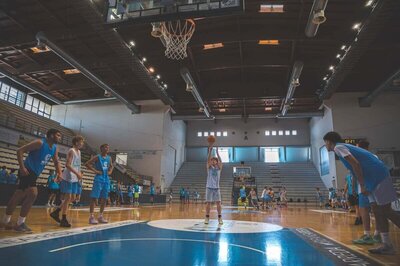




What Are Small-Sided Games for Zone Offense Basketball?
For the format of this blog, I have split small-sided game ideas into four categories (dribbling, passing, spacing and moving), with sub principles of play within each activity. The small-sided games are designed around the specific zone offense principle of play.
Dribbling
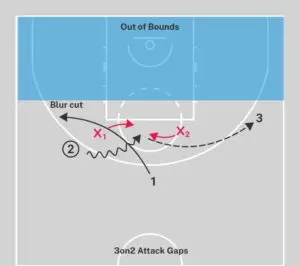
Principle of Play = Attacking and Exploiting Gaps
- SSG and Constraints = 3-on-2 with space constrained to playing only above the 1st hash mark. The player with the ball must force a help defender to commit to stopping the ball before kicking out to an open player with a numbers advantage. Bonus points for every offensive rebound and punishing one of the weaknesses of the zone.
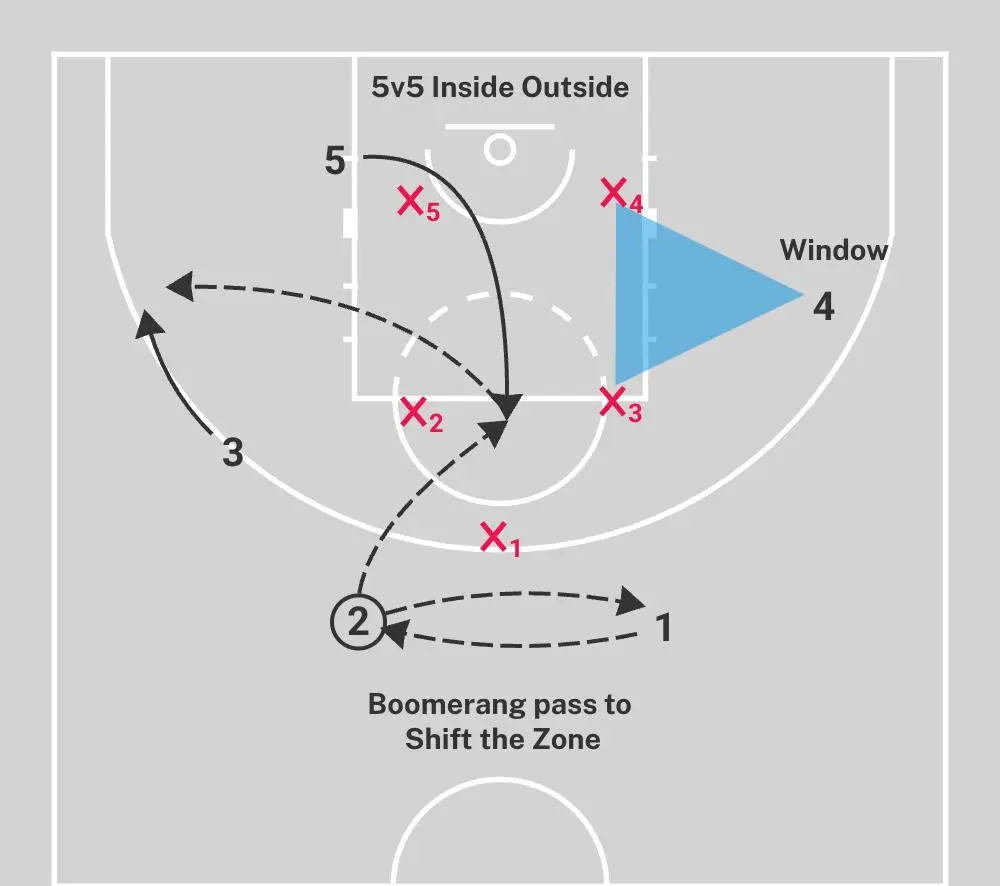
Principle of Play = Shift the Zone
- SSG and Constraints = 5-on-5 half court. Players can explore how to shift or distort the zone out of their preferred alignment. Scores after a reversal across the split line are worth double points. Bonus points for every offensive rebound.
Principle of Play = Engage Two defenders
- SSG and Constraints = 3-on-3 with space constrained to one side of the court. Players will use a dribble to draw two defenders and utilise the 2-on-1 advantage. Player must attack with the intent to get paint touch and if dribble does not engage a defender, then any subsequent score does not count. Bonus points for every offensive rebound.
PASSING
Principle of Play = Pin-Ins and Skip Passes
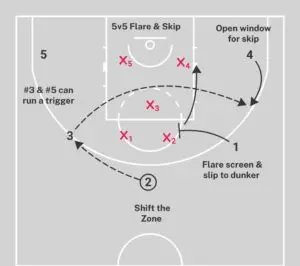
- SSG and Constraints = 5-on-5 live. Players explore how to give the receiver of a skip pass some time and space for the shot. A score on the skip pass does not count unless a defender is sealed / screened with a pin-in before the shot. Players to debrief where a seal was effective (e.g. dunker for corner shot, or elbow for wing shot). Bonus points for every offensive rebound. Note the slip from the player pinning in can also be an option.
Principle of Play = Misdirection
- SSG and Constraints = 4-on-4 half court. Players must explore how to use misdirection and force the defence to closeout. Players to debrief misdirection solutions (e.g. pass fakes, boomerang passes, ball reversals, quick reversals into a pick and roll, etc).
Principle of Play = Inside-Outside
- SSG and Constraints = 5-on-5 half court. The ball must go inside-outside at least once on each possession for score to count. This can be done with a high post player playing through the middle of the zone.
.
SPACING
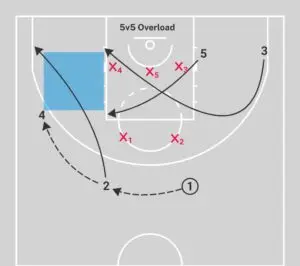
Principle of Play = Overload the Zone
- SSG and Constraints = 5-on-5 full court with 3 trips. Must be a different player in the dunker each trip and players have to explore how many different overloads they can create. Players debrief solutions (e.g. triangle, box, cut through, etc). Only ROB shot counts.
Principle of Play = Relocations
- SSG and Constraints = 3-on-3 with space constrained to one side of the court. Players to explore how to use dribble to attack gaps, kick out and relocate. Players to debrief relocate solutions (e.g. ghost screen, drift, lift, flare).
MOVING
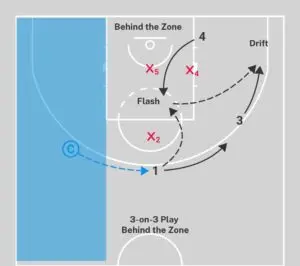
Principle of Play = Flash Cut
- SSG and Constraints = 4-on-4 with space constrained to one half of the court and players have to explore affordances from a flash cut behind the zone from weak side corner towards the middle. Players start point, wing, dunker and weakside corner. Players to debrief the attractive affordances (e.g. high-low or lob pass). Gold medals only or catch and shoot threes.
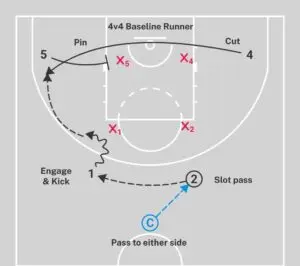
Principle of Play = Baseline Runner
- SSG and Constraints = 4-on-4 with space constrained below the block. Players have to explore how a baseline runner from behind the zone can create attractive affordances and/or numbers advantage. Player to debrief solutions found (e.g. exit screen on baseline for catch & shoot). Gold medals and 3s only.
Principle of Play = Screening the Zone
- SSG and Constraints = 3-on-2 with space constrained above the first hash mark on the key. Players have to explore ways to use a screen to get an open shot. Players to debrief solutions found (e.g. wing to point screen). Plus 2 points for screener scoring.

What Are Small-Sided Games for Zone Offense Basketball?
For the format of this blog, I have split small-sided game ideas into four categories (dribbling, passing, spacing and moving), with sub principles of play within each activity. The small-sided games are designed around the specific zone offense principle of play.
Dribbling
Principle of Play = Attacking and Exploiting Gaps
- SSG and Constraints = 3-on-2 with space constrained to playing only above the 1st hash mark. The player with the ball must force a help defender to commit to stopping the ball before kicking out to an open player with a numbers advantage. Bonus points for every offensive rebound and punishing one of the weaknesses of the zone.
Principle of Play = Shift the Zone
- SSG and Constraints = 5-on-5 half court. Players can explore how to shift or distort the zone out of their preferred alignment. Scores after a reversal across the split line are worth double points. Bonus points for every offensive rebound.
Principle of Play = Engage Two defenders
- SSG and Constraints = 3-on-3 with space constrained to one side of the court. Players will use a dribble to draw two defenders and utilise the 2-on-1 advantage. Player must attack with the intent to get paint touch and if dribble does not engage a defender, then any subsequent score does not count. Bonus points for every offensive rebound.
PASSING
Principle of Play = Pin-Ins and Skip Passes
- SSG and Constraints = 5-on-5 live. Players explore how to give the receiver of a skip pass some time and space for the shot. A score on the skip pass does not count unless a defender is sealed / screened with a pin-in before the shot. Players to debrief where a seal was effective (e.g. dunker for corner shot, or elbow for wing shot). Bonus points for every offensive rebound. Note the slip from the player pinning in can also be an option.
Principle of Play = Misdirection
- SSG and Constraints = 4-on-4 half court. Players must explore how to use misdirection and force the defence to closeout. Players to debrief misdirection solutions (e.g. pass fakes, boomerang passes, ball reversals, quick reversals into a pick and roll, etc).
Principle of Play = Inside-Outside
- SSG and Constraints = 5-on-5 half court. The ball must go inside-outside at least once on each possession for score to count. This can be done with a high post player playing through the middle of the zone.
.
SPACING
Principle of Play = Overload the Zone
- SSG and Constraints = 5-on-5 full court with 3 trips. Must be a different player in the dunker each trip and players have to explore how many different overloads they can create. Players debrief solutions (e.g. triangle, box, cut through, etc). Only ROB shot counts.
Principle of Play = Relocations
- SSG and Constraints = 3-on-3 with space constrained to one side of the court. Players to explore how to use dribble to attack gaps, kick out and relocate. Players to debrief relocate solutions (e.g. ghost screen, drift, lift, flare).
MOVING
Principle of Play = Flash Cut
- SSG and Constraints = 4-on-4 with space constrained to one half of the court and players have to explore affordances from a flash cut behind the zone from weak side corner towards the middle. Players start point, wing, dunker and weakside corner. Players to debrief the attractive affordances (e.g. high-low or lob pass). Gold medals only or catch and shoot threes.
Principle of Play = Baseline Runner
- SSG and Constraints = 4-on-4 with space constrained below the block. Players have to explore how a baseline runner from behind the zone can create attractive affordances and/or numbers advantage. Player to debrief solutions found (e.g. exit screen on baseline for catch & shoot). Gold medals and 3s only.
Principle of Play = Screening the Zone
- SSG and Constraints = 3-on-2 with space constrained above the first hash mark on the key. Players have to explore ways to use a screen to get an open shot. Players to debrief solutions found (e.g. wing to point screen). Plus 2 points for screener scoring.




check what's trending

What is ecological dynamics and how is it connected to a constraints-led approach?
Dec 8, 2025
George Vaz

Are you searching for the best small sided games (SSGs) to improve your basketball practices? Want to replace boring, low-transfer drills with competitive games that actually develop player decision-making and in-game skills?
In this post, I’m sharing my top 5 favorite small-sided basketball games—designed to teach core concepts like closeouts, pick-and-roll, advantage creation, and transition offense and defense. These basketball SSGs are intense, purposeful, and built around real-game actions.
Whether you're coaching youth basketball, high school, or pros, these top small sided games will make your sessions more effective, more engaging, and more fun—for both players and coaches.
Let’s break down each game and how it can transform your practices.
Aug 4, 2025
George Vaz

Whether you’re coaching in the NBA, EuroLeague, or youth basketball, one thing remains universally true: the worst transition offense is still more efficient than the best half-court offense. Yet, many teams still struggle to fully capitalize on transition opportunities, often opting to slow down the game instead of pushing the pace. The question is, why? By running more intentionally, teams can create easier scoring opportunities. So why do some teams hesitate?
Apr 7, 2025
George Vaz
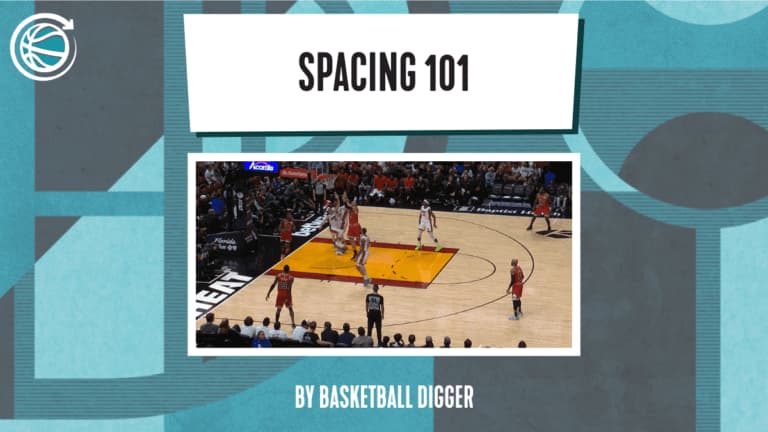
Spacing has changed the game. NBA offenses today look nothing like they did in the ’90s—more threes, better efficiency, and smarter shot selection. But why? The key lies in how teams use space to create and capitalize on advantages.
Mar 31, 2025
Simon Caret
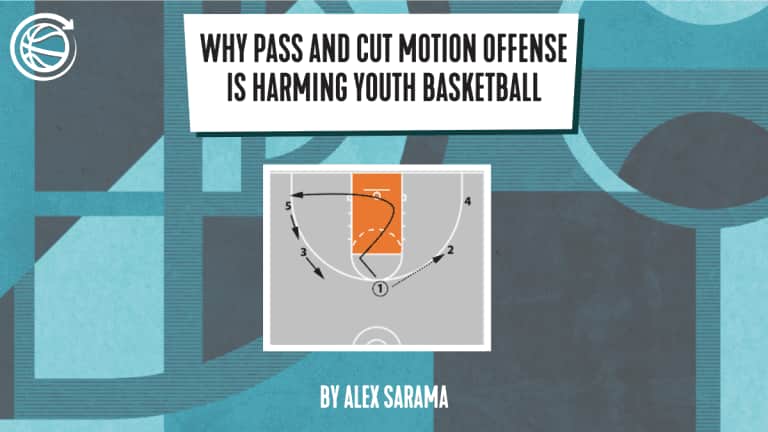
This article breaks down why pass and cut motion offense limits youth player development, and explores better ways to teach spacing, decision-making, and offensive creativity.
May 1, 2024
Alex Sarama
Approaches within the basketball industry are predominantly based upon experiential knowledge and traditions.


