

Why You Need to Constrain Space in Small-Sided Games
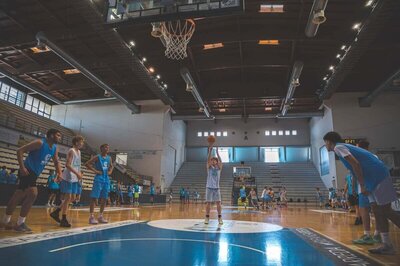




Are you struggling to see complete transfer from your small-sided games in practice to the real thing?
One of the reasons your small-sided games (SSGs) are not achieving their maximum result could be because of the unrepresentative behaviours the players are getting away with. And the most common culprit in this instance is failing to constrain space.
This is very important, because in SSG settings, such as 1-on-1, 2-on-1, 2-on-2, 3-on-3, etc., players operate in more time and space than they would encounter in 5-on-5. This is why it’s critical to consider how you shrink the space to avoid offensive and defensive players getting used to operating in spaces that would not exist in 5-on-5.
Of course, playing with smaller numbers in a SSG is an example of task simplification. But it is important to consider other ways to make the games that are not 5-on-5 more representative.
How to Constrain Space
The easiest way you can do this is sectioning an ‘out of bounds’ area in your SSGs. A coach could stand here (e.g. wall pick and roll) or you could use cones to mark out the section. Essentially, coaches are moving the out of bounds line when they constrain the space.
We asked the expert coaches in our membership community how they constrain space. They shared some really creative answers, starting with Christoph Nicol. This idea is the “moving wall’ concept to change the space available across every possession.

This next one is a good idea from Ari Braun. If you want to encourage cutting, then be sure to change it from 2 to 3 players so that you can still score from off-ball cuts.

In this example, Neil Houghton shares ideas for improving conventional 3-on-3 with a ton of different intentions and constraint builds.


Finally, if coaches want to constrain space just imagine how the game would be in a 5-on-5 environment. There might be shrink (gap) defenders on the ‘Solo’ drive. If coaches want to replicate this part of the game in a 1-on-1 advantage start game, they might put a shrink defender that is allowed to stunt at the ball, but not get in front of the drive.
Coaches can learn how to effectively manipulate spacial constraints to effectively target players rate limiters in this course: The Player Development Blueprint


Are you struggling to see complete transfer from your small-sided games in practice to the real thing?
One of the reasons your small-sided games (SSGs) are not achieving their maximum result could be because of the unrepresentative behaviours the players are getting away with. And the most common culprit in this instance is failing to constrain space.
This is very important, because in SSG settings, such as 1-on-1, 2-on-1, 2-on-2, 3-on-3, etc., players operate in more time and space than they would encounter in 5-on-5. This is why it’s critical to consider how you shrink the space to avoid offensive and defensive players getting used to operating in spaces that would not exist in 5-on-5.
Of course, playing with smaller numbers in a SSG is an example of task simplification. But it is important to consider other ways to make the games that are not 5-on-5 more representative.
How to Constrain Space
The easiest way you can do this is sectioning an ‘out of bounds’ area in your SSGs. A coach could stand here (e.g. wall pick and roll) or you could use cones to mark out the section. Essentially, coaches are moving the out of bounds line when they constrain the space.
We asked the expert coaches in our membership community how they constrain space. They shared some really creative answers, starting with Christoph Nicol. This idea is the “moving wall’ concept to change the space available across every possession.
This next one is a good idea from Ari Braun. If you want to encourage cutting, then be sure to change it from 2 to 3 players so that you can still score from off-ball cuts.
In this example, Neil Houghton shares ideas for improving conventional 3-on-3 with a ton of different intentions and constraint builds.
Finally, if coaches want to constrain space just imagine how the game would be in a 5-on-5 environment. There might be shrink (gap) defenders on the ‘Solo’ drive. If coaches want to replicate this part of the game in a 1-on-1 advantage start game, they might put a shrink defender that is allowed to stunt at the ball, but not get in front of the drive.
Coaches can learn how to effectively manipulate spacial constraints to effectively target players rate limiters in this course: The Player Development Blueprint




check what's trending

What is ecological dynamics and how is it connected to a constraints-led approach?
Dec 8, 2025
George Vaz

Are you searching for the best small sided games (SSGs) to improve your basketball practices? Want to replace boring, low-transfer drills with competitive games that actually develop player decision-making and in-game skills?
In this post, I’m sharing my top 5 favorite small-sided basketball games—designed to teach core concepts like closeouts, pick-and-roll, advantage creation, and transition offense and defense. These basketball SSGs are intense, purposeful, and built around real-game actions.
Whether you're coaching youth basketball, high school, or pros, these top small sided games will make your sessions more effective, more engaging, and more fun—for both players and coaches.
Let’s break down each game and how it can transform your practices.
Aug 4, 2025
George Vaz

Whether you’re coaching in the NBA, EuroLeague, or youth basketball, one thing remains universally true: the worst transition offense is still more efficient than the best half-court offense. Yet, many teams still struggle to fully capitalize on transition opportunities, often opting to slow down the game instead of pushing the pace. The question is, why? By running more intentionally, teams can create easier scoring opportunities. So why do some teams hesitate?
Apr 7, 2025
George Vaz
Spacing has changed the game. NBA offenses today look nothing like they did in the ’90s—more threes, better efficiency, and smarter shot selection. But why? The key lies in how teams use space to create and capitalize on advantages.
Mar 31, 2025
Simon Caret
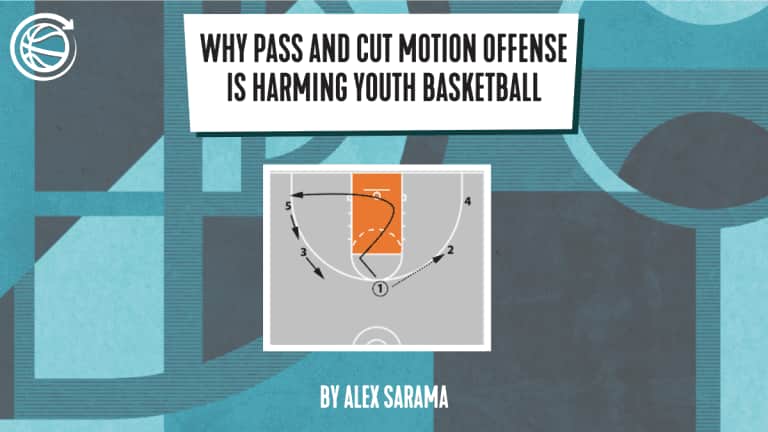
This article breaks down why pass and cut motion offense limits youth player development, and explores better ways to teach spacing, decision-making, and offensive creativity.
May 1, 2024
Alex Sarama
Approaches within the basketball industry are predominantly based upon experiential knowledge and traditions.


