

Constraints-Led Approach Basketball: Teach Lay-Ups




What Is the Constraints-Led Approach Basketball?
We had a member of our Transforming Community post this very interesting question:
“How do I teach a beginner to do a lay-up—without boring them or killing their joy?”
Good news: you don’t need to go back to 1-on-0 drills or static lay-up lines to teach kids how to lay the ball in.
By using the Constraints-Led Approach (CLA), you can build game-like, representative, and fun environments that help beginners convert lay-ups at a far greater rate than the dominant approach.
Here’s how to do it.
1. Start with the Game, Not the Technique
This goes against everything we have learnt in coaching since the dawn of time! But powerful research in the field of motor learning is now making us question everything we’ve seen in coaching across the past several decades.
Instead of isolating the two-step lay-up as a technique to be copied, create small-sided games that require players to move toward the basket under pressure, with purpose. This way, the movement emerges in context.
Activity Idea: 1-on-1 Chase and Score
Two players start at the top of the key—one with the ball, one as the chaser (slightly behind, as beginners will need the advantage). When offense moves it is live. The offense tries to score a lay-up while the defender chases.
Constraints:
- Chaser starts further behind (task simplification = make it easier for offense)
- Limit dribbles
Here is another similar game created by Kerri, one of our Transforming Clinicians, while she hosted a camp in Piegros, France.
2. Constrain to Afford
Use constraints to shape the movement rather than dictate it. You’re guiding attention and behavior—not prescribing solutions. Who is to say that the right, left footwork is the ‘correct’ technique? In the game, defenders will provide cues that will allow the offense to self-organise into the best footwork to finish the lay-up.
You could use constraints such as:
“Must Jump Off Two Feet” or “Only Score Off One Dribble”
These aren’t rules that you use forever—just temporary constraints to encourage exploration and provide boundaries for exploration. Mix-up constraints frequently to help beginners explore. For instance, the right constraints allow players to explore varied timings, footworks, ball pickup points and more.
The KEY is get the players moving away from the undesired behaviors using effective constraint manipulations vs getting them to do the “correct” movements.
3. Use the Environment as The Greatest Teacher
You don’t need to explain every detail. As human beings, we learn by doing. And beginners are not exempt from this.
As the coach, you can use constraints to modify the court space and starting point.
For example:
- Use a smaller ball or lower hoop for early success (equipment scaling, particularly important with U10’s and U12’s)
- If you see players start taking their 2 steps from a particular spot on the court, perhaps start the game from there – you could even start with no dribbles, off the catch, or 1 big step behind with 1 dribble.
- Have players start from different spots vs the conventional 45 degree angle approach.
4. Repetition Without Repetition
In traditional drills, reps come from standing in lines. With the CLA, reps come through repetition of solving the problem in different ways vs one repeated solution. Encouraging players to start in a different location every time ensures we can get a good amount of repetition without repetition.
Game idea: The Lay-Up Festival
Set up 3–4 different finishing stations, each with a unique constraint. For example:
- Finish overhand
- Finish underhand
- Broad Jumps (start as far as possible, 2 alternating one-foot jumps, must land inside the smile)
- Freestyle
Players rotate every 60 seconds. The variety keeps engagement high. You can have one guided defender or coach at each basket.
This is what it could look like to develop different movement solutions using broad jumps while smashing the ball into the ground.
5. Celebrate Creativity, Not Perfection
In early development, it’s not about perfect footwork—it’s about intent, adaptability, and learning through action. Kids might hop, skip, or euro-step their way into a lay-up. Great. That means they’re exploring movement solutions. They should not always be doing the same thing such as using the perfect 1-2 step footwork or always using their left hand on the left side of the basket!
Let go of chasing the textbook lay-up. The game isn’t about choreography—it’s about adaptability.
Design the Question
Teaching beginners lay-ups using the CLA means trusting in the process of human movement. With all the research we now have available, we know that skill will emerge when the right environment invites it. You’re not giving them the answer—you’re designing the question. And over time, the players start to answer it in their own creative ways.
So no, you don’t need cones and isolated 1-on-0 drills to teach lay-ups. What you need is a representative, engaging, and playful environment that encourages players to find their own way to the rim.
In the end, a lay-up technique that emerges is just a solution to a problem—and players are natural problem-solvers when the game is the teacher.
Check out our Course: Player Development to learn more – https://transformingbball.com/course-the-player-development-blueprint


What Is the Constraints-Led Approach Basketball?
We had a member of our Transforming Community post this very interesting question:
“How do I teach a beginner to do a lay-up—without boring them or killing their joy?”
Good news: you don’t need to go back to 1-on-0 drills or static lay-up lines to teach kids how to lay the ball in.
By using the Constraints-Led Approach (CLA), you can build game-like, representative, and fun environments that help beginners convert lay-ups at a far greater rate than the dominant approach.
Here’s how to do it.
1. Start with the Game, Not the Technique
This goes against everything we have learnt in coaching since the dawn of time! But powerful research in the field of motor learning is now making us question everything we’ve seen in coaching across the past several decades.
Instead of isolating the two-step lay-up as a technique to be copied, create small-sided games that require players to move toward the basket under pressure, with purpose. This way, the movement emerges in context.
Activity Idea: 1-on-1 Chase and Score
Two players start at the top of the key—one with the ball, one as the chaser (slightly behind, as beginners will need the advantage). When offense moves it is live. The offense tries to score a lay-up while the defender chases.
Constraints:
- Chaser starts further behind (task simplification = make it easier for offense)
- Limit dribbles
Here is another similar game created by Kerri, one of our Transforming Clinicians, while she hosted a camp in Piegros, France.
2. Constrain to Afford
Use constraints to shape the movement rather than dictate it. You’re guiding attention and behavior—not prescribing solutions. Who is to say that the right, left footwork is the ‘correct’ technique? In the game, defenders will provide cues that will allow the offense to self-organise into the best footwork to finish the lay-up.
You could use constraints such as:
“Must Jump Off Two Feet” or “Only Score Off One Dribble”
These aren’t rules that you use forever—just temporary constraints to encourage exploration and provide boundaries for exploration. Mix-up constraints frequently to help beginners explore. For instance, the right constraints allow players to explore varied timings, footworks, ball pickup points and more.
The KEY is get the players moving away from the undesired behaviors using effective constraint manipulations vs getting them to do the “correct” movements.
3. Use the Environment as The Greatest Teacher
You don’t need to explain every detail. As human beings, we learn by doing. And beginners are not exempt from this.
As the coach, you can use constraints to modify the court space and starting point.
For example:
- Use a smaller ball or lower hoop for early success (equipment scaling, particularly important with U10’s and U12’s)
- If you see players start taking their 2 steps from a particular spot on the court, perhaps start the game from there – you could even start with no dribbles, off the catch, or 1 big step behind with 1 dribble.
- Have players start from different spots vs the conventional 45 degree angle approach.
4. Repetition Without Repetition
In traditional drills, reps come from standing in lines. With the CLA, reps come through repetition of solving the problem in different ways vs one repeated solution. Encouraging players to start in a different location every time ensures we can get a good amount of repetition without repetition.
Game idea: The Lay-Up Festival
Set up 3–4 different finishing stations, each with a unique constraint. For example:
- Finish overhand
- Finish underhand
- Broad Jumps (start as far as possible, 2 alternating one-foot jumps, must land inside the smile)
- Freestyle
Players rotate every 60 seconds. The variety keeps engagement high. You can have one guided defender or coach at each basket.
This is what it could look like to develop different movement solutions using broad jumps while smashing the ball into the ground.
5. Celebrate Creativity, Not Perfection
In early development, it’s not about perfect footwork—it’s about intent, adaptability, and learning through action. Kids might hop, skip, or euro-step their way into a lay-up. Great. That means they’re exploring movement solutions. They should not always be doing the same thing such as using the perfect 1-2 step footwork or always using their left hand on the left side of the basket!
Let go of chasing the textbook lay-up. The game isn’t about choreography—it’s about adaptability.
Design the Question
Teaching beginners lay-ups using the CLA means trusting in the process of human movement. With all the research we now have available, we know that skill will emerge when the right environment invites it. You’re not giving them the answer—you’re designing the question. And over time, the players start to answer it in their own creative ways.
So no, you don’t need cones and isolated 1-on-0 drills to teach lay-ups. What you need is a representative, engaging, and playful environment that encourages players to find their own way to the rim.
In the end, a lay-up technique that emerges is just a solution to a problem—and players are natural problem-solvers when the game is the teacher.
Check out our Course: Player Development to learn more – https://transformingbball.com/course-the-player-development-blueprint




check what's trending

What is ecological dynamics and how is it connected to a constraints-led approach?
Dec 8, 2025
George Vaz

Are you searching for the best small sided games (SSGs) to improve your basketball practices? Want to replace boring, low-transfer drills with competitive games that actually develop player decision-making and in-game skills?
In this post, I’m sharing my top 5 favorite small-sided basketball games—designed to teach core concepts like closeouts, pick-and-roll, advantage creation, and transition offense and defense. These basketball SSGs are intense, purposeful, and built around real-game actions.
Whether you're coaching youth basketball, high school, or pros, these top small sided games will make your sessions more effective, more engaging, and more fun—for both players and coaches.
Let’s break down each game and how it can transform your practices.
Aug 4, 2025
George Vaz

Whether you’re coaching in the NBA, EuroLeague, or youth basketball, one thing remains universally true: the worst transition offense is still more efficient than the best half-court offense. Yet, many teams still struggle to fully capitalize on transition opportunities, often opting to slow down the game instead of pushing the pace. The question is, why? By running more intentionally, teams can create easier scoring opportunities. So why do some teams hesitate?
Apr 7, 2025
George Vaz
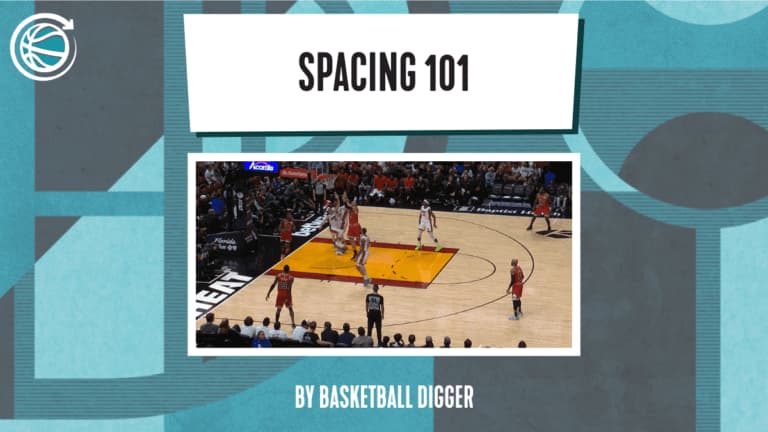
Spacing has changed the game. NBA offenses today look nothing like they did in the ’90s—more threes, better efficiency, and smarter shot selection. But why? The key lies in how teams use space to create and capitalize on advantages.
Mar 31, 2025
Simon Caret
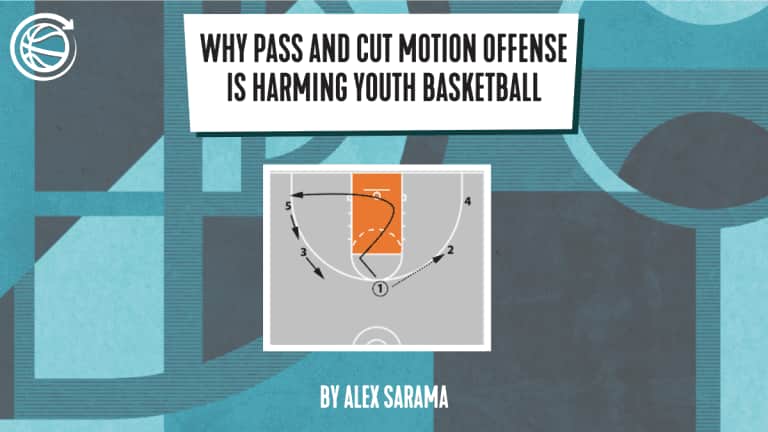
This article breaks down why pass and cut motion offense limits youth player development, and explores better ways to teach spacing, decision-making, and offensive creativity.
May 1, 2024
Alex Sarama
Approaches within the basketball industry are predominantly based upon experiential knowledge and traditions.


