

Guided Defense: Build Elite Basketball Finishers at the Rim




Guided defense is one of the most effective ways to help basketball players build real finishing dexterity at the rim.
If you observe a traditional basketball practice, you will likely see players standing in neat lines, executing unopposed finishing moves against air or casually weaving around static orange cones. Coaches often emphasize perfect footwork, demanding that players replicate the exact same Eurostep, pro-hop, or reverse layup repeatedly. However, when these same players enter a live game, those rehearsed, robotic movements frequently fall apart the moment a help defender unexpectedly steps into their path.
In a real basketball game, finishing at the rim is an inherently chaotic, open skill. No two drives are ever exactly the same. To build truly elite, adaptable finishers, coaches must move away from memorized choreography and focus instead on developing dexterity. One of the most effective tools to achieve this without overwhelming the athlete is the implementation of “Guided Defense.”
The Illusion of “On-Air” Mastery
When players practice finishing 1-on-0, they are training their action capabilities without the critical perceptual information that dictates those actions in a game. This creates a dangerous illusion of competence. Players may look incredibly smooth in an empty gym, but without a defender to read, they are simply reciting a dead pattern.
Skills develop best when perception (seeing) and action (doing) are practiced together. We perceive to act, and we act to perceive. By taking the defense away entirely, coaches rob players of the opportunity to read the shifting landscape of the floor. In game situations, finishers must constantly process the angle, speed, and distance with which a help defender is closing in to contest the shot. If an athlete has only ever practiced an uncontested right-handed layup off their left foot, they will lack the movement vocabulary to contort their body, shoot off the “wrong” foot, or extend the ball away from a shot blocker.
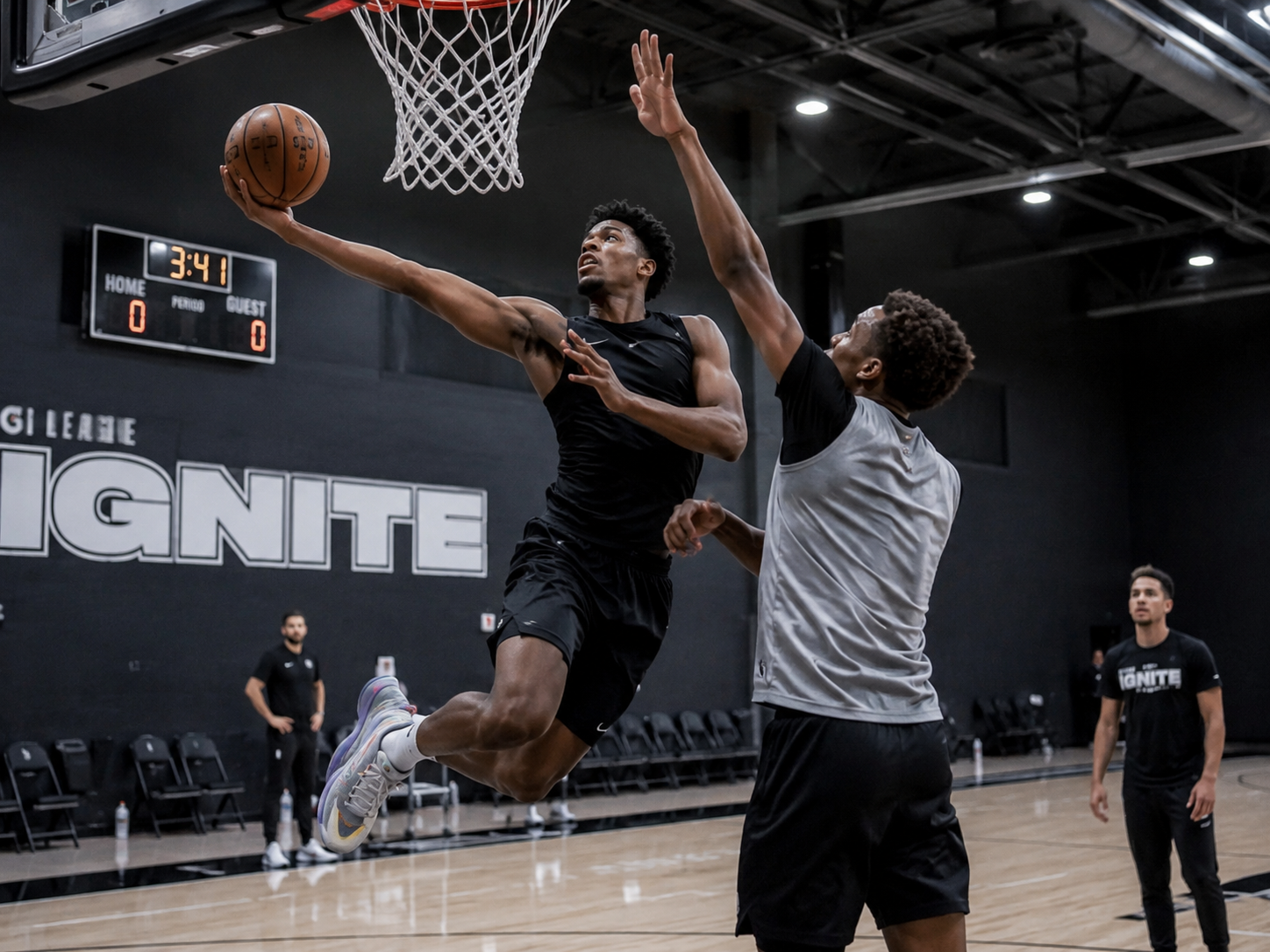
Basketball player practicing an acrobatic finish around a defender’s outstretched arms
Enter Guided Defense
Instead of taking the defense away entirely, coaches can reduce the pressure so the player can still practice reading the environment. Guided defense is when the defense is constrained in how they can defend an offensive player within a particular sequence or possession. The goal of guided defense is for players to develop functional movement solutions, simplify the task, or to teach a new concept that players are struggling with.
For professional teams and youth programs alike, guided defense is a fantastic way to move beyond the on-air practice styles which dominate the basketball industry. Without having to go fully live, which can sometimes push the challenge point too high for a player trying to refine a specific skill, guided defense serves as a powerful bridge. It provides a “safe uncertainty” that allows the offensive player to build confidence while still reacting to a live human body. Guided defense can be applied to almost any scenario, from post offense and perimeter drives to close-outs and pick-and-roll triggers.
Developing Dexterity: The “Smile” Finishing Game
To understand how guided defense actively builds dexterity, let us look at a practical small-sided game designed to improve finishing in the “smile” (the restricted area under the basket).
Instead of a traditional layup line, place an offensive player outside the smile with the ball. Place a guided defender inside the paint. The constraint for the defender is that they are not allowed to jump or aggressively try to block the shot; instead, they must hold their arms straight up, or even hold a basketball or medicine ball high above their head. The offensive player is given a maximum of two dribbles to attack the rim and must finish against this guided obstacle.
Technical demonstration of the Smile Finishing Game with guided defensive constraints
This specific guided constraint achieves three massive developmental goals organically:
1. Adjusting the Optimal Challenge Point
By putting the defender in a specific, disadvantaged position, you are providing the offense with the time and space to comfortably explore adaptable finishes. It slows down the overwhelming chaos of a full-blown help defender, allowing the offensive player to experiment with how they coordinate their body to protect the ball.
2. Discovering Extended Finishes
The game of basketball is often played within the frames of the shoulders, but the most adaptable finishers know how to explore outside that frame. Because the guided defender’s arms (or the medicine ball) are fixed high up, the offensive player naturally perceives this barrier. Without the coach ever stopping practice to lecture on technique, the player will organically discover how to use extended finishes, reaching around the defender’s body or using their inside hand to shield the ball from the contest.
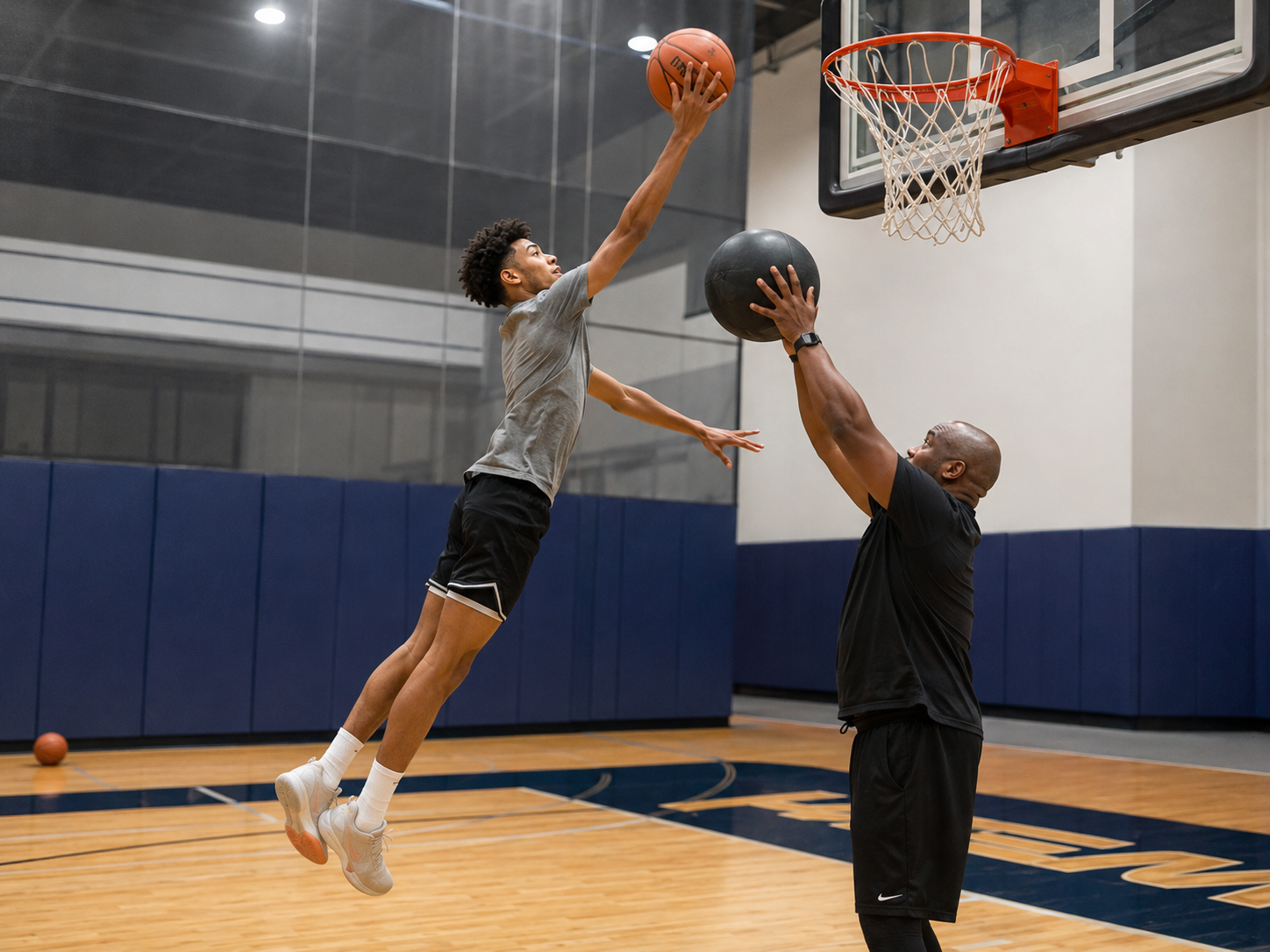
A coach/ guided defender using a medicine ball as a defensive obstacle in a finishing drill
Further Learning: Deepening Your Practice Design
If you are eager to explore how to implement these constraints and move away from block-style, on-air training, I highly recommend listening to Episode 122 of The Transforming Basketball Podcast.
In this episode, coaches Kerri Kuzbyt and Francois Lubino offer a masterful breakdown of how to use guided defenders to build highly adaptable finishers. They dive deep into the specific mechanics of how strategically constraining a defender’s arms challenges the offensive player to grab distance, coordinate their body, and discover creative finishing angles outside their normal shoulder frame. It is a fantastic, practical resource that seamlessly blends ecological theory with immediate, on-court application.
Conclusion
Dexterity is not built by rehearsing a singular, rigid movement in an empty gym. It is forged in the fire of interactive problem-solving. By utilizing guided defense, you provide your athletes with the perceptual information they need to read the game, while safely managing the complexity of the environment.
Guided defense is something that coaches can immediately implement into their practice design. It can be used in any activity: from 1-on-1 to 3-on-3 and 5-on-5. Stop coaching your players to look like robots executing a predetermined move. Ditch the cones, add a constrained defender, and watch your players organically develop the elite dexterity required to finish through the chaos of live competition.

Guided defense is one of the most effective ways to help basketball players build real finishing dexterity at the rim.
If you observe a traditional basketball practice, you will likely see players standing in neat lines, executing unopposed finishing moves against air or casually weaving around static orange cones. Coaches often emphasize perfect footwork, demanding that players replicate the exact same Eurostep, pro-hop, or reverse layup repeatedly. However, when these same players enter a live game, those rehearsed, robotic movements frequently fall apart the moment a help defender unexpectedly steps into their path.
In a real basketball game, finishing at the rim is an inherently chaotic, open skill. No two drives are ever exactly the same. To build truly elite, adaptable finishers, coaches must move away from memorized choreography and focus instead on developing dexterity. One of the most effective tools to achieve this without overwhelming the athlete is the implementation of “Guided Defense.”
The Illusion of “On-Air” Mastery
When players practice finishing 1-on-0, they are training their action capabilities without the critical perceptual information that dictates those actions in a game. This creates a dangerous illusion of competence. Players may look incredibly smooth in an empty gym, but without a defender to read, they are simply reciting a dead pattern.
Skills develop best when perception (seeing) and action (doing) are practiced together. We perceive to act, and we act to perceive. By taking the defense away entirely, coaches rob players of the opportunity to read the shifting landscape of the floor. In game situations, finishers must constantly process the angle, speed, and distance with which a help defender is closing in to contest the shot. If an athlete has only ever practiced an uncontested right-handed layup off their left foot, they will lack the movement vocabulary to contort their body, shoot off the “wrong” foot, or extend the ball away from a shot blocker.
Basketball player practicing an acrobatic finish around a defender’s outstretched arms
Enter Guided Defense
Instead of taking the defense away entirely, coaches can reduce the pressure so the player can still practice reading the environment. Guided defense is when the defense is constrained in how they can defend an offensive player within a particular sequence or possession. The goal of guided defense is for players to develop functional movement solutions, simplify the task, or to teach a new concept that players are struggling with.
For professional teams and youth programs alike, guided defense is a fantastic way to move beyond the on-air practice styles which dominate the basketball industry. Without having to go fully live, which can sometimes push the challenge point too high for a player trying to refine a specific skill, guided defense serves as a powerful bridge. It provides a “safe uncertainty” that allows the offensive player to build confidence while still reacting to a live human body. Guided defense can be applied to almost any scenario, from post offense and perimeter drives to close-outs and pick-and-roll triggers.
Developing Dexterity: The “Smile” Finishing Game
To understand how guided defense actively builds dexterity, let us look at a practical small-sided game designed to improve finishing in the “smile” (the restricted area under the basket).
Instead of a traditional layup line, place an offensive player outside the smile with the ball. Place a guided defender inside the paint. The constraint for the defender is that they are not allowed to jump or aggressively try to block the shot; instead, they must hold their arms straight up, or even hold a basketball or medicine ball high above their head. The offensive player is given a maximum of two dribbles to attack the rim and must finish against this guided obstacle.
Technical demonstration of the Smile Finishing Game with guided defensive constraints
This specific guided constraint achieves three massive developmental goals organically:
1. Adjusting the Optimal Challenge Point
By putting the defender in a specific, disadvantaged position, you are providing the offense with the time and space to comfortably explore adaptable finishes. It slows down the overwhelming chaos of a full-blown help defender, allowing the offensive player to experiment with how they coordinate their body to protect the ball.
2. Discovering Extended Finishes
The game of basketball is often played within the frames of the shoulders, but the most adaptable finishers know how to explore outside that frame. Because the guided defender’s arms (or the medicine ball) are fixed high up, the offensive player naturally perceives this barrier. Without the coach ever stopping practice to lecture on technique, the player will organically discover how to use extended finishes, reaching around the defender’s body or using their inside hand to shield the ball from the contest.
A coach/ guided defender using a medicine ball as a defensive obstacle in a finishing drill
Further Learning: Deepening Your Practice Design
If you are eager to explore how to implement these constraints and move away from block-style, on-air training, I highly recommend listening to Episode 122 of The Transforming Basketball Podcast.
In this episode, coaches Kerri Kuzbyt and Francois Lubino offer a masterful breakdown of how to use guided defenders to build highly adaptable finishers. They dive deep into the specific mechanics of how strategically constraining a defender’s arms challenges the offensive player to grab distance, coordinate their body, and discover creative finishing angles outside their normal shoulder frame. It is a fantastic, practical resource that seamlessly blends ecological theory with immediate, on-court application.
Conclusion
Dexterity is not built by rehearsing a singular, rigid movement in an empty gym. It is forged in the fire of interactive problem-solving. By utilizing guided defense, you provide your athletes with the perceptual information they need to read the game, while safely managing the complexity of the environment.
Guided defense is something that coaches can immediately implement into their practice design. It can be used in any activity: from 1-on-1 to 3-on-3 and 5-on-5. Stop coaching your players to look like robots executing a predetermined move. Ditch the cones, add a constrained defender, and watch your players organically develop the elite dexterity required to finish through the chaos of live competition.




check what's trending

What is ecological dynamics and how is it connected to a constraints-led approach?
Dec 8, 2025
George Vaz

Are you searching for the best small sided games (SSGs) to improve your basketball practices? Want to replace boring, low-transfer drills with competitive games that actually develop player decision-making and in-game skills?
In this post, I’m sharing my top 5 favorite small-sided basketball games—designed to teach core concepts like closeouts, pick-and-roll, advantage creation, and transition offense and defense. These basketball SSGs are intense, purposeful, and built around real-game actions.
Whether you're coaching youth basketball, high school, or pros, these top small sided games will make your sessions more effective, more engaging, and more fun—for both players and coaches.
Let’s break down each game and how it can transform your practices.
Aug 4, 2025
George Vaz

Whether you’re coaching in the NBA, EuroLeague, or youth basketball, one thing remains universally true: the worst transition offense is still more efficient than the best half-court offense. Yet, many teams still struggle to fully capitalize on transition opportunities, often opting to slow down the game instead of pushing the pace. The question is, why? By running more intentionally, teams can create easier scoring opportunities. So why do some teams hesitate?
Apr 7, 2025
George Vaz
Spacing has changed the game. NBA offenses today look nothing like they did in the ’90s—more threes, better efficiency, and smarter shot selection. But why? The key lies in how teams use space to create and capitalize on advantages.
Mar 31, 2025
Simon Caret
This article breaks down why pass and cut motion offense limits youth player development, and explores better ways to teach spacing, decision-making, and offensive creativity.
May 1, 2024
Alex Sarama
Approaches within the basketball industry are predominantly based upon experiential knowledge and traditions.


