

Understanding Survivorship Bias





Very early in my career as an assistant coach, I remember an instance during a youth training session when the head coach shouted at a player right after he missed a one-handed pass, saying that in basketball the pass should be made with two hands, because that way the chances of error are lower. I kept thinking about that and then asked: why should players learn to pass first with two hands and only later with one? Is there any reason for that? He replied that it was easier to learn how to pass the ball with two hands first and, from there, move on to passing with one hand.
That answer did not satisfy me, so I pushed a little further, arguing that in certain game situations, passing with one hand might be the only viable option. He then told me that a very famous coach taught that way; he had been an athlete under that coach, learned that way, and had always been very successful. After that argument, I, being a young assistant just starting my career, fell silent. At the time, I felt very frustrated with that answer. After all, I was new to coaching, and like many beginners, I believed I knew everything that was necessary to know.
Today, however, I feel a great deal of empathy for that coach, because throughout the rest of my journey I have made the same mistake many times (and still catch myself making it): assuming that something that is very successful, and that has been or is taught by great coaches, must work in exactly the same way for everyone, in all contexts, at all times. This problem is more common than we imagine, and it has a name: survivorship bias.
According to Chang (2024), survivorship bias refers to a cognitive fallacy that occurs when attention is disproportionately directed toward individuals or items that have managed to survive a selection process, while those that did not survive are ignored, mainly due to their lower visibility. In other words, the major problem with using the success of other people’s methods as a reference is that we become blind to the failures of those same methods, and the saying “history is told only by the winners” materializes right in front of us.
Thomas Kuhn, a famous philosopher of science, makes it clear that this bias appears even in scientific projects, suggesting that even in an extremely objective field (science), which seeks the best possible explanation, it is difficult to accept and do something different, even when there is clear evidence in favor of a new paradigm. I do not intend, with this text, to claim that we should discard methods that have been successful or that everything done so far by brilliant coaches and trainers should be thrown away. Quite the opposite: we should continue the journey with the help of these people, but with an attentive, critical, and contextualized perspective, since it is very easy to fall into the trap of “this is how it has always been done.”
Writing this, however, is almost a personal reminder, because my tendency is to believe that I need to know the right way to play or to teach, and once I discover that way, I must protect it as much as possible, disagreeing with anything that goes against what I think. But from the moment I understand basketball through the lens of ecological dynamics and realize that the game itself emerges from complex relationships among its participants, how can I believe that there is a ready-made answer? How can I guarantee that the way I teach will always work? Perhaps these questions are poorly formulated. Perhaps it is necessary to stop using a lens that pushes me toward fixed answers and instead embrace a perspective of complexity, in which a good coach is not the one who knows more or better, but the one who has the courage to explore new paths and the humility to learn in different ways.
References
-
CHANG, X. Blinding the blind: The perils of survivorship bias. Advances in Economics and Political Science, v. 72, p. 55–59, 2024.
-
KUHN, Thomas S. The Structure of Scientific Revolutions. Chicago: University of Chicago Press, 1997.




Very early in my career as an assistant coach, I remember an instance during a youth training session when the head coach shouted at a player right after he missed a one-handed pass, saying that in basketball the pass should be made with two hands, because that way the chances of error are lower. I kept thinking about that and then asked: why should players learn to pass first with two hands and only later with one? Is there any reason for that? He replied that it was easier to learn how to pass the ball with two hands first and, from there, move on to passing with one hand.
That answer did not satisfy me, so I pushed a little further, arguing that in certain game situations, passing with one hand might be the only viable option. He then told me that a very famous coach taught that way; he had been an athlete under that coach, learned that way, and had always been very successful. After that argument, I, being a young assistant just starting my career, fell silent. At the time, I felt very frustrated with that answer. After all, I was new to coaching, and like many beginners, I believed I knew everything that was necessary to know.
Today, however, I feel a great deal of empathy for that coach, because throughout the rest of my journey I have made the same mistake many times (and still catch myself making it): assuming that something that is very successful, and that has been or is taught by great coaches, must work in exactly the same way for everyone, in all contexts, at all times. This problem is more common than we imagine, and it has a name: survivorship bias.
According to Chang (2024), survivorship bias refers to a cognitive fallacy that occurs when attention is disproportionately directed toward individuals or items that have managed to survive a selection process, while those that did not survive are ignored, mainly due to their lower visibility. In other words, the major problem with using the success of other people’s methods as a reference is that we become blind to the failures of those same methods, and the saying “history is told only by the winners” materializes right in front of us.
Thomas Kuhn, a famous philosopher of science, makes it clear that this bias appears even in scientific projects, suggesting that even in an extremely objective field (science), which seeks the best possible explanation, it is difficult to accept and do something different, even when there is clear evidence in favor of a new paradigm. I do not intend, with this text, to claim that we should discard methods that have been successful or that everything done so far by brilliant coaches and trainers should be thrown away. Quite the opposite: we should continue the journey with the help of these people, but with an attentive, critical, and contextualized perspective, since it is very easy to fall into the trap of “this is how it has always been done.”
Writing this, however, is almost a personal reminder, because my tendency is to believe that I need to know the right way to play or to teach, and once I discover that way, I must protect it as much as possible, disagreeing with anything that goes against what I think. But from the moment I understand basketball through the lens of ecological dynamics and realize that the game itself emerges from complex relationships among its participants, how can I believe that there is a ready-made answer? How can I guarantee that the way I teach will always work? Perhaps these questions are poorly formulated. Perhaps it is necessary to stop using a lens that pushes me toward fixed answers and instead embrace a perspective of complexity, in which a good coach is not the one who knows more or better, but the one who has the courage to explore new paths and the humility to learn in different ways.
References
-
CHANG, X. Blinding the blind: The perils of survivorship bias. Advances in Economics and Political Science, v. 72, p. 55–59, 2024.
-
KUHN, Thomas S. The Structure of Scientific Revolutions. Chicago: University of Chicago Press, 1997.





check what's trending

What is ecological dynamics and how is it connected to a constraints-led approach?
Dec 8, 2025
George Vaz

Are you searching for the best small sided games (SSGs) to improve your basketball practices? Want to replace boring, low-transfer drills with competitive games that actually develop player decision-making and in-game skills?
In this post, I’m sharing my top 5 favorite small-sided basketball games—designed to teach core concepts like closeouts, pick-and-roll, advantage creation, and transition offense and defense. These basketball SSGs are intense, purposeful, and built around real-game actions.
Whether you're coaching youth basketball, high school, or pros, these top small sided games will make your sessions more effective, more engaging, and more fun—for both players and coaches.
Let’s break down each game and how it can transform your practices.
Aug 4, 2025
George Vaz

Whether you’re coaching in the NBA, EuroLeague, or youth basketball, one thing remains universally true: the worst transition offense is still more efficient than the best half-court offense. Yet, many teams still struggle to fully capitalize on transition opportunities, often opting to slow down the game instead of pushing the pace. The question is, why? By running more intentionally, teams can create easier scoring opportunities. So why do some teams hesitate?
Apr 7, 2025
George Vaz
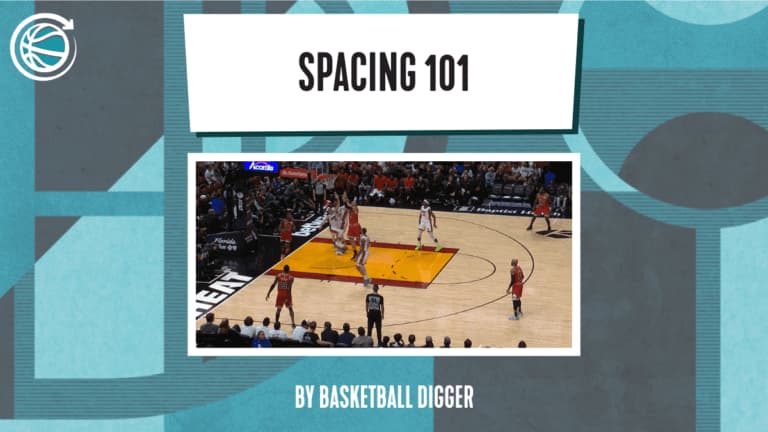
Spacing has changed the game. NBA offenses today look nothing like they did in the ’90s—more threes, better efficiency, and smarter shot selection. But why? The key lies in how teams use space to create and capitalize on advantages.
Mar 31, 2025
Simon Caret
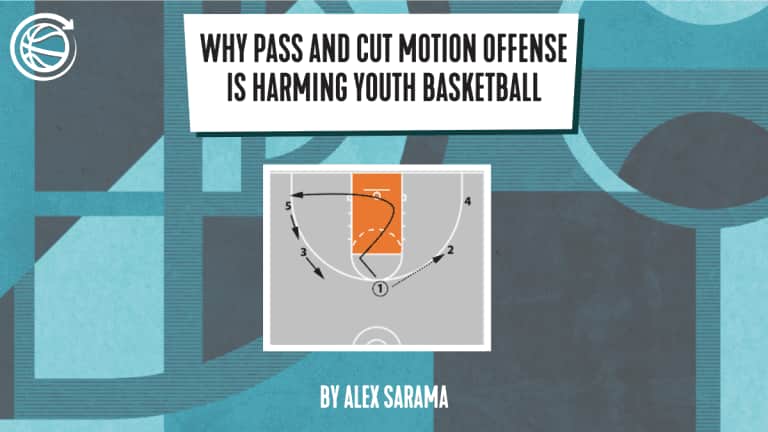
This article breaks down why pass and cut motion offense limits youth player development, and explores better ways to teach spacing, decision-making, and offensive creativity.
May 1, 2024
Alex Sarama
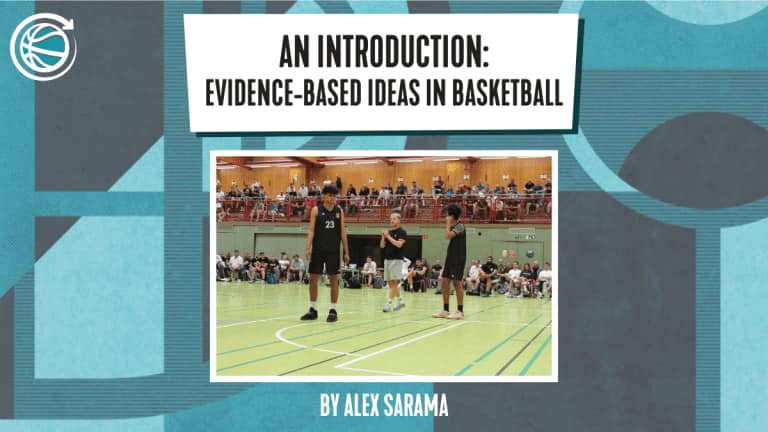
Approaches within the basketball industry are predominantly based upon experiential knowledge and traditions.


