
Ideia principal para treinadores
Ecological dynamics brings together ecological psychology and dynamical systems theory to explain movement in context. For a basketball coach, the practical question is how the player and environment interact. The constraints-led approach applies that perspective to the design of learning activities.
Ler o guia: Skill Acquisition in BasketballWhat ecological dynamics looks like in a 2-on-1
Two attackers face one defender at the basket. If the defender commits to the ball, a pass may open. If the defender stays with the receiver, the ball-handler may have room to finish. As the attackers move, they also change what the defender can cover.
| Concept | What the coach can observe |
|---|---|
| Affordance | A passing window is available relative to the passer’s reach, the receiver’s movement and the defender’s position. |
| Perception-action coupling | The handler’s drive draws the defender, changing the information for the next action. |
| Self-organization | The players coordinate their movement in response to the task without the coach prescribing every step. |
| Constraints | The players’ capabilities, the court and equipment, and the game’s rules shape the opportunities. |
If a young player cannot pass across the available distance, telling them to make a faster decision does not solve the task. Bring the receiver closer or adjust the defender’s freedom, then observe again. Episodes 2 and 28 connect these opportunities with what the individual can actually do.
EP2: Why Should All Coaches be Using Methods Backed by Science?
EP28: How Should You Adapt Constraints in Practice
Ecological dynamics explains skill through the relationship between a player and the environment. In basketball, a player’s movement changes the defender’s response, which changes the next opportunity to shoot, pass or drive. Practice design starts with those interactions.
What is Ecological Dynamics?
Ecological dynamics brings together ecological psychology and dynamical systems theory to explain perception, action and learning. Keith Davids and colleagues have helped develop its application to sport. The diagram below introduces terms from both fields.
Dynamical Systems Theory + Ecological Psychology This is a great diagram from Alex Sarama’s book, explaining the key terms within both fields.
Self-organization is a key part of dynamical systems theory. Instead of players following pre-programmed movements, self-organization is the idea that basketball players organize their bodies naturally to solve movement problems. In other words, they are not recalling stored techniques in the brain in order to move. The irony is that many coaches coach their players out of effective self-organizational techniques by trying to impart “the correct technique.”
Perception-action coupling comes from ecological psychology. It's the idea that perception informs action, and action is always shaping perception. This continuous loop is crucial for a player’s interactions within the game environment.
So where does the The Constraints-Led Approach (CLA) come in?
A CLA is a way of coaching that is based upon an ecological dynamics framework. Therefore, you have to understand an ecological approach if you want to be an effective CLA coach.
A CLA challenges traditional coaching methods that rely heavily on isolated drills and repetition without context. Instead, using CLA principles means creating “representative” learning environments where players experience live opponents to develop their skills effectively.
The Role of the Coach in Practice
An ecological approach has implications for the role of the coach in practice. The coach’s job is to design activities which contain specific affordances. An affordance is, simply put, an opportunity for action. The coach manipulates the constraints (see Newell’s constraints model below) to create varied affordances for the players to act on. The idea of constraints is that they may make some affordances enticing, and some less so!
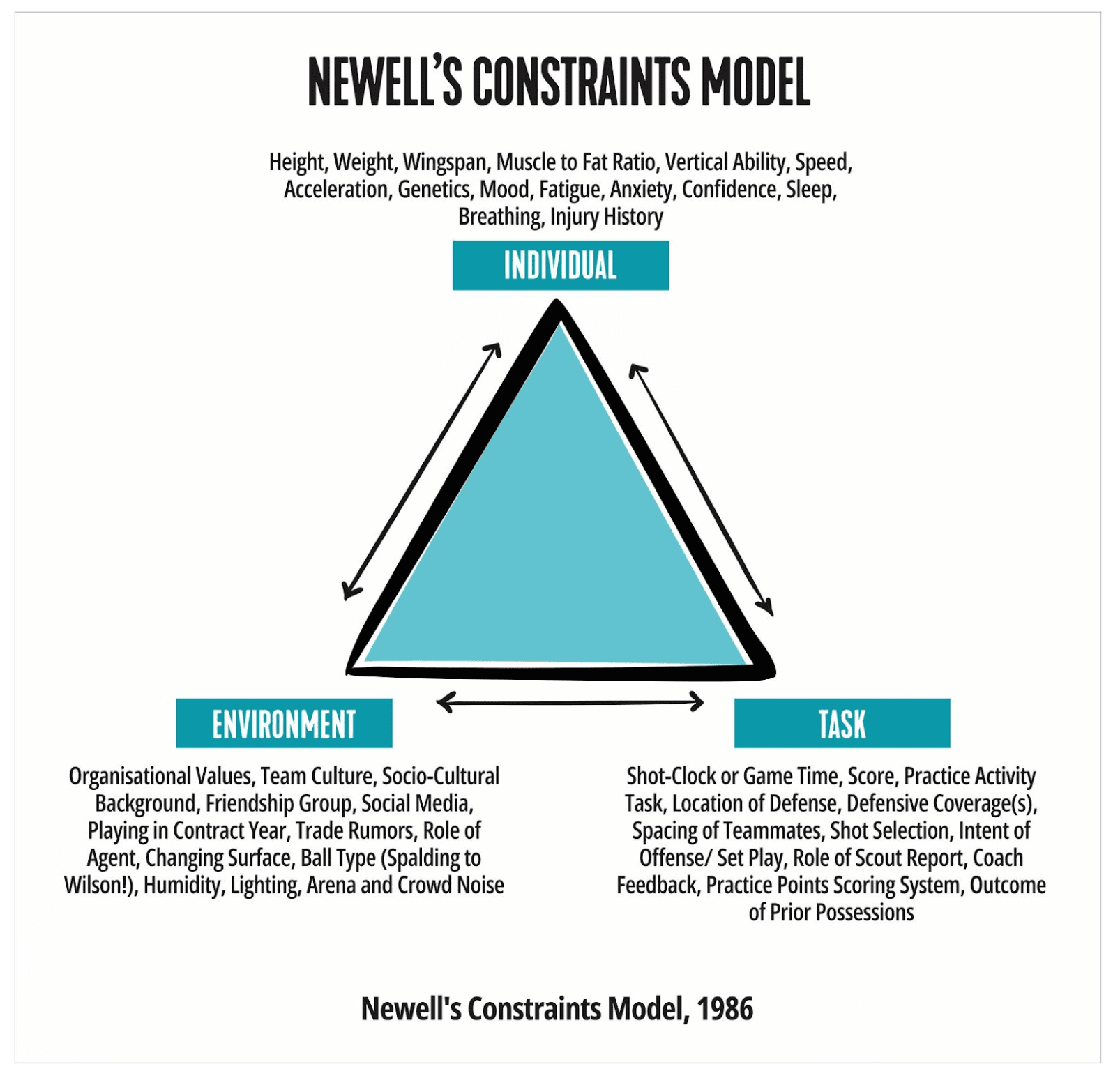
By manipulating constraints, it creates varied environments for the players to perceive and act on the new affordances that present themselves.
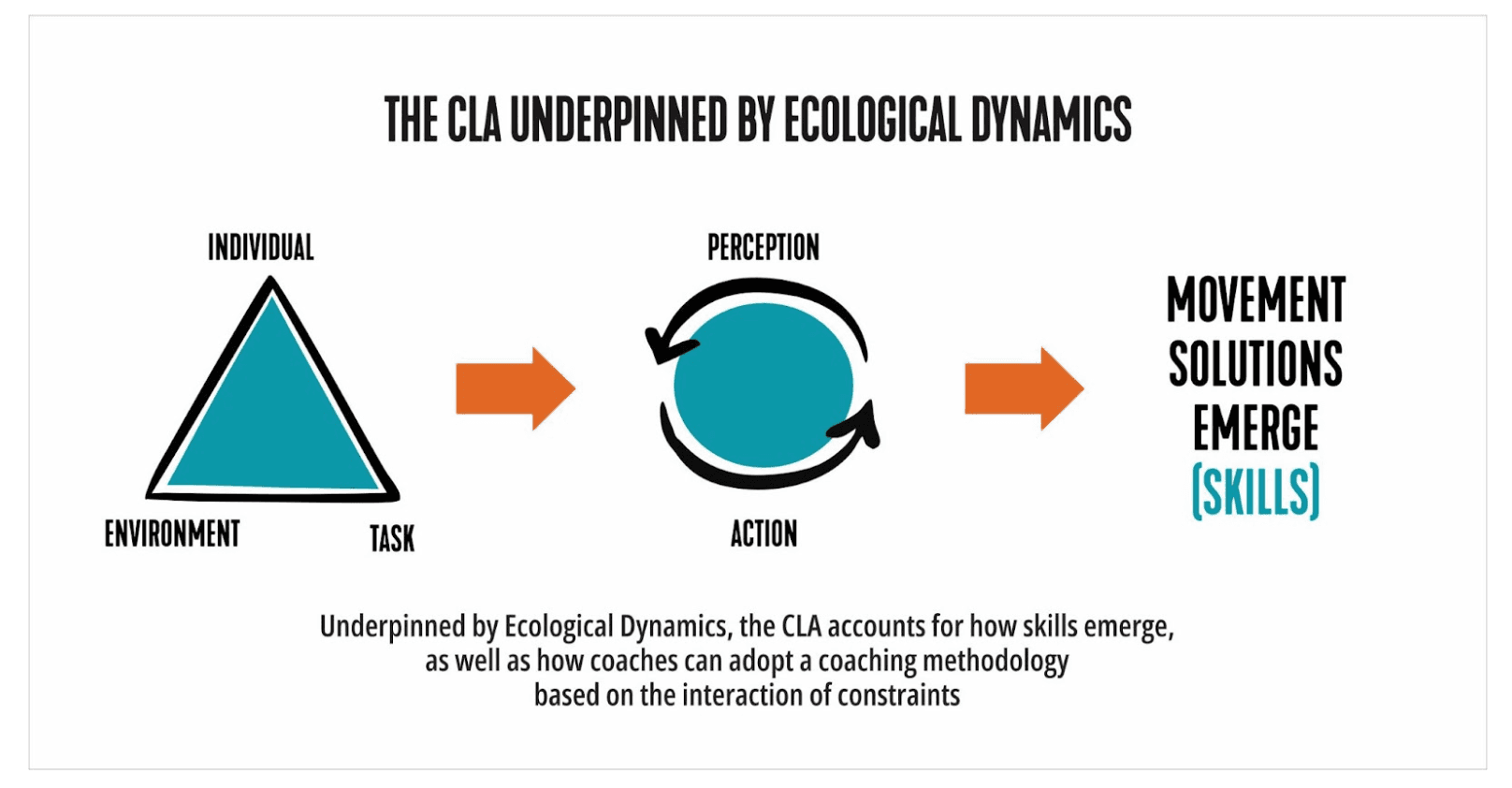
An effective CLA coach manipulates constraints well enough so that players are seeing the attractive affordance available to them, while finding ways to act upon them with functional solutions. A common misconception of a CLA is that the coach just creates live games and let’s anything happen. This couldn’t be further from the truth!
Implementing Ecological Dynamics in Training
These five principles can be effective in helping you use a CLA in your next practice…
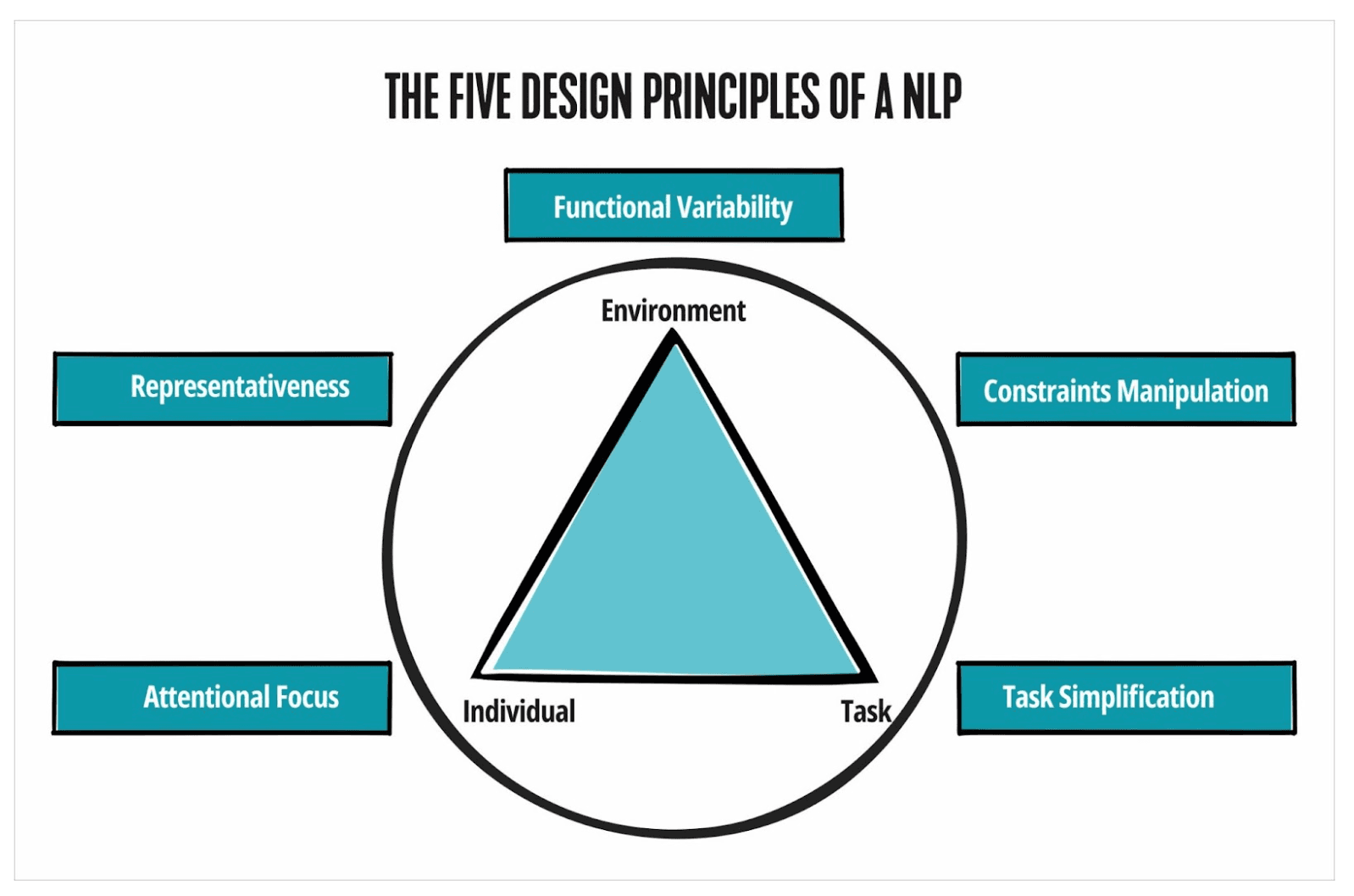
- Representative Learning Design (Representativeness): Make practice more game-like to improve transfer performance. Do players encounter the varied affordances they will encounter in competition?
- Manipulation of Constraints: Adjust constraints to shape player behavior without prescribing highly specific movement solutions. Manipulate constraints for a reason.
- Encouraging Exploratory Behavior (Functional Variability): Promote creativity by letting players discover movement solutions on their own.
- External vs Internal feedback (Attentional Focus): Focus players’ attention on outcomes, not internal mechanics. For example, shoot the ball higher instead of bend your knees.
- Task simplification: Adapt your activities to meet each player’s unique needs. If too challenging, simplify the task with constraints instead of removing the opponent.
What Ecological Dynamics Is NOT
- Not About Using Breakdowns and Rigid Techniques – Unlike traditional models that promote the coach as the master instructor and a one-size-fits-all approach to techniques, ecological dynamics recognizes that different movement solutions can be equally effective depending on the individual and situation.
- Not a Free-For-All Approach – While this approach values exploration and adaptability, an ecological framework does not suggest that athletes should just figure things out randomly. Coaches guide the process by manipulating constraints to encourage learning.
Conclusion
For a coach, the practical question is which information the player needs to solve the problem. Keep that information in the task, change the constraints with an intention and observe how the player adapts.
If you would like to learn more about Ecological Dynamics and the CLA in basketball check out the Amazon best-selling book.
Continue evoluindo como treinador.
Conecte estas ideias ao Success Pathway, à videoteca de atividades, à comunidade de treinadores e aos encontros mensais ao vivo.
Conheça a assinatura