

Newell’s Constraints: Practical Basketball Constraints




What Are Practical Basketball Constraints?
Practical basketball constraints are one of the most powerful changes a coach can achieve is to shift from being an instructor and telling the players what to do, to becoming a facilitator and designing environments where the players discover how to do it. That’s where constraints come in.
In this post, we’ll share how you can use Newell’s Constraints Model to guide your practice design and develop more skilful players.
What is Newell’s Constraints Model?
Newell’s Constraints Model (1986) explains how movement behavior emerges from the interaction of three types of constraints:
Individual”: Player-specific factors
Environmental: Physical and socio-cultural factors
Task: Specific to the activity or game
As a coach we have the most control over the task constraints. These are most relevant when we are designing small-sided games and anticipating what will happen in the game so we can prepare to effectively manipulate the constraints..
An example of an individual constraint is fatigue. If we want to practice shooting free throws like we would in a game, perhaps we should not prioritize shooting them outside of the context of a game. Instead, you can choose to play shorter games where the winning team must make 4 out of 5 free throws to seal the win or avoid a consequence.
Practical Basketball Constraints You Can Use
Practical basketball constraints are meant to guide behavior without telling the players exactly how to move or play.
In an effort to make the constraints easier to visualize in game, we have included small-sided game examples.
You can find these games and more by downloading our small-sided games book worth $35, but available to you completely FREE.
4-on-3, Three Trips
Constraints:
- Shot clock: Can be used to speed up decision making.
- Add a 6 second shot clock to a 4-on-3 game.
- Reinforce dominoes concepts for the team with 4 players
- Turnover if a player catches the ball in the lava, makes no zero second decision mid-dominoes, or spaces to allow 1 defender to guard 2.
- Junk defenses: promote the trail trap
- If the team with 4 players is able to trap, steal and score, they get double points
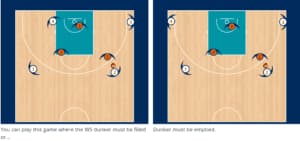
4-on-3 Dominoes HC, Offense Stays Until a Miss or Turnover
Constraints:
- Shot selection:
- Non ROB (range, open, balanced) shots = turnover
- Lay-ups = double points
- Bursts: if there are more players waiting and watching, have them come in as defense after every score. This forces your players to stay attentive, even while they are out.
- 1 Can’t guard 2:
- Score from ghost cuts = double points
- Players must ‘push, pull, hold’ and react to the ball or it is a turnover
- Individualized task constraints:
- Golden scorer: points from this player are worth double
- The Assist king or queen: every assist from this player is worth double
1-on-1 Close-out Start
Constraints:
- Different closeouts: hot, cold, normal
- Players stay for 3 reps, must give all 3 close-out types
- Limit dribbles
- 2 dribbles max
- Change scoring systems:
- Make the 3 point shot more enticing by increasing its value. E.g. 3 points for a made 3, 1 point for a lay up, 0 points for anything else.
- OR you can ONLY shoot 3s and then you can combine constraints…
- Reward the defense:
- A blocked shot = 4 points. Players will then work more on escape dribbles and shot fakes to be more deceptive as the defense becomes more aggressive.
- Different start locations
- Defense passes the ball from different locations
- Offense has to run into/ step into the shot
Environmental constraints you may harness:
- Music
- Simulated crowd noises
- No verbals: see how your players make connections when they cant communicate (could even make this an individualized constraint for certain players)
Individual constraints to consider:
- Fatigue: using more full-court games and quickly transitioning to half-court games, before going back to full-court
- Play VS different players constantly. This allows for more movement solutions to emerge, for example playing against a combination of taller, shorter, faster, slower defenders
- Scoring bonuses for certain players. For example, if you have a really good 3PT shooter, their threes are double points. This helps the defense recognize who is a shooter to run them off the line or chase them on off-ball screens, while also helping that player’s team on offense find them open shots. This idea can be adapted for any principle of play you want to emphasize for any players.
Why This Matters
The effective manipulation of constraints is the single most powerful tool basketball coaches can use in practice. It allows coaches the ability to create a very specific game environment where the actions they are after will organically emerge. This is turn:
- Encourages problem-solving and adaptability
- Promotes the development and functional perception-action couplings
- Reduces over-coaching by promoting self-organization
- Creates game-representative learning environments
See how Transforming Clinician George Vaz manipulates the constraints by changing the “type of finish” that players can use.
Bonus Tip
When designing a constraint, ask yourself:
“What behavior am I trying to encourage or discourage, and how can I manipulate the task, environment, or individual factors to nudge that change?”
“Am I constantly repeating the same instructions?” If so, consider adding a constraint so IF players DO NOT follow your instructions, there will be a consequence.

What Are Practical Basketball Constraints?
Practical basketball constraints are one of the most powerful changes a coach can achieve is to shift from being an instructor and telling the players what to do, to becoming a facilitator and designing environments where the players discover how to do it. That’s where constraints come in.
In this post, we’ll share how you can use Newell’s Constraints Model to guide your practice design and develop more skilful players.
What is Newell’s Constraints Model?
Newell’s Constraints Model (1986) explains how movement behavior emerges from the interaction of three types of constraints:
Individual”: Player-specific factors
Environmental: Physical and socio-cultural factors
Task: Specific to the activity or game
As a coach we have the most control over the task constraints. These are most relevant when we are designing small-sided games and anticipating what will happen in the game so we can prepare to effectively manipulate the constraints..
An example of an individual constraint is fatigue. If we want to practice shooting free throws like we would in a game, perhaps we should not prioritize shooting them outside of the context of a game. Instead, you can choose to play shorter games where the winning team must make 4 out of 5 free throws to seal the win or avoid a consequence.
Practical Basketball Constraints You Can Use
Practical basketball constraints are meant to guide behavior without telling the players exactly how to move or play.
In an effort to make the constraints easier to visualize in game, we have included small-sided game examples.
You can find these games and more by downloading our small-sided games book worth $35, but available to you completely FREE.
4-on-3, Three Trips
Constraints:
- Shot clock: Can be used to speed up decision making.
- Add a 6 second shot clock to a 4-on-3 game.
- Reinforce dominoes concepts for the team with 4 players
- Turnover if a player catches the ball in the lava, makes no zero second decision mid-dominoes, or spaces to allow 1 defender to guard 2.
- Junk defenses: promote the trail trap
- If the team with 4 players is able to trap, steal and score, they get double points
4-on-3 Dominoes HC, Offense Stays Until a Miss or Turnover
Constraints:
- Shot selection:
- Non ROB (range, open, balanced) shots = turnover
- Lay-ups = double points
- Bursts: if there are more players waiting and watching, have them come in as defense after every score. This forces your players to stay attentive, even while they are out.
- 1 Can’t guard 2:
- Score from ghost cuts = double points
- Players must ‘push, pull, hold’ and react to the ball or it is a turnover
- Individualized task constraints:
- Golden scorer: points from this player are worth double
- The Assist king or queen: every assist from this player is worth double
1-on-1 Close-out Start
Constraints:
- Different closeouts: hot, cold, normal
- Players stay for 3 reps, must give all 3 close-out types
- Limit dribbles
- 2 dribbles max
- Change scoring systems:
- Make the 3 point shot more enticing by increasing its value. E.g. 3 points for a made 3, 1 point for a lay up, 0 points for anything else.
- OR you can ONLY shoot 3s and then you can combine constraints…
- Reward the defense:
- A blocked shot = 4 points. Players will then work more on escape dribbles and shot fakes to be more deceptive as the defense becomes more aggressive.
- Different start locations
- Defense passes the ball from different locations
- Offense has to run into/ step into the shot
Environmental constraints you may harness:
- Music
- Simulated crowd noises
- No verbals: see how your players make connections when they cant communicate (could even make this an individualized constraint for certain players)
Individual constraints to consider:
- Fatigue: using more full-court games and quickly transitioning to half-court games, before going back to full-court
- Play VS different players constantly. This allows for more movement solutions to emerge, for example playing against a combination of taller, shorter, faster, slower defenders
- Scoring bonuses for certain players. For example, if you have a really good 3PT shooter, their threes are double points. This helps the defense recognize who is a shooter to run them off the line or chase them on off-ball screens, while also helping that player’s team on offense find them open shots. This idea can be adapted for any principle of play you want to emphasize for any players.
Why This Matters
The effective manipulation of constraints is the single most powerful tool basketball coaches can use in practice. It allows coaches the ability to create a very specific game environment where the actions they are after will organically emerge. This is turn:
- Encourages problem-solving and adaptability
- Promotes the development and functional perception-action couplings
- Reduces over-coaching by promoting self-organization
- Creates game-representative learning environments
See how Transforming Clinician George Vaz manipulates the constraints by changing the “type of finish” that players can use.
Bonus Tip
When designing a constraint, ask yourself:
“What behavior am I trying to encourage or discourage, and how can I manipulate the task, environment, or individual factors to nudge that change?”
“Am I constantly repeating the same instructions?” If so, consider adding a constraint so IF players DO NOT follow your instructions, there will be a consequence.




check what's trending

What is ecological dynamics and how is it connected to a constraints-led approach?
Dec 8, 2025
George Vaz

Are you searching for the best small sided games (SSGs) to improve your basketball practices? Want to replace boring, low-transfer drills with competitive games that actually develop player decision-making and in-game skills?
In this post, I’m sharing my top 5 favorite small-sided basketball games—designed to teach core concepts like closeouts, pick-and-roll, advantage creation, and transition offense and defense. These basketball SSGs are intense, purposeful, and built around real-game actions.
Whether you're coaching youth basketball, high school, or pros, these top small sided games will make your sessions more effective, more engaging, and more fun—for both players and coaches.
Let’s break down each game and how it can transform your practices.
Aug 4, 2025
George Vaz

Whether you’re coaching in the NBA, EuroLeague, or youth basketball, one thing remains universally true: the worst transition offense is still more efficient than the best half-court offense. Yet, many teams still struggle to fully capitalize on transition opportunities, often opting to slow down the game instead of pushing the pace. The question is, why? By running more intentionally, teams can create easier scoring opportunities. So why do some teams hesitate?
Apr 7, 2025
George Vaz
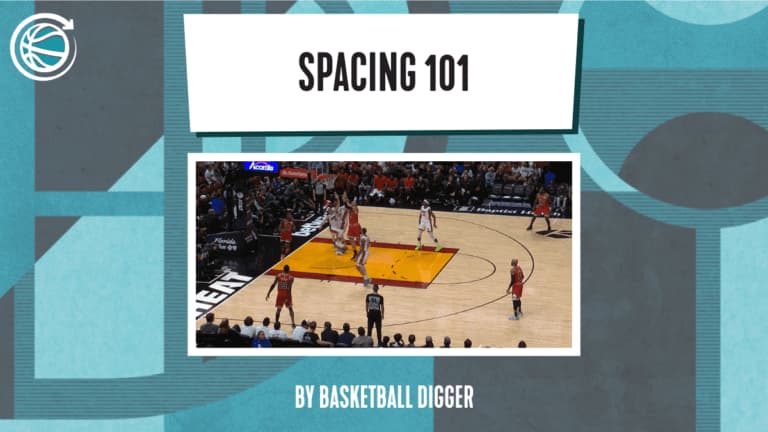
Spacing has changed the game. NBA offenses today look nothing like they did in the ’90s—more threes, better efficiency, and smarter shot selection. But why? The key lies in how teams use space to create and capitalize on advantages.
Mar 31, 2025
Simon Caret
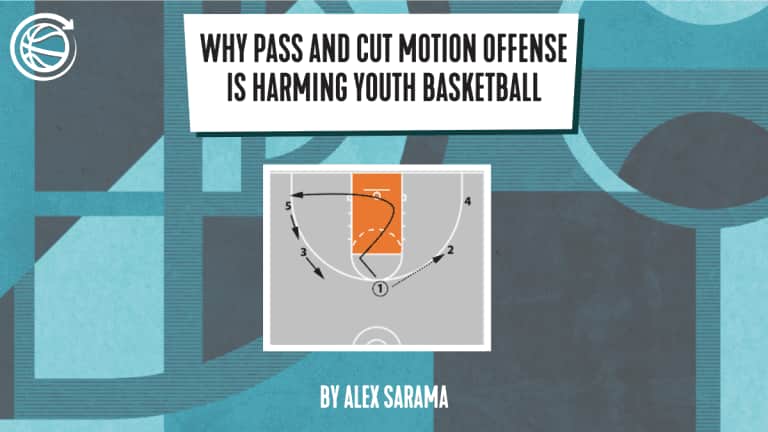
This article breaks down why pass and cut motion offense limits youth player development, and explores better ways to teach spacing, decision-making, and offensive creativity.
May 1, 2024
Alex Sarama
Approaches within the basketball industry are predominantly based upon experiential knowledge and traditions.


