

Better 1-on-1 Players: Move Away from “Check-Ball” and Embrace “Advantage-Starts”
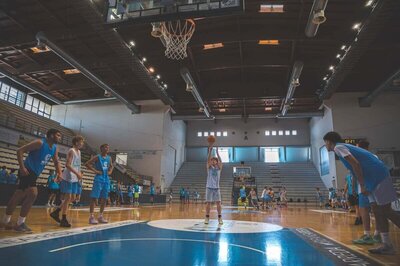




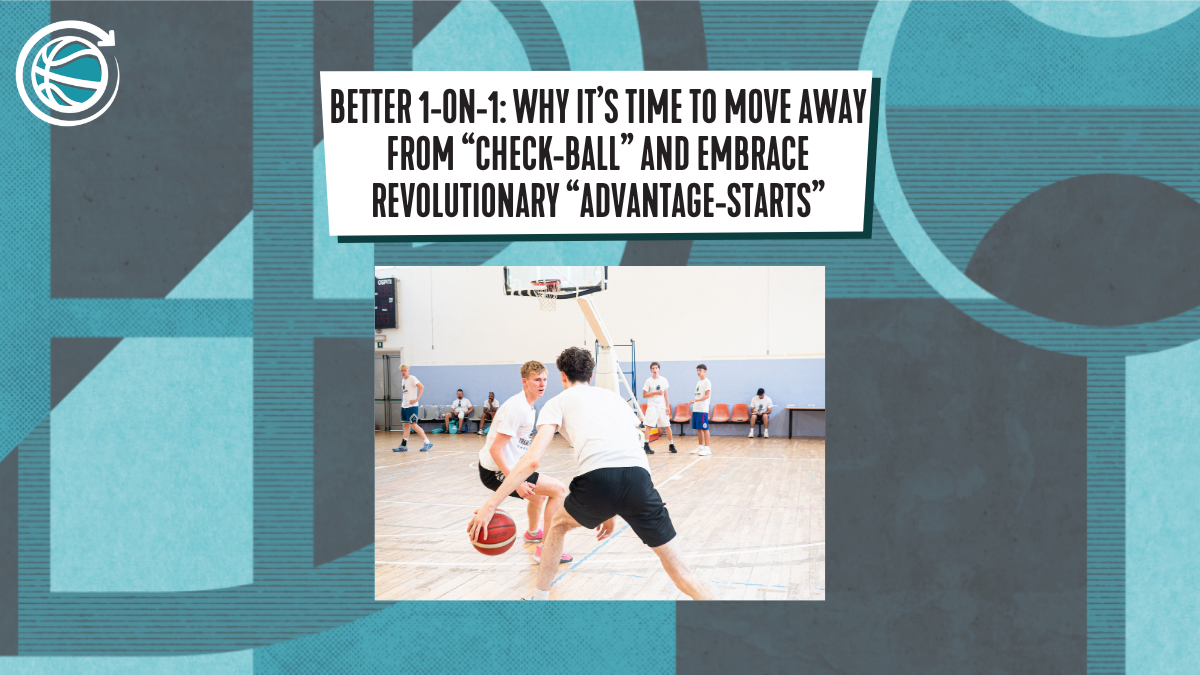
Walk into almost any open gym, driveway, or team practice around the world, and you will inevitably witness the same sequence: a player stands at the top of the key, bounces the ball to their defender, receives it back, and systematically squares up to attack. This “check-ball” 1-on-1 has been a staple of basketball culture for decades. It looks competitive, it feels like basketball, and it allows players to showcase their bag of isolation moves.
But if we evaluate this deeply ingrained habit through the lens of modern skill acquisition, a glaring issue emerges: the traditional “check-ball” 1-on-1 is shockingly unrepresentative of actual 5-on-5 basketball. Very rarely do players actually receive the ball with a live dribble. This is actually a strategic challenge that coaches have to figure out in higher levels of the game.
For youth players, if coaches want to build highly adaptable, lethal scorers, it is time to scrap the static “check-ball” ritual and replace it with advantage-start 1-on-1s. By reshaping the environment to mirror the dynamic reality of the sport, you can drastically accelerate your players’ development and ensure their skills actually translate to game day.
Types of Advantages:
1. Numerical Advantages: 4-on-3, 3-on-2, or 2-on-1 situations.
2. Positional (Situational) Advantages: Eg., close-outs, the space created after coming off a pick.
3. Individual (Match-Up) Advantages: differences in size, speed, or defensive ability between matched-up players. Eg., mouse or turtle.
4. Special Advantages: chaotic, broken-play situations. Eg., long rebound, transition.
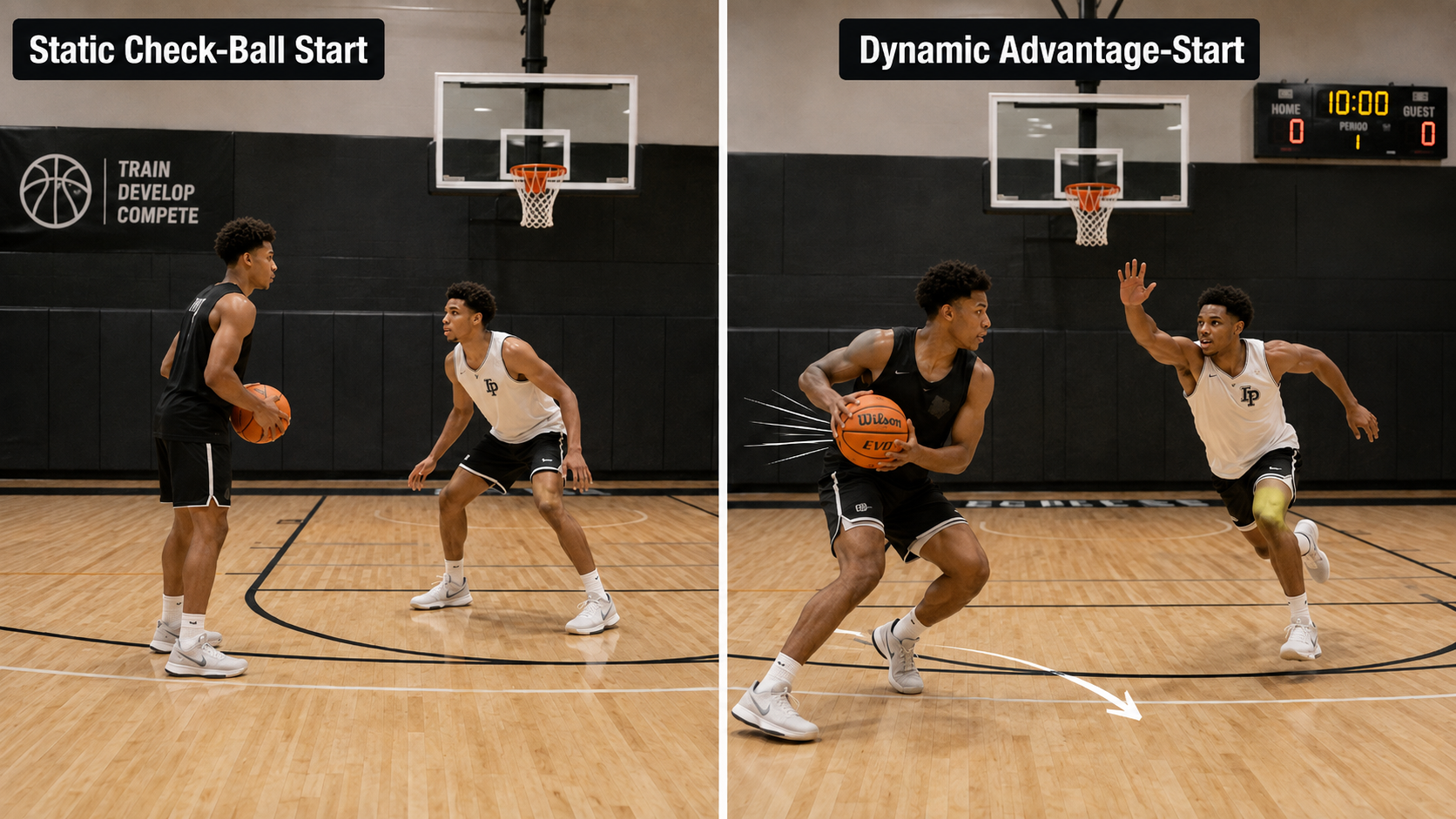
Comparison of traditional static check-ball basketball vs dynamic advantage-start training drills for skill acquisition.
The Problem with the “Check-Ball” Setup
In a live basketball game, how often does an offensive player catch the ball from a static, completely neutral stance, with the defender perfectly balanced and set right in front of them, waiting for the attack? The answer is almost never.
Basketball is a game of dynamic motion, continuous flow, and fleeting windows of opportunity. Players receive the ball on the move, attacking scrambled rotations, closing-out defenders, or while playing off transition advantages. Traditional “check-ball” 1-on-1 completely removes this crucial context. It builds an “illusion of competence,” where players become incredibly proficient at executing highly choreographed jab-steps and rehearsed dribble combos in a sterile environment.
However, because they are practicing these moves from a dead stop against a set defender, they are training action without authentic perception. They fail to develop the ability to read the shifting momentum of a live defender.
Pro-Tip: Check out this podcast episode between Adam and George on “functional” perception action couplings. “Perception-Action Coupling in Basketball.”
Representative Learning Design and Affordances
To build better 1-on-1 players, coaches must utilize Representative Learning Design—ensuring that the practice task looks, feels, and acts like the real game.
What situation is the player likely to encounter the most in the game?
How can constraints and starting positions of the players be manipulated to help players interact with these problems?
We must shift away from memorized choreography and focus instead on helping players perceive and act upon affordances (opportunities for action).
By utilizing advantage-start 1-on-1s, coaches intentionally manipulate the starting constraints of the game to bypass the stagnant setup phase. This places the offensive player immediately into a dynamic situation where an advantage already exists, forcing them to learn how to seamlessly convert it before the defense can recover to neutral. This approach guarantees “repetition without repetition”; players get high-volume 1-on-1 reps, but the angle, speed, and spatial pressure vary every single time.
Practical Small-Sided Games for Advantage-Starts
If you are ready to ditch the check-ball, here are three highly effective Small-Sided Games (SSGs) utilizing advantage-starts that you can immediately implement in your practices:
1. Chameleon 1-on-1
This is a brilliant activity to teach players how to maintain a driving advantage and finish under pressure. The offensive player starts with the ball pressed against the defender, who is facing the basket (blind to the offense).
- Big Advantage: The ball starts pressed against the defender’s back.
- Small Advantage: The ball starts pressed against the defender’s hip, allowing them to be side-by-side.
How it works: The play is entirely live the exact moment the offensive player lifts the ball. The offense’s goal is to maintain their downhill leverage and score, while the defense scrambles to get square and contain the drive.
Technical demonstration of the Chameleon 1-on-1 drill showing the ‘Big Advantage’ and ‘Small Advantage’ setups.
2. Blast Cut 1-on-1
Traditional 1-on-1 starts with the player simply holding the ball. This game fixes that by forcing the player to catch on the move, simulating an authentic offensive trigger.
- How it works: The offensive player starts in a double gap (e.g., the corner) and makes an explosive “blast cut” into a single gap (e.g., the 45-degree wing) to receive a pass from a coach or teammate.
- The constraint: The game is live immediately upon the catch. The offensive player can utilize a “stampede” catch—running through the ball with momentum—and instantly read the trailing or closing-out defender. This trains players to make zero-second decisions rather than catching and pausing.
3. Closeout 1-on-1 (Hot, Cold, Normal)
Closeouts are the most common 1-on-1 scenario in basketball. Instead of checking the ball, the defender starts with the ball and passes it to the offensive player, immediately sprinting to close out.
- How it works: Coaches can instruct the defense to apply different closeout constraints: “Hot” (running the shooter off the line), “Cold” (short closeout inviting the shot), or “Normal”. The offensive player must instantly perceive the type of closeout they are facing and decide whether to shoot a “silver medal” shot or attack the defender’s momentum.
Conclusion
If we want our athletes to thrive in the chaotic environment of a 5-on-5 game, we must practice in chaos. By shifting your practice design to advantage-start 1-on-1s, you stop training robots and start developing creative, decisive, and highly robust basketball players. Toss the cones, stop checking the ball, and let the environment become your ultimate teacher.
I challenge coaches to remove the check ball entirely out of their practices. A new rule in the ACB is that any time the ball goes out of bounds in the back court, players can immediately inbound it into play without having to check it to the ref. This rule was created to speed up the game. The same can be done in your practice environment. If the ball goes out of bounds or a foul is called, have players inbound the ball instead of checking it up.

Walk into almost any open gym, driveway, or team practice around the world, and you will inevitably witness the same sequence: a player stands at the top of the key, bounces the ball to their defender, receives it back, and systematically squares up to attack. This “check-ball” 1-on-1 has been a staple of basketball culture for decades. It looks competitive, it feels like basketball, and it allows players to showcase their bag of isolation moves.
But if we evaluate this deeply ingrained habit through the lens of modern skill acquisition, a glaring issue emerges: the traditional “check-ball” 1-on-1 is shockingly unrepresentative of actual 5-on-5 basketball. Very rarely do players actually receive the ball with a live dribble. This is actually a strategic challenge that coaches have to figure out in higher levels of the game.
For youth players, if coaches want to build highly adaptable, lethal scorers, it is time to scrap the static “check-ball” ritual and replace it with advantage-start 1-on-1s. By reshaping the environment to mirror the dynamic reality of the sport, you can drastically accelerate your players’ development and ensure their skills actually translate to game day.
Types of Advantages:
1. Numerical Advantages: 4-on-3, 3-on-2, or 2-on-1 situations.
2. Positional (Situational) Advantages: Eg., close-outs, the space created after coming off a pick.
3. Individual (Match-Up) Advantages: differences in size, speed, or defensive ability between matched-up players. Eg., mouse or turtle.
4. Special Advantages: chaotic, broken-play situations. Eg., long rebound, transition.
Comparison of traditional static check-ball basketball vs dynamic advantage-start training drills for skill acquisition.
The Problem with the “Check-Ball” Setup
In a live basketball game, how often does an offensive player catch the ball from a static, completely neutral stance, with the defender perfectly balanced and set right in front of them, waiting for the attack? The answer is almost never.
Basketball is a game of dynamic motion, continuous flow, and fleeting windows of opportunity. Players receive the ball on the move, attacking scrambled rotations, closing-out defenders, or while playing off transition advantages. Traditional “check-ball” 1-on-1 completely removes this crucial context. It builds an “illusion of competence,” where players become incredibly proficient at executing highly choreographed jab-steps and rehearsed dribble combos in a sterile environment.
However, because they are practicing these moves from a dead stop against a set defender, they are training action without authentic perception. They fail to develop the ability to read the shifting momentum of a live defender.
Pro-Tip: Check out this podcast episode between Adam and George on “functional” perception action couplings. “Perception-Action Coupling in Basketball.”
Representative Learning Design and Affordances
To build better 1-on-1 players, coaches must utilize Representative Learning Design—ensuring that the practice task looks, feels, and acts like the real game.
What situation is the player likely to encounter the most in the game?
How can constraints and starting positions of the players be manipulated to help players interact with these problems?
We must shift away from memorized choreography and focus instead on helping players perceive and act upon affordances (opportunities for action).
By utilizing advantage-start 1-on-1s, coaches intentionally manipulate the starting constraints of the game to bypass the stagnant setup phase. This places the offensive player immediately into a dynamic situation where an advantage already exists, forcing them to learn how to seamlessly convert it before the defense can recover to neutral. This approach guarantees “repetition without repetition”; players get high-volume 1-on-1 reps, but the angle, speed, and spatial pressure vary every single time.
Practical Small-Sided Games for Advantage-Starts
If you are ready to ditch the check-ball, here are three highly effective Small-Sided Games (SSGs) utilizing advantage-starts that you can immediately implement in your practices:
1. Chameleon 1-on-1
This is a brilliant activity to teach players how to maintain a driving advantage and finish under pressure. The offensive player starts with the ball pressed against the defender, who is facing the basket (blind to the offense).
- Big Advantage: The ball starts pressed against the defender’s back.
- Small Advantage: The ball starts pressed against the defender’s hip, allowing them to be side-by-side.
How it works: The play is entirely live the exact moment the offensive player lifts the ball. The offense’s goal is to maintain their downhill leverage and score, while the defense scrambles to get square and contain the drive.
Technical demonstration of the Chameleon 1-on-1 drill showing the ‘Big Advantage’ and ‘Small Advantage’ setups.
2. Blast Cut 1-on-1
Traditional 1-on-1 starts with the player simply holding the ball. This game fixes that by forcing the player to catch on the move, simulating an authentic offensive trigger.
- How it works: The offensive player starts in a double gap (e.g., the corner) and makes an explosive “blast cut” into a single gap (e.g., the 45-degree wing) to receive a pass from a coach or teammate.
- The constraint: The game is live immediately upon the catch. The offensive player can utilize a “stampede” catch—running through the ball with momentum—and instantly read the trailing or closing-out defender. This trains players to make zero-second decisions rather than catching and pausing.
3. Closeout 1-on-1 (Hot, Cold, Normal)
Closeouts are the most common 1-on-1 scenario in basketball. Instead of checking the ball, the defender starts with the ball and passes it to the offensive player, immediately sprinting to close out.
- How it works: Coaches can instruct the defense to apply different closeout constraints: “Hot” (running the shooter off the line), “Cold” (short closeout inviting the shot), or “Normal”. The offensive player must instantly perceive the type of closeout they are facing and decide whether to shoot a “silver medal” shot or attack the defender’s momentum.
Conclusion
If we want our athletes to thrive in the chaotic environment of a 5-on-5 game, we must practice in chaos. By shifting your practice design to advantage-start 1-on-1s, you stop training robots and start developing creative, decisive, and highly robust basketball players. Toss the cones, stop checking the ball, and let the environment become your ultimate teacher.
I challenge coaches to remove the check ball entirely out of their practices. A new rule in the ACB is that any time the ball goes out of bounds in the back court, players can immediately inbound it into play without having to check it to the ref. This rule was created to speed up the game. The same can be done in your practice environment. If the ball goes out of bounds or a foul is called, have players inbound the ball instead of checking it up.




check what's trending

What is ecological dynamics and how is it connected to a constraints-led approach?
Dec 8, 2025
George Vaz

Are you searching for the best small sided games (SSGs) to improve your basketball practices? Want to replace boring, low-transfer drills with competitive games that actually develop player decision-making and in-game skills?
In this post, I’m sharing my top 5 favorite small-sided basketball games—designed to teach core concepts like closeouts, pick-and-roll, advantage creation, and transition offense and defense. These basketball SSGs are intense, purposeful, and built around real-game actions.
Whether you're coaching youth basketball, high school, or pros, these top small sided games will make your sessions more effective, more engaging, and more fun—for both players and coaches.
Let’s break down each game and how it can transform your practices.
Aug 4, 2025
George Vaz

Whether you’re coaching in the NBA, EuroLeague, or youth basketball, one thing remains universally true: the worst transition offense is still more efficient than the best half-court offense. Yet, many teams still struggle to fully capitalize on transition opportunities, often opting to slow down the game instead of pushing the pace. The question is, why? By running more intentionally, teams can create easier scoring opportunities. So why do some teams hesitate?
Apr 7, 2025
George Vaz
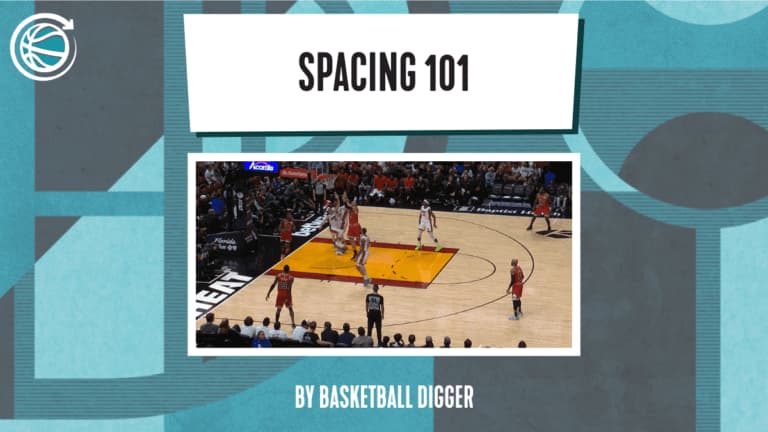
Spacing has changed the game. NBA offenses today look nothing like they did in the ’90s—more threes, better efficiency, and smarter shot selection. But why? The key lies in how teams use space to create and capitalize on advantages.
Mar 31, 2025
Simon Caret
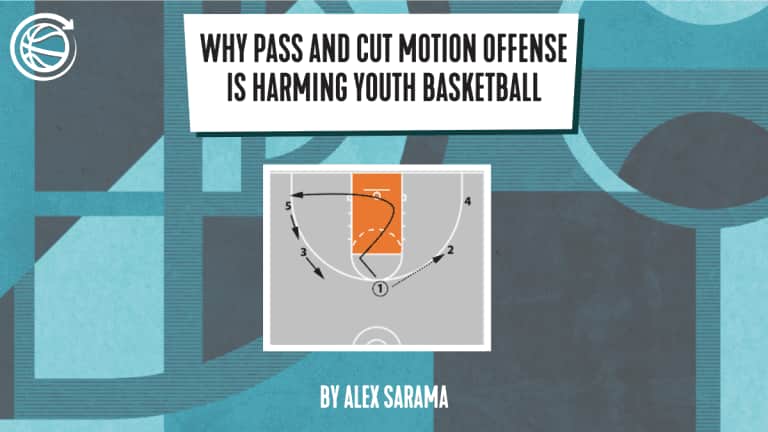
This article breaks down why pass and cut motion offense limits youth player development, and explores better ways to teach spacing, decision-making, and offensive creativity.
May 1, 2024
Alex Sarama
Approaches within the basketball industry are predominantly based upon experiential knowledge and traditions.


