

Why Donor Sports are the Essential Secret to Building Elite Basketball Players




What if the secret to building an elite basketball player has nothing to do with playing basketball? Donor Sports are one of the most powerful ways to build more adaptable, creative, and robust basketball players.
In today’s highly commercialized youth sports landscape, the prevailing belief is that if you want a player to reach the highest levels of basketball, they must specialize as early as possible. They play year-round, bounce from high school seasons to grueling AAU circuits, and spend their “free” time executing robotic repetitions with personal skills trainers. While this early specialization might create a temporary differential training effect, making a ten-year-old look incredibly polished compared to their peers, it often drastically lowers their long-term developmental ceiling.
By exclusively playing basketball, athletes limit their movement vocabulary. They repeatedly subject their bodies to the exact same physical stresses and only learn to solve a narrow set of spatial problems. To build truly robust, adaptable, and creative basketball players, we must look outside of our own sport. We need to embrace the Athletic Skills Model (ASM) and introduce our players to the concept of Donor Sports.
What is a Donor Sport?
The Athletic Skills Model (ASM) is a practitioner-led framework of talent development that emphasizes the value of “multi-sport” experiences to build fundamental movement competencies. Within this framework, a Donor Sport is defined as any non-basketball sport or physical activity that “donates” transferable movement skills and athletic solutions to the athlete’s primary target sport.
How does this work? Through an ecological dynamics lens, we understand that skills are not memorized techniques, but rather functional relationships between an athlete and their environment. Donor sports share performance-enhancing “affordances” (opportunities for action) with basketball. By exposing a player to a completely different sport, you place them in a novel affordance landscape that organically develops foundational athletic skills—such as:
- Balance and body awareness
- Coordination and reaction speed
- Spatial orientation
These are critical for basketball, but rarely trained by traditional basketball drills.
Consider the classic example of three-time NBA MVP Nikola Jokic. It is frequently noted that Jokic plays basketball as if he is playing water polo. Because of his background in that donor sport, he possesses a completely different movement repertoire: he handles intense physicality without losing balance, he manipulates the basketball with one hand like a water polo ball, and he utilizes passing angles that traditional basketball players simply do not see. Similarly, soccer can donate elite peripheral scanning and lateral quickness to basketball players.
Pro-Tip: Check out our blog on Ecological Dynamics to learn more about how “affordances” shape player decision-making on the court.
The Warm-Up as a Multi-Sport Laboratory
We know the research supports multi-sport sampling. However, as a basketball coach, you realistically cannot force your players to join a soccer league, nor can you easily take your entire roster to the local swimming pool to play water polo before practice.
But you can completely reimagine the first 15 minutes of your practice.
Instead of wasting your warm-up on static stretching, mindless jogging, or 1-on-0 layup lines that bear absolutely zero resemblance to live competition, you can transform this time into a multi-sport laboratory. By utilizing gamified donor sports in your warm-ups, you unfreeze your players’ degrees of freedom, giving them the opportunity to explore new coordination patterns in a low-stress, highly engaging environment. You allow them to acquire movement versatility outside the rigid context of basketball.
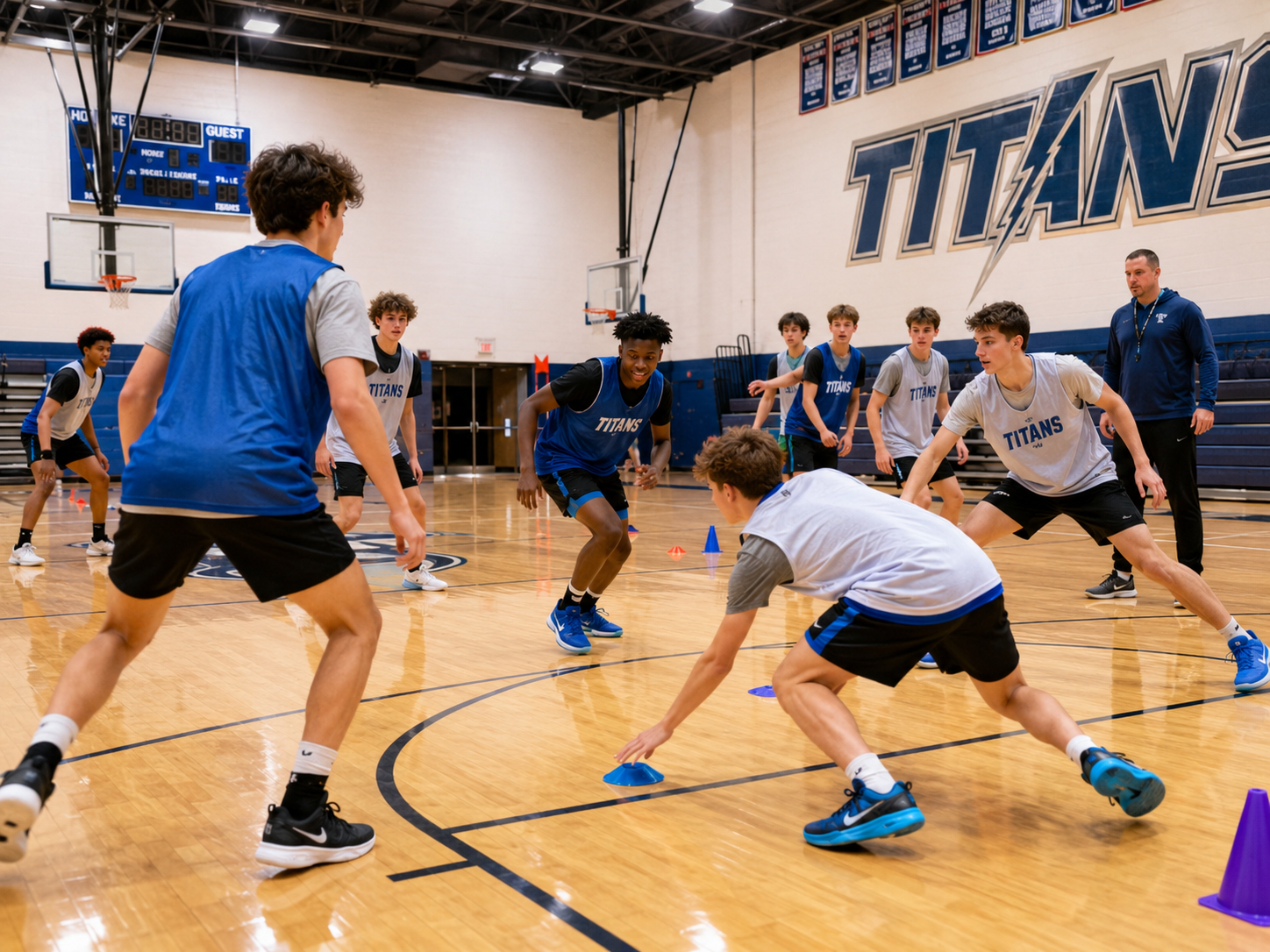
High school basketball team performing a gamified movement warm-up to increase coordination and athletic robustness.
Here are two highly effective Donor Sport Small-Sided Games (SSGs) you can immediately integrate into your next warm-up to build better all-around athletes:
1. Touchdown Tag (American Football / Rugby)
This is a phenomenal game for training spatial awareness, deceleration, and elite passing velocity without a single dribble being taken.
Technical demonstration of Touchdown Tag being used in a basketball practice setting.
- The Setup: Divide your players into two teams of 6 or 7. You can play baseline to baseline or sideline to sideline. Use a basketball, or for added variability, an American football or rugby ball.
- How it Works: Players are not allowed to travel or dribble with the ball; they can only pass. To score a “touchdown,” a player must catch the ball inside the “smile” (the restricted area under the basket) and place it on the ground.
- The Constraints: To directly target specific rate limiters, manipulate the rules. If you want to train deceleration and balance, constrain players so that every time they catch the ball, they must come to a complete stop on one foot. Because the objective is to advance the ball before the defense intercepts it, players will naturally start throwing blistering, laser-like passes without you ever having to lecture them on passing mechanics.
2. Basketball Volleyball
Playing a modified version of volleyball on the basketball court forces players to explore completely foreign upper-body coordination and striking patterns.
- The Setup: Set up a 7-on-7 or 8-on-8 game using the half-court line as the “net”.
- How it Works: Standard volleyball rules apply, but the players use a volleyball or a lighter, bouncier ball.
- The “Why”: In basketball, we use our fingertips and rely on finesse. In volleyball, players must adapt to striking the ball with their palms or forearms, manipulating their bodies in the air, and communicating rapidly to keep the ball alive. It introduces a safe, fun environment where players are allowed to be “bad” at something, which removes the fear of failure and encourages pure motor exploration.
Further Learning
To dive deeper into the science of multi-sport sampling and learn exactly how to program these activities into your team’s development plan, we highly recommend listening to Episode 143 of The Transforming Basketball Podcast.
In this episode, George Vaz explores the immense value of playing donor sports to improve specific basketball performance.
And if you would like to learn more about you can continue listening to the podcast and listen to Episode EP125: Why Your Warm-Up Isn’t Working And How to Fix It with Martina Navarro Martina talks about the ASM and the benefits of donor sports. It expands on the Athletic Skills Model (ASM), detailing how to identify your players’ specific rate limiters and seamlessly integrate activities like dodgeball, baseball-adaptations, and grappling into your daily routines.
Basketball players are, first and foremost, human movers. If we want them to solve the complex, dynamic problems that emerge on the basketball court, we must provide them with a movement toolbox that extends far beyond the hardwood. Stop confining your players to the same repetitive basketball drills. Introduce donor sports, embrace the chaos, and watch your players’ athleticism and creativity soar.
Coach’s Note: For more on how to implement these concepts, listen to our full podcast episode on Multi-Sport Sampling and the ASM Framework.


What if the secret to building an elite basketball player has nothing to do with playing basketball? Donor Sports are one of the most powerful ways to build more adaptable, creative, and robust basketball players.
In today’s highly commercialized youth sports landscape, the prevailing belief is that if you want a player to reach the highest levels of basketball, they must specialize as early as possible. They play year-round, bounce from high school seasons to grueling AAU circuits, and spend their “free” time executing robotic repetitions with personal skills trainers. While this early specialization might create a temporary differential training effect, making a ten-year-old look incredibly polished compared to their peers, it often drastically lowers their long-term developmental ceiling.
By exclusively playing basketball, athletes limit their movement vocabulary. They repeatedly subject their bodies to the exact same physical stresses and only learn to solve a narrow set of spatial problems. To build truly robust, adaptable, and creative basketball players, we must look outside of our own sport. We need to embrace the Athletic Skills Model (ASM) and introduce our players to the concept of Donor Sports.
What is a Donor Sport?
The Athletic Skills Model (ASM) is a practitioner-led framework of talent development that emphasizes the value of “multi-sport” experiences to build fundamental movement competencies. Within this framework, a Donor Sport is defined as any non-basketball sport or physical activity that “donates” transferable movement skills and athletic solutions to the athlete’s primary target sport.
How does this work? Through an ecological dynamics lens, we understand that skills are not memorized techniques, but rather functional relationships between an athlete and their environment. Donor sports share performance-enhancing “affordances” (opportunities for action) with basketball. By exposing a player to a completely different sport, you place them in a novel affordance landscape that organically develops foundational athletic skills—such as:
- Balance and body awareness
- Coordination and reaction speed
- Spatial orientation
These are critical for basketball, but rarely trained by traditional basketball drills.
Consider the classic example of three-time NBA MVP Nikola Jokic. It is frequently noted that Jokic plays basketball as if he is playing water polo. Because of his background in that donor sport, he possesses a completely different movement repertoire: he handles intense physicality without losing balance, he manipulates the basketball with one hand like a water polo ball, and he utilizes passing angles that traditional basketball players simply do not see. Similarly, soccer can donate elite peripheral scanning and lateral quickness to basketball players.
Pro-Tip: Check out our blog on Ecological Dynamics to learn more about how “affordances” shape player decision-making on the court.
The Warm-Up as a Multi-Sport Laboratory
We know the research supports multi-sport sampling. However, as a basketball coach, you realistically cannot force your players to join a soccer league, nor can you easily take your entire roster to the local swimming pool to play water polo before practice.
But you can completely reimagine the first 15 minutes of your practice.
Instead of wasting your warm-up on static stretching, mindless jogging, or 1-on-0 layup lines that bear absolutely zero resemblance to live competition, you can transform this time into a multi-sport laboratory. By utilizing gamified donor sports in your warm-ups, you unfreeze your players’ degrees of freedom, giving them the opportunity to explore new coordination patterns in a low-stress, highly engaging environment. You allow them to acquire movement versatility outside the rigid context of basketball.
High school basketball team performing a gamified movement warm-up to increase coordination and athletic robustness.
Here are two highly effective Donor Sport Small-Sided Games (SSGs) you can immediately integrate into your next warm-up to build better all-around athletes:
1. Touchdown Tag (American Football / Rugby)
This is a phenomenal game for training spatial awareness, deceleration, and elite passing velocity without a single dribble being taken.
Technical demonstration of Touchdown Tag being used in a basketball practice setting.
- The Setup: Divide your players into two teams of 6 or 7. You can play baseline to baseline or sideline to sideline. Use a basketball, or for added variability, an American football or rugby ball.
- How it Works: Players are not allowed to travel or dribble with the ball; they can only pass. To score a “touchdown,” a player must catch the ball inside the “smile” (the restricted area under the basket) and place it on the ground.
- The Constraints: To directly target specific rate limiters, manipulate the rules. If you want to train deceleration and balance, constrain players so that every time they catch the ball, they must come to a complete stop on one foot. Because the objective is to advance the ball before the defense intercepts it, players will naturally start throwing blistering, laser-like passes without you ever having to lecture them on passing mechanics.
2. Basketball Volleyball
Playing a modified version of volleyball on the basketball court forces players to explore completely foreign upper-body coordination and striking patterns.
- The Setup: Set up a 7-on-7 or 8-on-8 game using the half-court line as the “net”.
- How it Works: Standard volleyball rules apply, but the players use a volleyball or a lighter, bouncier ball.
- The “Why”: In basketball, we use our fingertips and rely on finesse. In volleyball, players must adapt to striking the ball with their palms or forearms, manipulating their bodies in the air, and communicating rapidly to keep the ball alive. It introduces a safe, fun environment where players are allowed to be “bad” at something, which removes the fear of failure and encourages pure motor exploration.
Further Learning
To dive deeper into the science of multi-sport sampling and learn exactly how to program these activities into your team’s development plan, we highly recommend listening to Episode 143 of The Transforming Basketball Podcast.
In this episode, George Vaz explores the immense value of playing donor sports to improve specific basketball performance.
And if you would like to learn more about you can continue listening to the podcast and listen to Episode EP125: Why Your Warm-Up Isn’t Working And How to Fix It with Martina Navarro Martina talks about the ASM and the benefits of donor sports. It expands on the Athletic Skills Model (ASM), detailing how to identify your players’ specific rate limiters and seamlessly integrate activities like dodgeball, baseball-adaptations, and grappling into your daily routines.
Basketball players are, first and foremost, human movers. If we want them to solve the complex, dynamic problems that emerge on the basketball court, we must provide them with a movement toolbox that extends far beyond the hardwood. Stop confining your players to the same repetitive basketball drills. Introduce donor sports, embrace the chaos, and watch your players’ athleticism and creativity soar.
Coach’s Note: For more on how to implement these concepts, listen to our full podcast episode on Multi-Sport Sampling and the ASM Framework.




check what's trending

What is ecological dynamics and how is it connected to a constraints-led approach?
Dec 8, 2025
George Vaz

Are you searching for the best small sided games (SSGs) to improve your basketball practices? Want to replace boring, low-transfer drills with competitive games that actually develop player decision-making and in-game skills?
In this post, I’m sharing my top 5 favorite small-sided basketball games—designed to teach core concepts like closeouts, pick-and-roll, advantage creation, and transition offense and defense. These basketball SSGs are intense, purposeful, and built around real-game actions.
Whether you're coaching youth basketball, high school, or pros, these top small sided games will make your sessions more effective, more engaging, and more fun—for both players and coaches.
Let’s break down each game and how it can transform your practices.
Aug 4, 2025
George Vaz

Whether you’re coaching in the NBA, EuroLeague, or youth basketball, one thing remains universally true: the worst transition offense is still more efficient than the best half-court offense. Yet, many teams still struggle to fully capitalize on transition opportunities, often opting to slow down the game instead of pushing the pace. The question is, why? By running more intentionally, teams can create easier scoring opportunities. So why do some teams hesitate?
Apr 7, 2025
George Vaz
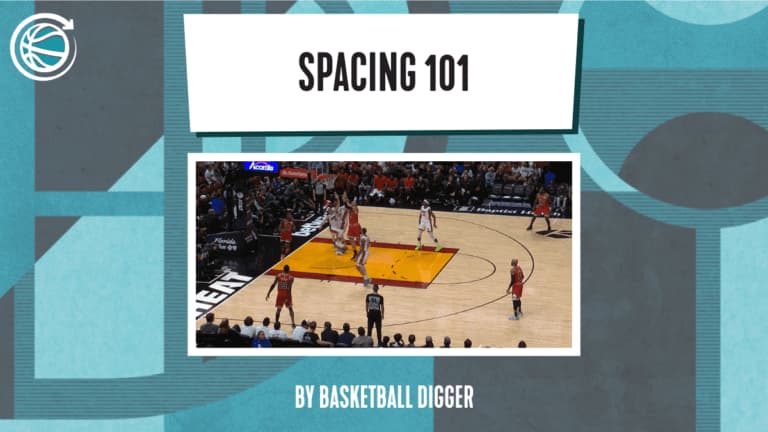
Spacing has changed the game. NBA offenses today look nothing like they did in the ’90s—more threes, better efficiency, and smarter shot selection. But why? The key lies in how teams use space to create and capitalize on advantages.
Mar 31, 2025
Simon Caret
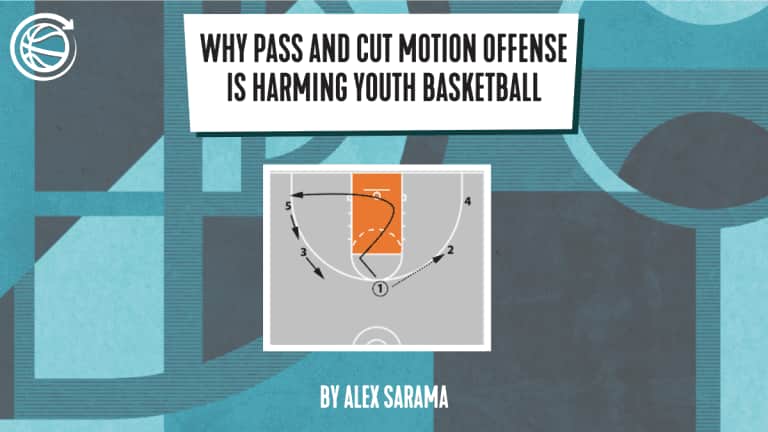
This article breaks down why pass and cut motion offense limits youth player development, and explores better ways to teach spacing, decision-making, and offensive creativity.
May 1, 2024
Alex Sarama
Approaches within the basketball industry are predominantly based upon experiential knowledge and traditions.


