

Late Game Basketball Strategy: The Brutal Truth About “Holding the Ball”
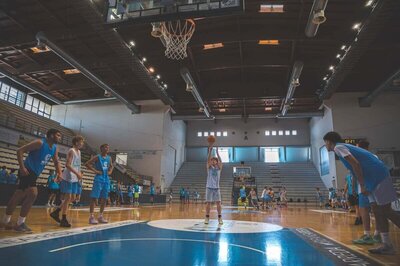




Late Game Basketball Strategy: The Brutal Truth and 4 Ways to Improve
Late game basketball strategy is often where coaches feel the most pressure to exert control, but the brutal reality is that over-coaching the finish is exactly what leads to stagnation and turnovers. For decades, the standard approach for a lead was simple: stop attacking and start passing. However, as many coaches are discovering, when you stop playing the way that got you the lead, you essentially hand the momentum back to the defense.
In our latest Coaches Roundtable, we dove deep into the pitfalls of traditional end-of-game coaching. If you want your team to be “clutch,” you have to move beyond the script. Here is how to navigate high-stakes finishes using a modern late game basketball strategy rooted in the Constraints-Led Approach (CLA) and a principles-of-play mindset.
1. The Trap of the “Hold the Ball” Mentality
The most common mistake in late game basketball strategy is the “Four-Corner Offense.” We’ve been conditioned to believe that when we have a lead, the clock is our primary opponent. We stop looking for “Pace and Space” and start looking at the scoreboard.
As noted in our roundtable, many coaches traditionally held the ball out with two minutes left, simply passing it around to kill time. This creates two massive problems:
- Rhythm Killer: It takes your players out of the flow that got you the lead in the first place.
- Defensive Clarity: It tells the defense exactly what you’re doing. When you stop attacking, the defense can get aggressive, jump passing lanes, and pressure the ball without fear of a backdoor cut or a drive to the rim.
Instead of “milking” the clock, we should be “managing” it. This doesn’t mean taking the first shot available, but it does mean maintaining scoring intent. If a “Gold Medal” layup presents itself early in the clock, you take it.
2. Principles Over Plays: Why Your Team Freezes
If your team only knows how to follow a script, they become incredibly easy to guard when the stakes are high.
In late game situations, the defense is often at its most “connected.” They are switching, and shrinking the floor. If you call a set play and the defense blows up the first action, your players often freeze because they haven’t been taught to read the affordances—the opportunities for action—in the environment.
Instead of a script, give them principles. For example:
- Maintain Short Spacing: Use the “Dunker Spot” to create double gaps, making it harder for the defense to help on a late-game drive.
- Hunt ROB Shots: Even with 10 seconds left on the shot clock, we only want shots that are in Rhythm, Open, and Balanced.
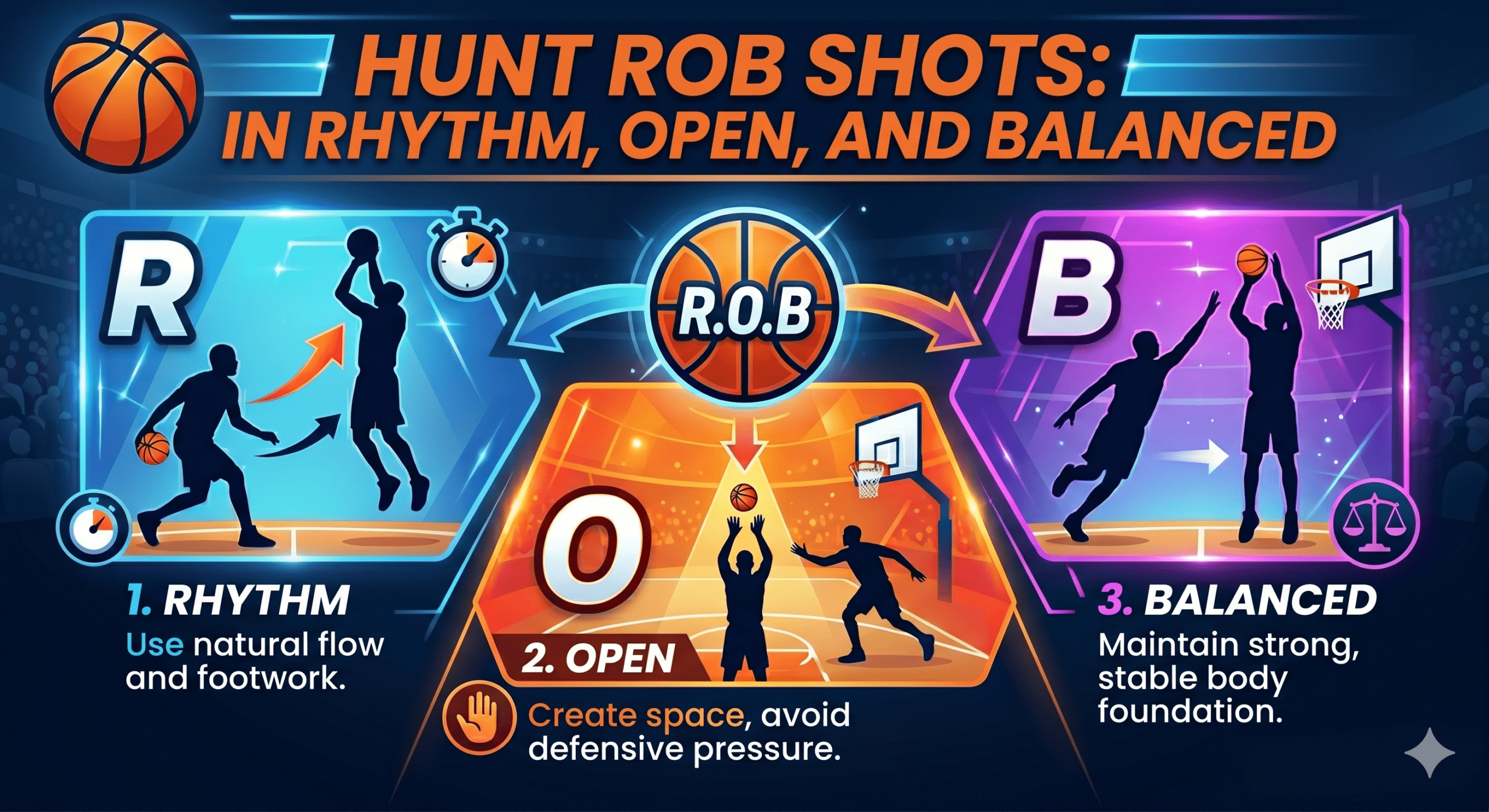
Hunting ROB shots: Ensuring every late-game look is in Rhythm, Open, and Balanced.
- Trigger Early: Use a “Get” action (pass and chase) to create immediate flow and act as a pressure release if the defense is overplaying your primary ball-handler. It allows your bigs to “pitch and slip” and “keep” if the coverage is aggressive.
3. Building “Clutch” Adaptability with CLA
You can’t expect your players to be calm in the final minute of a game if they only experience that pressure once a week. To refine your late game basketball strategy, you need practical ideas for practice that simulate the chaos of the finish.
In Episode 145, coach Jon Yu discusses the specific late-game challenge of clock management. He notes that players often struggle in these moments, shooting too early or triggering the offense too fast. To fix this, he emphasizes getting players to understand “time and score at all times…” (Link)
The Late Game Scenarios
Instead of a standard scrimmage, play 5-on-5 with a specific score and time.
- The Constraint: Team A team is down 3, Team B is in the bonus. 30 seconds left.
- Other Late Game Ideas:
- Team A is up 5 points, 2:00 left. Team B is full-court pressing.
- Team A is down 2 points, 15 seconds left. Team A has the ball at the top/ SLOB. Team B is in a “Drop” coverage.
- Team A and Team B are tied, 2:15 left. Team B is switching all actions. Team A must use “Short Spacing” (4-out, 1-in with a player in the dunker spot) to create double gaps and punish the switches.
- Team A and Team B are tied, 8 seconds left. Team A has a sideline out-of-bounds in the frontcourt.
- Team A is down 9 points, 2:30 left. Team A is in the bonus. Team B is “tagging up” to prevent the break.
- Team A is up 3 points, 6 seconds left. Team B has the ball in the frontcourt. Both teams are in the bonus. Team A must decide whether to play it out with “high-side” pressure or “cleanly” foul before Team B begins a shooting motion.
- Team A is up 1 point, 1:45 left. Team B is playing a zone defense.
- Team A is down 1 point, 4 seconds left. Team A has a baseline out-of-bounds under their own basket. Team B is denying the primary ball-handler.
- Team A is down 6 points, 2:00 left. Team B is trying to “milk” the clock.
- Team A is down 2 points, 10 seconds left. Team A is at the free-throw line for the second of two shots.
This forces players to communicate and solve problems; Similar problems to what can be expected in the game.
4. The Debate: Fouling Up 3
From an Ecological Dynamics perspective, we look at this through the lens of constraining the opponent’s affordances.
If you are up by 3 with less than 10 seconds left, the opponent’s primary “affordance” is a three-point shot. By fouling, you remove that affordance and replace it with two free throws. However, this also carries risks: the “missed second free throw/offensive rebound” nightmare and the “fouled in the act of shooting”.
During our roundtable, we discussed how fouling up 3 requires a high level of tactical attunement. If you choose to foul, it has to be a “clean” foul on the floor before the shooting motion begins. I also like the idea of fouling the picker when they come up to run an action. The foul is still in the play and usually the big will be a worse FT shooter.
Conclusion: Play to Win, Don’t Play “Not to Lose”
The best end of game coaching is often the coaching you do before the game starts. By building an adaptable, principles-based offense, you empower your players to make winning decisions when the pressure is highest.
Stop thinking of the last two minutes as a different sport. It’s still basketball. Keep your Pace and Space, hunt for ROB shots, and trust the principles you’ve built all season.
Your Next Steps:
- Audit your practice: How many minutes this week were spent in “live” late-game scenarios?
- Simplify the “Clutch”: Pick two offensive “Triggers” (like a “Get” or a “Rub”) that your team flows into when a set play breaks down.
- Join the Community: For more deep dives into late game situations and designing practice plans, check out the Transforming Basketball podcast or join our community of coaches today.

Late Game Basketball Strategy: The Brutal Truth and 4 Ways to Improve
Late game basketball strategy is often where coaches feel the most pressure to exert control, but the brutal reality is that over-coaching the finish is exactly what leads to stagnation and turnovers. For decades, the standard approach for a lead was simple: stop attacking and start passing. However, as many coaches are discovering, when you stop playing the way that got you the lead, you essentially hand the momentum back to the defense.
In our latest Coaches Roundtable, we dove deep into the pitfalls of traditional end-of-game coaching. If you want your team to be “clutch,” you have to move beyond the script. Here is how to navigate high-stakes finishes using a modern late game basketball strategy rooted in the Constraints-Led Approach (CLA) and a principles-of-play mindset.
1. The Trap of the “Hold the Ball” Mentality
The most common mistake in late game basketball strategy is the “Four-Corner Offense.” We’ve been conditioned to believe that when we have a lead, the clock is our primary opponent. We stop looking for “Pace and Space” and start looking at the scoreboard.
As noted in our roundtable, many coaches traditionally held the ball out with two minutes left, simply passing it around to kill time. This creates two massive problems:
- Rhythm Killer: It takes your players out of the flow that got you the lead in the first place.
- Defensive Clarity: It tells the defense exactly what you’re doing. When you stop attacking, the defense can get aggressive, jump passing lanes, and pressure the ball without fear of a backdoor cut or a drive to the rim.
Instead of “milking” the clock, we should be “managing” it. This doesn’t mean taking the first shot available, but it does mean maintaining scoring intent. If a “Gold Medal” layup presents itself early in the clock, you take it.
2. Principles Over Plays: Why Your Team Freezes
If your team only knows how to follow a script, they become incredibly easy to guard when the stakes are high.
In late game situations, the defense is often at its most “connected.” They are switching, and shrinking the floor. If you call a set play and the defense blows up the first action, your players often freeze because they haven’t been taught to read the affordances—the opportunities for action—in the environment.
Instead of a script, give them principles. For example:
- Maintain Short Spacing: Use the “Dunker Spot” to create double gaps, making it harder for the defense to help on a late-game drive.
- Hunt ROB Shots: Even with 10 seconds left on the shot clock, we only want shots that are in Rhythm, Open, and Balanced.
Hunting ROB shots: Ensuring every late-game look is in Rhythm, Open, and Balanced.
- Trigger Early: Use a “Get” action (pass and chase) to create immediate flow and act as a pressure release if the defense is overplaying your primary ball-handler. It allows your bigs to “pitch and slip” and “keep” if the coverage is aggressive.
3. Building “Clutch” Adaptability with CLA
You can’t expect your players to be calm in the final minute of a game if they only experience that pressure once a week. To refine your late game basketball strategy, you need practical ideas for practice that simulate the chaos of the finish.
In Episode 145, coach Jon Yu discusses the specific late-game challenge of clock management. He notes that players often struggle in these moments, shooting too early or triggering the offense too fast. To fix this, he emphasizes getting players to understand “time and score at all times…” (Link)
The Late Game Scenarios
Instead of a standard scrimmage, play 5-on-5 with a specific score and time.
- The Constraint: Team A team is down 3, Team B is in the bonus. 30 seconds left.
- Other Late Game Ideas:
- Team A is up 5 points, 2:00 left. Team B is full-court pressing.
- Team A is down 2 points, 15 seconds left. Team A has the ball at the top/ SLOB. Team B is in a “Drop” coverage.
- Team A and Team B are tied, 2:15 left. Team B is switching all actions. Team A must use “Short Spacing” (4-out, 1-in with a player in the dunker spot) to create double gaps and punish the switches.
- Team A and Team B are tied, 8 seconds left. Team A has a sideline out-of-bounds in the frontcourt.
- Team A is down 9 points, 2:30 left. Team A is in the bonus. Team B is “tagging up” to prevent the break.
- Team A is up 3 points, 6 seconds left. Team B has the ball in the frontcourt. Both teams are in the bonus. Team A must decide whether to play it out with “high-side” pressure or “cleanly” foul before Team B begins a shooting motion.
- Team A is up 1 point, 1:45 left. Team B is playing a zone defense.
- Team A is down 1 point, 4 seconds left. Team A has a baseline out-of-bounds under their own basket. Team B is denying the primary ball-handler.
- Team A is down 6 points, 2:00 left. Team B is trying to “milk” the clock.
- Team A is down 2 points, 10 seconds left. Team A is at the free-throw line for the second of two shots.
This forces players to communicate and solve problems; Similar problems to what can be expected in the game.
4. The Debate: Fouling Up 3
From an Ecological Dynamics perspective, we look at this through the lens of constraining the opponent’s affordances.
If you are up by 3 with less than 10 seconds left, the opponent’s primary “affordance” is a three-point shot. By fouling, you remove that affordance and replace it with two free throws. However, this also carries risks: the “missed second free throw/offensive rebound” nightmare and the “fouled in the act of shooting”.
During our roundtable, we discussed how fouling up 3 requires a high level of tactical attunement. If you choose to foul, it has to be a “clean” foul on the floor before the shooting motion begins. I also like the idea of fouling the picker when they come up to run an action. The foul is still in the play and usually the big will be a worse FT shooter.
Conclusion: Play to Win, Don’t Play “Not to Lose”
The best end of game coaching is often the coaching you do before the game starts. By building an adaptable, principles-based offense, you empower your players to make winning decisions when the pressure is highest.
Stop thinking of the last two minutes as a different sport. It’s still basketball. Keep your Pace and Space, hunt for ROB shots, and trust the principles you’ve built all season.
Your Next Steps:
- Audit your practice: How many minutes this week were spent in “live” late-game scenarios?
- Simplify the “Clutch”: Pick two offensive “Triggers” (like a “Get” or a “Rub”) that your team flows into when a set play breaks down.
- Join the Community: For more deep dives into late game situations and designing practice plans, check out the Transforming Basketball podcast or join our community of coaches today.




check what's trending
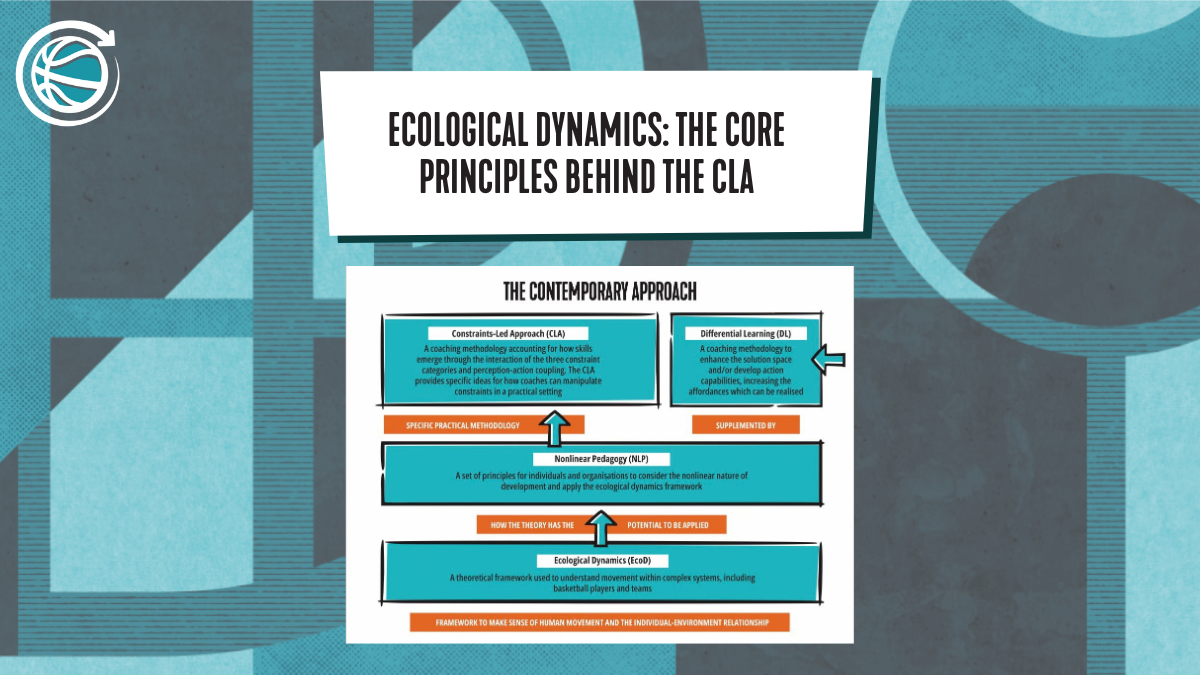
What is ecological dynamics and how is it connected to a constraints-led approach?
Dec 8, 2025
George Vaz

Are you searching for the best small sided games (SSGs) to improve your basketball practices? Want to replace boring, low-transfer drills with competitive games that actually develop player decision-making and in-game skills?
In this post, I’m sharing my top 5 favorite small-sided basketball games—designed to teach core concepts like closeouts, pick-and-roll, advantage creation, and transition offense and defense. These basketball SSGs are intense, purposeful, and built around real-game actions.
Whether you're coaching youth basketball, high school, or pros, these top small sided games will make your sessions more effective, more engaging, and more fun—for both players and coaches.
Let’s break down each game and how it can transform your practices.
Aug 4, 2025
George Vaz

Whether you’re coaching in the NBA, EuroLeague, or youth basketball, one thing remains universally true: the worst transition offense is still more efficient than the best half-court offense. Yet, many teams still struggle to fully capitalize on transition opportunities, often opting to slow down the game instead of pushing the pace. The question is, why? By running more intentionally, teams can create easier scoring opportunities. So why do some teams hesitate?
Apr 7, 2025
George Vaz
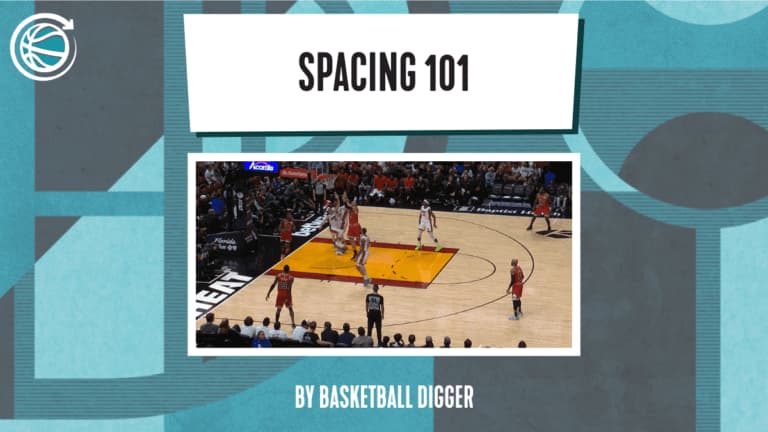
Spacing has changed the game. NBA offenses today look nothing like they did in the ’90s—more threes, better efficiency, and smarter shot selection. But why? The key lies in how teams use space to create and capitalize on advantages.
Mar 31, 2025
Simon Caret
This article breaks down why pass and cut motion offense limits youth player development, and explores better ways to teach spacing, decision-making, and offensive creativity.
May 1, 2024
Alex Sarama
Approaches within the basketball industry are predominantly based upon experiential knowledge and traditions.


