
コーチングの要点
Accumulated practice time alone does not explain expertise. The article reviews research that questions a universal hour target and considers other influences on development. For a coach, the practical focus is the quality and relevance of learning opportunities, alongside the player’s wider experience.
ガイドを読む: Skill Acquisition in BasketballThere is no single hour count that guarantees expertise in basketball. Practice duration matters, but so do the problems players encounter, the quality of their involvement and the experiences they bring to the court.
Treat accumulated hours as one part of a development history. Two players can spend the same time practicing while encountering very different tasks, feedback and opportunities. The coaching question is what those hours contain.
The Reality of Accumulated Hours: Why Volume Isn't Everything
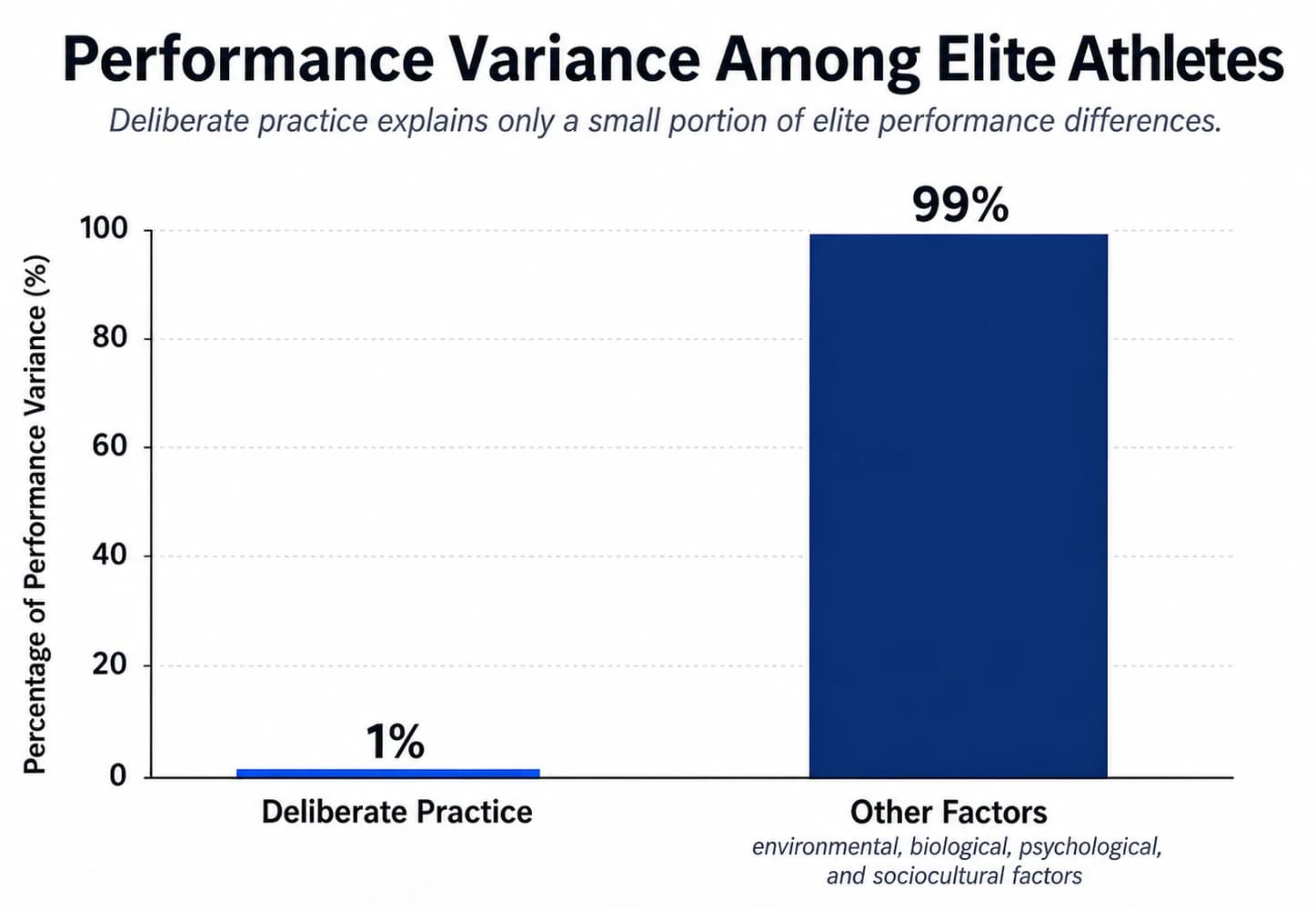
While deliberate practice is undeniably an important piece of the expertise puzzle, recent empirical evidence proves it is not the only piece—and certainly not the largest one. A landmark meta-analysis by Macnamara, Moreau, and Hambrick (2016) revealed that accumulated deliberate practice accounts for only 18% of the variance in overall sports performance.
Even more shockingly, the predictive power of deliberate practice diminishes drastically at the highest levels of competition. Among elite-level performers, deliberate practice accounts for a mere 1% of the variance in performance.
Factors Beyond the Stopwatch
If 82% of overall sports performance is unexplained by sheer volume, we must look at:
- Competition experience and psychological resilience.
- Unstructured play activities (the "backyard" effect).
- Physiological traits and genetic predispositions.
- Sociocultural environments that foster growth.
Quality vs. Quantity: Solving the "Transfer Paradox"
The traditional interpretation of the 10,000-hour rule pushes coaches toward linear pedagogy. To accumulate hours efficiently, complex skills are often decomposed into isolated parts. Athletes engage in "blocked practice"—repeating the same movement pattern under constant conditions to "groove" a motor program.
While this minimizes errors during the session, it creates an "illusion of competence." Because the environment is sterile, the athlete never learns to solve live movement problems. Consequently, when the chaotic constraints of a real game are applied, these fragile techniques break down.
Embracing Ecological Dynamics
Ecological dynamics refutes the idea that skill is a fixed "muscle memory." Instead, skill is an adaptive, functional relationship between an athlete and their environment.
- Repetition Without Repetition: Rather than chasing the same solution, athletes should find different ways to solve the same problem.
- Constraints-Led Approach (CLA): Using boundaries, rules, or equipment changes to force self-organization.
- Small-Sided Games (SSGs): Practice should look "messy" because active problem-solving leads to superior in-game transfer.
Pro-Tip: Listen to our podcast episode on Episode 22: Games-Based Approach vs. The CLA. This episode clarifies the scientific distinction between simply "letting kids play" and using the CLA. It explains why a general games-based approach—where players participate in the exact same SSG repeatedly—lacks the empirical backing to optimize skill adaptation. Instead, it highlights the science of tweaking constraints within SSGs to prevent players from relying on existing, comfortable habits.
The Specialization Trap vs. The Power of Sampling
The desperation to reach 10,000 hours as quickly as possible has fueled a damaging epidemic: early sports specialization. The assumption is that starting at age five provides an insurmountable lead. However, research indicates that early specialization dramatically increases the likelihood of psychological burnout and overuse injuries.
The Macnamara meta-analysis found a mean difference in starting age between higher-skill and lower-skill athletes of just 0.11 years—a statistically nonsignificant difference.
The Benefits of Sports Sampling
Instead of early specialization, science supports early diversification. Playing multiple sports improves:
- Core Motor Skills: A broader foundation of coordination.
- Degeneracy: The ability of different body parts to achieve the same movement outcome (e.g., finishing a layup while off-balance).
- Intrinsic Motivation: Children who engage in "deliberate play" between ages 6-13 develop a deeper passion for the game.
Redefining the Path to Expertise
The human being is a complex, adaptive biological system, not a machine. We cannot simply input 10,000 hours of rote repetition and expect a world-class output. To develop elite performers, we must trade mindless quantity for representative quality. We must abandon rigid, 1-on-0 drills in favor of variable environments that challenge athletes to make real decisions under pressure. Expertise is not a ticking clock you can beat—it is a lifelong, non-linear journey of adaptation.
Join the Transformation
- Join the Community: Access hundreds of SSG diagrams and clinics at TransformingBball.com
- The Deep Dive: Check out the Transforming Basketball book for the full evidence-based framework on player development.