

Skill Development: How to Build a Self-Teaching Basketball Environment




We’ve all been there. It’s Tuesday night and you’re exhausted. You find yourself standing on the sideline, barking instructions at your point guard to “pressure the ball” or “kick ahead” for the tenth time. You feel like if you stop talking, the whole practice will grind to a halt.
But here’s the uncomfortable truth: if you have to talk that much, your players aren’t actually learning—they’re just following orders.
The goal of a high-level skill development program isn’t to create players who are good at listening to you; it’s to create players who are good at “listening” to the game.
In this post, we’re going to break down how to stop micromanaging and start building an environment where the practice does the teaching for you. How to transform into The Invisible Coach.
1. Moving from “Instructor” to “Architect”
Most coaches think their value is in their voice (and energy). We think that if we aren’t providing constant feedback, we aren’t “coaching.”
Using the Constraints-Led Approach (CLA), we shift our perspective. Your real work happens before practice starts. You are an architect of the environment. The “Invisible Coach” is the idea that a practice should be so well-designed that if you walked out of the gym to take a phone call, the players would keep getting better without you.
The Coaching Shift:
- The Traditional Approach: Stop play every 30 seconds to explain what the player did wrong. This creates “joystick players” who wait for your command before they move. It’s deterministic and limits a player’s long-term adaptability.
- The Transformational Approach: Change the rules of the game (the constraints) so the player feels the problem and has to find a new solution. You guide the “search,” you don’t provide the answer. This is where real learning happens.
Is walking a skill?
My favorite example of teaching a skill without using instruction is teaching a baby to walk. Parents and family members don’t insist on the baby putting one foot in front of the other. Instead they meet the baby where they are at. My little cousin has recently been learning and my job, when me, her and her mother hung out was to put out my arms so she could walk towards me and have a safe landing spot. I noticed if me or her mother moved too far back, she would get scared and wouldn’t try to walk to either of us. We changed the constraints (moved closer) and she would practice walking (and falling).
2. Repatterining Movement Through Constraints
In high-performance sports, different tools are often used to force the body to reorganize. By changing the weight of a ball or the distance of a target, an athlete’s body has to find a new way to get the job done. They aren’t thinking about technical “steps”—their body is simply solving the physical problem presented to them. This is called Self organization. If we change the rules of the game, we will be changing what skills are needed to “win” the game.
Why this works:
Movement is a search for a solution. By adding a constraint—like a heavy ball or a restricted court space—you are “freeing the degrees of freedom.” The player explores new ways to move because the old, “bad” habit no longer works in the new environment.
Coach’s Tip: Instead of telling a player their jump shot is too slow, put a defender who starts two feet away and contests them. The constraint of the “defense” forces the shooter to find a functional solution in less time to get a shot off.
3. Training at (or Above) Game Intensity
Athletes rarely hit their “peak force” in training because the adrenaline isn’t there. We have to artificially create that intensity
In basketball, we do this through Small-Sided Games (SSGs) with extreme time constraints.
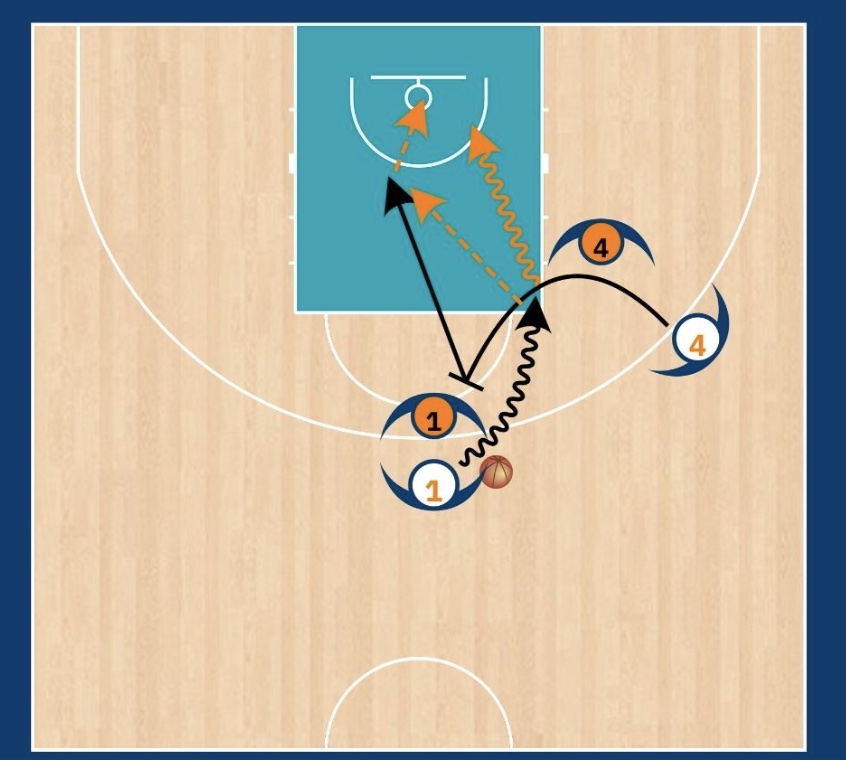
Practical Application: The 8-Second Trigger
Run a 3-on-3 (or 2-on-2 like the above diagram) continuous game. The offense has only 8 seconds to get a shot off.
- The Constraint: The clock.
- The Result: Players have to flow into triggers immediately. They don’t have time to look at the coach; they only have time to look at the defense. This builds “fitness” for decision-making and ensures your skill development translates to game speed.
4. Coaching Awareness, Not Instructions
One of the most powerful strategies involves helping athletes change their mechanics not through a 10-step manual, but through evidence. When players are shown exactly where their weaknesses lie and what elite performance looks like, they become self-correcting.
Once the athlete has awareness, they can begin to manipulate their own environment. In basketball, this means teaching “Principles of Play” instead of “Plays.” If a player understands the ROB principle (Rhythm, Open, Balanced), they can grade their own shots.
- The Traditional Approach: “That was a bad shot! Why did you take that?”
- The Transformational Approach: “Was that a ROB shot?” (Wait for player response). “Okay, what do you need to change to get balanced on the next one?”
That’s it. That’s the coaching. You’ve given them the “map” (the principle), and now they are the ones driving the car.
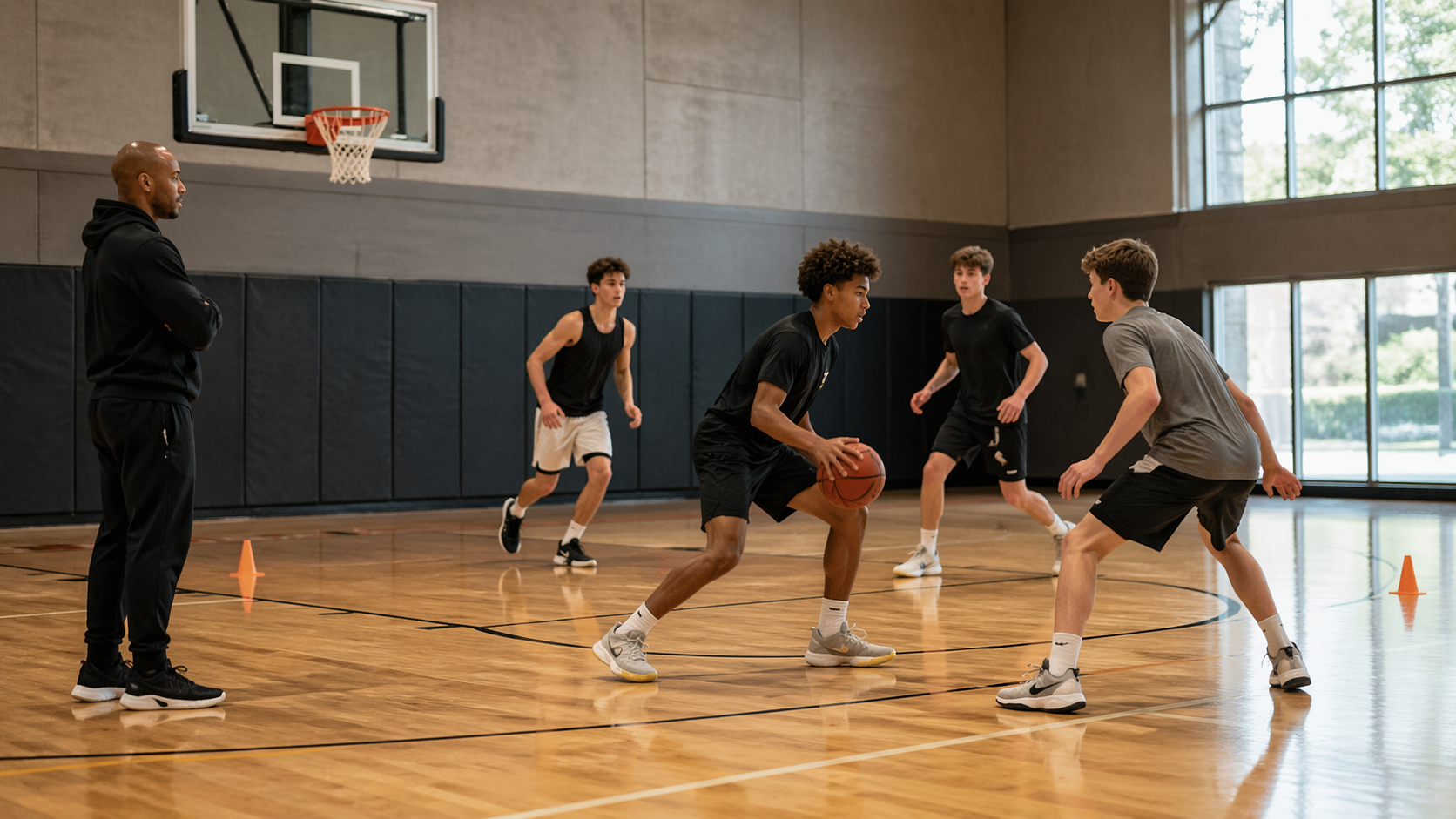
Transform into an “invisible coach” to encourage skill development.
5. The Next Practice Plan: How to Say 50% Less
If you want to move toward being an “Invisible Coach,” try this tomorrow:
- Front-Load the Info: At the start of practice, explain the why and the goal of the session for 2 minutes (or less). You can even do a “pop quiz” to test them on concepts they already know.
- Set the Constraints: Use a game like “3-on-3 Continuous Dominoes.” Tell them the only way to score is a “Gold/ silver Medal” shot (a layup or a catch-and-shoot three).
- The “Vow of Silence”: For a span of 10 minutes, do not blow your whistle to “correct” a technical mistake. Only blow it to restart the game or officiate the game.
- Observe and Tweak: Instead of talking to the players, watch how they struggle. If the game is too easy, add complexity: add more players. If it’s too hard, add an advantage start or guided defense.
You are manipulating the environment, not the athlete.
Summary: Trust the Process (and the Player)
Coaching less is actually harder than coaching more. It requires more preparation, more patience, and a deeper understanding of skill development. But the results are undeniable. Players who learn to solve problems in practice become the players who make the winning plays in the fourth quarter.
By moving from the traditional approach of micromanagement to the transformational approach of environmental design, you empower your players. Say less, prepare more, and let the game be the teacher.
Ready to Transform Your Practice?
If you want to dive deeper into the Constraints-Led Approach and get access hundreds of Small-Sided Games that act as an “Invisible Coach” for your team, join our community.
- Download our Free Guide to Small-Sided Games

We’ve all been there. It’s Tuesday night and you’re exhausted. You find yourself standing on the sideline, barking instructions at your point guard to “pressure the ball” or “kick ahead” for the tenth time. You feel like if you stop talking, the whole practice will grind to a halt.
But here’s the uncomfortable truth: if you have to talk that much, your players aren’t actually learning—they’re just following orders.
The goal of a high-level skill development program isn’t to create players who are good at listening to you; it’s to create players who are good at “listening” to the game.
In this post, we’re going to break down how to stop micromanaging and start building an environment where the practice does the teaching for you. How to transform into The Invisible Coach.
1. Moving from “Instructor” to “Architect”
Most coaches think their value is in their voice (and energy). We think that if we aren’t providing constant feedback, we aren’t “coaching.”
Using the Constraints-Led Approach (CLA), we shift our perspective. Your real work happens before practice starts. You are an architect of the environment. The “Invisible Coach” is the idea that a practice should be so well-designed that if you walked out of the gym to take a phone call, the players would keep getting better without you.
The Coaching Shift:
- The Traditional Approach: Stop play every 30 seconds to explain what the player did wrong. This creates “joystick players” who wait for your command before they move. It’s deterministic and limits a player’s long-term adaptability.
- The Transformational Approach: Change the rules of the game (the constraints) so the player feels the problem and has to find a new solution. You guide the “search,” you don’t provide the answer. This is where real learning happens.
Is walking a skill?
My favorite example of teaching a skill without using instruction is teaching a baby to walk. Parents and family members don’t insist on the baby putting one foot in front of the other. Instead they meet the baby where they are at. My little cousin has recently been learning and my job, when me, her and her mother hung out was to put out my arms so she could walk towards me and have a safe landing spot. I noticed if me or her mother moved too far back, she would get scared and wouldn’t try to walk to either of us. We changed the constraints (moved closer) and she would practice walking (and falling).
2. Repatterining Movement Through Constraints
In high-performance sports, different tools are often used to force the body to reorganize. By changing the weight of a ball or the distance of a target, an athlete’s body has to find a new way to get the job done. They aren’t thinking about technical “steps”—their body is simply solving the physical problem presented to them. This is called Self organization. If we change the rules of the game, we will be changing what skills are needed to “win” the game.
Why this works:
Movement is a search for a solution. By adding a constraint—like a heavy ball or a restricted court space—you are “freeing the degrees of freedom.” The player explores new ways to move because the old, “bad” habit no longer works in the new environment.
Coach’s Tip: Instead of telling a player their jump shot is too slow, put a defender who starts two feet away and contests them. The constraint of the “defense” forces the shooter to find a functional solution in less time to get a shot off.
3. Training at (or Above) Game Intensity
Athletes rarely hit their “peak force” in training because the adrenaline isn’t there. We have to artificially create that intensity
In basketball, we do this through Small-Sided Games (SSGs) with extreme time constraints.
Practical Application: The 8-Second Trigger
Run a 3-on-3 (or 2-on-2 like the above diagram) continuous game. The offense has only 8 seconds to get a shot off.
- The Constraint: The clock.
- The Result: Players have to flow into triggers immediately. They don’t have time to look at the coach; they only have time to look at the defense. This builds “fitness” for decision-making and ensures your skill development translates to game speed.
4. Coaching Awareness, Not Instructions
One of the most powerful strategies involves helping athletes change their mechanics not through a 10-step manual, but through evidence. When players are shown exactly where their weaknesses lie and what elite performance looks like, they become self-correcting.
Once the athlete has awareness, they can begin to manipulate their own environment. In basketball, this means teaching “Principles of Play” instead of “Plays.” If a player understands the ROB principle (Rhythm, Open, Balanced), they can grade their own shots.
- The Traditional Approach: “That was a bad shot! Why did you take that?”
- The Transformational Approach: “Was that a ROB shot?” (Wait for player response). “Okay, what do you need to change to get balanced on the next one?”
That’s it. That’s the coaching. You’ve given them the “map” (the principle), and now they are the ones driving the car.
Transform into an “invisible coach” to encourage skill development.
5. The Next Practice Plan: How to Say 50% Less
If you want to move toward being an “Invisible Coach,” try this tomorrow:
- Front-Load the Info: At the start of practice, explain the why and the goal of the session for 2 minutes (or less). You can even do a “pop quiz” to test them on concepts they already know.
- Set the Constraints: Use a game like “3-on-3 Continuous Dominoes.” Tell them the only way to score is a “Gold/ silver Medal” shot (a layup or a catch-and-shoot three).
- The “Vow of Silence”: For a span of 10 minutes, do not blow your whistle to “correct” a technical mistake. Only blow it to restart the game or officiate the game.
- Observe and Tweak: Instead of talking to the players, watch how they struggle. If the game is too easy, add complexity: add more players. If it’s too hard, add an advantage start or guided defense.
You are manipulating the environment, not the athlete.
Summary: Trust the Process (and the Player)
Coaching less is actually harder than coaching more. It requires more preparation, more patience, and a deeper understanding of skill development. But the results are undeniable. Players who learn to solve problems in practice become the players who make the winning plays in the fourth quarter.
By moving from the traditional approach of micromanagement to the transformational approach of environmental design, you empower your players. Say less, prepare more, and let the game be the teacher.
Ready to Transform Your Practice?
If you want to dive deeper into the Constraints-Led Approach and get access hundreds of Small-Sided Games that act as an “Invisible Coach” for your team, join our community.
- Download our Free Guide to Small-Sided Games




check what's trending

What is ecological dynamics and how is it connected to a constraints-led approach?
Dec 8, 2025
George Vaz

Are you searching for the best small sided games (SSGs) to improve your basketball practices? Want to replace boring, low-transfer drills with competitive games that actually develop player decision-making and in-game skills?
In this post, I’m sharing my top 5 favorite small-sided basketball games—designed to teach core concepts like closeouts, pick-and-roll, advantage creation, and transition offense and defense. These basketball SSGs are intense, purposeful, and built around real-game actions.
Whether you're coaching youth basketball, high school, or pros, these top small sided games will make your sessions more effective, more engaging, and more fun—for both players and coaches.
Let’s break down each game and how it can transform your practices.
Aug 4, 2025
George Vaz

Whether you’re coaching in the NBA, EuroLeague, or youth basketball, one thing remains universally true: the worst transition offense is still more efficient than the best half-court offense. Yet, many teams still struggle to fully capitalize on transition opportunities, often opting to slow down the game instead of pushing the pace. The question is, why? By running more intentionally, teams can create easier scoring opportunities. So why do some teams hesitate?
Apr 7, 2025
George Vaz
Spacing has changed the game. NBA offenses today look nothing like they did in the ’90s—more threes, better efficiency, and smarter shot selection. But why? The key lies in how teams use space to create and capitalize on advantages.
Mar 31, 2025
Simon Caret
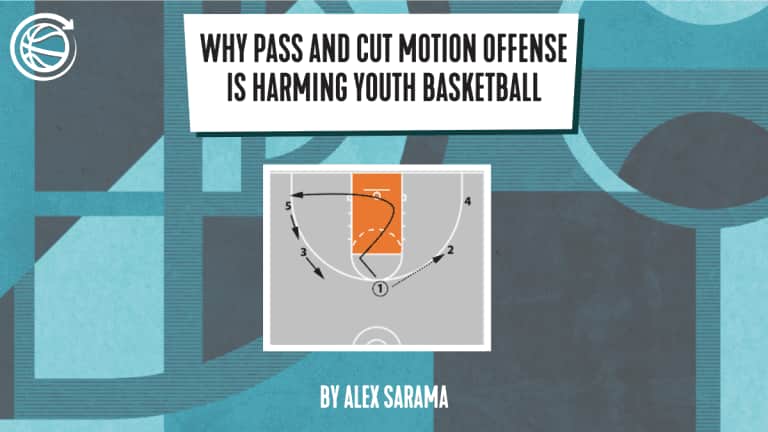
This article breaks down why pass and cut motion offense limits youth player development, and explores better ways to teach spacing, decision-making, and offensive creativity.
May 1, 2024
Alex Sarama
Approaches within the basketball industry are predominantly based upon experiential knowledge and traditions.


