

Game Design Principles for Better Basketball Practices





How do the principles of video game design compare to that of game design on the basketball court?
In this blog, we will look at the 5 basic principles of game design. We will take each principle and convert it into into tangible examples for the basketball practice court.
1. Study and play other games and build around a core game mechanic
Research and learn about the games and drills that are popular in the sport and simply find a way to add a decision for the players. This can be done through successful constraint manipulation. This episode of the Transforming Basketball podcast gives some practical examples of how to do this.
The concept of a “core game mechanic” is having clear principles that you can use in every one of these games. For example, if you are doing an advantage 1-on-1 game, such as a 1-on-1+1 close-outs with a passer, and one of your principles of play is 0 second decisions, then you must ensure this principle is embedded in the game. We will talk more about this in principle 5 later on…
<iframe style=”border-radius:12px” src=”https://open.spotify.com/embed/episode/3lCBdGzLMGuj28bRU4KjF5?utm_source=generator” width=”100%” height=”352″ frameBorder=”0″ allowfullscreen=”” allow=”autoplay; clipboard-write; encrypted-media; fullscreen; picture-in-picture” loading=”lazy”></iframe>
2. Design games that are easy to learn but hard to master
Ideally, you should be able to explain your game in 30 seconds or less. This is one of Mike MacKay’s concepts; “the rule of 30.” And as you will see in a CLA environment, there will be plenty of mistakes as the players learn and adapt on the fly.
3. Reward players with innovative incentives
A few incentives include:
- Golden snitch (instant-win): if a team or player executes a specific coverage solution that you are encouraging during a “2-on-2 Wall Pick and Roll” small-sided game, they immediately win the game, regardless of the score.
- Double points: Similar to the above, but with a goal that is not as difficult. For example, if playing Advantage Dunker Spacing 2-on-2, you may reward double points for a score after performing a Nash dribble if this is a behaviour that needs to be encouraged.
- Score reset: particularly effective defensively. If the team does not perform the coverage according to the expected standards (e.g. communicating in a leadership voice, aggressive switching, etc.) their team’s score resets to 0 points.
4. Set concrete goals and objectives
It is important to keep things simple, especially with the objectives of the game. If the intention of the game is to work on an active MIG (most important guy or girl), then we should not ‘worry’ or emphasize the angle of the pick. Many coaches fall into the trip of providing way too much feedback. Alex Sarama calls this the “shotgun” approach. By trying to catch every rabbit, you will end up catching none!
5. Set clear success criteria:
Being clear with your players about how to ‘win’ the small-sided game will ensure players are attuned to the rules of the game. One way to be clear about what you are emphasizing is by calling a turnover for the undesired behaviour. For example, if playing 2-on-2 Wall Pick and Roll, the intention may be creating a collision on the switch whereby the screener’s defender pushes the picker up so that their switching teammate can get underneath the pick, thereby neutralizing the advantage. In this game, the defense earns a point for each successful stop. However, if the defense does not even attempt to create a collision by controlling the screener, the coach may yell “turnover”. This immediate feedback will help players learn what behaviors they must have in this game to be successful. This is one of many examples of effective CLA coaching: the coach needs to be heavily involved in the practice as opposed to standing with their arms folded and letting anything happen!

How do the principles of video game design compare to that of game design on the basketball court?
In this blog, we will look at the 5 basic principles of game design. We will take each principle and convert it into into tangible examples for the basketball practice court.
1. Study and play other games and build around a core game mechanic
Research and learn about the games and drills that are popular in the sport and simply find a way to add a decision for the players. This can be done through successful constraint manipulation. This episode of the Transforming Basketball podcast gives some practical examples of how to do this.
The concept of a “core game mechanic” is having clear principles that you can use in every one of these games. For example, if you are doing an advantage 1-on-1 game, such as a 1-on-1+1 close-outs with a passer, and one of your principles of play is 0 second decisions, then you must ensure this principle is embedded in the game. We will talk more about this in principle 5 later on…
<iframe style=”border-radius:12px” src=”https://open.spotify.com/embed/episode/3lCBdGzLMGuj28bRU4KjF5?utm_source=generator” width=”100%” height=”352″ frameBorder=”0″ allowfullscreen=”” allow=”autoplay; clipboard-write; encrypted-media; fullscreen; picture-in-picture” loading=”lazy”></iframe>
2. Design games that are easy to learn but hard to master
Ideally, you should be able to explain your game in 30 seconds or less. This is one of Mike MacKay’s concepts; “the rule of 30.” And as you will see in a CLA environment, there will be plenty of mistakes as the players learn and adapt on the fly.
3. Reward players with innovative incentives
A few incentives include:
- Golden snitch (instant-win): if a team or player executes a specific coverage solution that you are encouraging during a “2-on-2 Wall Pick and Roll” small-sided game, they immediately win the game, regardless of the score.
- Double points: Similar to the above, but with a goal that is not as difficult. For example, if playing Advantage Dunker Spacing 2-on-2, you may reward double points for a score after performing a Nash dribble if this is a behaviour that needs to be encouraged.
- Score reset: particularly effective defensively. If the team does not perform the coverage according to the expected standards (e.g. communicating in a leadership voice, aggressive switching, etc.) their team’s score resets to 0 points.
4. Set concrete goals and objectives
It is important to keep things simple, especially with the objectives of the game. If the intention of the game is to work on an active MIG (most important guy or girl), then we should not ‘worry’ or emphasize the angle of the pick. Many coaches fall into the trip of providing way too much feedback. Alex Sarama calls this the “shotgun” approach. By trying to catch every rabbit, you will end up catching none!
5. Set clear success criteria:
Being clear with your players about how to ‘win’ the small-sided game will ensure players are attuned to the rules of the game. One way to be clear about what you are emphasizing is by calling a turnover for the undesired behaviour. For example, if playing 2-on-2 Wall Pick and Roll, the intention may be creating a collision on the switch whereby the screener’s defender pushes the picker up so that their switching teammate can get underneath the pick, thereby neutralizing the advantage. In this game, the defense earns a point for each successful stop. However, if the defense does not even attempt to create a collision by controlling the screener, the coach may yell “turnover”. This immediate feedback will help players learn what behaviors they must have in this game to be successful. This is one of many examples of effective CLA coaching: the coach needs to be heavily involved in the practice as opposed to standing with their arms folded and letting anything happen!




check what's trending

What is ecological dynamics and how is it connected to a constraints-led approach?
Dec 8, 2025
George Vaz

Are you searching for the best small sided games (SSGs) to improve your basketball practices? Want to replace boring, low-transfer drills with competitive games that actually develop player decision-making and in-game skills?
In this post, I’m sharing my top 5 favorite small-sided basketball games—designed to teach core concepts like closeouts, pick-and-roll, advantage creation, and transition offense and defense. These basketball SSGs are intense, purposeful, and built around real-game actions.
Whether you're coaching youth basketball, high school, or pros, these top small sided games will make your sessions more effective, more engaging, and more fun—for both players and coaches.
Let’s break down each game and how it can transform your practices.
Aug 4, 2025
George Vaz

Whether you’re coaching in the NBA, EuroLeague, or youth basketball, one thing remains universally true: the worst transition offense is still more efficient than the best half-court offense. Yet, many teams still struggle to fully capitalize on transition opportunities, often opting to slow down the game instead of pushing the pace. The question is, why? By running more intentionally, teams can create easier scoring opportunities. So why do some teams hesitate?
Apr 7, 2025
George Vaz
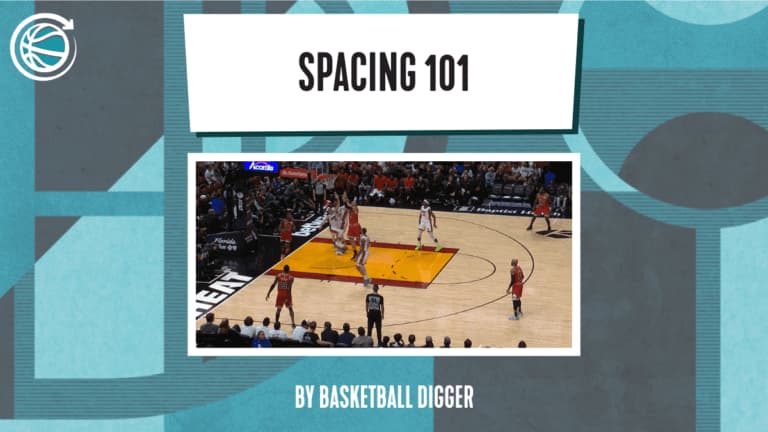
Spacing has changed the game. NBA offenses today look nothing like they did in the ’90s—more threes, better efficiency, and smarter shot selection. But why? The key lies in how teams use space to create and capitalize on advantages.
Mar 31, 2025
Simon Caret
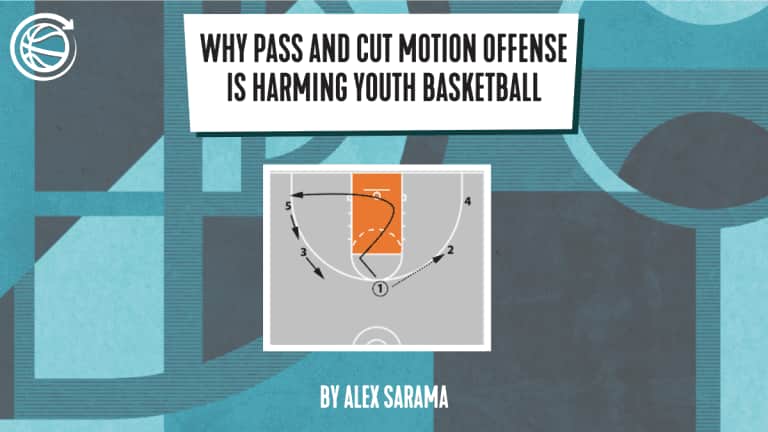
This article breaks down why pass and cut motion offense limits youth player development, and explores better ways to teach spacing, decision-making, and offensive creativity.
May 1, 2024
Alex Sarama
Approaches within the basketball industry are predominantly based upon experiential knowledge and traditions.


