Podcast
EP182: Building Confidence and Trust with Jamie Ransberry
George is joined by Jamie Ransberry during the Transforming Summer Camp 2026 in Roseto, Italy.
14 minListen
Alex Sarama is joined by Alex Lossberg to discuss his journey into evidence-based coaching and the application of contemporary skill acquisition ideas within basketball.
Keep listening while you explore. Your episode keeps playing as you browse other pages on this site.
In this episode, Alex Sarama is joined by Alex Lossberg to discuss his journey into evidence-based coaching and the application of contemporary skill acquisition ideas within basketball. He shares insights on how he incorporates ecological dynamics frameworks into his coaching philosophy, offering valuable perspectives on game sense, representative learning design, and differential learning. Throughout the episode, they delves into the nuances of coaching at different levels, emphasizing the importance of autonomy and relevance in practice activities for player development.
Our FREE skill acquisition workshop is a comprehensive resource for you to learn about evidence-based coaching strategies. Get instant access here: https://transformingbball.com/online-skill-acquisition-workshop
Esta transcrição corresponde ao áudio original em inglês.
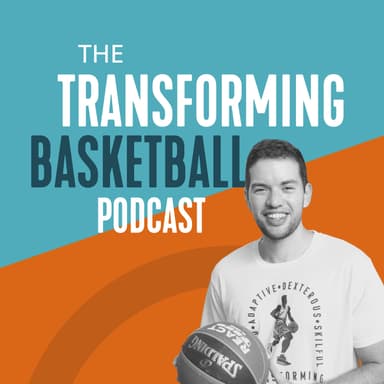
This is the Transforming Basketball Podcast hosted by Alex Sarama. This is the podcast helping coaches and practitioners change the way we think about basketball performance. Our goal is to provide the ultimate resource for making sense of applying contemporary skill acquisition ideas within basketball.
Within this podcast, Alex and his guests unpack how an ecological dynamics framework impacts our perspective of the game. If you're ready to join us in our quest to transform the basketball world, this is the podcast for you.
Hey coach, a short message before we start today's podcast. If you enjoy tuning into the show, we would sincerely appreciate it if you would spend 10 seconds leaving a rating or review on your favorite podcasting channel. This would be enormously helpful in helping us spread the message and take the Transforming Basketball approach to other coaches throughout the world.
Explore Transforming Basketball membership and continue your coach development.
George is joined by Jamie Ransberry during the Transforming Summer Camp 2026 in Roseto, Italy.
George is joined by João Pacheco, a coach from Portugal who has been living and coaching in Germany for nearly 14 years.
Use deception, tag games and live opponents to build basketball agility, perception and decision-making in your warm-up.
Thank you so much and enjoy today's episode. Welcome back to the Transforming Basketball Podcast. Today we are joined by Transforming contributor Alex Lossberg. Alex, thanks for joining the podcast.
Thanks so much for having me, Alex. It's good to be talking to like-minded people.
So we've got to know each other over the last year or so in particular. You've got a really interesting background because you studied a little bit under Ian Renshaw at university. Could you start just outlining your context in terms of where you're coaching, obviously in Australia, and how your experience kind of, I guess, really learning SkillAct, understanding the theory, practically applying that, Has influenced your coaching?
So studied under is an interesting word because I think it simplifies things a little too much. And I actually have an interesting background where, yeah, I— so I worked as a team assistant with the Brisbane Bullets last season. I'm currently an assistant coach at NBL 1 level for Brisbane Capitals in NBL 1 North.
But my background is like not basketball related in the slightest. So I studied computer science at university. And where I studied computer science, that's where Ian works. That's where some other guys in the field, Adam Gorman, work and whatnot. And I was lucky enough to just, like, towards the end of my degree, as basketball coaching was kind of looking like a legitimate pathway for me, I just started, yeah, mainly through Adam actually, and taking classes on that side.
Like, I had a few electives to kill, and that really led me into this whole world and kind of, and it just, one thing led to another, new connections, new people.
Yeah.
And I was fortunate enough, even through my association at the time, I switched clubs and met some really like-minded people. And yeah, that threw me all into coaching with evidence-based ideas. And yeah.
Love it. So it was, you know, when you had that chance to— I think it was one module, right?
Yeah, it's a very interesting thing where at our university, like, it's not even part of my degree, but I did it as an elective where they actually teach Like the coaching unit is just all CLA-based. It's all, which is amazing. Yeah, it's just something that I wish more people would look towards, particularly as like often people think of the CLA as like something you teach after they know how to coach or after they, whereas it's like, no, you can actually come into it with the idea that, hey, this is what coaching actually looks like.
Yeah.
So before you did this module, Alex, would you say you were experimenting with some CLA ideas? Were you more games approach, teaching games to understand? Where would you say you were at?
I would say I was kind of one of those mishmashed, all over the place, but had their heart in the right place, if that makes sense. Where games approach here, see an idea that you like from someone else, obviously talk about the CLA, but there was some stuff I really struggle with even now that I still have to catch myself with that, really like the overcoaching in certain moments or The hardest one that I've struggled for the longest time is like, obviously massive difference between the CLA and a game-based approach is how we're constraining scoring
and how we're looking to just develop scoring. Like, not in terms of actually putting the ball in the basket, but making sure all of our games have sort of a point system to incentivize certain actions. And yeah, that's kind of the path that that subject led me towards and just learning in a more formal manner.
Excellent. Where— and I've always been really interested in Australian basketball. I think there's an amazing culture of learning and coach development that takes place, and I'd really love to see more CLA done in Australia. And I think some coaches are there, like, really exploring this now, which is great.
But I think there's also a lot of maybe misunderstandings of thinking CLA is games approach. Where would you say Australian basketball is at? I don't want to stereotype by any means, but just some discussions with coaches, because I think it— I think Australia could be one place this could really take off in the future.
Yeah, so I think, as I said, like, I think a lot of people have their heart in the right place, at least the first instance, which means like there's great coaches. Like, even if they don't have the theory, they can care about humans on an individual level enough to like kind of intuitively find their way towards these ideas, which is important.
I think the big thing for me, and I cringe back at when I think about the first interview I had, not interview, but first discussions I had with Capitals, Murray Aldred at Caps, he's our performance manager and has been huge in my development and learning these ideas and just having someone to talk to.
When I first had a chat with him, I was coming over from another club and I remember I was talking about, oh, we ran this and oh, we did it, and it was all like Exeter and all like that. And in hindsight, I just cringe because none of it was actually about what I consider coaching now.
Like, yes, that's important, but that was me just almost flexing in a way of, this is what I know and where can I fit in? I think the amazing thing is that people like Ari can take and mold people like that, which is important.
Where, yeah, there's a lot of people with the hearts in the right place in Australian basketball. I think, as I said, a lot of people just accidentally fall into even a games-based approach. Like, they disagree with how rigid Block practice is and just see the benefit of letting things go a little more.
And there's even like intuitive things that I see in like, yeah, coach might use say we can discuss for hours and hours the importance of filling or disagree with five on O. But then there's coaches who will do five on O in the half court, like where everyone's in the exact same place and it's scripted super heavily and we all understand how.
I don't know if you guys have done it, but coaches will start introducing, all right, we're going to do 5-on-0, but everyone has to start at halfway. And when you ask them that, they're like, oh, because we need to make sure they understand organization, how to get organized.
It's like, great, that's what the CLA is here for. And this is how, like, it's not something that we just turn on and off like water coming out of a tap, but it's actually something that has to govern everything that we do.
That's a really interesting one. What do you think could help coaches better understand that, that you can't just change your lens suddenly?
That's why theory exists. I think that's the, the main important thing. Like, when people are coaching in that way where they're intuitively finding things, yes, the heart's in the right place and you can see them discovering these things in real time. But it like apply it in one specific frame of reference or one specific context, and then once it's applied there, doesn't cross over then into how are they doing like their player development, like when they do playing development.
They're going to start from the same spot every time. They're going to shoot from the same spot every time. It's going to be very static with how everything goes. The same idea that you had in that 5-on-0 where you wanted everyone to start from different spots and different roles and self-organize, that still applies to every single thing you do.
And I think sometimes it's just that reality check of, oh wait, yeah, you're right. That light bulb moment, more so than anything that theory can actually teach.
Yeah, I love it. So Alex, you were instrumental in our new Transforming Basketball Skill Acquisition Workshop being released. A lot of coaches are unaware that it's out there as a really valuable resource, and we did it because we wanted to remove any barrier to entry for a coach to be able to make sense of these ideas and practically apply it.
So could you speak a little bit just about your impressions of the workshop? Why it's out there and how we intend for coaches to be able to use it.
So the workshop's up now. It's basically like, having been through university myself, or anyone who studied like any higher education, they just know that sometimes reading paper after paper after paper after paper can get very dry. I feel like this is a good mishmash of every form of media that we've really got, both like that's accessible and also across Transforming.
So we've got Primarily using podcast clips to teach. So we've gone through and the guests that have been interviewed by Alex, there's snippets of everything in there that really shows you what the theory actually is without having to bore you by reading text after text after text.
Now there still is some important text there and it talks, but it's more about like a glossary, I would say, where it's talking about this is what the term is and this is where it exists. And then some modules are in there on just putting the theory into practice.
So there's some examples from Alex that he's been kind enough to show. There's some examples from my own training where I'm really trying to show just how easy it is. You don't have to go full everything in. Just step by step, you could just throw in small-sided game, light scoring constraints, get everyone playing.
And that's the most important thing. And the course is available now. It's got as well some amazing infographics and little snippets from the book as well scattered throughout. So it really just condenses everything that we've got available online into one concise place.
That's it. I think, I don't know if it was the same for you, Alex, but when I was learning this stuff, part of the reason why it took so long is because I was having to go to all these different places to learn it and hear from different people, like hearing the same concept but repeated from different people.
It resonated with me because they maybe use a different way of describing it, a different metaphor. And I, I'd say that was really the work we've done with this workshop. It's compiling all this information but putting it into one place so a coach doesn't have to do all that really hard work.
Now, they still got to do some hard work to actually study it and think about it critically and then apply it. And obviously, as they're applying it, think about how to improve it, what to change, all of that. But I would say it's a lot more accessible than probably what you and I both had when we were first wrestling with an ecological framework, et cetera.
Yeah. So when I was learning this, it was all paper, paper, paper, textbook, paper, paper, paper, textbook. And I think while that works for some people, it just doesn't get through to the message that really this, like, it's a lot easier than, like, yes, it comes from academia.
So inherently there is some sort of fear that No, you must know X, Y, Z to do it. No, it's really simple once we just see what it actually looks like and then reverse that.
100%. So let's talk a little bit about what's in the workshop. You obviously mentioned the podcast clips. Do you have a favorite section? And for the coaches listening, I think it might be worth just talking about how we wanted to make a workshop that's actually more informed by the CLA as opposed to, you know, a very kind of linear, I guess, course.
I'd say it's more reflective and it's more interesting because we've got a variety of both theory, application, etc. Have you enrolled in our free Skill Acquisition Workshop? This is a game-changing resource for you to apply the ideas discussed within the podcast. The workshop features some of the best snippets from previous podcast guests, in addition to illustrations and free small-sided games for you to use in your practice.
Click the link in the footnotes of this podcast episode to enroll in the workshop today and receive lots of instant ideas for your next practice.
Yeah. So there's a couple of different units where we just kind of break it down into how the CLA like exists as like the top-level implementation of it, but then it starts off from the psychology behind it. And while it kind of like scatters between everything that sort of links it between the two.
So there's a module on ecological psychology, dynamic systems theory, ecological dynamics, everything like that. Probably the most like interesting one that I've gone back on and the one that I learned the most from actually watching the podcast. Like, you know, a lot of people might come in here as well and go, well, why would I do it?
Like, already have watched every other podcast or I know it. The one that I got a lot out of it when I was listening through is the Representative Learning Design module. I think that one's really good just as like something to throw out there and just understand, like a lot of people understand the CLA.
But they don't really understand why things have to be representative and like the importance of having representative tasks and not just doing something for the sake of like having a small-sided game to run in training. The other one that's in there as well, that's the only like non-CLA linked but still evidence-based theory, is the differential learning section.
I think we've discussed the importance of developing shooters in this day and age to great detail, but that It's separate and exists separate from the CLA. And if you haven't really delved into that before, it just exists as one module to go over.
100%. So practice activities, we've obviously included a bunch of activities from my practices this year with the London Lions and your practices too, you know, showing those activities. Was there a particular reason why you went for the ones that you chose, Alex, and what you really want coaches to consider As they're actually going through and watching these small-sided game videos?
So the team that I had for this season where I've taken the activities from, for some context, it was an under-16, what we call a bronze team at representative level where we coach. That's like third team. And that's primarily consisting of like bottom age players who have another year in the same age group.
And it's really just Seeing what we can get out of these guys long term. The reason I say that is these activities you can see in some of it. Like we've got guys who are absolutely brand new to basketball. We've got guys who have played for multiple years with me as their coach.
We've got guys who've been playing since under nines, under tens, but now they're cracking into higher level youth basketball and just showing how like the biggest thing that I have to overcome when I'm trying to I guess. get my assistant coaches comfortable with this is how practice is going to look messy.
All of these tasks, you see how it starts completely chaotic, but you've got to live with the mess and live there and just kind of clean it up with the cues and instructions and everything that you're going around saying and just be comfortable with that.
Every single small-sided game that I've thrown in there has a link back to what the actual module is about and how it links to that. So for example, if I was just to go through it now, and when you see the small-sided game and— are we able to cut like a little bit of this?
When you open the representative learning design module, you'll see there's a practical example of 2-on-2 gets. Now, when you go through representative learning design, you'll understand the need for relevance in your activities. We run a conceptual offense. We see the importance of gets, particularly at the youth level, when you're talking about players who haven't used the ball screen, haven't learned what coverages are.
Yeah. And you want to get somewhere quickly. Using gets is a great way to do that. We throw it in there and we tie it back to why RLD is important in the first place, which is to make these players connect what we're doing in small-sided games to our actual 5-on-5 games.
Love that, Alex. So Alex, let's look at now how you apply all the things we've just spoken about on a daily setting in your role with Brisbane and the Bullets. And you're assistant coaching the NBL 1 team right now, and I think that has some unique So maybe you could just touch upon that a little bit for the listeners.
So we've actually got— I think there's a little bit on this in our differential learning module— MAYA, Most Advanced Yet Acceptable. That's probably the term that I would associate most with coaching at this level. Obviously, when I've coached like under-12s right now, it's very easy to just walk into practice and like they have no idea what a coach looks like, they don't know what a coach felt like, and you just throw everything out there and like it clicks into place.
When you are coaching in that environment, you are going to be slightly different from the coach they had last season, the coach they had yesterday, everything, the other assistants on the staff, so on and so forth. The biggest thing that I take away from what I've learned with Skill-Lac is just how can you see something in your role and make it most compliant with the theories that we understand to better practice.
And that could be in any role that you're doing, whether it's assistant, head coach.
Yeah.
Whatever. I was fortunate enough that I actually had the first player who really trusted me at bullets. And we would get there like 2 hours before practice started, get shots up, everything like that. I was very fortunate. He had had Ross Pickman as a player dev coach in the NBL years ago.
And so we connected immediately 'cause I was like, dominoes, everything like that.
Yeah.
That's my terminology. You're speaking my language. So. When we started talking about that stuff, then we were able to immediately start going into, all right, well, we're shooting like warm shots or stuff like that. Hang on, I'll just be the defender. Like, let's get this a bit more live.
Let's run around, let's add some cues to it. And it was just like that. It really is just understanding what my environment is, what my role is. Like, what can I actually do in here? Like, I couldn't do that with every single player and a player who's been a vet in the league for 15 years.
There's some challenges in NBL One as well, where we are lucky that with the NBL One team that I've got right now, all of our NBL guys played for the Bullets as well. So already had somewhat of a relationship and had met everyone or worked out with them and whatnot.
The interesting challenge that we have with NBL One is that everyone has a different role to where they were in NBL. So for example, some of our guys might be more of a defensive player, or they might be A development player playing one role at the NBL level, just trying to crack the roster and having to highlight like their unique skills and what they bring to the table.
Whereas in the NBL 1 level, we're trying to get them to round out what their skill set is so that they can bring it back for the next year. And that's how you get a little bit of buy-in as well. So we talk about like players trying to play a different position or not even just playing a different position, but their play type.
So they might be use more than one pick and roll as the primary ball handler at the NBL level. But here we're trying to put them in positions where they're learning about how to beat a pick and roll, testing rejects, splitting, hard shot, like everything that is required to be a functional pick and roll player at a high level.
And I think it's really interesting how you can just throw out little tasks or even just, you're playing 5-on-5 and you're just constraining in small ways one-on-one. Which is a big thing. I do it as an assistant where you're just talking about miniature constraints, almost like if you're not governing the whole practice, but at the same time, let's constrain and use some of these ideas to try and find the solutions that we need.
Great stuff. So Alex, I'd love to, as we wrap up here, I'd love to ask you what's next for you. Do you have a particular intention or goal with your coaching of something that you're trying to incorporate into your coaching over there in Brisbane?
I know it's an unusual question, but I think you'd have an interesting answer because you're someone who researches, learns a lot. And I think you strike me as someone who always has a very clear goal and intention. So I'd love to hear what you have to say to that.
So I think in the immediate term, the interesting thing that I'm doing right now while coaching NBL 1 men, the head coach of our under-12 gold team at representative level, which is the complete opposite end of the spectrum as a club that we offer.
So that's my immediate thing. I want to see how far I can get them with understanding. Like, we've been massive on team standards and they're driving everything that we do in practice. Like, actually trying to understand how they're delivering the CLA as assistant coaches by themselves, and they're literally like 10 and 11.
And just that sort of feedback loop and seeing how we can take it to another level with giving autonomy to young players. That's something that I want to experiment with long-term where How do we deliver these ideas in a way where we can get not just buy-in because we're the head coach, but buy-in because people can grasp it's for their own benefit?
In the longer term, I haven't decided what or figured out what I'm doing at the NBL level next season. I'd love to be involved again, not sure in what capacity yet. But I think the interesting thing that always is presented with my background is with my computer science degree.
I'm really interested in how that could take me somewhere. But at the same time, I find it very interesting talking to— I kind of get in a mishmash where people think of me as the computer science guy with the skill act knowledge rather than like the coach or like the coaching knowledge.
And I've run into issues with that when I'm talking about people with projects that excited me rather than I want to be seen as the coach who has the computer science background to be able to fix stuff in the—
Yeah.
Or be like the mediator, I guess. And it's always interesting when you're trying to figure out a problem and just be like, oh, I can automate that. Oh, I can do that with this. Or, oh, there's something there. And it pops up all the time.
But then you're like, oh, biting your tongue going, do I really, like, is this really a path that I want to go down? And it's difficult because yeah, every, like coaches want you for the computer science background, but then the guys who are doing, had some talks.
a while back about like doing, can't go too far into it, but like basically had like your big buzzwords, like your AI, your basketball, like, like all of, everyone who knows Brisbane knows that we're getting the Olympics in 2032. There's a lot of funding in that academia space.
And I was definitely interested in seeing what you can get out of that. But then all of the computer science guys just wanted me for the fact that I already had the coaching and skill acquisition practice to go out and intermediate and translate what on earth do these guys want and give it back to them.
And that would basically have been it. But yeah, I definitely think long-term I want to stay at this men's level, figure out what it offers, because I think it's definitely the biggest challenge for me initially was finding my feet, having been so experienced at the youth level and going, holy shit, these guys are older than me.
I know the feeling there.
Yeah. Every coach or assistant coach is 3 times your age and you're talking about like what you did on the weekend and you're like, oh, Definitely different bubbles we live in.
Alex, thank you so much for joining the podcast. I think people will certainly be hearing more of you in the future. I'm really excited to see where your coaching journey takes you, and thanks for taking the time to join us today.
Thanks for having me. It's been a pleasure.
Thanks for tuning in to this episode of the Transforming Basketball Podcast. If you'd like to learn more about the work that we do, Head to transformingbball.com to access our free resources and spread these ideas throughout the basketball world. If you enjoyed today's episode, be sure to subscribe and leave a review on your favorite podcast platform.
You can also connect with us on Instagram, X, or YouTube with any questions that you have from the episode. See you next time on the Transforming Basketball Podcast.