
A warm-up can expose a problem that is limiting a player’s game: protecting the ball while tracking an opponent, moving into a passing window or reacting when possession changes. Choose a game around that problem and scale the demand to the start of the session.
Begin by observing the player in a relevant task. A lost pass might involve distance, timing, receiver movement or pressure. Change one feature and look at what becomes possible before deciding what is limiting the player.
Connect the warm-up with a specific intention from the development plan. Keep the game simple enough for the players to enter it quickly, then adjust the challenge as they become ready.
What is a Rate Limiter?
https://drive.google.com/file/d/1aMGLLPb172WSASrg6Eii1AdFNIsakiof/view?usp=sharing
A rate limiter is a specific physical, cognitive, or emotional bottleneck that acts as a temporary "handbrake" on a player's learning and skill expression.
Rate limiters are the underlying reasons why a player cannot execute a specific functional solution in a game. For example, a young player might consistently throw poor passes in transition. A traditional coach might assume the player has "bad passing technique." However, a coach utilizing the Constraints-Led Approach (CLA) will dig deeper.
- Is the rate limiter a physical lack of arm strength?
- Is it a perceptual inability to read the shifting defense while moving at full speed?
- Or is it an emotional fear of making a mistake under pressure?
Once you identify the specific rate limiter holding a player or your team back, your Player Development Plan (PDP) gains incredible clarity. You no longer have to rely on generic, one-size-fits-all drills; instead, you can actively design practice constraints that force the players to confront and overcome their unique bottlenecks.
The Warm-Up as a Laboratory for Skill Adaptation
The warm-up is the perfect, low-stakes environment to target these rate limiters. By using gamified SSGs in the first 10-15 minutes of practice, we invite players to safely unfreeze their "degrees of freedom". When athletes play tag games, keep-away, or modified sports like soccer or handball, they are forced to lunge, squat, change direction, and contort their bodies in ways they never would in a rehearsed dynamic stretching line. This promotes repetition without repetition—repeating the process of solving a dynamic problem without ever moving the exact same way twice.
Here is how you can directly connect specific rate limiters to custom-designed warm-up SSGs for your team.
1. Rate Limiter: Poor Ball Control Under Physical Pressure
Many players look like magicians when handling the ball on-air, but the moment a defender gets into their personal space, their eyes drop, their posture stiffens, and they turn the ball over. Their rate limiter is an inability to couple their perception (seeing the floor) with their action (dribbling) under physical duress.
The Warm-Up Solution: Shield Tag (1-on-1+1)
Instead of doing two-ball stationary dribbling, play Shield Tag. Group players into threes in a highly confined space (like the center circle). One player is the offensive ball-handler, one is the defender (tagger), and the third is a "shield". The offense must continuously dribble to stay alive while the shield actively moves to physically block the defender from tagging the ball-handler.
Why it works: This game organically forces the ball-handler to keep their eyes up to read the defender's pursuit angle and use their body leverage to protect the ball. It is inherently chaotic, forcing players to discover functional ball-protection solutions without the coach ever having to scream, "Keep your head up!".
Demonstration of the Shield Tag drill focusing on ball protection and spatial awareness.
2. Rate Limiter: Sluggish "Zero-Second" Pass Decisions
A major rate limiter for many teams is that players hold the ball too long upon catching it, allowing the defense to recover to neutral. They lack the ability to make "zero-second" (first-touch) decisions to pass on time and on target.
The Warm-Up Solution: Basketball Rondo
Adapt the classic soccer "Rondo" for the basketball court. Play 4-on-2 or 5-on-3 keep-away in a designated grid. The offensive team must string together a set number of consecutive passes to win a point, while the defense tries to deflect the ball or tag the player in possession.
Why it works: To survive against an overloaded defense in a tight space, the offense cannot hold the ball. You can manipulate constraints to target specific perceptual bottlenecks: require players to call out the name of the teammate they are passing to, mandate that every pass must be a bounce pass, or constrain players to move to a new spot immediately after releasing the ball. This primes the brain for rapid, lag-free decision-making before you even begin your half-court offensive segments.
High-speed basketball rondo drill with players practicing quick passing and zero-second decision making under defensive pressure.
3. Rate Limiter: Slow Transition Reactions
If your team continually fails to generate numerical advantages (like 3-on-2s or 2-on-1s) in transition, their rate limiter could be a lack of "lag-free reactions". They are not winning their first three steps when possession changes.
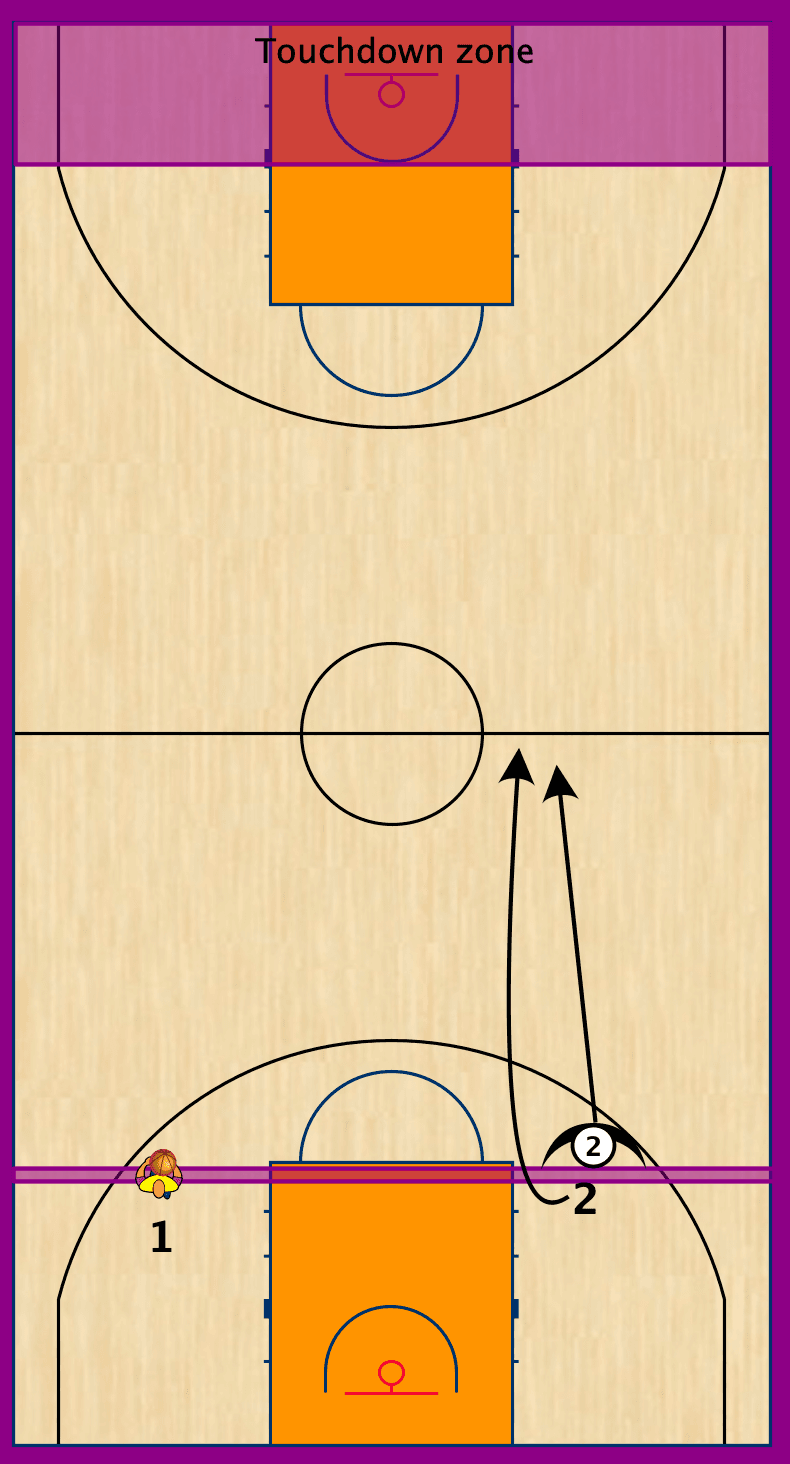
The Warm-Up Solution: Touchdown Tag
Set up pairs on the free throw line extended. The offensive player starts without the ball, and the defender stands exactly one arm's length away. The game is live the exact moment the offensive player moves. The offense's goal is to sprint and receive a pass from a coach to score a "touchdown" (or a layup) before the defender can catch up and two-hand tag them.
Why it works: It completely gamifies the physical trait of sudden acceleration. The offensive player is entirely focused on the external goal of escaping the defender, naturally organizing their body to sprint with maximum force and efficiency. You are actively training explosive transition habits while the players are just having fun playing tag.
Connect the warm-up with the session
Choose a warm-up that prepares the group and exposes the intended movement problem. Its value comes from what the players can explore and how it fits the session.
Record what you noticed and whether the adjustment helped. Return to the problem in the later basketball activity to see whether it remains relevant.
Sigue desarrollándote como entrenador.
Conecta estas ideas con el Success Pathway, la videoteca de actividades, la comunidad de entrenadores y las sesiones mensuales en directo.
Descubre la membresíaCompártelo con otro entrenador
¿Conoces a alguien a quien le resultaría útil? Comparte este artículo.