Constraints, Curiosity, and Coaching: Ashley Cookson on Leading the Essex Rebels
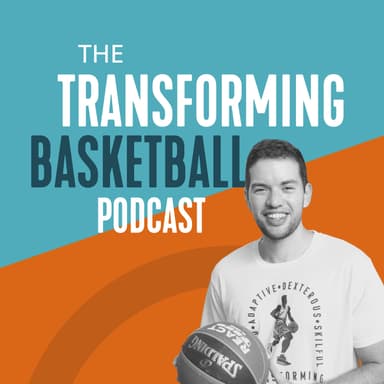
George Vaz sits down with Ashley Cookson, Head of Basketball Performance and Head Coach of the Essex Rebels women's team.

George Vaz sits down with Ashley Cookson, Head of Basketball Performance and Head Coach of the Essex Rebels women's team.

Keep listening while you explore. Your episode keeps playing as you browse other pages on this site.
In this episode, George Vaz sits down with Ashley Cookson, Head of Basketball Performance and Head Coach of the Essex Rebels women's team. Ashley shares his journey through coaching in the UK, Sweden, Canada, and Australia, and how ecological dynamics and constraints-led approaches shape his philosophy.
Select a chapter to start listening from that moment.
Useful for your staff or players? Share this episode—or a specific moment—with them.
Esta transcrição corresponde ao áudio original em inglês.
This is the Transforming Basketball Podcast. This is the podcast helping coaches and practitioners change the way we think about basketball performance. Our goal is to provide the ultimate resource for making sense of applying contemporary skill acquisition ideas within basketball. Within this podcast, we unpack how an ecological dynamics framework Impacts our perspective of the game.
If you're ready to join us in our quest to transform the basketball world, this is the podcast for you.
Hello and welcome to the Transforming Basketball Podcast. On today's episode, we have Ashley Cookson. I actually met Ashley last season or the season before when he was in London visiting for a London Lions game. I hadn't actually, you You know, had too much time to speak to Ashley about his career or how his teams have gone with the Essex Rebels.
So there was a lot of things that, you know, doing research on this episode, Ashley, I'm like learning about you. So I'm excited to have you on the show. Welcome.
Thanks for having me, George. Appreciate it.
Explore Transforming Basketball membership and continue your coach development.
So how did you get involved with the CLA? How did you get connected with Alex? How's your story look like?
I hate to do a psychoanalysis of myself. But I think it starts in my childhood. So I was actually, my parents did a really good job of kind of allowing me to make my own decisions, make my own mistakes along the way. And they did a really good job of guiding me without kind of being a helicopter parent.
And I think that was kind of the start of it, like how I was led by my parents. And then I also, I did taekwondo when I was very young, so I'd, I started that when I was 5. And I really enjoyed the sparring element of it, the like hand-to-hand combat and trying to solve that problem, you know, like, okay, so I've gotta try and if I kick somebody to head, it's worth 3 points.
If I kick them to the midsection, it's worth 2. I can't kick them below the belt. So it's sort of like the constraints are there right away. But it was fun to be in that one-to-one combat situation. And I was very frustrated by the other parts of taekwondo, which was like The patterns and the, you know, having to do these techniques that were like this idealized model, but they wouldn't work in a real fight.
And practice looked like that?
Yeah, so it was like, it was both, right? So it's like the sparring element where you get to like be in combat with somebody, and then the, okay, we're gonna do these patterns, which is basically just like a sequence of techniques. Yeah, that you'd memorize and then I got frustrated by that.
And then the other thing that kind of like influenced, like fast forward, like playing basketball I played when I was younger, I, I used to shoot from like my waist and I got coached out of that heavily, you know, like all kinds of drills that were putting your forearm against the wall.
And I'm guilty of doing these things, forearm against the wall, ball in the hand, like perfect. Right angles and all this kind of stuff. And it makes me think now, like with what I know about skill acquisition, like you know what shooter could I have become if it wasn't coached out?
I mean, like my natural movement solution. How would it have been? And so now, like my son is my experiment. Just kind of let him figure it out. He's three years old and he's he's shooting how he shoots. So we'll see how that goes with some guidance.
And then just like to now. It just kind of maps on with my experiences, really, the CLA and just these ecological dynamics. It just resonates with me. So that's why I enjoy coaching in that way. Absolutely.
Just a natural fit. Like you just naturally gravitated towards finding a, obviously an evidence-based approach to coaching. And how has that helped you or how, and maybe let's not say helped, how has that challenged you as a coach? From the day that you started implementing it into your practices and into your interactions with players to now, obviously coaching at the professional level with the Essex Rebels?
Yeah, I mean, I think it's been a journey and it continues to be. It's a way of coaching that players aren't always used to or have experience in. And players at this level, they hold onto their prior experiences of like, okay, this is the way I've done it for a long time.
And this is what's helped me become like a professional basketball player. And so they hold tightly onto those ideas of like, okay, well, I need to get my reps in. And I don't fight against that. Like, I think there's space for that. And if that's gonna help you with the mental massage to help you feel ready from a confidence standpoint, then that's great.
Like, Go ahead and do that. But here are some ways that will help you improve in applying these, these things that you want to do in the game. So yeah, we make things look like the game as much as possible. And the thing is about that, players enjoy it.
Players want to play. So it's not really a difficult way to coach in that sense. It can be difficult with how to design it so that, you know, the constraints There's a lot of sometimes cheating the games, have to, you know, grease that in a way that is beneficial and productive.
Like, I love coaching it this way, and I think it can apply to the 5-year-old that's just picking up the ball and the seasoned professionals. There's no—
Yeah, I remember, to build on your point, like your taekwondo point about growing up and experience, because I think I naturally gravitated towards this approach because I remember being a child, obviously, you know, being a lot taller than kids, we would always have like the smaller kids that would want to like play tag with us in Brazil, right?
And I remember we would put constraints on those kids so that they can still play the game with us, but that they didn't have the same consequences. So that way the game was still enjoyable. We'd have people that were a part of the game.
We'd have lots of, you know, kids running around and we were playing tag. But we weren't allowed to like tag the little kids so that they would be the taggers. They were just in the game. They were just involved. But that was like, it's funny because that was a constraint so that we all could have fun without ostracizing anybody and having lots of people in the game.
But I just wanted to share that because it's like one of the hardest things of being a coach now and something that's really, that has been my challenge. And I don't know if you can relate to this, is manipulating the constraints in real time.
Because like you said, it's, you know, you're playing, so you're having to watch and focus on the game, and then you're having to like, all right, how can I manipulate these constraints to get the behaviors I wanna see to get, you know, players involved or what, what have you?
Yeah, I mean, that's difficult balance to strike with the pre-planning, the, okay, these constraints are gonna help us to develop in this area, but actually it's not coming to life the way I thought. And now I have to adjust.
And you guys, this last season, I was watching the game yesterday, your team, and correct me if I'm wrong, super intentional about playing in transition. How did you guys practice that? What kind of activities did you do? How do you coach that? Can you talk to us about it?
Yeah. I don't know whether you saw me like flapping on the sideline, like, just go, go.
That's the trick.
Yeah. Yeah. I mean, there's something I say a lot. We actually call it our go phase. You know, first 8 seconds of the shot clock. I can give you an example of how we kind of work on this. So we have a 4v3 continuous drill.
Actually works best with 14 players because we have a pretty big roster because we also have a university team. We usually have around that number. So it's perfect for that. Have a couple constraints. So the first one being the first catch has to be inside the 3-point line.
So after that defensive rebound. First catch has to be inside the 3, and then we constrain it. We start with a 10-second shot clock, then we go down 9 to 8 to 7. We haven't really gone below 7 because we feel that's maybe a little bit too fast and the shot quality starts to go down.
But with 7, you can definitely get it done. 4v3 intentions. So we are trying to get a shot at the rim and 3s. Those are the only shots we can take in 4v3 because we have the advantage anyways, numbers advantage. And then we have like some more subjective constraints that we put on it as well.
So all 4 have to sprint. So now I'm policing that. That's where it becomes a little, like the players get a little uncomfortable with that because they're like, I was sprinting. But now you weren't because here's the video back from 10 seconds before.
So we are going to add, this is something that I've been thinking about over the summer. It's like, okay, so we wanted to play fast. What was our rate limiter to doing that? Well, looking at the numbers, our defensive rebounding. If we become a better defensive rebounding team, then we have more opportunities to run.
And so the next constraint, so it's actually perfectly set up for that defensive rebounding because now you can, you have a disadvantage, right? When it comes to defensive rebounding. And what we did was with offense, if you've got an offensive rebound, there's a 3-second shot clock.
So it had to be, had to be a putback or it had to be a kickout 3. And so now I'm thinking, okay, we have 3 players. Anytime they keep it to 1 shot and get a defensive rebound, then it's a +1. So we're playing, you know, a 2-minute game, a 3-minute game, depending on, you know, where we are in the season.
We want to keep that pace up. We want to keep that shot clock nice and short. So maybe we have to make the game shorter.
Yeah.
In order to keep that pace up. So yeah, that, that's, I think, something that we need to improve upon then on thinking of ways to challenge our defensive rebounding in order for us to connect that to the transition game.
And what do you mean by making the game shorter?
Shorter in terms of length, right? So shorter timeframe, a 1-minute game, a 2-minute game, 3-minute game.
Oh, right. So you can focus on actually sprinting as opposed to going too long.
Yeah. And if we go, we go too long. But the thing is, we also need to show that we can do that and build that capacity. So it's all about the balance of where we are in the season and how much loading. Yeah.
Like finding that competitive advantage. Right. And I guess that's the benefit of having the university team, because then you have a lot of players and a lot of players that want to play, a lot of players that can play, and then you're, you can constantly sub.
To be in that green. But I would imagine, you know, you get to a final, you're in the playoffs, you're not going to be able to rotate that much. So you talked about the loading, but how do you prepare the players? I guess, because your role is head of performance, right?
I was like, that's a fancy role. So how do you prepare the players as head of performance and the coach in the weight room to be ready to, if they're playing extended minutes and you still want to be intentional about playing in your go phase?
So yeah, my title is Head of Basketball Performance. It's an all-encompassing role, so it oversees the men's program, obviously head coach of the women's program. That's the bulk of the work, but that's most of the time day to day spent on that. But then we also have a junior program that I oversee as well.
And so in terms of performance elements, we have 3 things mainly. So it's, it's team practices, it's strength and conditioning, and it's skill development. And we work Myself and Justin, our strength and conditioning coach, we work very closely together, particularly with players' development plans, so that it's completely connected.
Like, if I think that there's a physical deficiency that's stopping them from moving in an effective way, or there's a conditioning issue, that then that stuff is integrated. So I'll give you an example that we do jump testing. Twice a week before practices.
If an individual scores low on their jump test, or we do as a team, then we adjust the loading in practice. Then we also have subjective numbers, you know, like wellness scores on XPS that we use as well. And anything that we think is a rate limiter in terms of their development, we will try to address that, whether that be in the weight room or in skill development or something that we can track in team practice.
To your point earlier, I guess one simple way you can adjust the load if they score low on that jump test is simply doing shorter games. So less games, maybe less reps before the reset, things like that. Is there anything else off the top of your head?
Yeah, like shortening the practice overall. We are not afraid to have players sitting out of practice as well. If they have, you know, like—
They must hate you for it.
Yeah, but I think in the long term that they're more grateful that they're available for the game. And that's our main thing. It's like, that's the guiding principle. It's like, okay, player availability is the most important thing, availability to play in the games.
And so whatever we need to do to manage that load, but also still have enough stimulus to have enough capacity to be able to play, it's a fine balance. But I, I just have much smarter people than me around me. To help me with that.
Justin, our S&C coach, is very good at that.
And so let's pivot now. You've been around. When I was reading, I was like, wow, this guy's been everywhere. So you've been to Sweden, Canada, obviously now the UK. I don't know if I'm missing any place, but—
Australia as well.
Australia as well.
Wow.
What were those stops like? And what, are there any kind of universal truths or anything that you picked up that you've been using? Or maybe it's some things that you haven't, you know, that you've picked up and used, like, I'm not going to use that.
Like, like, yeah, I've been fortunate to be around some amazing coaches and players as well in Australia. The biggest takeaway from Australia was that building a network of coaches around you is really important. Coaches in similar situations to you that you can just speak And it could be about something that's specifically to do with practice.
It could be about player issues, could be recruitment, could be anything, but also just like they can relate to the lifestyle and how, how you can manage your time. Like they just recently started a young family. Like my oldest is 3 years old.
I have an 8-month-old as well. Managing the family life with coaching, it's not an easy thing. Have good people that I could talk to. That are going through similar situations. And in Australia, they have such a good network of coaches, like they're always having coaching clinics, like literally just around coaches all the time.
And the biggest takeaway from Australia was that they are so open to sharing ideas, and I can't say that for everywhere. That's not the case everywhere. So yeah, I would say that that was something I picked up there. And then Sweden was interesting because it was like I was in a role that I was trying to develop the junior program in a completely different culture, as well as assist the pro women's team.
And it was very challenging to like learn a culture, but also try to bring these new ideas of kind of like with an ecological lens, with the dynamic of, you know, pair of volunteers being the coaches. That was an interesting thing to try and balance.
What would you do differently in that Sweden and that Sweden experience? Because I had a similar experience in terms of, you know, the forms of life, like moving to a new culture and being with different forms of life. And you're like, all right, I'm going to put my, you know, the basketball, my principles in.
But then to your point, sometimes you have the volunteer coaches that maybe don't know as much. So you have your different forms of life affecting how you implement. your principles and your ideas through that ecological lens. So what would, is there anything you'd do differently?
Yeah, I think the big thing that stands out is I would show them more of what I meant instead of trying to explain.
The language barrier as well.
Let me just take over this practice and then you can take the next activity and then I'll jump in, you know? So like being more of the example and that's something that I've taken with me because I think that then it's much easier than for a pair of volunteers to kind of like see how I like things to be done and then like it.
And I was taking the approach of like, okay, not so much like here's the theory, but like, this is how we'd like to do things. So showing it just makes it easier, right?
That was the Sweden experience. Then you had the Canada.
Canada was university coaching. So assistant coaching at universities. What I learned from Canada was their level of defensive intensity is just like, I haven't seen anything like it since. And so trying to bring that into my coach, because I don't really, I'm more of an offensive first kind of coach.
And so seeing the opposite was really cool because it just like, okay, like there's more detail to this that I'm not quite understanding. And yeah, just how they were able to drive intensity in practices. I was around 3 different Head coaches in Canada.
Yeah, the collegiate system is similar to the States, but they play FIBA rules. So I thought that's cool too. Like similar philosophy in terms of coaching, like coaches, really good kind of storytellers, really good use of language and terminology. And they're just really good at driving intensity, usually by being intense.
And that's something that I can't quite resonate with, but there's time, there's time and place for it, right? Because sometimes you need to take players a little bit by surprise. So yeah, that was the learnings from Canada.
And what specifically in terms of constraints, constraint ideas, adding to practice that you've kind of taken away from that Canada experience to implement with your team now to maybe up the intensity at practice?
Yeah, I mean, there's, there's a lot in terms of, I'll give an example with defense. I called it this year. Perfect possessions, so I would give three constraints on a particular situation. So let's say it's pick and roll coverage, and we're in red, which is blitz at hard hedge.
So on the red, it had to be the guard had to be triple A, so attach avoid attach. So they're attached again over the screen, and they're getting under the hedging player. So triple A put a guard, and then the big had to be sending.
That ball handler up the floorboards, like they had to be retreat and then recovering. And then the last thing was blast had to be there. So blast being the last line of help and they were tagging the roller. So they had to get a stop.
If they didn't do all 3 of those things, then it wasn't a perfect. And obviously like subjective. So many upset players, like, no, it wasn't perfect. Like you weren't, you weren't attached to begin with. Like, you, you know, so, and you can be as harsh on that as you want.
You can have assistant coaches helping you with that. If you, you know, okay, Ashton, he was one of my volunteer assistants, you, you take the last player, you know, and it'd be like, yeah, it was all good on ball. Ashton, what'd you think?
No, last wasn't there. Tag wasn't high enough.
But okay.
So yeah, like having those kind of subjective constraints, but fun as well, because there's a lot of biting back from the players and I quite like that.
That's a challenge point raised because you're really asking, you know, near perfection on a coverage, on a pick and roll coverage. And while you were saying it, I was thinking like, oh, you could even play a game like first team to 3 perfect possessions wins.
So then they're like, we did 3 in a row.
I know. Yeah, those, I mean, that goes for a while.
But I love it because then you're obviously the constraint with 3 in a row, at least, you know, if you think about it, they're going to get fatigued as well. So you're going to get that individual constraints. With them as well, which is something I've been thinking a lot about lately, like how to manipulate the fatigue levels and then put them in situations to make tough decisions that you would see at the end of games.
But no, that's the, yeah, that's a great one. Perfect possessions. And I guess that would be like your pillar for defense or one of your guiding principles for defense. Like, oh, we want to, you know, this game, we want to come into this game and have, I don't know, you know, 20 perfect possessions.
Versus this team on this red play that they have, or on the set play that they have?
I haven't thought about tracking it in that way, but yeah, we usually, when we do the video review, it will be matched up or aligned with the keys to the game. So whatever 3 things we think are most important to play against this opponent, we will review those things, but also we'll review some of our principles of play as well.
So that's how I like to think about constraints is the first way we manipulate constraints is to feed into our principles. So it's to like amplify our principles. Like we wanna play fast, so let's put some constraints in to make us play fast.
And the other way is the opponent. So sprinkled in throughout the week, like throughout the microcycle leading up to the game is, okay, so they are very good in side pick and roll, you know, like empty. Okay. When they do this, I'm just spitballing here.
This is not something that we did, but okay. When they do this, we want to play ice because then we have somebody to rotate on the pick and pop because we're sending to the side where help can come from. And so, yeah, then we could manipulate the constraints based on the opponent.
So it's either to amplify our principles or to reward the opponent's principles.
Yeah.
the solutions against something that they do either defensively or offensively.
And I want to ask you, because you said, oh, this is not something we particularly do, but I thought that was an interesting point. I just want to ask you here, you're obviously in the process of recruitment during the summer now. I'm curious, how do you modify your principles of play as you get new players?
So obviously, like you played a certain way the last season, now you're going to get these new players. How do you look at yourself and your team and think, all right, well, this player's strengths are this, this is how we gotta change. But how do you do that?
It's interesting because I've thought of this in 2 different ways, but I've come back to this. It starts with what are the ways in which you would like to coach the team? Because if you're just gonna play a whole way that you, you don't believe in, or you don't think there's enough data to back that up, for For me, it's like it comes down to efficiency.
Like, what's the most efficient way to play within our context? And so the overarching principles kind of stay the same. Like, we want to play fast in transition offensively. We want to play a lot of pick and roll. Okay, so I'm going to recruit players that I think are going to be effective in those situations.
And then defensively, I want to stay in neutral situations as much as possible. I don't want to be in rotation. Okay, and you can do that in different ways. Like, you can try and keep it to 2v2. You could switch to keep it neutral.
Like, there's different ways to do that. So that's the starting point. But then it's also in recruitment phase about, well, best available, because you're trying to build a team with enough— like we spoke about this before, the talent-character equation. Like, you want to have high, high talent, high character people as much as possible.
And so by recruiting the best available, sometimes you're going to have to Bend or adjust the principles, but it doesn't mean to say that you can't start out with like ideally I'd like to play like this and then try and recruit players to that because in our setup right in the pro at the pro level you have a budget and it's about trying to maximize that budget with the depth that you need to be able to compete for us a long season like we go until the end of May so.
If we're making it to the playoff final. So I would say starting with some core principles and then adjusting based on the personnel you have, because then, then you can get more into the detail of like, all right, we're going to have these couple sets so that we can get Maria in a post-up because we think she has an advantage in this situation.
Makes sense. Less about changing everything, more about just minor adjustments to what your core— I want to say like core values, but your core principles. Of, you know, principles of play. So it's like you make these adjustments based on players, but you still want to play fast.
You still want to get into your pick and roll early.
There's also refinement of that too. Like I, I have on the whiteboard, like principles of play, and then I put it into this nice document. And then I look at it at the end of the year and I'm like, okay, like this needs some refinement because that maybe I can change it so the language is better, or maybe I could take some things out because I can just summarize it in this way.
And so, yeah, like that, I'm going, I'm going through that process again. Like, how can I make this easily understandable, better for the players to resonate with?
Ash, I want to thank you. It's been great catching up. Great to speak to you. I wish you the best of luck this upcoming season. And before I let you get out of here, I want to ask you our transformative tip question. If it's one piece of advice, if there's one piece of advice you could leave coaches to instantly improve their practice,
Yeah, I think in the words of the great Ted Lasso, that was probably stolen from somewhere else, be curious.
I think the best way to get the most out of the people that you're coaching is by being as well-informed as possible. And you only get to that point by asking the right questions. And that's the questions that you need to ask the players, or you need to ask other people in the organization.
Other coaches to gain that knowledge and that wide base. But it's not just about within basketball, it's also about broadening your horizons. The more you know about other things, you'll be surprised at how much, you know, listening to podcasts with other business owners or leaders or just, you know, like philosophers or whoever, and how much of that you can apply to your coaching.
Because coaching is a holistic task. It's not just about the X's and O's of basketball.
It's about helping people develop much more, much more than X's and O's for sure. Thank you so much, Ash.
Thanks, George.
Thanks for tuning in to this episode of the Transforming Basketball Podcast. If you'd like to learn more about the work that we do, head to transformingbball.com. To access our free resources and spread these ideas throughout the basketball world. If you enjoyed today's episode, be sure to subscribe and leave a review on your favorite podcast platform.
You can also connect with us on Instagram, X, or YouTube with any questions that you have from the episode. See you next time on the Transforming Basketball Podcast.