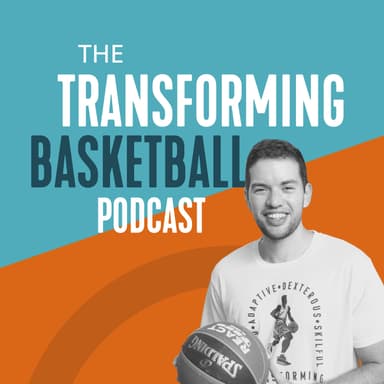
In our first episode, Alex Sarama is interviewed by Adam Omiecinski to introduce the Transforming Basketball Podcast.
Keep listening while you explore. Your episode keeps playing as you browse other pages on this site.
In our first episode, Alex Sarama is interviewed by Adam Omiecinski to introduce the Transforming Basketball Podcast. This podcast series aims to bridge the gap between the research and its practical application in the basketball world. Alex discusses his journey of discovering an ecological dynamics framework and the constraints-led approach (CLA), in addition to why he believes understanding contemporary skill acquisition is a game-changer for coaches of all levels. He also explains his motivations for starting Transforming Basketball and his vision for the future within the global basketball coaching community.
Want to take a deep dive into the Transforming approach? Our skill acquisition workshop is a comprehensive resource for you to learn about evidence-based coaching strategies. Get instant access here: https://transformingbball.com/online-skill-acquisition-workshop
Esta transcrição corresponde ao áudio original em inglês.
This is the Transforming Basketball Podcast, and I'm your host, Alex Sarama. This is the podcast where we help coaches and practitioners change the way we think about basketball performance. Our goal is to create the ultimate resource to help make sense of how contemporary skill acquisition ideas can be applied within the basketball world.
Throughout the podcast, we'll unpack how an ecological dynamics framework alters our perspective of the game. If you're ready to join us in our quest to transform the basketball world, then this is the podcast for you. Welcome to the first episode of Transforming Basketball.
This is your host, Alex Sarama. This is gonna be a really different podcast series. It's going to be a combination not just of guest interviews, but I'm also going to do some solo casts where I take topics and do a deep dive into different areas of the game and skill acquisition ideas.
And also, I think a key part of this podcast is I want to introduce practitioners working in multiple different roles in basketball all over the world to help make sense of contemporary skill acquisition ideas. So the tables have flipped a little bit in this episode.
My— one of my good friends, Adam Omiecinski, who worked with me last year at College Prep, is joining us, and Adam's going to ask me some questions And in a future episode, it's going to be flipped, and I'm going to be asking Adam a bunch of different questions based on the work we've done over the last few years, especially all the ideas we did in Italy.
So Adam, over to you. Thanks so much for doing this. There's no one better to ask in the basketball world than you. I think we've had so many conversations about all these ideas over the years, so much appreciated.
Absolutely. Thank you for giving me the opportunity to ask you some questions and have it recorded. Let's just start out with something very simple that I know you're probably going to hit on with every single guest probably that comes on this podcast, is how did you first encounter the constraints-led approach?
Absolutely. So I'd say it was about 5 years ago, and I'd come across some games approach stuff before, and that was mostly through YouTube. And I'd say probably some of the clinics that Mike McKay was doing 8 years ago. I think a lot of people know of how much of an influence Mike has had on me.
He's probably been one of my biggest coach mentors. And obviously Mike's the performance director of Basketball Canada, for those who don't know. I definitely recommend checking out some of his YouTube stuff. So I kind of started with that and using a games approach, and I just really enjoyed that and how different it was to traditional drills.
At the same time though, I'd say there are some things I wasn't able to properly understand or articulate as to why they were happening. And, you know, now obviously I'm very clear of the differences between a games approach and a CLA. That's actually going to be a whole episode.
So when I went to this conference in England, it was called the— I think it was called the, uh, the Future of Coaching, I believe. Might have got that wrong. But Stuart Armstrong was one of the speakers of the Talent Equation, and his presentation was obviously on the constraints-led approach and ecological dynamics.
So straight away that it was just— I was hooked and it just made complete sense. And I think it's kind of what maybe I've been longing for a little bit, and some of the limitations that I had just experienced using a games approach.
So that's when I got to grips with it. But I don't think many people know this, Adam. I actually— I spent a few months really trying to understand it, the CLA and ecological dynamics, read a bunch of papers, listened to a bunch of podcasts.
I, I don't wanna say I gave up, but it was actually so challenging and I had no one in the— I knew no one in the basketball world at that time who was, you know, close to these ideas or who, you know, these ideas would've resonated with.
So I was stuck. So I actually, after spending a lot of time trying to get to grips with it, reading, I think, I think it might've been the first edition of the Nonlinear Pedagogy book, I believe. And then several months went by and I just didn't touch any of the material.
I just found it very challenging. Things like an affordance, all this language at the time, the first time I was exposed to it, was very difficult. But then after a few months, I just got right back into it and I was like, all right, I'm determined this time to properly understand it now.
And that was not an easy process. It was trying to learn from a bunch of different sources, put it together, and then critically actually try it in different settings. And at the time, I was working for NBA Europe, so That's actually one of the, one of the reasons I left.
It was a very difficult decision. I was very young at the time, and I, you know, it was the life of luxury traveling the world, staying in Ritz-Carlton hotels. It was amazing, but I felt like I wouldn't have been able to learn and properly get to grips with these ideas.
And that was what was most important to me, to try and pioneer this and really get to grips with it. So that's kind of what led to me embarking on a long winding journey until here I am today. And it was really— it's been a case of just trial and error and having so many conversations with coaches like you who have an interest in these ideas, and also kind of seeking out experts in the field in the skill acquisition space.
And really, just once I learn it, just once I learn some of these theories, it's just having the freedom to, to experiment. And that's obviously why I was in Italy for 3 years. It was just my laboratory where I could do whatever I wanted.
And I think if I didn't have that, you know, path dependency, traditional ideas, it's so entrenched within the basketball world, I probably wouldn't be doing what I'm doing today. And I think having that freedom and the ability to be creative was so important in my development.
Wow, that's plenty to work with there for my follow-up question. But something that really stood out to me, and no, I didn't really recall you ever mentioning that previously in our conversations, that There was a stretch there where you just put it away and you just couldn't do it.
Can you tell me a little bit more about that stretch? Like what was going on? I understand the difficulty because I think anybody who, at least that embarked on this journey the way we have, where we didn't have a lot of these resources and we were making these interpretations.
What eventually made you like decide, all right, I have to, I have to look at this more. I have to look at this more.
I think it was just, I've always been a curious person. And I've always enjoyed, even like from, I was reading kind of like personal development books from like 13 years old. So I've always been interested in growing and just in the intellectual side of learning something new.
I think that just really appealed to me. And I think just it made me more determined to get it, the fact I didn't get it the first time and it didn't come easy. And I think the reason I didn't get it was because maybe there was some games approach content being shared at the time.
I wouldn't say much, of it. It was still quite rare. So obviously the CLA was even rarer. And I think it was just a case of I was so isolated in the early days, in the probably the first 2 years of me discovering the CLA.
I had no one in basketball really I could talk about. And that's changed a lot now, which is, I think, for the better. And really, Adam, that whole experience, that's basically why I've started Transforming Basketball. If someone came across these ideas and they're a practitioner in the basketball world, regardless of whether they're a coach working in a front office, athletic performance, a scout, physio, whatever, where would they go if they really wanted to make sense of all these ideas?
And I, I don't think there's anywhere you would where all the research is kind of made sense for you applied in a basket— in a basketball context. And then you've got practical examples in all these different fields of what it looks like. And that's why I envision Transforming Basketball being a tool to basically accelerate the adoption of contemporary, you know, skill acquisition ideas in the basketball world.
but critically being a bridge with the research and the practice. And I, I think that's the most important thing because there's so much amazing work being done. So like we talk about it all the time, you're sending me like new research papers virtually every week, and it's almost like we can't keep up.
So the key thing though is how do we apply it? And that's kind of what I want to be here to help people understand. Wow.
Now that really does. And I mean, A lot of our actions, I think, are based on emotion. And I can just envision like the struggle of like watching the players and knowing in your heart, like, I didn't really see this through. I need to explore this.
And that's very difficult. That's very difficult. And I applaud you for going further through that. And now it makes sense. You wanna make it easier and more accessible for everybody else that we didn't necessarily experience a few years ago when we discovered this.
Yeah, that's exactly it. And I think it's, especially for, for coaches. I mean, I, I understand how hard it is, especially I've had the luxury of being a professional coach for, well, the last 5 years, at the same time I discovered the CLA, really.
So I've had the time to do this, but I've also wasted a lot of time going down, you know, wrong paths. And that was necessary for me to be where I am now. And I— what I just— I want coaches to be able to feel like they can grasp this because Both of us, we've seen the results, you know, whether it's a college prep or even other environments all around the world.
We know what this can do at any level of basketball. And I just think we owe it to the players, you know, if there's an approach that we know is based by a rigorous, supported by a rigorous evidence base, you know, not just in terms of making players more skillful, but the other kind of things you get out of it, whether that's leadership, confidence, all those things which are just so important for life.
You know, I just think that's, you can't dispute that and how beneficial the CLA is in that regard.
Wonderful. Thank you for sharing that, Alex. And I'm glad I didn't directly like try and seek out like how Transforming came about, but that's, that's very cool that we got to hit on the topic of like why we're here in the first place and why you decided to start this company.
And speaking of like starting this company, something that's always been on my mind recently is as soon as you asked me like, hey, would you like to ask me some questions? Is like, you're very, you seem very excited about taking on big tasks.
I mean, just going through your history, I mean, you started coaching, you like, I believe you started your own AAU team at age 16, just because you wanted to start coaching. And it always, we transitioned from that. You got this job at NBA Europe, so you're traveling all over the world seeing these things at a very young age.
Then you're like, oh, I want to take on this Belgium thing. I want to run this. Nope, this isn't good enough for me. I want to run my own program. And then on top of that, you're also juggling things like, oh, I wanna start a conceptual offense.
I wanna write a book. I wanna do this. What excites you about that process that just, it seems like you always have something big in the queue, sort of, sort of say.
Yeah, absolutely, Adam. I mean, honestly, the selfish reason is because doing these things makes me better. And it's just the thought process of going through all these different projects that I've partaken in over the years. It's kind of really forced me to think deeply and look at, you know, how can I present these ideas in an understandable way?
And, you know, anytime you take on a new project, it's like the Paris example. I had the great chance to work with Will Weaver in Paris last year, and that was new to me, but it was essential because figuring out how to apply the CLA at that level of basketball was huge in my growth as a coach.
So I think And another thing is it just makes me feel good being able to share ideas and know that other coaches and players are benefiting from this. And that's one of the best parts of the job is when I get a message on social media with a coach telling me about, you know, I don't care so much about the wins.
You know, it's great when that happens and coaches have amazing seasons, but more telling me about what they're seeing in the behaviors of their players, like the skillful behaviors that are emerging, the lifestyles, how much the players are having fun. And even coaches too.
I've had so many coaches tell me it's just It's completely opened them up. It's unlocked them. That's, that's the word some have used with me, to a completely different philosophy of life and the game. And I think that's really why I do this.
That's interesting. As you were talking there, I think it actually finally hit me why you're so comfortable in that environment. I mean, what age were you when you started at NBA Europe, Alex?
So I was 21. I think I was the youngest kind of employee in the league office by quite a way.
And I'm thinking about your role in there. You traveled all over the place. Helping run camps, constantly interacting with coaches, representing the NBA in essence. So from a very young age, you were constantly in big environments, so you were very comfortable there.
It's true. But you know what, Adam, it's like I kind of felt— I didn't say I felt imposter syndrome, but maybe I did a little bit because at the beginning I didn't, you know, I really didn't. But then when I discovered the CLA, like halfway through that, I think Then, because I was with the NBA 3 years, that last year and a half I found very difficult because, you know, people were saying, oh, like I was doing games approach stuff in the clinics and people were like, oh, this is amazing.
I've never seen stuff like that. But then I knew, well, there's a whole new world which I haven't even discovered yet. And so that's actually how I really felt when I was in that role. And it was tough because I had an amazing team to work with.
I've actually reunited with one of my colleagues. Vanya Sonivac, she just hired me at London for the director of methodology position. So it's come full circle. But I just felt at the time, it's like what I saw as well, Adam, was a lot of— and I'm not saying this, this is wrong— but kind of connections and networking.
It's a huge part of the NBA industry. And what I saw a lot of was people really focusing on that, especially to try and get coaching jobs. And I just knew at the time, I was like, if I ever kind of get to a position you know, some type of coaching position in the NBA or whatever, I want it to be because I offer something completely different.
I don't want it to be because someone— because I kind of schmoozed my way into a job or because someone just likes me from all the networking I've done. I want them to like me because I think differently and I'm bringing something unique to the table, you know.
And that's, that's kind of— I had that mentality from like 23 when I was in the NBA Europe.
That's cool to have, like, because it's very easy for you to be in those environments and then more or less like, oh, this is what everybody else does, this is apparently what I should be doing. But you, you had a different take on that.
Yeah, definitely. And it was funny because everyone was like, oh, you're so lucky, you know, seeing all these things. And it's like, that was actually when I realized just how much the basketball world needed to evolve. Like, I suspected it before, but when I was kind of in that world and I saw what was going on, you know, at the highest level in practices And just all over the world seeing kind of what's being coached, I've just seen the same patterns emerging, like the same drills being used, the same kind of coaches viewing their role
in the same way, the same offenses. And that's obviously now I see that even more, the more I'm aware of the theory, way more than back then. But I realized, you know, how much of a problem we have as a basketball world 5 years ago.
That actually transitions perfectly into my next question, which is What were some of the key things that went into the emergence of the conceptual offense?
Absolutely. So I think an understanding of ecological dynamics completely changed the way I saw the game. Now, I was first exposed to conceptual offense by 2 coaches in New Zealand, Ross McManus and Zico Coronel. Now, obviously it's been done in the NBA years, but I felt like the way kind of Ross and Zico explained it was Very different in terms of how they're able to articulate it so coherently.
So then kind of what I did is that inspired me and I thought, okay, with the knowledge I have of ecological dynamics, how can we take this further? And then I think the key difference was how can we use the CLA to actually bring it to life?
And that was where, you know, conceptual offenses, we've seen that in the NBA for a number of years, but I'd say for the most, well, the CLA is not being used to develop it, right? I'm pretty confident I can say that. And I think that's, you know, the whole essence of a conceptual offense is to develop adaptive performers who are attuned to the affordance landscape.
So the different invitations for action may appear when they're using a trigger or whatever. So, you know, when we're using these practice environments, which are, you know, without defense or not even a live defender, just some type of— could even be a coach just playing defense in a variable manner.
You know, but when we're not doing any of that and we're running a— teaching a conceptual offense with 3-on-0, 5-on-0, to me that defeats the object of a conceptual offense because it's not to run a pattern. It's to develop players who are attuned to different ways to create dominoes, to create an advantage.
So that's, you know, obviously redefining my version of conceptual offense and coming up with a terminology that makes it clear to educate the intention and attention of the players. But critically look at how we use the CLA to bring these principles of play to life.
Interesting. So while you were putting that, your ideas more or less together, I guess 2 questions more or less. A, what did you struggle with the most in that process? What like seemed to take up the most time that you're like, I don't know, I'm still not confident in this aspect of it.
And how did you decide like, oh, I'm good. I'm, I'm good with this. I can put this out there.
Yeah. So I think the light bulb moment for me was when I first understood how to properly design activities. And I think, I don't think, I'm not saying this in spite or anything, I want to really make that clear. I think a lot of coaches right now think they know a CLA, but really it's a games approach.
And I see a lot of talk about small-sided games and playing loads of different small-sided games, but that's not, that's not it, right? It's why are we using activity? What's the intention of doing this? Like, What principles of play do we want to develop?
What affordances, what opportunities for action do we want to expose our players to? What kind of movements? How do we want to kind of develop dexterity and movement, get them moving in different ways? So for me, that's when I first understood like how to properly design activities and manipulate constraints.
That was it. And it's like, as opposed to staying on the same small-sided game for like 8 minutes, You know, maybe after 3 minutes we change it, we manipulate a constraint, a different starting location, we start it in a different way. Maybe we introduce a different trigger, a different point system.
So many different things we can do. I'll give you a great example on that, Adam, too, like, because I want Transforming to be as practical as possible, and I want people to leave whatever kind of content they're engaging with, whether it's the podcast, blog, courses, I want them to be able to apply it straight away.
So today in a practice, I was watching players run 2-on-2 in a pick and roll. And obviously it was great. I was pleased to see that they were doing that live as opposed to doing a drill and doing that 2-on-0. But what I noticed was they did that same version of the 2-on-2 for 9 minutes, and it was always against a drop, and the players were all down the same end of the court.
So they weren't getting much repetition out of repetition, and it was very scripted. So that would be more of a games approach. What we could have done with the CLA, using a CLA effectively, well, firstly, obviously, I'd have both players, both groups of players divide on each basket and constantly moving them between both baskets.
Why?
Individual constraints. Playing with a 7-foot roll man, maybe versus a fast 7-footer versus a slower 6'8, different skills are going to emerge within that. Then what we did at prep a lot was our wall, our imaginary wall, where coaches make an imaginary wall.
Players can only play in between that. So within what I saw today, they were kind of venturing into unrealistic spacings.
Yeah.
And that wouldn't happen in the game. You know, it's not representative. At the same time, there are maybe, you know, the shot clock, there was no shot clock and score wasn't really being kept. So by using a CLA, it's so specific. And I think some people have confused the CLA for being very generic, but it's the complete opposite.
And I think if you just say that, you're not really understanding what the CLA is. So, you know, doing our 2-on-2 wall pick and roll, we could have had a variable shot clock, had them play in the space and critically change the coverage.
Yeah.
Even if the goal is to develop proficiency using a drop defensively or punishing on offense, if it's always a drop, it's not that variable and it's not going to be useful because the players know what it is. So we've got to, whether it's mixing in a different trigger sometimes so they don't actually know when the pick and roll will emerge, or just mixing the coverages up.
I think, you know, that's a great example of how we can use the CLA to kind of transform a game's approach activity.
That's so funny where you took that. I was asking you about like the most difficult aspect of the conceptual offense and like, how did you know was done. And it actually did reveal quite a lot because it really is about the implementation. And I think that's probably what people lose sight of when they're taking in the conceptual offense from a distance.
Because again, they're just looking at, oh hey, triggers and oh, catch like a quarterback. They're looking at these very broad concepts. But where you came in here was like, the implementation is the biggest thing.
It's the biggest thing, Adam. I think too, it's— I've changed a lot. When I first started, I was very reductionist when it came to coverage solutions. I was almost like an if X, then Y. And now, as you know, I'm the complete opposite to that because it's just not ecological.
And we got to appreciate that different coverage solutions will be effective for different players, and the moment will always change. So it's much more principles now. So our coverage solutions are merely principles of play. They're not automatics. I really don't like that phrase automatic, and we don't have You know, I don't have any automatics in the offense because there's never such thing as an automatic.
It always could be slightly different. You never know. And I think it's so much better to have these principles rather than these very strict models, which the players must always adhere to no matter what the environment is inviting them, you know, or offering them.
Okay.
So just building off that, like, obviously, like you're interacting with a lot of coaches and what are like the biggest misconceptions either about how you coach the CLA in general? And like, how would you go— like, because again, this, this would probably be very helpful for people.
You can just circumvent this question or critiques that you commonly get. Can you address just like the one or two of the most common misconceptions you get on a daily basis?
Yeah, so I'd say viewing my activities as creative small-sided games without understanding the wider methodology behind it. So without, you know, coaches see something, they're like, oh, that's cool. We could do that at the end of our practice after we've spent the first 45 minutes doing drills, 1-on-0, to develop that.
So they think it's something that, you know, you might come to at the end. And that's totally cool. I understand why they think that way. My job is just, I want to just show the alternative and why we don't need to do any of that stuff beforehand.
So I'd say that's a key one. Adam, just a misunderstanding of how deep this stuff goes. And that links into my second point, understanding how the CLA can be applied to every part of a basketball organization regardless of the level. So from your warm-up to how you deliver video to your game coaching, if you have a physio, to your athletic performance, and obviously at the higher level, your front office, scouting, sports science, all of that.
And I think that to me is— I think we're a long way from that. In the basketball world, because right now we're a long way from the CLA being understood in coaching circles. So I think we have to kind of knock that door down first, and that, that's what I want to do through Transforming.
I want the CLA to become the dominant approach in my lifetime, and that's, that's a very kind of ambitious goal, but that's what I'd like to see. But at the same time, I want other people to understand how if you're a basketball practitioner, whether you're a physio, an athletic performance coach, The CLA is a theoretical framework that you can use in your practices.
And I think when we see, when we will see organizations who really harness the full benefits of what this is, they'll be going all in in every organizational field. So they'll be breaking down these organizational silos, which I see in every program, especially professionally, where each kind of department works so separately.
So my vision of the future is the CLA would be a shared theoretical framework. And as opposed to these specialists really kind of being so involved, like digging their own trench even deeper, we have everyone working together, everyone collaborating, and just working a very unified approach.
And that's kind of— I don't want to go more into that on this episode, but that's really going to be the focus of everything we're sharing at Transforming over the next 2 years, how you can use this stuff in everything across the program.
That's fair. Yeah, I think that probably deserves its own episode because I think— yeah, you're right, it does play a very key role. And I mean, I saw it when I was at college prep with you and how the constraints around you in that environment and the, the gyms we were using and that, that shapes what's possible and what's not possible.
It really does. Absolutely.
Well, seeing how I just brought up college prep, I'm curious, you say this at least to me all the time and I, I might as well ask it now because I don't like this kind of thing, but I'm kind of forced to here on this podcast.
You mentioned like how I've really shaped, really changed your mind about things and really shaped your learning over this past year. Can you just give me a few examples of what's really changed for you?
Well, firstly, I think, I think people should know that it's every coach should, I think, have someone like to help them and coach them regardless of the level that they're coaching at. And for me, just having you to lean on and kind of your role was really to make me better.
And that's what I asked you to do, to critique me the whole time. And I think I'd actually like to share some of those conversations we had and kind of the things that I wasn't doing as effectively as I kind of should have been doing.
I think that would be interesting for Coach. Maybe that can be another episode, Adam. But I think really what we focused on was we said at the start of the year, like, whether it was practice planning, helping me with a problem, something I couldn't figure out, helping me understand something within a research paper.
that maybe I was stuck on. Just all those different things, just having, you know, having you there. So whenever I was stuck on something, I could just text you and you give me some ideas. So for instance, it could be, all right, this player today really struggling, uh, punishing a drop.
Uh, these are the activities I did. Any ideas on how we could have manipulated this? I found that the optimal challenge, it was a little bit too hard, and then I manipulated constraints a bit too easy. So if you've got any ideas, Adam, on what we could do to kind of figure this out.
So just things like that, but very, very specific. And I think too, obviously you were in a kind of part in-person, part remote. So you're there for 6 months and then you had to go home for 3 halfway through because the— obviously we couldn't get a US visa to be in Italy the whole year.
But even, you know, when you were remote, I found there's such value in that because you weren't then attached to everything and you were the kind of— the feedback you were able to give me was even more useful because obviously you were— you zoomed out.
So I would just say, to answer the question now properly, where I was at in September was I was very— I was confident for sure with the CLA, but how I finished the season was a completely different level. And the reason why was because of how, how well I think I grasped the theory now.
And hopefully, you know, that might change in 6 months and I'll look back on now and be disappointed with myself. That's how it should be. But just having like the use of the ecological language and then actually understanding what it looked like— people say, you know, why does theory matter.
But I will say, from going through that firsthand, when you really understand the theory, it changes everything because you start thinking about these things in practice, and it actually changes not just how you see the game and how you're observing performance, whether that's practice or in the game, but then it changes how you think and how you respond in that moment.
And, and that's kind of what you helped me with so much. I think during the year, I think we must have probably gone through probably about 100 research papers at least. And I think that's— we had the chance to read, apply, read, apply, and just think.
And I think so many programs, Adam, the reason why the basketball world's so traditional is because coaches unfortunately don't have that time.
They—
what we had was a luxury, but that's the whole reason we did it, because we know that's what would have made us better. Purposely went at that level as opposed to maybe coaching full-time professionally because I knew That's the benefit I would gain from it.
And having that time to do that, it's, it's a game changer.
So to close that out, I think, what would you suggest for the everyday coach as far as getting ahold of that theory and what, like, what's a reasonable step that they could take to make that easier? I mean, obviously every circumstance is gonna be different, but what would be like the easiest step they could to start exploring the theory?
That way they can get that kind of experience that you just discussed.
So I, I don't want to do a pitch here, but I would say definitely you set me up for that question so easily. Well, firstly, obviously what we're doing with Transforming is with the podcast. I'm not— I'm purposely— this is not being disrespectful, but I'm not getting celebrity well-known coaches on here.
That's, that's not what this is about. I want real-world practitioners at every level of basketball. We will have some NBA coaches come on, But also we have high school coaches, we have coaches internationally, mini basket coaches, coaches who have been coaching for 6 months using a CLA.
We're going to have everyone on. And the reason why is because that's how I think we need this reality of what coaches are facing in their environments for the basketball world to truly grasp this. Then what we'll be doing is through blogs, we'll be sharing some of the research papers, and we might even have podcasts where we talk about it.
And I really dive into it and I put it into a basketball-specific context. This is also a cool opportunity to announce that I have been working on a book, which is more information is going to come out on that soon. It's kind of like an all-encompassing guide for if someone was to stumble across this for the first time, kind of a lot is shared within that and it's all practical at the same time.
Now, outside of that, I think there's a lot of kind of amazing people doing work within the skill acquisition community. So they'll be coming on the podcast, but also I'd implore people to check their resources out. So like the guys at Emergence, you know, awesome stuff.
The Constraints Collective website, Rob Gray, you know, a lot of these names I think will be familiar maybe to coaches who, if they've explored this stuff before. And I think what we'll be doing too is sharing some of the great stuff that they're doing, because I think the more different, you know, sources that people can learn this from, the easier it becomes to kind of make sense of it and put it into their terms.
Well, I'm glad I could help you with your pitch right there, Alex. And just thanks for letting me Ask a couple questions and get to know you a little bit better and introduce everybody to Transforming Basketball, the podcast.
No, I'm really grateful. I don't— I think there's no one that could have done it better than you. And I— it was cool because even these things we haven't even spoken about in our conversations. So I think it was a very authentic conversation, and I'm looking forward to, to turning the tables in a few episodes and putting you on the hot seat.
So thanks again, and thanks everyone for tuning in and listening to this episode. Thanks for tuning into this episode of the Transforming Basketball Podcast. If you would like to learn more about the work we do, head to www.transformingbball.com to access our free resources and help spread these ideas throughout the basketball world.
If you enjoyed this episode, then please subscribe and leave a rating or review On your favorite podcast platform. We will gladly answer any questions from today's episode via our social media platforms. See you next time on the Transforming Basketball Podcast.
Explore Transforming Basketball membership and continue your coach development.