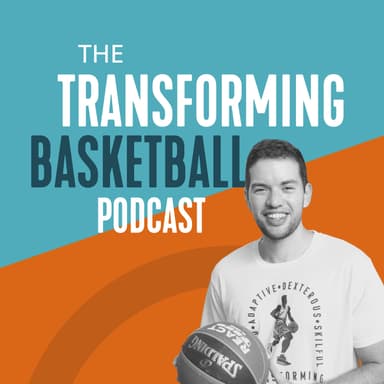
Gabriel Solé Head S&C Coach for Ourense Baloncesto in Spain's Primera Feb
George is joined by Gabriel Solé, Head Strength & Conditioning Coach for Ourense Baloncesto in Spain's Primera FEB, to explore how blending traditional strength work…

George is joined by Gabriel Solé, Head Strength & Conditioning Coach for Ourense Baloncesto in Spain's Primera FEB, to explore how blending traditional strength work…

Keep listening while you explore. Your episode keeps playing as you browse other pages on this site.
In this episode, George is joined by Gabriel Solé, Head Strength & Conditioning Coach for Ourense Baloncesto in Spain's Primera FEB, to explore how blending traditional strength work with ecological dynamics and game-like movement solutions can create more adaptable, resilient basketball players.
Select a chapter to start listening from that moment.
Useful for your staff or players? Share this episode—or a specific moment—with them.
This transcript follows the original English audio.
This is the Transforming Basketball Podcast. This is the podcast helping coaches and practitioners change the way we think about basketball performance. Our goal is to provide the ultimate resource for making sense of applying contemporary skill acquisition ideas within basketball. Within this podcast, we unpack how an ecological dynamics framework impacts our perspective of the game.
If you're ready to join us in our quest to transform the basketball world, This is the podcast for you.
Welcome to the Transforming Basketball Podcast. Today's guest is Gabriel Solé, the head strength and conditioning coach for Orense Baloncesto in Spain's Primera FEB, which is the second league in Spain. He is a leading voice in the Brazilian performance space. And Gabriel specializes in bridging the gap between the weight room and elite on-court performance.
Explore Transforming Basketball membership and continue your coach development.
You can check out some of his stuff on the social media. It'll be included in the show notes. And he's here to discuss some, his evidence-based approach to building more explosive, resilient basketball players. Gabriel, welcome.
Hi, George. Yeah, thank you for having me. It's a, it's a pleasure to be here and try to give some good insights for the listeners and maybe some ideas and reflections as well.
Yeah, absolutely. I mean, let's get straight into it. You use a lot of, let's say, ecological dynamics, like where it's players are reacting or perceiving and then moving as part of your, let's say, return to action, return to play, or just in the weight room where, you know, getting movement preparation in.
Like, what's the thought process behind that?
It's been a journey for me. So I started Very traditional, I would say, in my approach to the weight room. And especially when I started working with professional basketball players. But as soon as I got comfortable with the role and the job, I, I've always been curious.
I was never really afraid to try stuff, to experiment a little. And then when I started seeing and studying a little bit about the approach It made a lot of sense to me, first of all, because it matches my personality. I'm not really a person that's into very monotonous activities.
I like to be changing and trying and creating all the time. I do use it a lot more consciously now after I study it. I did it in the beginning more, I would say more of a, I had more of a feel of trying stuff.
Now I do it more consciously. I know what I want from, from each. drill, and I've been really trying to use the approach among other stuff. I still do a lot of traditional stuff because I think in the weight room they actually work.
But I like to think that I, I mix things up. I mix a bunch of different methods, approaches, and into like this salad. That's my training sessions.
No, that's fascinating. Let's get into that. So I'm curious to learn more about that. Like, how do you— so if you're in the weight room and let's say you're doing squats, And you're doing the more traditional 6 by 3, or 3 sets, 6 reps to really build power and strength.
So you're still doing those exercises. You believe they're important. But then as you transition to the court, how else are you using— how do you combine the two, basically?
We have different sections of a workout. We can say we have the first block, which is preparation for the workout. There we can actually do a lot. And some people will say that's the warmup part. I call it preparation. And that space opens up a lot of opportunities.
We can be crawling, we can be hanging, we can be maybe doing like a tag game with not so much motion if you're in the weight room, but stuff like that. Then we would move on to auxiliary lifts. You can still do Some stuff there.
You can use variability. You can do lunges with asymmetrical loads. You can do different types of stencils. You can do different types of contractions along the set or throughout the 2 or 3 sets that I'm going to do there. Different jumps, a bunch of stuff you can do there.
And then we have a main section. That main section, it's a part of the workout that I like to Okay, now we lift. So now we do our hard work. Now it's more basic. Now we don't have to think, we just have to act.
So that's one way that I mix things up. I also like to do in the beginning of everything, before everything that I just mentioned, a lot of, I would call it posture work. So it's a prehab work based on their posture. And if they need to bias more internal rotation, external rotation, if they need to Expand a little bit on the lower back, on the ribs, more individual prehab stuff.
So that's like a basic structure that I would tend to use, but it depends also if it's offseason, preseason, in-season, and so on.
Right. And we could get it, like, we could definitely open, you know, that's a whole nother, you know, what part of the season it is. Cause I do understand it changes a lot depending on that, but I'd like to, to just maybe summarize what you said.
It's like, With the preparation phase, you're still using variability. And then even in the next phase, the auxiliary phase, then you're still, you're with weights, but maybe there are less weight on them. And then you can still add some variability in the form, maybe different stances, different speeds.
And then you get into your main lifts, which are, you know, more power. And that's where you want to have, make sure you have the, I guess, the proper, the correct form so you don't get hurt. For example, if I understand that correctly.
Actually, I don't correct them that much, even though it's a, it's a heavy knit. So I kind of let them try their own techniques most of the time, unless it's dangerous, of course. But yeah, that would be our, uh, our heavier stuff depending on the day of the week we are.
Sometimes we're not even doing anything heavy if it's, we have a game close by or something like that. But yeah, that's, that would be the basic table that they would get with the different blocks of the workout.
No, I love that. How do you use the gym to make someone a better basketball player? You know, we talked about now making them more athletic, you know, stronger, more resilient. But now as far as like, how do you combine the actual skills into what you're doing in the weight room?
You spoke a little bit about tag games. Can you elaborate?
Yeah. So, I mean, for me, the general benefits of weight room work are pretty well established. So like I said, I like to do Bulgarians. I like to do deadlifts. I like to do squats. And I think they help. Then I think we need to understand that we are a part of a process, a long-term process.
So we are not acutely reacting as important as we may think, at least in my opinion, but we are a part of what has been done before with other trainers. And we are a part of what's going to be done in the future.
And then in that sense, if we want to create adaptable and healthy athletes, the thing that I care most about is that they have first intention and then add that to finding movement solutions. Something that's very important for me. One way to generate intention on more traditional lifts is using, for instance, VBT, velocity-based training, because now they have a screen in front of their faces.
And if they don't move fast, the bar on the iPad doesn't go up. So they now want to make the bar go up, so they move fast. That's a very simple way to do it. But then we're talking about more traditional stuff. Yeah.
Less traditional stuff. We can try other stuff to generate intention and to help them find movement solutions. So I have an exercise that I've been using quite a lot. I stole it from a Brazilian friend of mine, Mateus Cordeiro. He's from Fortaleza and it's the
box rolling exercise. Basically what you do is you have a plyo box and you elevate one of the ends with, let's say, yoga blocks or plates or whatever it is. And then you put the— not a basketball, you put any ball on top of it and you just let it roll down.
So you allow it to roll. The Thai From the ball starts to roll until it almost hits the edge and you have to grab it is the time that you have to do something. Now I could ask a player to just do a bound, like jump from left to right, right to left, but now he has to do that and catch the ball before it bounces on the floor.
So that's where we'll generate intention to find a movement solution. I can ask him to run, screen a cone or a marker on the floor, come back and grab the ball. That would be like an example of how I would substitute an agility slash plyometric slash speed exercise into something more contextual, I would say.
And then we can do that for basically every exercise. I said tag games, like today I did not really a tag game, but a knee tap game. So they have to hold onto a stick, both players in pairs, and they have to try to tap each other as many times as they can in 10 seconds.
And then I always love to switch pairs. Because I feel like going against different people provides them with different challenges. And I think that's really good for their development. So that's one example that I used at the end of their preparatory block, for instance.
I love that, man. I think what you said is just so smart. You're basically adding time, but it's not in the form of a screen because not all coaches have those resources. It's just a ball falling down from a, you know, a box.
So any, anyone can do that in their gym and maybe like coaches can even like roll the ball from point A to point B if they don't have a box. And that could act as like, you know, the time to do the activity.
Yeah.
And if you're by yourself, you can just drop the ball and do the same thing. It's a time constraint. And it's interesting with that one because you give them the chance to do reps in it and you immediately see after 3 or 4 reps, their body changing the way it moves.
It's changing the pattern, you know, of how it moves. Learning as we go. So I think that's very valuable, especially for younger players, I would say.
Yeah, finding the most functional solution to be able to do it as fast and as efficient as possible. Yeah, I want to move on a little bit. I think that's great, Gabriel. So as far as, you know, you've worked in a lot of places, like you're in Spain now, but you know, you've been in other countries in Europe.
I want to ask you, how do you stay aligned with team practices when, you know, considering things like load management? Maybe you're playing 3 games in the week, like how do you stay aligned with the coach and the other staff on the team?
So I think load is always a big thing. There's a bunch of studies about it. In the beginning, I was very scared of load in a way, but I learned that players can take much more load than we give them credit for. So they can actually go pretty hard and be tired and still perform pretty well.
And then the way I align, it really depends on how much influence I have on the practice to deal with load. Like some coaches, I worked with, I think, 5 or 6 different coaches in the last 8 years. And including drill selection, okay, we're going to start with 3 against 2, and then we're going to move on to 4 against 4.
And then I want 25 minutes of 5 against 5 at the end, and that's it. And then some other coaches, they have their own way of doing stuff. And this is the practice and that's it. So the communication with different staffs that I have changed a lot.
Because I had to adapt to them because basketball, it's always a priority. Like physical training is not the priority. It's basketball and it's the basketball games and it's the tactical part. That's 95% of the time what they're doing. So it's the most important thing.
Uh, but I try to organize it with the combination of active minutes and content of the sessions. And then we can have different types of sessions and that's what I'm going to communicate with the staff. So we have preparatory session, load session, tapering, and recovery.
Each session has its colors. I use green for preparatory, red for load, orange for tapering, and then blue for recovery. I think colors makes everything more visual and more simple. And then I organize it through the week. So a normal week, we're going to start after an off day with preparatory session.
Which is a more extensive session. So it's a longer buildup to start the contact part, and it's more extensive, is not so much intensive type of session. Load is going to be load. So yes, if we're looking for adaptation, we're looking for them to push.
And tapering, now we're thinking about the game. So we try to keep everything intense but shorter. And then the recovery session, it's The recovery session. And then we can use full court, half court, contact, no contact to help with the content of the sessions.
So you have these conversations with the coach, with the team, and you're like, you know, this is what I think, this is what is best for them in the long term so they can stay healthy throughout the season. This is how we're going to structure it.
You know, day off, we're going to start with a more extensive preparatory session and then we'll get into the load. And the tapering session?
Yeah, those conversations happen more in the beginning of the process. During the season, so much is going on, it's kind of like the rules are established. So yes, I do send them the schedule. We talk a little bit about it, but everybody kind of already knows how it's going to go.
And then we, of course, we have ways to control it. So how do we do that? Well, a very simple way that everyone can do is the wellness questionnaire. It's super simple, but I think it's honestly super effective. I do it every day.
Then I can control for active minutes because up until this season, I always used to do RPE control. So from 0 to 10, how hard was the session? I don't think it works that well. I prefer controlling active minutes. So every time I have my clock going and every time they're stopping practice, I'm stopping my clock.
Actually, like Every active minute is intense, so it gives me a much better sense of load than their RPE. Well, I've been finding that maybe I change next season because I'm always changing stuff. And also I'm working with VALD this season. It's a, they have a bunch of stuff, but I have their force decks.
So every game day we're doing a countermovement jump with hands on the hips. And from there I take a few metrics and I try to establish if they have some sort of level of fatigue or not. So I look at jump height, of course, modified RSI.
I look at countermovement depth and I look at contraction time on the surface. And then I look at more metrics if I need to. And from those data, wellness, active minutes, and jumping on game day, we can have more discussions. The load is working, if the plan is going according to what we thought it was the best and so on.
Now, I think the preparation honestly in professional sports doesn't have to do so much With players' health long-term, even though I care personally a lot about that, but we always think next game. So it's next game, next game, next game.
And I'm curious, like, you know, you have the equipment and the resources to do this. If you're a coach, you know, you can, I call it time on task. So you can easily time when the players are actually playing in your practice, right?
You can have a wellness questionnaire, but then as far as measuring that, the jump, right? You know, realistically, most coaches aren't going to have access to that type of resource. What do you suggest coaches can do to kind of measure like where the player's baseline is on a game day?
Oh, I think like, honestly, you don't need to— well, you do have apps that share that measure jump height today, but they're not very like— the usability is not so good, especially for game day. It takes a while to get the stuff done and it's— I do not recommend it.
But I feel like just organic conversations and observational experience will help you a lot. Just like asking on game day, hey, how are you feeling? How was the week on your body? How the game goes today? You feel hyped or, you know, I feel that gives you a lot.
And I do that even though I have the objective measures. I like to just talk to them organically, you know, just ask them how they are. Literally, that's the conversation. And then you observe. Like, are they doing second efforts? Are they crashing the boards?
Are they running through screens? Or, you know, and you compare them to themselves. I think that can give you a lot. I wouldn't, I wouldn't try to go too crazy on the objective measures because it might be like a lot of work for very minimal result.
You have your eyes and your ears, you know.
So how has your philosophy changed since moving from Brazil to now working in Spain? Like, what was the catalyst for you? We've spoken about evidence-based answers to everything, right, that you, you've mentioned here. So how did that change from when you started to now?
What made it change?
It's been a journey because I did the physical education. I went to physical education university in Brazil, and I really couldn't find myself there. So I graduated and then I went to Ireland. For a year. And then I just had the weirdest jobs, like, you know, doing a whole bunch of random stuff that had nothing to do with what I studied.
I stayed there for 1 year and a half, I think, because the training did— it just didn't make sense to me. Because it's funny, when I got here now this season in 2025, I did a bunch of CLA stuff, games. I'm really into games this season.
And I got the feedback that, well, it's nice to have a Brazilian here because you have this thing, it's playful, it's, you know, it's like your football and stuff. But actually studying in Brazil and growing up there, it was not like that at all.
It was very, very traditional, maybe even a little military in a way. And then in Ireland, I saw people working out and I saw trainers and I saw stuff that looked more like, you know, yeah, I can relate that to sports, basketball, and it makes more sense to me.
So I just started asking them, hey, where did you learn this? And then I got, well, you know, different phases. There was the functional training phase, and then there was other stuff. And then eventually when I got to Sweden, I went there to do a master's in sports science, and I started working with professional basketball in Sweden.
I never really worked with basketball in Brazil. And like I said in the beginning, I started very traditional with the, you know, ramp warmup. You know, everything that's more on the basic physical preparation side of stuff. But then I think Sweden really allows me to have autonomy to try other stuff.
There's not a lot of pressure there. People are, you know, very open, I would say, to different ideas. And players are so nice and welcoming to you. They're very educated in a way. So it was fun to try stuff there. And little by little, I loosened it up, I would say.
And I started To you know, put my my foot on the water and then slowly got to meet people when I got references and I got to the Transforming Basketball book, which was very interesting read for me. Then from there I went to Rob Gray.
Then I met this amazing trainers Dominik Theodorou from Germany. Now I have Retasaurus, great Instagram name from volleyball trainer, and I started to get all this references and and I was. Sort of my environment allowed me to try stuff and it worked really well for me.
And I was never really scared to try because some people, they block themselves of trying because they don't, maybe they don't want to make mistakes and, you know, but I never had that. So it was good for me. And then like coming to Spain, I was really going, my mind was exploding already with all this stuff.
I wanted to put it out there. And then I come to a league that's Primera FEB. That's a really high-level league, but also that has a very high cognitive and emotional demand. There's a lot more pressure. We're going to have 5,000, 6,000, 8,000, 10,000 people maybe watching a game.
It's a very tactical league, very, very tactical league. And it's a very interesting basketball. You know, a lot of, I think all the teams I would say have a big rotation on the squad. So people are playing maybe max 20, 25 minutes per game.
The lead scorers of the league maybe average 15, 16 points per game. So it's, yeah, it's a very interesting league. The thing is, with that high cognitive and emotional demand from the league, I had to lower down my demands from them, you know, quite a lot.
So when I came here, I started to choose simpler tasks, but still highly demanding in terms of intention, like I said before, but I started to focus more on instinctive actions, you know, instinctive basketball. So I like to say less math. More act.
So less thinking, more going for it, and more fun also. You know, I try to avoid the monotony of the tactical against zero, against zero, against zero, and then play and then play throughout the whole week. A lot of video sessions, a lot of scouting on this league.
People scout heavily on this league. So I feel like it can be quite heavy for some players, you know. So I try to avoid the monotony and find ways to get them going without overloading too much the cognitive side. Because if you do like a session that is very demanding, a physical session that's more demanding on the brain, on the cognitive area, you get tired from it.
It's tiring, you know. So I was having that approach of having less thinking and more fun, trying to avoid the monotony.
I love what you said about wanting to try new things because like you said, I think sometimes the biggest constraint on a coach You know, it can be their environment, but I think oftentimes the biggest constraint is just themselves and not like, you know, giving it a try.
Like what happens if you do a small-sided game and the players have fun? You know, like just give it a try and it's going to look super messy maybe at first, but you'll get better and better every single time you do it as like coaching it and setting them up versus, you know, just sticking to what you know because you're comfortable with that.
You can get them to You know, look like an actual basketball team, I guess, doing drills and things like that. So I, you know, I really like what you said. It's like sometimes the biggest constraint is yourself, and it wasn't like that for you.
You were both in an environment where you could try things out and you wanted to try things out.
Exactly, exactly. By trying stuff, you learn, you know. For years, I've been trying to find a way to get them sprinting full speed in the beginning of practice, because with basketball players, that's so hard if you just ask them. Your warmup time is not so long.
And if you want to get some sprints, you're not going to get it. Like if you just ask them, if you run from line to line, they're going to go 70%, maybe 80%, maybe one player is going to go 100%, but it's hard.
And then I tried out stuff this season that I didn't even do any stretching. I didn't even do any mobility. I just went from less intense game to medium intensity game. And then at the end, there was one day I did something very interesting.
That I did a very simple frisbee throw. I talked about this before, like trying to get them going in a fun way, not very demanding cognitively and not monotonous. So this is the perfect example. So they have basically a throwing area and an end zone.
One player had to throw the frisbee, the other one had to catch the further they could on the basketball court. They could go behind the basket as well. I promise you, I never seen basketball players sprint so hard after such a short warmup in my life.
So it's a very interesting experience when you just give them something, literally on this case, to chase.
No, I completely agree. It always reminds me of, you know, you could tell players, like, you know, I used to always coach, have the players go up 50%, 70%. All right, now 100%. Whereas now I'm like, all right, put the ball on the player's back.
And as soon as you lift it, you have to run to the opposite line and the other player has to try and tag you before you get there. And you'll just see they'll naturally just sprint as fast as they can. And I think it's just a great solution to your point to get them to sprint.
I do want to ask you one last question, Gabriel, and we ask all our guests this. It's the transformative tip. If you could leave coaches with one piece of advice that would instantly improve their practice environment, what would it be?
I'm going to give you 2 things, one quicker, one a bit longer. I thought about this question a lot the last 2 days and I couldn't, you know, I could only think about 2. I have to say 2 things. I couldn't think about just one.
But I think first one, it's more on a personal level for you as a coach. And I think it's finding something outside of basketball that you like to do. I think it makes you more present. It makes you more observational. It makes you more creative.
And it will just help you enjoy your routine, like your day-to-day life more. And I feel like when you enjoy more, you actually work better. You have better ideas and you provide a lighter environment for your players and for your team, like your staff.
You know, I think that I like, for example, I like climbing and I like music. So I take like piano classes now and I go climbing a lot. I feel like it really helps me to be a better coach in a way. I don't do it for that reason though.
I do it to enjoy, but I think it's a bonus, you know. Then the second thing, I actually learned this from a player. So it's a very nice guy, uh, Yehia Domb. I had him in Sweden and he'd mentioned in one of his— he liked to do vlogs and he mentioned in one of his vlogs to never let anyone take away your love for the game.
And I think in this job it's very important because it's absolutely crucial if you're gonna work with, especially with CLA and more creativity and a more open environment that you are enjoying your routine. So in this area, in this job, you will have to work with other people.
There's no way out of it unless you work privately. But I would guess that most of the people that you will work with do not share the same approach as you. Everybody has a different way to do it, and it can also work, but I feel like you shouldn't allow that to take away what you believe.
So stay connected to who you are and what you believe you should do, and work will become lighter and you will find possibilities even if you are very much constrained by a coach opinion or by a director's opinion or by even your structure, like your physical structure.
Maybe you don't have access to all the equipment you wanted to have or stuff like that. But if you just keep trying and, you know, really trying to enjoy the process of trying, you will find solutions. So it's, it's more like a philosophical type of answer, but yeah, it's what came to my mind.
So.
I think it's great, Gabriel. I really like the tips where it's like less about basketball and more about the human element, because I think it's so important. Like, you know, you can talk X's and O's, strategies, tactics, principles, but the human element. I think is always going to just win out, you know, over the basketball side of it.
And we always talk about how we can help the players, but it's like, how can we help ourselves? So we're the best person to help the players. So, um, thank you, man. Thank you so much for sharing that.
Yeah, thanks a lot, George. It was a pleasure to be sharing here with you guys.
Thanks for tuning in to this episode of the Transforming Basketball Podcast. If you'd like to learn more about the work that we do, head to transformingbball.com to access our free resources and spread these ideas throughout the basketball world. If you enjoyed today's episode, be sure to subscribe and leave a review on your favorite podcast platform.
You can also connect with us on Instagram, X, or YouTube with any questions that you have from the episode. See you next time on the Transforming Basketball Podcast.