Keep listening while you explore. Your episode keeps playing as you browse other pages on this site.
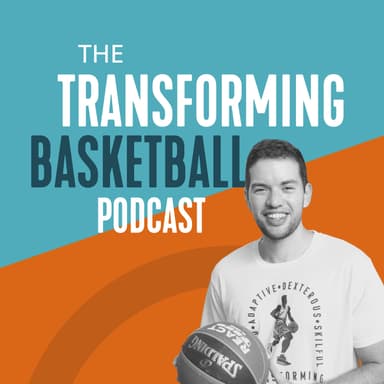
In this milestone 100th episode of Transforming Basketball, Adam welcomes none other than the founder himself, Alex Sarama. Together, they reflect on the journey of Transforming Basketball, the impact it has made on coaches worldwide, and what's next for the movement.
Want to learn more about conceptual offense? We have you covered with our FREE conceptual playbook. Learn more about the offense and receive your free copy instantly: https://transformingbball.com/conceptual-playbook
This transcript follows the original English audio.
This is the Transforming Basketball Podcast hosted by Alex Sarama. This is the podcast helping coaches and practitioners change the way we think about basketball performance. Our goal is to provide the ultimate resource for making sense of applying contemporary skill acquisition ideas within basketball.
Within this podcast, Alex and his guests unpack how an ecological dynamics framework impacts our perspective of the game. If you're ready to join us, Join us in our quest to transform the basketball world. This is the podcast for you.
Hi, and welcome to episode 100 of the Transforming Basketball Podcast. And who else would I have on the podcast for episode 100 than the founder of Transforming Basketball, Alex Sarama? How are you, buddy?
Explore Transforming Basketball membership and continue your coach development.
I actually feel really proud to be doing this. I mean, episode 100 of the podcast—it's pretty surreal. And I think I forget that transforming is still well, it's only really a year and a half old. So yeah, just really proud of everything we've accomplished and everything still to come.
And then you know, obviously really thankful to all the listeners and all the amazing guests we've had on on this podcast.
That actually transitions right in one of my questions that I had written down was like. Since starting the company and the release of the book and all that, what moment stands out that you're most proud of since starting the company?
Oh, that's a great point. I think it's lots of small ones, but I think the obvious one would obviously be these ideas now finally becoming more— I don't want to use the word widespread because they're certainly not, but people having an awareness of these ideas at the highest level, obviously the NBA, and obviously that equated to Myself and Gray, Gray Thomas getting jobs with you know with two leading teams.
But I think it's it's actually not that for me. It's more the proudest moments for me are actually more the interactions with the coaches in our community and the messages we get from new coaches every week who are discovering this for the first time, taking a deep dive into transforming, and it's like seeing just how vote like how much that's picked up in the last year.
That's what makes me really proud because it's like, obviously, you know, we've got a great team at Transforming and they keep me posted with the things we're getting, the questions coming in. And it's actually like, wow, there's actually such a huge wave, a huge momentum of interest in these ideas.
And that's what makes me really proud that coaches all over the world are tapping into this and curious to learn more, you know, genuinely trying it with their players. And I think that's what gives me a lot of motivation to see that coming through versus kind of saying, oh, it's, It's one moment, you know, it's all the small moments that add up that really make me very, very satisfied to be part of Transforming.
I don't know if you've covered this before, but I'm just curious. I don't have it explicitly in my head. What were your aspirations with starting Transforming?
It was really to— I wanted to go against the grain, challenging and really challenge the status quo of how things are done in the basketball space. And then more create a space for— I basically wanted the resource that I would've wanted as I was learning all of this.
And I think that's where we've been so intentional with everything we've done with Transforming in terms of how can we create the most comprehensive but efficient resource where coaches can just run with these ideas, make them their own, and, and also make sure it's not about us, but it's about the coaches, the players.
And it's, you know, we're making these ideas accessible, but, you know, I didn't want to kind of make it all about us. I wanted to make it about the idea, about the concept, about this whole movement. So that was really the motivation for doing this.
And I think some of my frustrations at the beginning were, you know, I was really— I felt so by myself when I was trying to articulate these ideas. I remember dinners where, you know, other coaches would just be laughing at me. And when I used to work for the league office, you know, I had great friends and I'm in touch with all of them today, but people would be, you know, paying no attention to my ideas, that they thought I was crazy.
So I wanted Transforming to be a safe space and a space where others could share maybe, you know, their journey, their frustrations, and other people to rely on and learn how to really use this stuff. And I think that's, that's basically exactly what we've achieved, especially with the membership community.
I mean, I went on the other day and there's close to 500 coaches now, and just seeing some of the interaction in there, like coaches are saying, oh, this has changed my team, changed my season, and That makes me really proud of the work we're doing.
One more question I had for since the inauguration, the year and a half it's been since Transforming, what's changed in your life? I mean, obviously you took the job with the Cavaliers, but what else is kind of— I'm thinking more outside of the Cavaliers position.
What has changed for you?
I think going from coach developer and having complete freedom to experiment and coach a lot every day to then doing this in, in a team environment. I mean, it's a huge change. I know you said outside of the Cavaliers, but it's like, I mean, my, my life has foundationally changed because obviously, you know, even a year and a half ago when I started Transforming, I was just coming off finishing Italy in college prep.
And that was, I mean, it was an experience I'm always going to relish and something I do want to go back to at some point just because you have Complete freedom in that environment to basically do whatever you want, and it's I felt like I developed so much as a coach in that time frame just because of the constraints of the environment in terms of I mean I had twelve hours a week on court really good players who would do whatever we asked of them the life off the court was incredibly enjoyable obviously living in
Italy and and all of that stuff and then I had a team of staff where everyone believed in this stuff so I think just that was. It was almost like too out of this world that it was a bit of a reality check to go to anything after that experience.
And then obviously last year, I'd say, applying these ideas in the G League team in Portland, the London Lions, that was great, really enjoyable. And kind of now it's like one step further. And I think it's so tough in the NBA with the schedule to continuously learn.
I feel like I'm not learning at nearly the rate I had in Italy. Because of just the time and the constraints of a job. So it's kind of like, I'm so glad that I had all these diverse coaching experiences before in Italy, like coaching in camps around the world, you know, working with players of all different ages and abilities, because that I think is what made me really adaptable as a coach.
And it's like all the stuff I learned in that whole time frame I'm doing now at this level, you know, just with obviously very different players. But it's like, I think it's— I would not be the coach I was today if not for those experiences.
And I think that's what is a big shift for me is moving away from all the coach developer stuff. 'Cause I love doing that and actually developing coaches. So that's been a big adjustment. I mean, obviously there's a little bit of that, you know, on the job now, but it's not like the past where I was traveling, you know, so much to go to clinics all over the world, help coaches out.
That was something very satisfying. And I think it's definitely something I want to return to in the future. But I feel like, you know, doing this now, it's a great learning experience for me. And I think it's, I want it to pave the way for others in the field to get these jobs and to shift how basketball is coached at the highest level.
And I think obviously I'm in a great position to do that.
Yeah, I appreciate you talking about just the constraints on your time in the NBA and how different it is and just developing yourself as a coach because that's, I mean, people dream of having that, being on a coaching staff in the NBA, but you're shedding some light on, well, It's not always what it's always cracked up to be.
There are great moments, and I'm sure there's plenty of highlights you've had since arriving with the Cavaliers, but there are drawbacks to every single position you take, and that's just a reality. And it's helpful that you actually share that so people actually know what they're aspiring to get into.
100%. I think you've got to be so intentional with your time and find opportunities to learn. Like, my big thing right now is using flights to learn. I just have a stash of research papers downloaded, and some other things to read. And that's just like my window to get stuff done and, and try and learn new things.
But I think, you know, I'd say to a lot of people, it's like, you know, the NBA is— it's always kind of seen as like the pinnacle, right, of basketball. But I think there's so many other great things. And it's more like, can you just have the greatest impact at your level?
Even if, if you're coaching like a youth team, can you give them the best experience possible, Create a really transformational environment, and you know run with these ideas. And and you know I think for a lot of people that might be more rewarding, more compelling than working in the NBA.
You know so I think there's so many opportunities in basketball, and I think the number one thing is it's it's like if you if you really focus on your learning and you have a sense of desperation to get better as a coach, then you know I think opportunities will naturally come your way.
And I think that's the biggest difference I see with the transforming community and. You know, all our members—it's it's coaches who genuinely care about being the best version of themselves. And I think regardless of what level they they coach at, I think I'll be completely honest.
I think there are a number of coaches in our community who I think are innovating and trying more things than really high you know coaches who are working at the highest levels in our sport. And I think that's something I'll always really respect.
And it's for me it's it's more about. I don't care kind of what people, what level people coach at and the status of it, but I care about who they are as a person and the quality of their ideas. And I think that's something that really stands out with everything we're doing here at Transforming.
I gotta be honest, dude, if I looked at my questions right now, you've kind of like answered all of them. It's somewhat of a bummer, but at the same time, like, you're hitting on like topics that are, I think, are going to be very impactful no matter how long we talk here.
So thank you for that, buddy. Since your time with the Cavaliers, and this could be on-court or off-court, what are some lessons you're going to take with you going forward?
You know, a lot of really good principles of play ideas from Kenny. Obviously, it's been awesome having the chance to work under him. And just, you know, the fact that he— I'm really grateful for the fact he hired me and genuinely believes in these ideas and wanted to really go ahead and trailblaze doing this stuff.
So, you know, a lot of lessons from Kenny and, you know, the other coaches. I think for me, it's been great learning how to develop relationships with NBA players, with American players, 'cause it's really different coming from Europe. You know, I think it's culturally, forms of life.
It's working with the European player is really different to working with players from North America. It just is, right? So that's been great for me, you know, learn that side of things and just how to package CLA at this level, how to get players buying into it, and how to actually do it on the court and see results.
So, you know, without kind of revealing secrets of the team, There's been a lot that I've learned in the last 5, 6 months, which I think is going to set me up for success, whatever happens in the future, wherever, you know, whatever level I want to coach at, whatever I want to do.
And obviously, you know, I think it's a really good organization to work with in terms of, you know, what we're trying to achieve, where we're at right now, the players we have. So I'm hoping we can just break down some doors in the NBA for these ideas to hopefully become more widespread and, you know, over the next decade.
I guess just to close, Alex, what are your aspirations for both yourself and Transforming moving forward? And have they changed since, you know, you— since these last year and a half since you started the company?
Yeah, great question, Adam. I think with Transforming, I just— I really want to keep growing it because I know the, the impact it can have on coaches. And I think I want to really do a better job trying to make these ideas more accessible for the entry-level coach.
So Transforming is always going to be something very close to my heart. And I think, you know, we've made some really good hires recently to, you know, people who can take the pressure off my shoulders because obviously, you know, I just don't have the time to do it like I did before with my role with the Cavs.
So, you know, I think people, people like yourself are really helping Transforming grow. So I think the next thing will be, you know, how can we grow that membership community more to continue offering like the best value, the best offering to our members?
To coaches who really care about these ideas. I just want Transforming to be like the go-to resource in this space for them. And I think we got some really interesting ideas coming in 2025 in terms of things like a Transforming certification, which is going to be really cool, some more events.
We've obviously got our Transforming clinicians now who are running events all over the world. So I think there's so much space to grow there. And obviously, you know, got my second book, which, uh, Will come out sometime in the next year. I don't know when, but working on it.
And then personally, I think it's for me, I just, I think my biggest, like my values and kind of what I'm striving for personally are achieving difficult things with people who completely align with these ideas and colleagues who really wanna, you know, go all in with an evidence-based approach.
So it's like whatever level of basketball, whether it's me staying for years at the Cavs or, Coaching internationally, I really don't know. And I'm trying to not spend too much time thinking about the future, but really just trying to do the best job I can right now in the present with the Cavs and focus on having all my processes in place and contributing to the team as much as I can.
Because I believe in the long term, if I focus on that, things will take care of itself. And it's easier said than done. And I think as professional coaches, we sometimes get so caught up in, oh, where am I going to coach next year, all of that.
I think I'm kind of lucky I have transforming because I don't get myself too caught up in that stuff. It's more what that allows me to do is to be more, I'd say, be a little bit bolder in the things I do. I'm not afraid to take risks in terms of, oh, let's try a new activity today, because I'm very confident in what I do and what I bring.
The fact that I have that freedom, I think it means I don't have to conform to the norms of what you typically see in the NBA. And that's why I understand why a lot of coaches Maybe reluctant to try these things because they don't have that security net, if that makes sense.
So yeah, really it's just you know how can we keep really pushing the boat, getting these ideas across, helping coaches at all levels you know apply constraints that approach differential learning, conceptual offense. And I think in five years, I really think the basketball scene is going to be very different.
And I like to think that transforming will have played a huge part. in shifting the tide and laying the foundation for these changes to occur.
I think that's a great aspiration to have, man. So thank you for coming on.
Thanks for tuning in to this episode of the Transforming Basketball Podcast. If you'd like to learn more about the work that we do, head to transformingbball.com to access our free resources and spread these ideas throughout the basketball world. If you enjoyed today's episode, be sure to subscribe and leave a review on your favorite podcast platform.
You can also connect with us on Instagram, X, or YouTube with any questions that you have from the episode. See you next time on the Transforming Basketball Podcast.