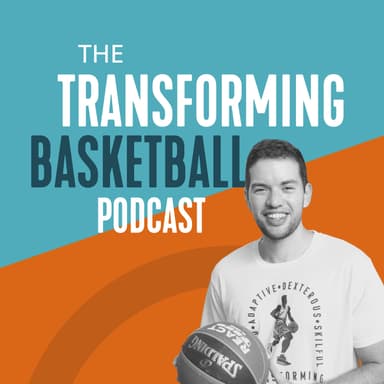
Understanding Non-Linear Pedagogy with Dr. Matt Bowers from the University of Texas
George is joined by returning guest Dr. Matt Bowers to dive deeper into the practical application of Non-Linear Pedagogy (NLP) and the Constraints-Led Approach in…

George is joined by returning guest Dr. Matt Bowers to dive deeper into the practical application of Non-Linear Pedagogy (NLP) and the Constraints-Led Approach in…

Keep listening while you explore. Your episode keeps playing as you browse other pages on this site.
In this episode, George is joined by returning guest Dr. Matt Bowers to dive deeper into the practical application of Non-Linear Pedagogy (NLP) and the Constraints-Led Approach in basketball coaching.
At its core, NLP focuses on five key principles to drive skill acquisition:
Representative Learning Design: Ensuring practice environments contain the same information and "cues" found in a real game.
Constraints Manipulation: Strategically adjusting task, environmental, or individual constraints to guide players toward functional solutions.
Functional Variability: Encouraging "repetition without repetition" so players develop adaptable movement patterns rather than one "textbook" technique.
Information-Movement Coupling: Linking perception directly to action; players learn to move based on what they see (teammates, defenders, spacing).
External Focus of Attention: Directing a player's focus toward the intended outcome of a movement rather than internal body mechanics.
Building on their previous conversation, Dr. Matt Bowers breaks down how coaches can design more representative, game-like learning environments that empower players to solve problems, adapt in real time, and develop true basketball intelligence. Check their previous conversation here (https://open.spotify.com/episode/5KE8Oev1bfiVnU66Dd3GfQ?si=DU8bbh8oQ9itj1QkmLDxsg).
Select a chapter to start listening from that moment.
Useful for your staff or players? Share this episode—or a specific moment—with them.
هذا النص يتبع التسجيل الصوتي الأصلي باللغة الإنجليزية.
This is the Transforming Basketball Podcast. This is the podcast helping coaches and practitioners change the way we think about basketball performance. Our goal is to provide the ultimate resource for making sense of applying contemporary skill acquisition ideas within basketball. Within this podcast, we unpack how an ecological dynamics framework Impacts our perspective of the game.
If you're ready to join us in our quest to transform the basketball world, this is the podcast for you.
Welcome back to the Transforming Basketball Podcast. On today's episode, we have, well, my very first return guest, Matt Bowers. Matt, welcome to the show. You were here, I I think it was maybe 10 or 15 episodes ago now. And we really got into a lot of different topics.
Explore Transforming Basketball membership and continue your coach development.
You're working obviously at University of Texas. And today we want to get into a little bit more, unpack a little bit more of what we couldn't talk about in the first episode. So Matt, once again, welcome to the show.
Back by popular demand, I guess. Thank you. Thanks, George, for having me back. You know, I think last time, yeah, we were starting to get into this really nerdy stuff. I mean, very cool stuff, but like, you know, there's a lot to unpack.
You know, today I think we're going to talk about some NLP, some nonlinear pedagogy, but I'm going to try to do it in a way that doesn't put everybody to sleep. We will, we'll try not to get too, too academic. We won't dive into all the specific studies and all that stuff, but try to keep it, you know, in a place where there's a lot of fun, fun takeaways and I hope Coaches listening can kind of see how this stuff may sound complicated, but there's like, you know, some clear ways that you can be integrating
this into your program and what you're trying to build. So.
Absolutely. So let's get straight into it. NLP, you know, Alex usually says that you don't really need to get into nonlinear pedagogy because it's our, you know, like the CLA and ecological dynamics is complex enough, but it is important to know the 5 design principles of nonlinear pedagogy.
So just briefly before we start, do you want to just explain what the NLP is and then we'll get into the first principle of it?
Yeah. So, I mean, and it's not something that is like wholly distinct from the constraints-led approach. In the academic world, you can, there's a lot of nitpicking, you know, there's a lot of kind of like, well, this is sort of the same, but slightly different in this way.
I think for our purposes, you know, when we think about what NLP is, and we're going to, we'll, I can run down the 5 principles or whatever that, you know, that kind of talked about offline. Essentially what we're trying to do is design, develop, implement problems that look like what it's like to be in a game, right?
And to create an environment where players are able to be the ones searching for a range of solutions to that problem. Right. And so then we use our constraints, we use cues, we manipulate the environment to kind of, you know, shape that search in a way that allows the players to arrive at, again, a range of potential successful approaches to it.
Right.
That's a good segue, but just before I do segue, the 5 design principles are representative learning design, functional variability, Constraint manipulation, external focus of attention or attentional focus, and perception-action coupling, you know, information movement coupling. The first one that you touched on just now, the representative learning design, do you want to open that up a little bit?
What exactly does that mean?
You know, it's not that difficult. It is kind of what it says it is, right? It's like, does this look and feel like what we're really doing? Like when players are in a game. And then we, maybe we scale it, maybe we, you know, play with constraints or whatever, but ultimately is the learning itself is what's going on representative of the types of environments that they're going to be in.
Right. And it's really not a whole lot more kind of complicated than that, you know, when you think about it. And so I think while that may seem really obvious of like, sure. Yeah. Well, we'll scrimmage, we'll do, you know, like The way that we actually implement this principle is often something that I think we kind of assume it's happening in ways that it's not actually, you know, that it's not actually happening.
Right. And so we actually, a lot of times as coaches enter into kind of real non-representative learning structures, right, where we're trying to help, we're trying to make sure that The players understand what we're doing, but by not making it representative of what's going on and what they're going to find themselves in, we're actually maybe not progressing as high as we could in that.
And a lot of these situations we're trading off, like CLA, NLP, like these are super messy. It's hard as a coach to get to the place where messy is actually what you seek. Because you understand that what underlies the messiness is learning. Like, learning is messy.
When we isolate everything, when we drill everything, when we block train everything, we look like, you know, we are these military generals who are in complete command and the troops are doing what they need to do. The issue with that is, again, that's not actually representative of the situation they're going to find themselves in most of the time.
And so I always kind of like, if I think of an analogy, as coaches, we tend to default to wanting to be like conductors of a symphony, right? Like we're sort of like pulling all the strings. We're telling people when to come in and when to pull back.
When in reality, if we're following NLP, we're following CLA, what we really want to become is like the roadie for a jazz band. Like you want, you want your players to be like jazz musicians who can understand context, who can riff off of each other, who can know when to come in on their own without you having to be the person that cues them in.
And so maybe as we start off, that's an analogy that we can use to think about, right? And I love the symphony as much as the next person, but You know, there's this, it's a seductive sort of like, it feels good when it looks good in practice and it feels bad when it looks bad.
And the challenge with that is we end up kind of unintentionally abandoning the things that are more representative in terms of how we learn in order to move towards less representative approaches because they feel better. And especially if you have freaking parents in the gym.
Yeah, absolutely. Yeah. Because the parents want to see it nice and neat. Yeah. We've spoken about that before here.
Absolutely right. And I'm a parent of a basketball player, so I— and I've coached at many different levels. I get it, but there's a trap there. So that's kind of like the most basic, like, does this look and feel like the real thing that we're actually going to be doing when we need the real thing?
And to build off of what you said, I think like a practical example that I see in gyms a lot that maybe coaches can Change or consider changing is instead of checking the ball up on a score, or, you know, if there's a turnover, just get straight to the next possession.
So maybe you can just clear the 3-point line or clear to the half court even, or, you know, literally just inbound the ball. So that's more representative of the nature of the game where it's always back and forth, you know, after a score.
And even now you see in the ACB league, like they don't, if it's like just an out of bounds, Players can just get the ball and pass it in. So it's even more fast-paced. So I do want to ask you just quickly before we get— so the next one we'll talk about here, instead of functional variability, I want to talk about constraint manipulation.
And the reason is I want to ask you as a segue, what level of success do you think is important? You know, do you want your players— I always hear the number 70-30, like we want to have success 70% of the time and then failure 30%.
But is that true? What's your experience with that?
No, that's a really good question. Right. And so a lot of the times when we think about, or even read research and things on, you know, what is that sort of golden ratio of like, how much should we be failing? How much should we be succeeding?
Some of it depends on, on the level you're coaching. Right. And so I'm not going to say for every team you should be failing 60% of the time and succeeding 40% of the time. But as a general rule, I would say half and half-ish, you know, and then like, if you're coaching 6-year-olds, you're failing all the time, right?
Or if you're coaching U17s or whatever, like that's, that might be different. So we need to change our relationship with failure, right? I think we also need to change our relationship with how we measure Success. And I think, you know, I, that was probably something you wanted to talk a little bit more about maybe later on, but since we're, we've arrived at it, you know, the typical ways that we define success are things that are outside of our locus of control, right?
So, or at least not fully within our control. So did we win, right? Like that's the most fundamental, classic, original success metric. Like, did we win? And it's really hard to decouple from that type of thinking, right? Or even like, if, you know, some coaches are better at kind of focusing on process over outcome and process as a success metric.
But even in those situations, okay, did we, did we execute the play, right? Like you could, you have, you know, I remember especially when I was a younger coach and starting to think about these things, but not really having a full grasp of it.
That was something I would focus on of like, well, we, We successfully executed our play, right? And so that was good process, maybe, but that's actually kind of a trap as well, right? Of like, because then we're still framing things in terms of like, did we adhere to a predefined script?
And well, I think, can we measure adaptability, right? Like we have to determine how we measure that as a coaching staff. Right? Like, and again, you may not have a coaching staff. I should be, I should point out, I recognize that. But can we be measuring or at least scoring and rewarding like how quickly our players are adapting to a change in coverage, right?
To a new, okay, they were full court, you know, they've been running full court against us the whole time. And then they're coming out in 3 quarters, right? Like, how are my players, are Are we successfully navigating that? Right. You can actually, like, you can figure out how you could measure and track that.
What about, you know, a lot of times like decision-making or decision quality, right? Are we, sure, maybe we shot 27% from the field, but maybe we were 78% in terms of our decision-making, right? Like given the coverage, given the kind of tactical constraints that were in place.
Yeah.
We were making the right, we were penetrating, we were swinging the ball, we were getting open looks. They just weren't falling. You could leave a game like that feeling really crummy because you shot 20 whatever percent, or you could leave a game like that being like, damn, like that's not going to hold up over time.
Like soon those percentages are going to rise because our process is good.
Yeah. It's more like a lot of people look at a player's shot selection and they say, well, he's only a 33% 3-point shooter. And then, you know, maybe like scouts, if players going professional, but then it's like, well, he's 33%, but what kind of shots did he get?
Were they open? You know, were they, was he on balance? You know, was it off the dribble? Was it catch and shoot? Once you really get into those things, you can better define success and why that player is, you know, underperforming. You know, I want to say quote unquote underperforming.
One thing you can play with when you're talking about success is, you know, Both like on a game-to-game basis, you can be tracking certain things, certain process-related things that you want to focus on. You can also be doing that over the course of a season as well.
Right. And so like, yes, we care about winning, but like on a week-to-week basis, like every few games or so, like, do we feel like, are our players seeing the floor better? Are they solving more things on their own? Are they relying less on us?
That's the interesting part of this whole approach, right? And Alex would certainly kind of back this up that like the better a job we do coaching CLA, NLP, whatever, the less necessary we become as coaches. And that doesn't mean we're not important and not relevant to the, you know, beats of the game or whatever, but it means that In situations that our players find themselves in, they're not turning to us being like, what should we run right now?
It's like, you know what to run because we've been, you know, because of the representative learning we've been doing because of the way that we've manipulated the constraints. Like you've been in this situation numerous times with different variations. And so like, you're just reading and reacting.
You're just responding to the context, and then you're making those decisions. So I think, you know, for me, when I look at success, when I felt success with these types of approaches is actually those moments. And you'll feel it as a coach, like those moments where you're like, damn, they just did that.
Right?
Like they just did that without me having to tell them what they needed to do. They knew it already.
On another episode with Kyle Bodie. He mentioned he went to a practice. It was a college baseball practice and the 3 coaches weren't available. They were all, they all had commitments, but the practice was run all by the players. And he said it was one of the best practices he'd seen.
So to your point, you know, giving the players that autonomy and that ownership really helped makes your job. Obviously, you know, you still, we're not saying coaches aren't important. They are. But to your point, now, if the, you know, the coach is not there to give the instructions.
Can your players adapt? And I think that's the key.
That's a great example. Like you can even do this on a more kind of tactical level as well. Right. So there's, there's, you know, Gregg Popovich, one of the greatest coaching minds of all time. Right. And he's not the only person to have done this or whatever, but, you know, when you look at the Spurs and their culture building and the things that they did, you know, sometimes there'd be really tough stretches of a game where You know, you need to short circuit the momentum and all of that.
And so, you know, call a timeout and he'll, you know, go and huddle with his assistants and just never go back to the huddle, you know, to the point where the players start to realize like, okay, well, we got to figure this out.
Right. And then they become energized around like taking some ownership of that. And so that is, it can be really hard to do, especially with younger and younger kids. Right. Like, It's like we have to enter the relationship and this dynamic as a coach with a level of respect for what our players are capable of, not for thinking that they are a bunch of knuckleheads who can't do anything right.
And they need me to be able to like— That may be true. Like that may, that may be true in stretches or moments, but we have to be careful we don't lose sight of that fundamental respect for their capacity. Because if you don't have that, these approaches won't work because you're going to abandon them because you're going to feel scared that they're going to embarrass you or themselves.
Right. And I'm not saying that I've always been perfect with that, or I hope I don't come across saying like, oh, this is easy. You just do this and that. It's not, but the messiness is what makes it beautiful.
And what I'm hearing you say is it's almost like we have to be very careful as coaches to, you know, it's like we want to build this player's character and not invest in their reputation so much by, you know, it's like, yeah, sometimes they will need us, but we want to build their character so that they'll need us less and less.
Also, I want to ask you, I want to pick your brain a little bit on this. We did talk about some of the ways we can measure You know, success. Can you give the listeners and myself a practical example of doing this, especially when it comes to maybe, you know, going back to the NLP, the constraint manipulation?
So let's say we put in this, a new constraint in a small-sided game, and then how can we measure success, let's say, in this environment?
Yeah. So one of the challenges is measuring, right? And tracking these things and doing it in a way that is going to resonate with the players and you as a, you know, your coaching team, right? Because it's really hard sometimes on a practice-to-practice level to have players see what you're trying to get them to see, right?
That can be really, really difficult. We tend to default to, and correctly so, like crafting competition, right? So if we want them to do something, if we want to manipulate a constraint, like If we want to see, to return to an earlier example, if we're running through our kind of offensive approach through in practice, and we really want to emphasize getting into the paint and using that to be able to open up, you know, more shots from the corner, then what we can do is actually manipulate how we scorekeep around that.
Right.
So to make a pass from the paint to the corner is 3 points, right? And so to take a shot without getting into the paint, just as an example, is negative 1 point. Right. So we can, we can, for players, they need that immediate feedback, right?
Because otherwise it can be too abstract for them. And so that's really our job with this is like traditional linear pedagogy, traditional kind of linear coaching is we are the instructor. We are the source of knowledge. And that knowledge flows down from us into our players.
In nonlinear pedagogy, we are the designer of the experience. We are the one who's creating the conditions that will nudge our players towards the types of actions and behaviors That we believe linked to success.
And you said it right there. You said, add the scoring system. So it's instead of saying, all right guys, you have to touch the paint and pass to the corner. But it's like, well, no, because sometimes that's not going to be available. Right.
So then you're saying, all right, well, if you do touch the paint and pass to the corner, then you get those extra 3 points. And then you're also taking away that opportunity for them to not touch the paint and shoot the ball. Right.
So they're always going to be looking to touch the paint. So you're designing that environment to really get them to act on those opportunities.
And players are really responsive to that. And I think a lot of coaches will agree, right? That like, there may be a couple of minutes of like, wait, what do I have to do? You know, like of just kind of like learning, messy, messy kind of learning.
But it's like, once that scoreboard starts ticking, All of a sudden, they like they just naturally kind of coalesce around it. And so that's what I've in again in my own coaching when I've felt the most success is when I've given up on this this approach of like just begging them to do the thing that I want them to right like and then instead just creating a system of incentives manipulating those constraints that nudge them toward the thing that.
We want, it's like night and day. And so if you're a coach who's out there just feeling like you're at your wit's end because your team will not box out, then instead of for the 400th time just begging them, right? Please find— the shot goes up, find somebody.
Figure out how you can reward the behaviors that you want and focusing on process, right? Like, You can't focus just straight up on like, how many rebounds did we get?
Right?
Because like rebounding is such a disastrous, you know, like exercise, it's chaos. Right. And so it's really hard. How many times have you like tried to shoot to create rebounds for your team and you just like keep making shots? You know, what you want to do is measure and reward process.
And so for that, perhaps you're actually scoring, not rebounding. But the number of times that the ball hits the ground, and then that's the number of points for the defending team, right? Like, can you box out and hold that box out to the point where you get a bounce, you get 2 bounces or whatever, right?
So that is easier for people when you're really struggling to break through and they're struggling, right? It's not that they don't want to do it most of the time. It's just that they don't quite know how. And so, you know, maybe changing what they focus on.
And that actually like kind of connects with, I know we're bouncing all around, but one of the, one of the other 5 principles is an external focus of attention, right? So in traditional kind of linear pedagogy, it is very much like, okay, you've got to, you know, have a solid base.
Get your elbow in, get your hand under the ball, but make sure your thumb, you know, you're very focused on you in your internal approaches and actions. What NLP wants you to do is focus on external ways of thinking about that, right? So by focusing on how many bounces can we get, that shifts our external focus versus I need to go and box out.
No, and I was just going to ask, and correct me if I'm wrong, but that's one of the fields of the NLP that's the most researched, how external feedback and external focus is so much better than internal.
Yeah, and it's kind of counterintuitive, right? And again, especially I feel like I have to add this caveat to everything that like when you're working with 5-year-olds, it's not that you can't do these things, it's just that it's going to feel Even messier than it does with 15-year-olds.
And you just kind of have to like trust that process. So instead of keep your elbow in, it's one thing I used to do with my son is snapping your, your follow-through and dipping your fingers into the net, right? Like over the front of the rim and into the net on your shot.
By focusing on something external more than keep your elbow in, keep your hands this way, like all the internal things, I'm having him focus on something external. That he's able to do. And then the, the sort of the things you wanted to try to coach in the linear way actually kind of like align themselves toward those behaviors by focusing on the external.
Does that make sense?
Yeah, absolutely. It's focusing on the outcome instead of, you know, I guess like, how can I put it? Focusing on, I want to make the shot, so I want to focus on the Actually making the shot. So like the ball going straight, but I don't want to focus on, you know, the fact that my feet should be placed in a certain position.
So I don't, I don't necessarily know how to word that.
Yeah. Yeah. It's almost kind of, it might feel counter to what we've been saying. Cause it's like, well, then you're focusing on the outcome. You're not, you're still focusing on the process. Think of one of the greatest scorers of all time, Kevin Durant, Longhorn.
When you watch I can't remember who I was listening to recently. It was like something that popped up on Instagram after a great Transforming Basketball post. It like, I kept scrolling and it was one of his former teammates kind of talking about how he practices and stuff.
And they basically were like, watch his shot. I mean, his body can be in any number of positions, but if you watch his shot during practice, every ball goes through the rim at the back of the rim. Every time, like there is no variation in that.
And so like, that's kind of what we're talking about. Like, can you actually draw the attention of your athletes to the spaces, the way that things are interacting with the environment? And then that in turn actually helps pull the kind of technical stuff, you know, the training types of things that you would normally rep out.
Like it actually like does that anyway. And so that's a really actually a good segue to, you know, when we, when we think about like, does this stuff really work? Like the studies that have been out there have shown, you know, that there was a big meta-analysis in 2025 of a lot of the work that's been done.
And basically it showed that like linear training versus nonlinear training, there was no real difference on skill acquisition, right? So like your ability to execute basic skills and things. Where we saw that difference was that when we looked at sort of tactical environmental awareness, decision-making, all of those things, that's where nonlinear pedagogy was like far and away better than a linear approach.
And so I think what sometimes the pushback or the pullback on this idea of like going all in on NLP is that it's like, well, they don't know the basics yet. Right. So like we have to drill them to the point where like, then they can be more elevated in what they do.
The research actually suggests that there's no real difference there in the long term.
Right.
And that, while you may say, well, what are you talking about? There's no difference. That doesn't sound that good. It actually is pretty good because you're not spending tons of time drilling basic Kind of technical stuff and it's still getting taught. It's getting learned, I should say.
Yeah. You can get straight to the actual work. You don't have to, like, oh, let's do drills for 15 minutes, 1 on 0 so we can get it. And then we'll, we'll get into the decision-making. Well, no, let's just use those 15 minutes and get twice as good.
You know, I think that that's the key there as well. Matt, just to wrap up here, last 2 that we kind of, we kind of Spoke over it, but I do want to speak about them as well. Functional variability and then perception-action coupling.
You know, when we talk about movement or functional variability, really what you're, you're, you're wanting is you want players to find multiple ways to navigate or solve the same problem. So again, in linear pedagogy, it's like we are coaching them to a solution.
We want them to adhere to the pattern, right? And so, okay, let's, let's think of a simple, super simple example. You're coaching young kids and you want to work on left-handed layups, right? Or non-dominant hand layups. Okay. Well, you're, you know, we clear everything out and we go in a very linear fashion and we drill and we drill and we focus on the footwork and making sure they're stepping where they need to step.
And they're, you know, that is how we tend to approach that. What an NLP approach would say is rather than taking everything away, we actually should continue to put more realistic, more representative types of constraints in place. And that, that will also teach them and in the longer run, teach them better than what, you know, we would do by just drilling.
Right. So can we figure out how we vary the angle of our finish.
How would we do that practically? What kind of advice or tips would you give to coaches to really, yeah, have that functional variability?
Yeah. So one thing I love doing is taking, putting a defender there in different positions as we work through, right? So it doesn't mean you never like are running in drill form, right? But it just means that you're constantly Trying to better represent what they're going to face in a game.
And so, okay, for one of these, you could be in a situation where the defender is starting at your hip, right on the inside. And so how are you going to go finish? We're not going to talk about footwork. We're not going to talk about what hand you're doing.
How are you going to go finish from there? And what you're going to see is, okay, you put a defender on your inside hip. You're going to search for and explore potential solutions. That are going to naturally over time see you moving your ball to the outside hand, right?
See you trying to learn and navigate that space. Okay. Now this time we're going to put a defender on your hip on the outside, right? And so what, what are you going to do there? Then we're going to put a defender coming from behind, right?
So by just playing around and you might run through that a few times by just playing around with a more realistic scenario for how you might have to finish, you're going to force them into understanding where a ball needs to be, how their body needs to be positioned.
And in turn, their footwork and the technical pieces are going to actually kind of fall into place. It's really, so that's kind of the magic moment of doing this type of approach. At first, you're going to say, well, how are they going to They don't even have the basics down, but by manipulating those constraints and forcing movement variability, you actually are molding their learning in such a way that they arrive at some of those conclusions even more effectively than they otherwise would.
So that's one example. And I know the last one is just sort of this like kind of movement coupling, right? So action is coupled to environment. So we're, we're moving in response to the game-like situations, right? So we're not doing closeout drills on cones.
We're doing closeout drills on shooters who have a menu of options of things that they can do with clear consequences for how we respond to those inputs, if you will.
Right.
And so, and you can, you can even scoreboard some of that stuff, right?
Of like, Okay.
Well, if you get, you leave your feet and you get beat on a pump fake, right? Well, that's negative 1 point, right? If you like, so you can, you can play around with that, but ultimately, yes, it's about how do we move in response to game-like situations and couple our brain and our body, basically.
And then you also want to, it's almost increased the complexity during a specific small-sided game. So that when it gets to the actual game, they would have seen it already. And it's probably, you know, it'll be even easier in the game. So like an example I can give with this one, it's like, you know, shooting.
So it's like a one-on-one closeout game, pass the ball and you can close out. You're either going to close out hot, cold, or normal. But if you close out hot, you have to fly by and try to block the shot. So the goal is to block this.
If you block the shot, it resets the offensive score to zero. And like, this just makes the contest really hard, but then players can adapt. So they can either pump fake and sidestep, or you can add a dribble in. So, you know, it just really makes it hard, really challenging so that when in the game, you know, oh, I've seen this before, I can do this.
Yeah, exactly. And you can, you know, if you focus on reading, reacting, again, kind of like tying the brain to the body, then you can help Your players start to see how they can make decisions based on the positioning of the defender's hips, right?
Like those are things that feel really high level, but if you're in an NLP kind of world, that's like the basics, right? And you start to see the external environment as the thing that helps dictate what your response can be or your range of responses.
So.
No, absolutely. Matt, I want to thank you. I know we're just going to finish here. I feel like, you know, we could up— it's almost like what I'm thinking now is like we could unpack each one of these and talk about it for 30 minutes.
Right. But like, you know, really good to just kind of go through. I really appreciate your time. Always nice talking to you as well.
Yeah. Likewise, man. Thank you for having me back on. I'm happy. Like I said, I'm a fan of what you guys are doing. I think you're bringing a lot of good into the basketball learning and coaching world. And it's, it's exciting to see the kind of momentum that's being built from all the efforts that you guys are making.
So it's my pleasure to come on. Thanks for tuning in to this episode of the Transforming Basketball Podcast. If you'd like to learn more about the work that we do, head to transformingbball.com to access our Free resources and spread these ideas throughout the basketball world.
If you enjoyed today's episode, be sure to subscribe and leave a review on your favorite podcast platform. You can also connect with us on Instagram, X, or YouTube with any questions that you have from the episode. See you next time on the Transforming Basketball Podcast.