

High-Quality Interactions: The Essential Guide To Go Beyond Cones





High-Quality Interactions: The Secret to Advantage Creation
Whether you’re coaching youth ball or professional athletes, the goal is the same: find a way to score.
The secret is high-quality interactions.This means that every action is a scoring action. Players must learn about what coverage the defense is in and what coverage solutions might be best for them to create an advantage. Whether it is a solo or a pick and roll, players must be attuned to potential opportunities that will lead to an advantage. This is the start of high-quality interactions. And once the advantage is created, those same high-quality interactions must continue to happen.
The Death of 5-on-0: Context is King
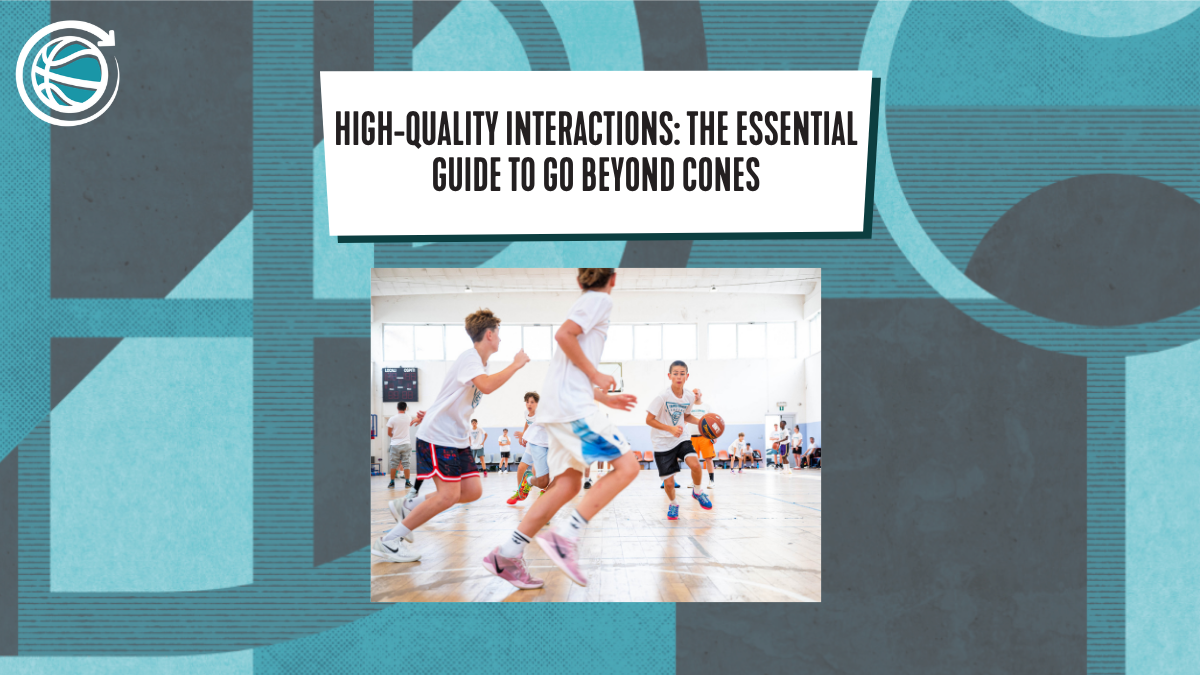
We’ve all seen it: four lines of players repeating the same layup or a 5-on-0 set where everyone moves in perfect synchronization. There is no interaction between the offense and defense.
The problem? There is no context.
Training should be representative of the competition. If you’re practicing against air or cones, your players aren’t learning how to read a defender’s hips, anticipate a gap, or time a cut based on a teammate’s drive.
The Practical Shift: Replace your “cones” with “bones.”
“Why should me operating against a cone have any effective transfer to a game environment where all my cues, all my timing, everything that I’m looking for is entirely different?” — Daniel Sokolovsky Episode 112 on the Transforming Basketball Podcast
Every Action is a Scoring Action
A common mistake I see in modern “flow” offenses is “empty action.” This happens when players go through a movement—like a second-side handoff or a swing-swing—just because the coach told them to, not because they are trying to score.
We must coach the intent to generate, transfer, and then multiply advantages.
WIN: What’s Important Now?
Basketball is an emotional rollercoaster. A missed layup leads to a blown defensive assignment; a turnover leads to hanging heads. A powerful acronym to keep teams present: WIN (What’s Important Now).
This is a feedback tool for the “performance variable”—the human being. When a player turns the ball over, the message isn’t just “get back.” It’s “go figure out how to positively impact the new setting we’re in.”
Coaching Tip for Tomorrow:
Next time your player makes a mistake, Call out “WIN!” to remind them that the only thing they can control is the immediate next interaction. Whether it’s a physical reconnection like a high-five, sprinting back on defense, or eye contact in a huddle, pulling them back to the present is the key to resilience.
The Force Multiplier: Small-Sided Games (SSGs)
If you have limited gym time you need drills that teach multiple habits at once.
The “Paint Start” 3-on-3
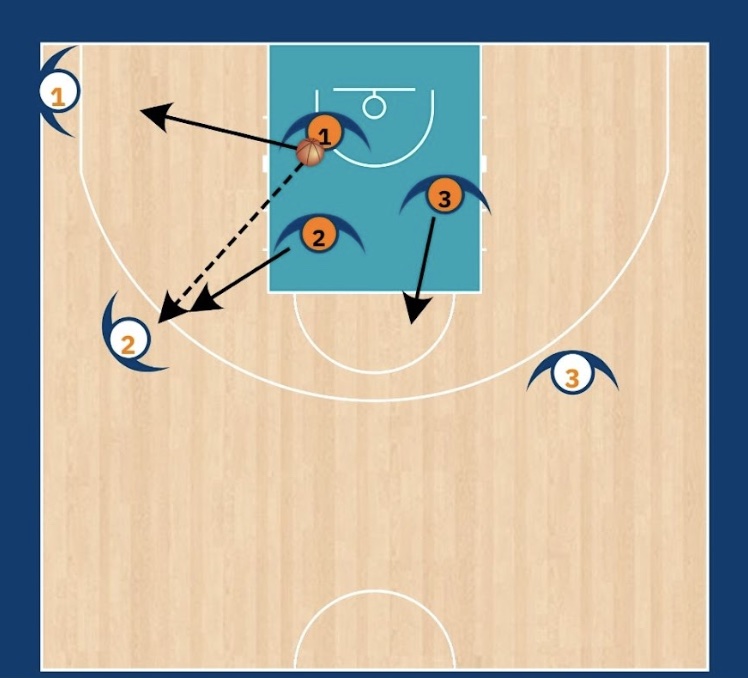
Use this SSG to develop high-quality interactions.
This SSG from Ross McMains (Boston Celtics) touches on five principles in one possession:
- Advantage Creation: Start with a kick-out from the paint.
- Defensive Urgency: Defense must sprint to a “hot closeout” to prevent a first-catch three.
- Dominoes: The offense attacks the closeout to create the “dominoes.”
- Spacing: Offense must fill the “deep corner” and “45” spots.
- Transition: If the ball goes through the basket, the new offense has 4 seconds to cross half-court, or the defense gets a point.
This SSG works on:
- Half-court defense: Work on close-outs
- Half-court offense: Work on attacking the close-outs and re-triggering if dominoes is lost.
- Transition defense: Work on ‘Tagging up’ transition defense principles.
- Transition offense: Work on the micro principles of getting the ball into the opponents scoring zone as fast as possible. (You can read about the micro principles in this blog post)
Conclusion: Pursuing Mastery
To get to Mastery, you have to be willing to part with your most closely held beliefs. If your “pass and cut” pattern isn’t working against a disciplined defense, it’s not because your players aren’t “running the play” hard enough—it’s because they are missing solutions that come from practicing these high-quality interactions. Perhaps the players cannot find ways to create dominoes with the “pass and cut” vs the team you are playing against. What other interactions could lead to dominoes?
Key Takeaways:
- Context over Cones: Make training look like the game.
- Intentionality: Every catch and every cut must be a scoring threat.
- WIN: Focus your players on what is happening right now.
Looking for more SSG’s you can use in your Practice?
Look no further: 21 SSG’s for Your Next Practice – https://transformingbball.com/21-ssgs-for-your-next-practice

High-Quality Interactions: The Secret to Advantage Creation
Whether you’re coaching youth ball or professional athletes, the goal is the same: find a way to score.
The secret is high-quality interactions.This means that every action is a scoring action. Players must learn about what coverage the defense is in and what coverage solutions might be best for them to create an advantage. Whether it is a solo or a pick and roll, players must be attuned to potential opportunities that will lead to an advantage. This is the start of high-quality interactions. And once the advantage is created, those same high-quality interactions must continue to happen.
The Death of 5-on-0: Context is King
We’ve all seen it: four lines of players repeating the same layup or a 5-on-0 set where everyone moves in perfect synchronization. There is no interaction between the offense and defense.
The problem? There is no context.
Training should be representative of the competition. If you’re practicing against air or cones, your players aren’t learning how to read a defender’s hips, anticipate a gap, or time a cut based on a teammate’s drive.
The Practical Shift: Replace your “cones” with “bones.”
“Why should me operating against a cone have any effective transfer to a game environment where all my cues, all my timing, everything that I’m looking for is entirely different?” — Daniel Sokolovsky Episode 112 on the Transforming Basketball Podcast
Every Action is a Scoring Action
A common mistake I see in modern “flow” offenses is “empty action.” This happens when players go through a movement—like a second-side handoff or a swing-swing—just because the coach told them to, not because they are trying to score.
We must coach the intent to generate, transfer, and then multiply advantages.
WIN: What’s Important Now?
Basketball is an emotional rollercoaster. A missed layup leads to a blown defensive assignment; a turnover leads to hanging heads. A powerful acronym to keep teams present: WIN (What’s Important Now).
This is a feedback tool for the “performance variable”—the human being. When a player turns the ball over, the message isn’t just “get back.” It’s “go figure out how to positively impact the new setting we’re in.”
Coaching Tip for Tomorrow:
Next time your player makes a mistake, Call out “WIN!” to remind them that the only thing they can control is the immediate next interaction. Whether it’s a physical reconnection like a high-five, sprinting back on defense, or eye contact in a huddle, pulling them back to the present is the key to resilience.
The Force Multiplier: Small-Sided Games (SSGs)
If you have limited gym time you need drills that teach multiple habits at once.
The “Paint Start” 3-on-3
Use this SSG to develop high-quality interactions.
This SSG from Ross McMains (Boston Celtics) touches on five principles in one possession:
- Advantage Creation: Start with a kick-out from the paint.
- Defensive Urgency: Defense must sprint to a “hot closeout” to prevent a first-catch three.
- Dominoes: The offense attacks the closeout to create the “dominoes.”
- Spacing: Offense must fill the “deep corner” and “45” spots.
- Transition: If the ball goes through the basket, the new offense has 4 seconds to cross half-court, or the defense gets a point.
This SSG works on:
- Half-court defense: Work on close-outs
- Half-court offense: Work on attacking the close-outs and re-triggering if dominoes is lost.
- Transition defense: Work on ‘Tagging up’ transition defense principles.
- Transition offense: Work on the micro principles of getting the ball into the opponents scoring zone as fast as possible. (You can read about the micro principles in this blog post)
Conclusion: Pursuing Mastery
To get to Mastery, you have to be willing to part with your most closely held beliefs. If your “pass and cut” pattern isn’t working against a disciplined defense, it’s not because your players aren’t “running the play” hard enough—it’s because they are missing solutions that come from practicing these high-quality interactions. Perhaps the players cannot find ways to create dominoes with the “pass and cut” vs the team you are playing against. What other interactions could lead to dominoes?
Key Takeaways:
- Context over Cones: Make training look like the game.
- Intentionality: Every catch and every cut must be a scoring threat.
- WIN: Focus your players on what is happening right now.
Looking for more SSG’s you can use in your Practice?
Look no further: 21 SSG’s for Your Next Practice – https://transformingbball.com/21-ssgs-for-your-next-practice




check what's trending

What is ecological dynamics and how is it connected to a constraints-led approach?
Dec 8, 2025
George Vaz

Are you searching for the best small sided games (SSGs) to improve your basketball practices? Want to replace boring, low-transfer drills with competitive games that actually develop player decision-making and in-game skills?
In this post, I’m sharing my top 5 favorite small-sided basketball games—designed to teach core concepts like closeouts, pick-and-roll, advantage creation, and transition offense and defense. These basketball SSGs are intense, purposeful, and built around real-game actions.
Whether you're coaching youth basketball, high school, or pros, these top small sided games will make your sessions more effective, more engaging, and more fun—for both players and coaches.
Let’s break down each game and how it can transform your practices.
Aug 4, 2025
George Vaz

Whether you’re coaching in the NBA, EuroLeague, or youth basketball, one thing remains universally true: the worst transition offense is still more efficient than the best half-court offense. Yet, many teams still struggle to fully capitalize on transition opportunities, often opting to slow down the game instead of pushing the pace. The question is, why? By running more intentionally, teams can create easier scoring opportunities. So why do some teams hesitate?
Apr 7, 2025
George Vaz
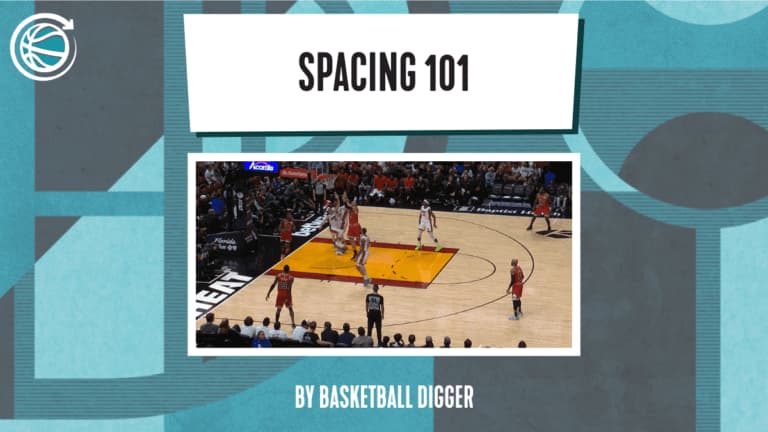
Spacing has changed the game. NBA offenses today look nothing like they did in the ’90s—more threes, better efficiency, and smarter shot selection. But why? The key lies in how teams use space to create and capitalize on advantages.
Mar 31, 2025
Simon Caret
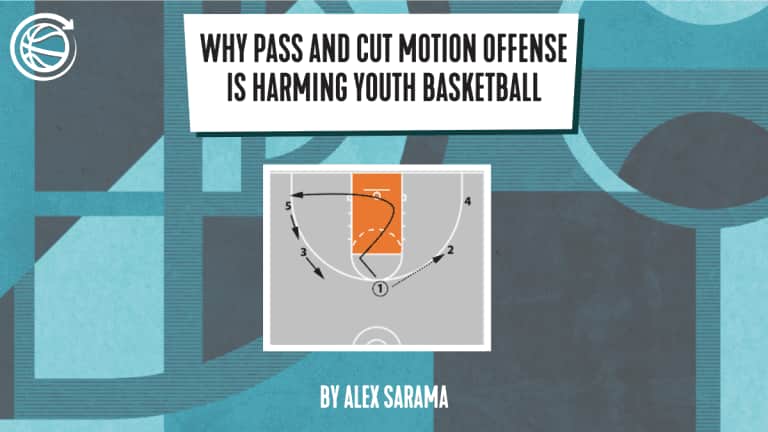
This article breaks down why pass and cut motion offense limits youth player development, and explores better ways to teach spacing, decision-making, and offensive creativity.
May 1, 2024
Alex Sarama
Approaches within the basketball industry are predominantly based upon experiential knowledge and traditions.


