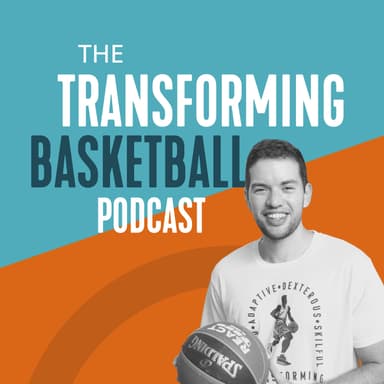
Behind the Build: How We're Scaling Transforming Sports | COO Nikki Pepper
George is joined by Nikki Pepper, COO of Transforming Basketball, to discuss how her background in gymnastics, collegiate cheerleading, weightlifting, marketing, and…
Keep listening while you explore. Your episode keeps playing as you browse other pages on this site.
Episode notes
In this episode, George is joined by Nikki Pepper, COO of Transforming Basketball, to discuss how her background in gymnastics, collegiate cheerleading, weightlifting, marketing, and coaching has shaped her approach to leadership and athlete development. Nikki shares lessons from her time at Reebok, the importance of building relationships and connecting with people first, and how constraints-led principles can be applied across different sports.
Jump to a chapter(11)▾
Select a chapter to start listening from that moment.
Jump to a chapter
Select a chapter to start listening from that moment.
Useful for your staff or players? Share this episode—or a specific moment—with them.
Read transcript
Esta transcripción corresponde al audio original en inglés.
This is the Transforming Basketball Podcast. This is the podcast helping coaches and practitioners change the way we think about basketball performance. Our goal is to provide the ultimate resource for making sense of applying contemporary skill acquisition ideas within basketball. Within this podcast, we unpack how an ecological dynamics framework impacts our perspective of the game.
If you're ready to join us in our quest to transform the basketball world, This is the podcast for you.
Welcome to the Transforming Basketball Podcast. On today's episode, I'd like to introduce Nikki Pepper. So Nikki is the COO of Transforming Basketball, and she's been with us just over a year. It was actually your anniversary a couple weeks ago, right?
Yeah, I can't believe time flies and just so much growth has happened in such a short amount of time. Here we are in person. Yeah, doing it live.
Oh, and it's been so great to have you on the team, and it's been great to meet you here in Roseto as well. So we're recording this podcast during the 2026 Roseto Residential Summer Camp, and, you know, we're— we also meeting Cesar, who's behind the camera now, and all the members of the team.
So it's actually a time of the year where we actually get to meet the team members of the Transforming team. So it's been, you know, lovely to meet you. And just before, you know, I kind of ask you some questions, I just want to introduce you.
You are a professional gymnast, collegiate-level cheerleader, and national-level weightlifter.
Yeah.
So we're going to talk a little bit about that. And we're also going to talk about you as a COO of Transforming Basketball. So just talk to me about your experience as a COO.
Yeah. And so I think I would say when I was first introduced to Alex and the Transforming team, one thing I absolutely loved is that it's in the athletic space and in the coaching space. And What a great merging of, you know, my childhood and young adult years of being super competitive.
My other fun fact that I didn't share is my grandmother was a coach and my dad was a coach and I was a coach. So 3 generations of coaches and being introduced to Transforming and seeing just how impactful the work is that we're doing and knowing that my ability in kind of the corporate world with marketing and Working for some, some big athletic brands, I was like, this is a no-brainer.
This is a company that I'm excited to collaborate with and really take it to the next level. So definitely the ability to take what we're sharing with coaches and players and to be able to get it out to more people.
No, that's amazing. Can you, yeah, talk to us about your experience and what you've learned from your previous companies that you worked with?
Yeah. And so a little bit on the business side of things. So my very first job out of college was doing marketing for Reebok headquarters. So dream job, went to business school, but always loved sports, fitness, and athletics. And I think what's really interesting when you come from working at a really big global corporation like Reebok, which was also under Adidas, is you get to see what a massive company is, but still be able to distill it down to how would I apply this for like a small to medium-sized company?
Yeah.
And Being able to have that hands-on experience, I think one thing to reflect upon, it's always in hindsight that you learn a skill. Yes. And maybe a year later, 2 years later, 3 years later, you're like, oh, that's why I learned that. And being able to, to apply it.
So yeah, it's the learning is nonlinear.
Yes.
And it applies to everything you do.
Yeah.
And I'm curious as well, Nikki, while you were talking there, like you mentioned with being at Reebok, You, you know, you learn things there that maybe at the time you're like, okay, this is going to be great, but I don't know. But then years later, maybe, okay, well, I remember we did this at Reebok.
I'm really curious how, how, or even if you could share some specifics, how important or how, how much does it help you when you're working with Transforming Basketball coming from a brand like that?
Yeah, it definitely has helped a lot. I think there's, there's a few key moments that I can remember in my, in my Reebok days and I think one that pops into my mind was doing a lot of in-person work with a lot of the like store associates or just being able to train people like on the product, why it matters and how to speak to customers.
And I think what's really interesting, and there's a few lessons that I think are gonna just be channeled, channeled from the, the archives here.
Yeah.
And I remember I would go to the stores and make sure that I was forming a relationship with the employees first. And so I could have gone into the store and said like, here's the tech specs and you need to sell X amount of shoes and here's the campaign.
But that never really worked if I didn't say, hey, you know, tell me about you. What's your family like? Like, what's your day-to-day? Do you have any hobbies? And getting to know the human first. And then of course, once that trust was built with a lot of those team members who I was managing, at that point I had the buy-in and then we were able to be on the same team versus them feeling like this, you know, corporate marketing person is coming in and they don't know what my, you know, shift is like.
They don't know the day-to-day and being able to ask them questions like, what would be helpful for you to like do your role better or whatnot. So I think a lot of the, the basketball takeaways that I've observed this week from connecting with the human first on any team and also being able to ask questions and knowing that whether you're talking to a player or talking to a team member who is a player on your team at the end of the day, Asking them the questions about, you know, their thoughts, their opinions, and getting them
enrolled in the process is something that applies across the board. That wasn't even planned. I just thought of that.
That's super helpful as well. I think even as a takeaway for myself personally, and I'm sure for the listeners as well. Before we get into, you know, the, your, the sports side of things, you know, you mentioned relationships and I always feel like every business and every, any kind of, you know, business venture, anything is a relationship thing.
You could be working in In marketing, you could be working in finance, you could be working behind, you know, the computer, but it's still, it's always relationships. You're never going to be isolated. So it's about how you handle yourself with other people. And so I really liked you mentioning that as well.
Yeah, I have another kind of takeaway to build on that with, I think, with relationships. And I think what's been really special about being here in person is you get those, you know, side conversations, getting to know someone, just Genuinely taking the time to look someone in the eyes and have a conversation.
And I think one thing that comes to mind when someone asks me, you know, how do you scale a business or how do you grow or whatnot? It's like the people first and building those relationships over time. The word, the thing that served me the most has been being unattached to like, oh, like, can this person help me?
Or what can I get from someone? Instead, I've always approached my relationships of like, what can I give? How can I support? And knowing that when you plant those seeds over time, at some point it's gonna, it's gonna come back. And also knowing that your reputation is one of the most important things about you.
And so I think being able to genuinely care about people, see what you can do for others before looking what others can do for you. And that ultimately is, is gonna pay off.
No. And I think honestly, I, I mean, I can't speak for everyone on the team, but it's, And it's, you know, and it's always been like that with the Transforming Basketball team. So it's absolutely great that you've come in and it's the exact same mindset with, of course, a lot more experience to help grow Transforming Basketball.
Now moving on to the sports side of things, we were actually talking yesterday or on Tuesday. It was, it was the, you were talking about the gymnast.
Yes.
And going, and it was like, oh, this is what we did. I was like, whoa, those are types of constraints. Can you talk about— firstly, I want to talk about the block challenge.
Yes.
And so how that works. So, yeah, so just explain it because I don't know much about gymnasts. I've been to a meet and I think it's awesome, but just give context and then tell us about the blocks.
Yes. And so I think what's been really interesting being here at the basketball camp is so many of the constraints that we apply can really be applied to any sport, and gymnastics doesn't even use a ball. Like, you think of different, you know, soccer or baseball, and that might be a little more parallel, but the deeper we got into our conversation, we realized that you can really put a constraint around anything.
Absolutely.
And so, when it comes to gymnastics, of course, you're practicing your routines. You have vault, bars, beam, floor, and ultimately, practice is you practice for the game. And so, how can you make your practices like the competition? How can you emulate Mm-hmm. So that when those things come up in the meet, you're not surprised.
You can handle whatever is literally or figuratively being thrown at you. So with the blocks, if you've ever seen those kind of foam pit blocks, they're very soft. They're, you know, not gonna hurt you. But if you're on the balance beam, we would do our prepping for our competition week and weeks leading up to it, throw in as many distractions as we could.
And one of those, you are on the balance beam and your coach and teammates every so often will just throw a ball at you. And you have to catch it.
Love it.
They're doing it very carefully, so no one's gonna get hurt, but it's just enough to— are you focused? And if you do lose your focus, can you take a breath, regulate, regulate your emotions, like take a moment and stay focused on your body and what's at hand?
And so it's really emulating any distraction. You know, they'll put on really loud music sometimes too, just to see How can you adjust when the circumstances aren't perfect? Because they're not going to be when you're in competition.
Yeah, I know. I love that. And the other one was the pressure sets. So talk a little bit about those.
Yeah, those, I think I still have some lowercase c trauma from the pressure sets, but they worked. So with the pressure set, again, how can you emulate what it feels like to be in a competition? You're nervous. You like have to do well on the first try.
There are no redos.
And just to add before you continue, it's you train all All year, or, you know, however the, the season is, and for this one competition, right? So there's that added pressure there as well.
Yeah, added pressure at every level. And so with a pressure set for, let's say, whether it was balance beam or bars, etc., usually balance beam because that's where you're most likely to fall, you would have to hit 3 routines in a row and then you're done.
So it could take you 10 minutes and then maybe you're done for the day, but if you do not hit your routine, you have to start back from one. And so, if you get to that 3rd routine, you're feeling the pressure, you want to be done.
It's maybe the end of, or, you know, a couple hours into practice. And if you miss that 3rd one, you've got to start back. And then maybe you get to the 3rd one again, and now you're on your 6th routine. Now you're really feeling kind of tired.
You're like, I really hope I don't fall. And it's becoming more and more challenging. If you fall again and you have 9 routines instead of 3, Girls will be having meltdowns and then it just allows you to say, when it matters, I'm going to hit this because I do not want the consequence of falling.
So, or having to do it again. Yeah.
And it's the same thing in basketball. Coaches can say, you know, maybe you're doing a shooting game and it's make 3 in a row, or maybe you're playing a small-sided game and it's you have to score 3 in a row, like whether you're playing 5-on-5, 3-on-3, and you have to score 3 in a row to win the game.
And so I love that idea. And Carrie actually gave a similar one where it's like tennis scoring, where it's like to get 1 point in tennis, you know, you go 15, 30, 40, and then it's 1-love, right? If I'm not mistaken, that's what they call it.
And it's the same thing. And I had— she said it Tuesday, and then you said it earlier today. And I was like, yes.
Yeah.
Yeah.
I think the other thing that's interesting that Carrie and I also talked about was really that, you know, self-talk or like what words and thoughts are coming up. As you're under the challenge.
Yes.
So, I think that's also been a big takeaway of camp is your mindset, your word choice, and being able to navigate both your thoughts and your emotions. And when you're in the moment of pressure or stress or frustration, what are the things that you're saying to yourself that are going to alter your perception, really even alter how your body is physiologically responding?
And are you You know, being mindful of that. And I have one of my favorite quotes, which is a related one, is, you're not responsible for your first thought, but you are responsible for your second thought and your first action. So if like a negative thing pops into your head, like, all right, I'm going to reframe this and then choose to take an action in the direction I want.
Absolutely. And other things that you've used, what are they? I know you mentioned visualization.
Yes. So visualization, there's definitely been studies that if you visualize practicing something, it is almost equally as impactful as physically doing the actual thing. And your body and your brain don't necessarily know the difference between visualizing something and then actually doing the thing.
Mm-hmm.
So it's one of the most powerful techniques.
Wow.
And with visualization, I think it's a skill that you can use as an athlete, but also in, you know, if you're giving a speech or you're going into a big meeting or Visualizing how you want the outcome to happen. And I think connecting the visualization with the feelings in your body makes it extra potent as well.
So sitting, closing your eyes and imagining, you know, step by step yourself going through it.
That's so powerful. I know I've heard so many athletes that I respect and admire talking about that very thing. And even, you know, people from other fields as well that I respect and admire talking about visualization. And how much it's done for them as well.
Yeah. All right. So last couple of questions here for you. Taking Transforming Basketball to the next level, what are your plans? What's in store? What can we expect?
Yes, I love this question. We're going to the moon. So I would say with Transforming, I think one of the— I'm going to bring it full circle with the relationships. So I think what's been so interesting being here at camp is Really seeing when the coaches are here in person, just how committed they are, they're invested.
It is more than just a brand name or a company. It is truly a movement. And you can see the passion and truly the heart and the care that's gone into building this. And I get emotional just thinking about the impact on the kids and at every level.
And I think what's interesting is that Transforming Basketball is going to transcend basketball. It's going beyond that. So a couple sneak peeks. It's It's coming, so I'm allowed to say it now. We are transferring into some other sports. So we have soccer coming very shortly after the World Cup here.
So we have soccer, we have baseball, and we have a couple other different avenues of which we're really applying the principles and being able to get this methodology into the hands of more coaches, more players, and ultimately creates, you know, better experience.
And in different fields.
And yep, in different fields. So I think being able to bring it to more sports and knowing that it's not just about the methodology, but how is this even shaping, you know, humans who are, who are going through it?
Yeah.
So more sports on the way. And I think the other thing that comes to mind when I think about the relationships, and we just relaunched the soft plug, the Transforming membership.
So no, that's awesome. We were talking about like the search function and for me, You know, I'm, you know, the community, you know, engagement manager there. But for me, I love it now because I can search for anything I want and it's right there.
So.
Exactly. And with the, with the membership, I think what's important to, as we're definitely doubling down on that, and what's important about it is in today's world, there's no shortage of information. You can go on YouTube, you can ask ChatGPT, you can ask Claude.
There's so much information out there. But that's not what's going to create transformation because information without implementation is meaningless. So you could, you know, compile all your YouTube videos or watch all the things, but where the real transformation for the coaches takes place is in the roundtables.
It's in the community asking questions, getting feedback, and no amount of like tech or videos can replicate that. So I think what feels really special about really expanding the membership and getting as many coaches in there as, you know, we can, is that you are ultimately going to learn from each other, learn from relationships, ask questions, feel supported, be vulnerable.
And there's nothing that can replace human connection. And that's going to be something that's going to impact a lot of people.
Absolutely. And, and you mentioned relationships. It's so important. I know you, you know, we kind of got connected through the relationship you had with somebody else that you worked with, that they had a relationship with Transforming Basketball. And I just want to ask you, you know, being at the Rossetto camp as well, what's your experience been like here?
You know, from, I guess I want to say, a non-basketball coach perspective, what are your takeaways so far?
Such a good question. I think I would say it's in the observing of how people are interacting with each other and also being able to see something start to finish. So it's like at the beginning of camp, you get kind of that like first day of school vibes, like, where do I sit?
Yeah, I'm not sure. And then being able to watch both the kids and the coaches get more confident, go through challenges, support each other. And I think the magic is actually in the side conversations.
Mm-hmm.
So like the little conversations you're having at dinner, and you can't grow in isolation either. Yeah. And so having a lot of conversations with what, 32 different countries are here.
Yeah.
So being able to see all different perspectives and There's no better way to, to learn than from people who are both similar and different from yourself. So I think my takeaway is, even though I'm like, I know I love sports, so I have watched a lot of basketball, but don't ask me to do a free throw.
It's just not— it was not part of the interview.
But it's nice, you know, if you make 3 out of 4, you're actually a really good shooter.
I think being able to see that I can see the intention that goes behind every coaching cue, every way that things are communicated. And the drill is 5% of it, and the 95% comes from the how and like the interactions and all of those small little details that go along with the relationships.
Yeah. And I think that's been a, you know, huge theme, not just this summer camp but all the summer camps as well. And it's, you know, it's, it's always so important that you Cultivate, you know, the people and you invest in the people around you.
And that's exactly what we do here. You know, I get emotional and everyone does as well when you have these conversations too. But Nick, I really want to thank you for your time. And I, you know, it's been an absolute pleasure. I look forward to continuing to work with you as well.
Do I get to give a transforming tip?
Yes.
Yes. No, I don't have one, but ready?
Thank you for reminding me. So transformational tip, we ask every guest this. What is one piece of advice that you would give to to coaches to instantly improve their practice environment?
Yes, I would say I'm going to tie it back to like coming to, you know, whether it's this camp or something else. I think the best way to learn is to get out of your comfort zone, to know, to admit that you don't know what you don't know, and to be willing to get uncomfortable.
And yeah, to put yourself in environments where people are going to cause you to raise your own standards. So getting into the right rooms, being around people who are going to call you upward and not let you, you know, stay complacent. So get around the right people, get in the right rooms, and you're gonna be well on your way.
Yeah.
Be vulnerable. I love that. Thank you so much.
Thanks everyone.
Thanks for tuning in to this episode of the Transforming Basketball Podcast. If you'd like to learn more about the work that we do, Head to transformingbball.com to access our free resources and spread these ideas throughout the basketball world. If you enjoyed today's episode, be sure to subscribe and leave a review on your favorite podcast platform.
You can also connect with us on Instagram, X, or YouTube with any questions that you have from the episode. See you next time on the Transforming Basketball Podcast.
Bring these ideas into your coaching
Explore Transforming Basketball membership and continue your coach development.